
Germany · Perspektive Online · · 3h
Recall of millions of vehicles: Is VW falling even deeper into the crisis?
Deutsch (original) · Auto-translated to English
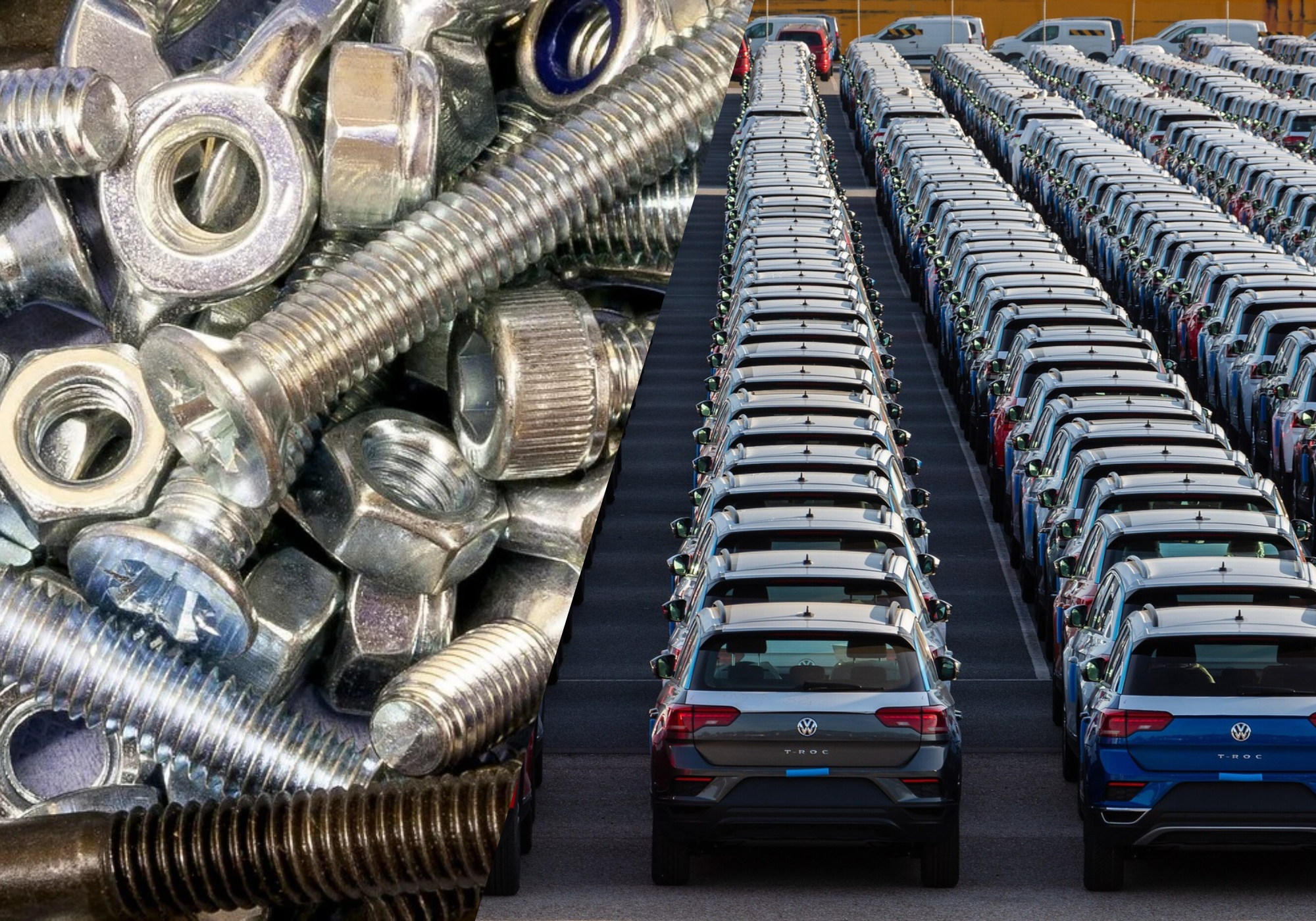
The Federal Motor Transport Authority calls aloneGermanyalmost 900,000 Volkswagens returned because of unsafe screws. It could be Volkswagen's biggest recall since the 2015 diesel scandal. This could help the car company go even deeper into the crisis.
Hexagon collar screw M12x1.5×70, number N10552402 inVW parts catalog: A lot depends on her for the VW Group at the moment. Normally, the steel screw attaches the steering gear of a car to the front axle support and ensures that movements at the steering wheel are mechanically transmitted to the wheels. An indispensable component that should be produced according to the best and latest industry standards. However, Europe's largest car company, Volkswagen, has apparently ignored an important standard.
According to the car company's own information, the screw is not sufficiently protected against corrosion. This means that the component, which is only seven centimeters long, poses a safety risk for drivers. Because corrosion, i.e. rust, weakens the material structurally.
The connection to the chassis could become loose. In the worst case, the screw could even crack due to the weakened material and mechanical stress. In this case, the steering wheel would no longer function because the wheels would no longer turn and the car could no longer be steered properly.
Recall has global dimensions
The affected brands and models are recorded by the Federal Motor Transport Authority. The campaign has now been officially confirmed for Volkswagen, Audi and Seat. So captures thatKBA alone for VWover two million vehicles worldwide, including 895,832 in Germany. Seat has 43,574 vehicles in Germany. The final figures for Audi and Skoda are not yet publicly available. However, Skoda is currently assuming around 1.2 to 1.5 million vehicles worldwide and around 370,000 vehicles in Germany.
The production period that is recorded goes back to September 24, 2013 for some of the models known so far. The oldest affected vehicles now have 13 years of wear behind them, which further increases the risk. Which series have been recorded in detail has not yet been finally published. After official publication, you can use theRecall databaseYou can ask the KBA whether your own vehicle is affected by the recall.
Despite these high numbers of affected cars, the KBA and the manufacturers emphasize that no injuries or damage to property have been reported so far. There is therefore currently no driving ban for the affected models.
The problem had probably been known for 2 years
The mass recall of vehicles only became public in the last few weeks. But the VW Group was probably aware of the problems much earlier.
On September 11th of this year, the US National Highway Traffic Safety Administration (NHTSA) received a report of a safety recall from Volkswagen Group of America. ByReport 26V590The American branch lists which models are affected. The document also shows that the group was first made aware of the possible risk in the steering gear in 2024.
The chronology of the report states that the first report of corrosion on the fastening screw was received in October 2024. The resulting fracture of the steering gear housing has also already been mentioned here.
According to the information in report 26V590, this report was followed by several investigations and analyzes by VW itself. By August 2026, the individual components were tested and examined for possible defects. The focus was also on possible scenarios that could lead to the steering gear housing breaking.
After years of investigation and analysis, the product safety committees concluded that “there may be a safety defect.” This assessment then prompted Volkswagen and Audi to carry out a voluntary recall. Until September of this year, no information about this possible risk factor had previously been made public.
However, VW does not see any reason for concern.So explains a speaker, the previous screw remains functional for several years “even under conditions that promote severe corrosion”. Nevertheless, report 26V590 stipulates that all affected vehicles should have the vulnerable screw replaced.
Delivery bottlenecks instead of a solution
In order to literally remove the possible safety risk from circulation, VW will have to recall several million vehicles. The vehicle owners will be informed directly by letter and will have to take their car to the nearest workshop.
There the screw N10552402 should be replaced free of charge by the successor WHT 013461. According to Volkswagen, this screw would have been produced with an “optimized coating system” and would be more resistant to corrosion.
However, a problem also arises here. Because Volkswagendoes not have enough of these replacement screws. These still have to be produced on a large scale. In order to bridge these delivery bottlenecks, some customers initially only replace the old screw with a screw from the same series. As soon as the new screw is available, the vehicle will have to be repaired again.
It is difficult to understand exactly what is causing the delivery bottlenecks for the new screws. Because Volkswagen keeps the component and the supply chain a secret.
Neither material, costs nor the supplier manufacturer are disclosed by the VW Group. It is also not possible to see whether or how many replacement screws have already been delivered to workshops as part of the recall campaign.Not even a pictureof the new component can be found at Volkswagen.
VW boss blurted out: “What we did was fraud, yes.” – This has legal consequences
Will the recall become a new diesel scandal?
The extent of the current recall could be on the scale ofDiesel scandals from 2015 grow. At that time, the American Environmental Protection Agency (EPA) accused the VW Group of cheating on emissions values. VW has used software that detects when the car is being tested for emissions. This software then ensured that the emission values that could be read looked as low as possible. So they should meet the strict regulations. In normal operation, however, according to the EPA, the pollutant emissions of these cars were 10 to 40 times higher.
The legal and financial consequences of this continue to this day. VW has so far had to raise more than 33 billion euros as part of the diesel affair. Alone around770 million euros in compensationwere paid out to 250,000 diesel customers in 2020. Ex-VW boss Winterkorn and four other former department heads also had to stand their ground in court from September 2021.
For the ex-managers, the criminal trial ends in May 2025 with two prison sentences and two suspended sentences each. The proceedings against Winterkorn were temporarily discontinued on July 1, 2025 due to his alleged lack of fitness to stand trial.
Since the diesel scandal, the VW Group has repeatedly emphasized publicly that since thenchanged and improvedto have. Nevertheless, faulty components, safety risks and ultimately recalls still occur. The group had to do so worldwide between 2025 and 202610.16 million vehicles recalled.
One reason for the ongoing decline in quality, he saysADAC, are technical innovations. These are allegedly enforced unreasonably quickly, often at great financial expense. This requires savings in other areas, for example in the coating of a screw.
Certificate for white-collar crime: trial against Winterkorn (VW) discontinued
Sales are declining
The tough competition in the global auto industry and the associated cost-cutting measures by German car manufacturers such as VW cannot be dismissed. VW reported another decline in sales for the second quarter of 20268.6 percent. The reason for this is particularly falling sales in China, the USA and few electric cars being sold.
In order to compensate for the increasing crises and the associated losses, savings should also be made in terms of labor. Worldwide, 100,000 of around 657,000 jobs in the VW Group are to be cut.
VW terminates collective agreements: austerity measures at the expense of the workers
VW terminates collective agreements
Just last week it was announced that ten out of thirteen collective agreements would be concluded by the end of this yearterminatedbecome. Normally, after a collective agreement expires, a new version is negotiated. By terminating the contracts, VW is sending a clear signal. The options for the group to cut employee benefits are no longer off the table. Collective bargaining allowances, training takeovers and protective regulations for older and health-impaired employees could be at stake, they saidIG Metall.
The “job guarantee” the company promised two years ago is contradictory to the upcoming collective bargaining cuts and job cuts. VW continues to assert that operational layoffs will continue until the end of 2030excludedremain. The fact that the tense economic situation is being passed on to the workforce has been noticeable for years.
At the same time, profits are being privatized and...billionAmount distributed to shareholders. Due to these developments, the union is already announcing widespread protests for the coming week. With the peace obligation expiring at the end of 2026, from the first of Januarystrikeslegally possible again.
Closures and upgrades
This exploitation is also evident in the run-up to the upcoming collective bargaining round. The five percent wage increases demanded by the union are viewed by VW management as “otherworldlydeclared and rejected.
VW boss Oliver Blume also shares one thingPodcastIn the future, employees will only be granted 30 instead of 36 days of annual leave. There should be no wage compensation for this. VW is now behind the German car manufacturer Mercedes. This company is also demanding more working hours, while special payments or wage increases should be eliminated.
Not only are jobs to be cut, but entire plants are also to be closed. They are affectedLocationsHanover, Zwickau and Emden as well as the Audi plant in Neckarsulm. Also the work inOsnabruckis scheduled to stop car production by 2027.
In order to save the plant from permanent closure, the state of Lower Saxony took over the plant. With the help of the Israeli financial investor Aurelius, the state is allowing the upgrade to move into the factory. Because that's where the Israeli defense company is supposed to beRafael Advanced Defense SystemsWeapons are manufactured.
IG Metall celebrates the takeover of the VW factory in Osnabrück by an Israeli arms manufacturer
The defense company primarily wants to produce parts for the so-called Iron Dome there. Projectiles for Israel's missile defense system will not be produced at the plant, but other important parts will be.
For example, starting devices, power generators or trucks for transport. With the purchase of the Osnabrück plant, another Israeli arms company is establishing itself in Germany. Only inJuneIt became known that the city of Berlin had entered into a deal with Israel Aerospace Industries (IAI). The crises in the auto industry are not only putting money in the pockets of shareholders, but also for the advancing rearmament industry.
The postRecall of millions of vehicles: Is VW falling even deeper into the crisis?appeared firstperspective.
Read the full story at the source
Source: Perspektive Online