
War & Militarism Perspektive Online
Against rearmament and forced mobilization: Conscientious objectors network at a conference in the EU Parliament
From Germany to Turkey to Russia and Ukraine: more and more people are resisting military service. Activists discussed at an international conference in the European Parliament
Deutsch (original) ·Auto-translated to English
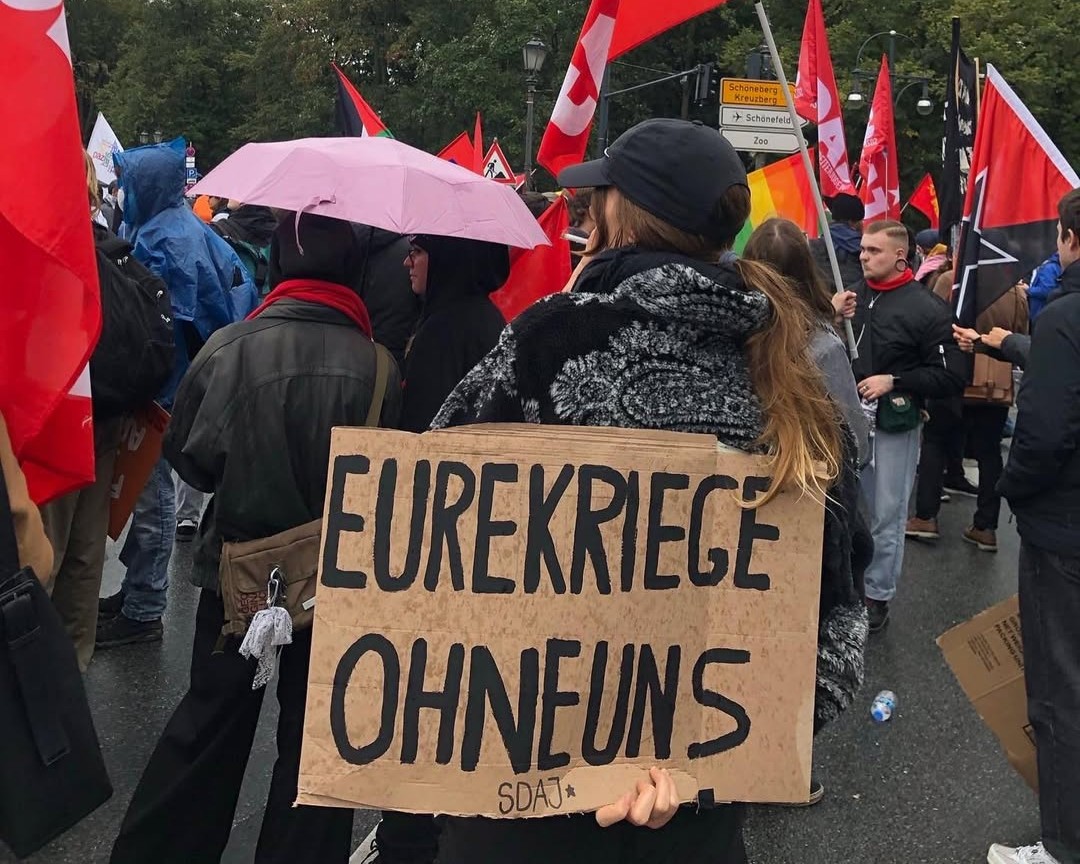
From Germany to Turkey to Russia and Ukraine: more and more people are resisting military service. At an international conference in the European Parliament, activists discussed repression, refusal and the question of how individual resistance can become a joint anti-militarist movement.
Militarization is met with resistance across Europe. The education strikes in France combine poor funding of the education system with rising military budgets. In Germany, the school strike movement against conscription brought tens of thousands of young people onto the streets. At protests against the genocide in Gaza and German and European support for Israel, young people were in the front rows, and students occupied their universities. The annual peace demonstrations on October 3rd and the Easter marches have also recently seen increasing numbers of participants.
These protests are united by the desire for peace. Many people also agree on the question of who is responsible for the world's wars and that militarization and rearmament benefit arms companies more than those affected by military conflicts.
Conscientious objection is playing an increasingly important role. The Left – the group of left-wing parties in the European Parliament – organized the conference a week ago“Conscientious objection is a human right“This gave different international answers to the question of individual, but above all social, conscientious objection.
Ukraine, Russia, Germany and Turkey: resistance to mobilization
In many countries, such as Germany, compulsory military service is currently being gradually reintroduced. In Germany invitations are acceptedPatternssent. In Belgium, the defense minister writes to all 17-year-oldslettersto get them to join the military.
In Turkey, too, many people avoid compulsory military service, even though the right to conscientious objection to military service is not recognized by the state. Support in Ukraine and RussiaConscientious objection networksand international alliances people who evade the draft or desert.
By the end of 2025, there would be more than 300,000 in UkraineProceedingsinitiated because of desertion. But even before they are called up, young men try to avoid military service. According to Andrei Konovalov of the Post Soviet Left organization, some do not leave their homes for months because they fear being kidnapped on the street.
Konovalov said 75 percent of all Ukrainian soldiers have now been mobilized. This does not always happen voluntarily. According to him, 31 people died in Ukrainian military training centers in June 2026 alone. Violence during confiscation is not uncommon. Over two million Ukrainians are now wanted by the police, and many have fled to the EU. But they are increasingly being denied asylum. For Konovalov, solidarity with Ukraine means “ending the war instead of subjecting more people to the horror of war.”
“The people of Russia, Ukraine and Belarus have common interests” – Interview with Post-Soviet Left
Conscientious objection in Russia
The appearance of the Russian Ilya attracted particular attention, especially from the EU Parliament's security serviceZaripovfrom the organization Idite Lesom (“Get Lost”). He reported on hundreds of thousands of Russians refusing to go to war. Many political prisoners are also conscientious objectors.
Deserters would be systematically persecuted. In every army regiment there are units that search for them, largely without legal restrictions or effective control. Zaripov describes the lives of the refugees as a post-apocalyptic dystopia: They tried to survive between the fronts and moved outside of any social and legal order. Of the estimated 200,000 deserters, only very few have been able to leave Russia so far.
For Zaripov, support for deserters should not stop at humanitarian aid. It must become part of a broader political movement. He calls for a Europe-wide network in which deserters can contribute their experiences as equal political actors.
The debate must be carried beyond left-wing circles. Anyone who supports deserters is not only questioning Russian warfare, but also the increasing militarization of Europe. According to Zaripov, “a fraction of the spending on European rearmament” could be enough to offer deserters protection and prospects and contribute to de-escalation.
Human war material: lack of Ukrainian soldiers and the hunt for deserters
Enormous repression against conscientious objectors
Conscientious objection is not a right guaranteed anywhere in the world. In many countries, conscientious objection to military service is punishable. In South Korea, for example, there is a risk of up to36 monthsRe-education camp.
Şendoğan reported what the so-called civilian death looks likeYazıcı. He made his declaration of conscientious objection 52 years ago. Since Turkey does not recognize conscientious objection to military service, objectors are prosecuted. Prosecution does not end with a conviction: every police stop threatens with new charges and proceedings.
There have already been 18 cases against Yazıcı for the same reason. He had to pay over 650,000 Turkish lira, around 12,000 euros, in fines. What is particularly serious is that conscientious objectors are not allowed to practice any profession in Turkey. A Defense Department order says they “must be discharged within 15 days.” The father of a socialist family is therefore forced to work without social security or a regular employment contract.
Human rights violations in Turkey: Conscientious objectors are harassed by the state for life
Arkun Merve, head of the human rights organization Conscientious Objection in Turkey, also discussed civilian death as a punitive instrument. She herself refused military service for feminist reasons. The Turkish state declared itself an opponent of the women's revolution in northeast Syria and supported, among other things, the Islamic State and other Islamist-fundamentalist groups.
There is also considerable repression against conscientious objectors in Israel. Ella Kaida Greenberg of the Young Communist League of Israel called Israeli society “deeply, perverted, militarized.” All 18-year-olds must undergo military service and undergo military service. Anyone who refuses is considered a traitor and is sent to a military prison. Greenberg himself was in solitary confinement for 30 days - a form of white torture.
The EU's double standards: No asylum for conscientious objectors from Belarus
While the EU is siding with Ukraine and the Belarusian population against ruler Lukashenko in resolutions, it is hardly drawing any practical consequences from this, criticizes Olga Karach from Belarus. The human rights activist and head of the organization Nasch Dom (Our House) advocates for Belarusians in exileConscientious objectorsa.
Since the beginning of the war in Ukraine, she has supported men who refuse to go to war. What particularly surprised them was the lack of protection from European states. While they face persecution and imprisonment in Belarus, European states sometimes reject their asylum applications on the grounds that they could be recruited by Russia in the future. People who want to avoid the war, of all people, would be treated as a security risk.
For Karach, this reveals a double standard in European politics. How credible is the commitment to peace and human rights if people who refuse to kill do not receive any protection?
However, the foreign policy interests of the EU major powers do not stop at Russian or Belarusian conscientious objectors. For example, there is ongoing discussion in German government circles as to whether Ukrainian refugees who are subject to military service should also be deported to Ukraine. The aim is to help out the Ukrainian army, which is suffering from a lack of personnel.
From the factory to the street – oppose militarization everywhere
This showed that militarization and resistance do not just begin at the front, but have long since shaped everyday life in EuropeFinal podium“From factories to schools and streets – Refusing war together everywhere”.
Shmuel Schatz, who is involved in school strikes against conscription, pointed to the growing dissatisfaction with the German government and criticized the return of military power politics. Even those who do not die in war are affected by militarization: it changes social life, the everyday lives of young people and political priorities.
Christian Gorn from the Munich initiative “Tram Drivers Against Military Advertising” showed what resistance can look like in the workplace. Several tram drivers refused, for reasons of conscience, to ride trams with Bundeswehr advertising. The action triggered a huge media response. One of those involved received a warning under labor law. After the first case was dismissed, the employees want to continue their lawsuit before the state labor court.
They see this as a fight for the basic right to freedom of conscience. A petition against military advertising on trams has already collected more than 5,000 signatures. Their message is: “Workers don’t shoot at workers, workers don’t build tanks, tram drivers don’t drive Bundeswehr advertisements.”
Marius Pletsch from the German Peace Society - United War Resisters (DFG-VK), Germany's oldest pacifist organization, also emphasized the importance of practical solidarity. The organization supports conscientious objectors and students protesting against conscription. Pletsch announced that he would work with them to oppose any attempt to force young people into military service.
It's about resisting getting used to a war regime and having the courage to say no. Resistance to militarization is not a purely individual decision of conscience, but must be organized collectively.
The postAgainst rearmament and forced mobilization: Conscientious objectors network at a conference in the EU Parliamentappeared firstperspective.