
Politics Mother Jones
Long Covid Disabled Millions of Workers. Then Came Trump 2.0.
Covid constitutes the largest mass disabling event in the United States since the Americans with Disabilities Act became law in 1990. It’s hard to measure the scale: Millions of Americans, maybe tens
English (original) ·Read in Deutsch ⇄
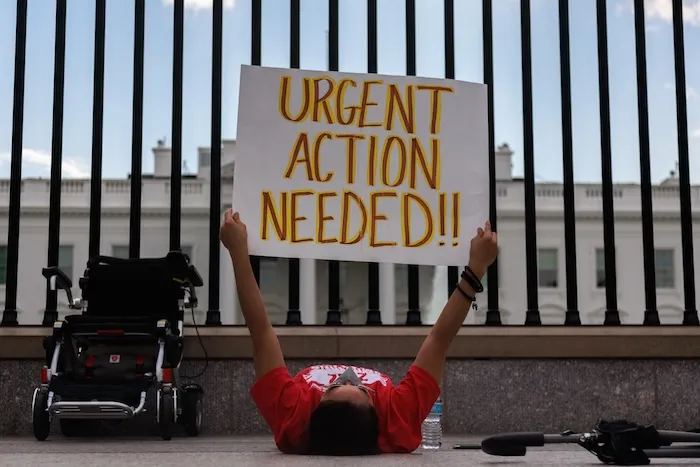
Covid constitutes the largest mass disabling event in the United States since the Americans with Disabilities Act became law in 1990. It’s hard to measure the scale: Millions of Americans, maybe tens of millions, live with Long Covid. Many, from farmworkers to white-collar executives, are still in the workforce—some by choice, some paying an unsustainable price to support themselves or their families.
On the act’s anniversary in 2021, President Joe Biden announced in a White House Rose Garden speech that Long Covid would be treated as a disability under federal law. The Department of Health and Human Services in 2023 even established an office dedicated to Long Covid. In short, the ADA extends to Long Covid, which guarantees reasonable accommodations meant to allow people with the condition to work.
For those who can work at all—around 8 in 10, one study found—accommodations are often what makes it possible. The costs of unaccommodated Long Covid have piled up: Lost jobs and hours of work from the condition cost over $12 billion in 2022 alone, by one estimate, with attendant issues like housing insecurity.
Now, the Trump administration’s anti-worker and anti-disability turn—HHS dismantled its Long Covid office in 2025—has created a climate of fear and difficulty around Long Covid accommodations, exacerbated by corporate backlash and the spread of AI-powered “bossware.” Employers have been emboldened to fight their staff on accommodations, despite evidence that they lead to more retention and productivity overall. And academic studies, researchers, and employment attorneys I spoke with suggest that the costs and challenges of not accommodating Long Covid are rising for both employees and firms.
Almost two years into President Donald Trump’s return to office, as millions more people develop Long Covid through repeat infections, federal institutions that protected people with Long Covid under the Biden administration are now indifferent or openly hostile. The Department of Labor quietly deleted guidance on Long Covid and the workplace that said the department was “committed to supporting individuals experiencing Long COVID and its related conditions who want to keep working or return to work,” instructing employers on dozens of straightforward means to do so—from flexibility around scheduling and restructuring of roles to practical changes around lighting and ergonomics.
The insurance industry, one employment lawyer said, “knows they’ve got a friend in the White House.”
The Equal Employment Opportunity Commission, which in 2022 warned employers that using AI in hiring and evaluating employees was likely to promote bias and run afoul of the ADA, has not published any similar guidance since, despite the explosion in its use. Nor has it addressed the closely related issue of bossware: employee surveillance software that tracks everything from workers’ keystrokes to bathroom breaks, which plays a growing role in layoffs—and which disabled workers have alleged affects them disproportionately.
“At least of the folks that I’ve worked with, I think every single one of them is already very scared of losing their job just for asking for an accommodation,” said Hillary Benham-Baker, a California-based employment lawyer with extensive background in disability law. A 2024 report found that nearly half of disabled workers and job seekers who didn’t disclose their need for accommodations were afraid to ask for them—even under a more active Department of Labor and EEOC. And it’s become easier for workplaces to deny accommodations on what Benham-Baker calls a “mushy, subjective” basis.
Now, “employers feel very comfortable undermining all these benefits,” said New Jersey–based employment lawyer Barbara Comerford, who herself lives with myalgic encephalomyelitis/chronic fatigue syndrome.
“Under certain administrations, there is sensitivity to, and frankly logic behind, making sure the law is sufficiently progressive and sufficiently aware of what some of the existing weaknesses are, and strengthening it so that you can get people to continue in the workforce in whatever capacity they can,” she added. But that’s no longer the case.
“I’ll get calls from lawyers who represent employers,” Comerford said, “and they’re trying to get around some of the provisions that protect people…what they do is they look for a hardship basis to excuse having to accommodate people.” And disability insurance claims have become similarly challenging. The insurance industry, she said, “knows they’ve got a friend in the White House.”
Lee Frost was among the earlier Americans to contract Covid, at the Biogen “superspreader” conference in February 2020. She now experiences a range of persistent symptoms. At the time, Frost worked 60- to 80-hour weeks in a workplace “not open” to accommodations; she told me that co-workers who had taken medical leave seemed to often be affected by layoffs. A change of workplace—she now works for a healthcare nonprofit—transformed her ability to continue working.
“I can take breaks when I need to, and I just feel more at ease,” Frost told me. “I feel safer, and that’s just made me be able to enjoy life more.”
Some elements of the regulatory system meant to protect workers with Long Covid still operate, even amid other federal attacks. The Department of Justice’s Disability Rights Section, which oversees ADA enforcement, is led by a career federal worker, not a political appointee. The EEOC, which adjudicates ADA discrimination claims, is still actively pursuing disability cases, unlike those pertaining to anti-transgender discrimination. But vanishingly few Long Covid cases make it to the EEOC, a Bloomberg Law analysis found in August: The “scarcity of rulings on this new, complex illness underscores shortcomings within the legal frameworks and court processes” meant to enforce disability discrimination law, the authors wrote.
Among other obstacles, the variability of symptoms and severity and limited understanding of Long Covid make the condition more challenging to address under the law—and more likely to face skepticism in the workplace, despite ADA protections, said Doron Dorfman, a Seton Hall University law professor. That dovetails with what Benham-Baker called the “politicized space” of Covid itself: An administration committed to downplaying its severity has a vested interest in doing little to address it, despite economic and other costs.
The EEOC declined to fulfill a public records request for how many people have filed ADA claims related to Long Covid annually since 2021. EEOC statistics show that disability cases overall have increased—from just under 23,000 in fiscal year 2021 to over 36,000 in fiscal year 2025—which presumably does include people with Long Covid.
As a mass disabling event, Long Covid has put the limitations of the ADA under a microscope. “The legislation really doesn’t give you a whole lot of leeway to be that inventive,” said Comerford, the New Jersey employment lawyer, “because the ultimate trump card on the part of the employer” is the power to deny accommodations on the basis of undue hardship.
That’s compounded by what Dorfman called the “fluidity” of Long Covid. A more robust ADA, Comerford said, would make it harder for firms to deny accommodations as long as employees’ work gets done. And the ADA has been strengthened before, most recently in 2008, when federal legislation made its definition of disability more expansive.
But when I spoke last year to former Rep. Tony Coelho, the ADA’s primary author, he cautioned against new efforts to directly change the ADA under the current political climate—which he said could lead to attacks that alter it for the worse. Today’s Republican Party isn’t the one that helped pass the initial bill, which President George H.W. Bush signed into law.
Benham-Baker does still think there should be more extensive guidance for employers on how to work with people with Long Covid, even if it ultimately comes from the state level. “Guidance can be very useful,” she said, “and that guidance will be widely distributed…and reviewed by employers to understand what their obligations are.”
This article was published in partnership with The Sick Times.