
World · Middle East Eye · · 3h
Gulf-Eurasian energy crunch pushes Europe to the edge of an inflationary crisis
English (original) · Read in Deutsch ⇄
Gulf-Eurasian energy crunch pushes Europe to the edge of an inflationary crisis
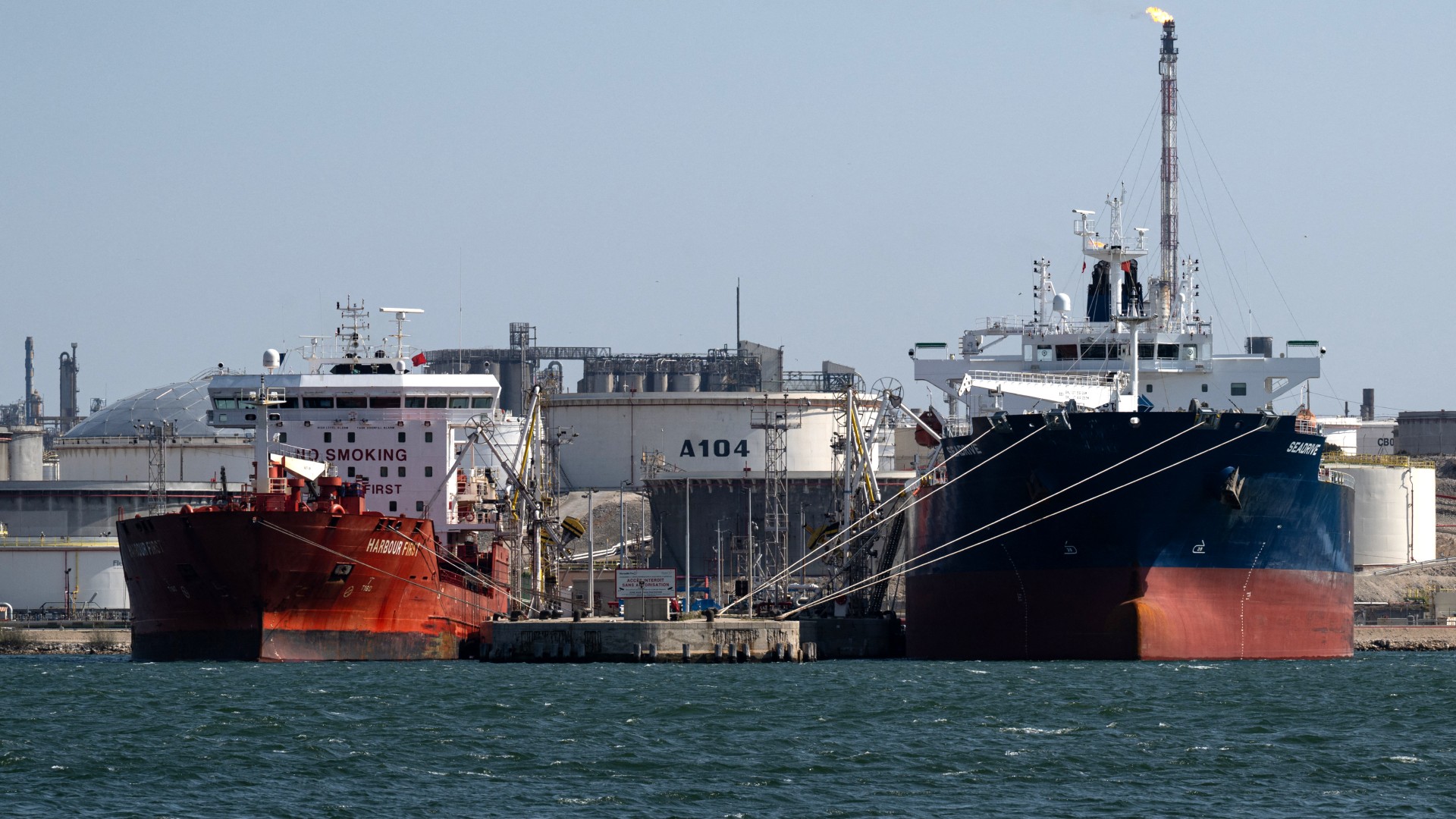
Submitted by Ilya Roubanis on Fri, 09/18/2026 - 17:18 Europe will be counting on luck as much as policy to face a mounting energy crisis fuelled by wars in Iran and Russia-Ukraine This photograph taken from Port-de-Bouc, southern France shows oil tankers in Martigues, on 25 March 2026 (Elodie Clement/AFP)
Off
Europe’s oil and gas supply is now disrupted by conflicts in both the Gulf and Eurasia. On Friday, Saudi Arabia told European refineries to not expect any crude oil deliveries next month. The continent will need as much good fortune as foresightful policy to withstand the evolving energy crisis.
Conflicts on the periphery of the European Union, the Eastern Mediterranean, the Red Sea, the Straits of Hormuz, the Black and Caspian Seas have made it clear that Europe is not able to secure critical energy value chains.
With shallow infrastructure in terms of strategic reserves for oil and gas, a dependence on spot markets, and increasingly volatile weather, Europe needs luck.
Houthi forces have advanced rapidly along Yemen’s southwestern Red Sea coast, capturing the Port of Mokha on 10 September, seizing Mayun/Perim Island inside the Bab el-Mandeb Strait on 11 September, and reportedly taking Greater and Lesser Hanish Islands on 14 September.
These islands sit directly on tanker and LNG shipping lanes entering the Red Sea, making even limited Houthi presence commercially significant. The strait is not physically closed, but territorial control now allows the Houthis to disrupt traffic.
“The Houthis do not need to physically close Bab el-Mandeb to extract strategic value from their position,” Abdi Guled, editor of Horn Briefs and a former AP and Reuters correspondent, told Middle East Eye.
War-risk insurance premiums for Red Sea transits have surged, and even a perceived threat can make routine voyages commercially unviable.
'The Houthis do not need to physically close Bab el-Mandeb to extract strategic value from their position'
- Abdi Guled, editor, Horn Briefs
While it’s still early to tell, early indicators show the transit of vessels has declined, with major insurance companies withdrawing war-risk coverage for Bab el-Mandeb, and shipping companies diverting vessels around the Cape of Good Hope, adding 10-14 days to voyages and raising costs across global supply chains.
These Red Sea disruptions come as global markets are still absorbing the shock of the months-long closure of the Strait of Hormuz earlier this year. The combined effect is visible in Europe’s inflation data: reduced supply, higher shipping costs, and refinery outages feed directly into diesel, electricity, and food prices.
The closure of Hormuz from February to early September removed an estimated 17-19 million barrels per day from global markets, forcing Europe to rely more heavily on Atlantic Basin and Caspian supply.
Saudi Arabia mitigated part of the shock by diverting crude through its East–West Pipeline to the Yanbu export terminal on the Red Sea, increasing flows – until recently – from roughly two million barrels per day at the start of the year to around six million barrels per day.
The pipeline can technically carry up to seven million barrels per day, though Yanbu’s loading capacity limits this to some extent.
A drone attack on a pumping station on 11 September prompted the immediate closure of the East-West line, and, at the time of writing, it is not clear when it will reopen.
“The current energy crisis is morphing into a global financial crisis with symptoms in Europe now evident as eurozone inflation is accelerating at 3.3 percent and energy inflation jumping at 14.3 percent,” Costantinos Stambolis, Chairman of the Institute of Energy for South-East Europe, told MEE.
Four seas, two wars, one market
Europe’s quandary is that conflict is constraining energy supplies from both Russia and the Gulf.
Ukrainian strikes on Russian refineries and export terminals have created industrial constraints on Russian supply at a moment when European sanctions limit alternative inflows.
 From Syria to UAE, the race to bypass Strait of Hormuz is on
Read More »
From Syria to UAE, the race to bypass Strait of Hormuz is on
Read More »
US President Donald Trump claimed this week that the two countries had agreed not to strike energy targets, but Kyiv said it was conditional and there is no public confirmation from Moscow.
One of Europe’s hopes for diversifying supply beyond the Middle East was Kazakhstan, a country that has quietly become one of the few producers capable of easing Europe’s tightening oil balance.
However, Kazakhstan’s main export artery is the CPC pipeline, which handles more than 80 percent of the country’s crude exports - but which delivers the crude to a loading terminal at Russia’s Black Sea port of Novorossiysk.
“There’s a difference between shortages and total crisis,” says John Roberts, formerly an editor at Financial Times Energy and an Atlantic Council Fellow, “but Europe is now exposed because several supply routes are under strain at once”.
“Ukraine seems capable and indeed willing to attack Novorossiysk,” Roberts said, leaving Kazakhstan unable to rely on its main outlet at a moment when alternative routes are limited.
The Caspian is the logical alternative to the Black Sea route, with energy transit via Azerbaijan and Turkey.
Through this route, tankers transit the Caspian Sea and feed the Baku-Supsa pipeline, which can handle around 150,000 barrels per day - far below Kazakhstan’s typical export volumes. Additional volumes can be channelled through the Baku–Tbilisi–Ceyhan pipeline, making Azerbaijan’s infrastructure key for Europe’s energy security.
But the Caspian route is not safe either.
On July 25, a Ukrainian drone struck an Iranian vessel in the Caspian. The strike proved that such attacks are possible and can happen again. For the moment, an understanding between Kyiv and Tehran has eased major concerns. There is little doubt that this is also an existential challenge for Central Asian states.
If Kazakhstan cannot ship west, China becomes the default buyer, reducing volumes available to Europe.
“They don’t want to be dependent on a monopsonist customer (single dominant buyer),” Roberts said.
Regulation compounds volatility
Experts are now placing their hope for easing inflation on “demand destruction” - poorer countries reducing consumption because they can no longer afford high prices, diverting supply to Europe.
Weather is a key factor: a mild winter would give Europe breathing space. How weather will affect demand for fossil fuels is anything but clear.
According to reports from Rystad Energy and ICIS, the 2026-2027 El Niño weather pattern will change how much energy Europe uses over the next year.
 China's oil imports plunge 40 percent, keeping a lid on energy prices
Read More »
China's oil imports plunge 40 percent, keeping a lid on energy prices
Read More »
In a July 2026 assessment, analysts warned that while a milder start to the December 2026 to January 2027 winter could initially lower heating demand, a sudden atmospheric shift could trigger severe cold snaps in February 2027, causing a late-winter spike in gas and electricity use.
Furthermore, historical data from ICIS shows that strong El Niño events can cut European wind power generation by up to 9.8 percent during the winter months, forcing power plants to burn more natural gas to keep the lights on.
However, regulation is reducing Europe’s scope to address short-to-medium pressure.
EU methane rules taking effect in 2027 will require gas and LNG importers to prove that overseas producers meet EU-level monitoring and verification standards.
Analysts such as Ben Cahill at CSIS say this will immediately split the market between compliant and non-compliant exporters. Many producers lack the equipment and data systems needed to meet EU-level monitoring standards, meaning compliant gas may become more expensive. This is likely to affect suppliers from Central Asia.
Central Asian countries such as Kazakhstan and Turkmenistan are studying ways to access the European market. But this requires the placement of critical infrastructure to carry Kazakh oil or Turkmen gas across the Caspian. This is hard, as the EU cannot offer investment capital or long-term contracting for oil and gas projects due to environmental regulations.
One proposal is for a short interconnector with a capacity of around five billion cubic metres between Turkmenistan’s own offshore platforms and those of Azerbaijan.
Advocates have put the cost of laying such a line at around $500m - or closer to one billion if the line were eventually intended to carry 10-12 bcm. Such a pipeline would pass through the territorial waters of only two countries, which, under the 2018 Convention on the Legal Status of the Caspian Sea, reduces Moscow and Tehran's ability to block the project.
Nonetheless, Moscow and Tehran can use environmental impact assessments to exert pressure.
Europe’s energy crisis is turning into an industrial and inflationary challenge that cannot be addressed with policy or regulatory interventions.
While in the long run Europe may come to rely on renewables alone, in the short run, there is little that policymakers can say to dissuade concerns. Luck matters more than policy.
Analysis News Post Date Override 0 Update Date Mon, 05/04/2020 - 21:19 Update Date Override 0Read the full story at the source
Source: Middle East Eye