
World · Left Voice · · 2h
Against Kautsky’s Ultraimperialism: What Kind of Anti-Imperialist Movement Do We Need?
English (original) · Read in Deutsch ⇄
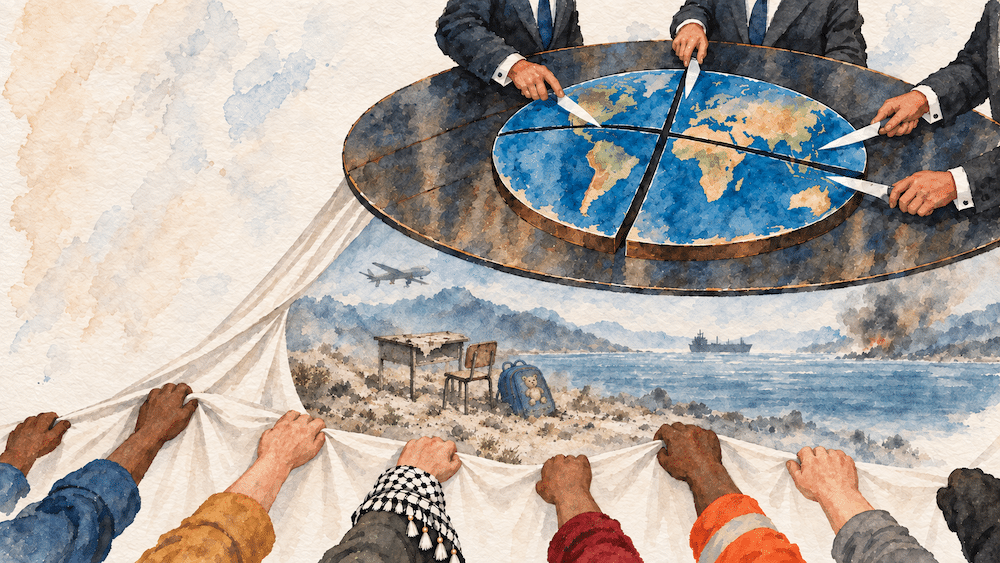
Nearly seven months into the imperialist war against Iran, a striking contradiction has emerged. Although public support for the war has fallen sharply — and one comparative analysis describes it as the most unpopular major war in U.S. history — the millions politicized by the genocide in Gaza and Trump’s offensives against Venezuela, Cuba, and Iran remain without a sustained anti-war and anti-imperialist movement.
From the opening days of the war, this contradiction has produced an important debate on the U.S. left. In Why Is There No Antiwar Movement in the US?, Eric Blanc, one of the main writers for Jacobin and an influential leader of the DSA, offers a series of explanations: a widespread sense of powerlessness; the hope that the war would end quickly; the dispersal of activists across Trump’s many offensives; the substitution of one-day mobilizations for sustained organizing; and the isolation produced by what he considers excessively radical or sectarian politics, echoing his recent statements toward the Palestine and BLM movements.
These are real organizational problems and in the face of them, Blanc proposes for the left to participate in protests organized by Democrats, build organizational infrastructure between the day of actions, and to use the 2028 presidential election (in two years from now) as a referendum on runaway military spending, U.S. imperial wars, and U.S. support for the genocidal Israeli state.
Blanc’s argument clearly contains a strategical tension: he identifies widespread powerlessness as one of the main reasons an anti-war movement has not emerged, yet his proposals risk deepening that same sense of powerlessness. This is because his proposals go in the direction of subordinating the need for the kind of mass action that was able to partially push Trump and his imperialist interests back — as in the Minneapolis uprising and “Blocchiamo Tutto,” the strikes and blockades organized across Italy in solidarity with Palestine — to a dependence on the electoral timetables and political calculations of a wing of the Democratic Party.
While figures such as Alexandria Ocasio-Cortez and Zohran Mamdani may offer a sharper critique of U.S. foreign policy, their position within the Democratic Party binds them to institutions that were built to reproduce the legitimacy of a bipartisan regime. Thus, Blanc’s conception turns socialist politics into an effort to improve the rhetoric and personnel of U.S. imperialism, rather than organize the independent power needed to challenge it, in the way that only the self-organized working class can do.
This begs the question: is imperialism simply a set of policies that “good” or “bad” politicians can manage or is it more fundamentally a historical stage of capitalism in which powerful banks, corporations, and states compete to control markets, resources, labor, territory, and political power across the world?
As the 2008 financial crisis, pandemic, war in Ukraine, genocide in Gaza, offensive against Venezuela and Cuba, and war against Iran show, this is no longer an abstract question, as the more classical features of this historical stage of capitalism reappear. Is imperialism sustained by uniquely “bad” politicians from Obama who promised to end the war with Iraq but was converted into the “Drone King,” to “Genocide Joe,” and now Trump 2.0, or a system that compels every administration to defend U.S. capitalist interests and geopolitical power abroad in their own way?
The roots of this question trace back to one of the most important debates in the history of the socialist movement, over the question of the fundamental characteristics of imperialism, and what those conclusions imply about how socialists, especially in the heart of imperialism, politically organize themselves in the face of war, imperialist domination, and the crimes of their own ruling class.
Karl Kautsky, a leader of the Social Democratic Party of Germany (SPD) , the largest party in the Second International, and its “centrist” wing, wrote “Ultra-Imperialism” in 1914, right as the competition among Europe’s great powers was exploding into world war. He saw imperialism as a policy associated with finance capital: rich industrial states exported capital, dominated poorer agrarian regions, and fought one another over the division of the world.
But Kautsky did not think this rivalry had to continue. He essentially believed, as he said so himself in his text, that “capitalists of all countries” would “unite” (inverting Marx’s famous phrase about proletarian internationalism) as war imposed enormous costs on capitalists and workers alike. Once the ruling classes understood the danger, they could find it more rational to cooperate. Instead of competing empires, Kautsky’s utopian vision of the world imagined a cartel of powerful states that would jointly and more peacefully exploit the rest of the world. Even as capitalism remained unequal and predatory, Kautsky envisioned that relations among the great powers could become more peaceful.
From the point of view of a recent Jacobin article revisiting Kautsky, the postwar order looked surprisingly close to this prediction. They mention how the United States organized the major Western powers through NATO, while multinational corporations and institutions such as the IMF and World Bank enforced the dependency of poorer countries. The article stops short of fully vindicating Kautsky because China’s rise, tensions within the Western alliance, and renewed arms races may show that cooperation was only a temporary phase, as the author points out. Still, it leaves the debate suspended between two empirical possibilities: perhaps capitalist states will cooperate; perhaps they will return to open rivalry.
That framing misses the political core of Lenin’s disagreement with Kautsky. As Lenin wrote in Imperialism, The Highest Stage of Capitalism, agreements among capitalist powers were possible, but they could only constitute temporary truces. Because capitalist states and monopolies develop unevenly, every division of markets, resources, and spheres of influence eventually comes into conflict with a changing balance of power. Cooperation and war were therefore not opposite historical paths but alternating forms of the same imperialist system. Kautsky, Lenin argued, treated war and annexation as policies that could be exchanged for less violent ones while leaving the economic foundation of imperialism intact.
The history of U.S. hegemony supports neither a picture of permanent unity nor one of uninterrupted war among the major powers. Washington built alliances, institutions, and rules that coordinated capitalist states under its leadership. It also waged devastating wars across Korea, Vietnam, Iraq, Afghanistan, and the broader Middle East. Relative peace within the Western bloc rested on violence outside it. The “rational” order remained an imperial order.
Kautsky saw that capitalist powers could cooperate. His error was to treat cooperation as a possible escape from the contradictions driving imperialism. Peace could then appear as the rational interest of the system as a whole, opening the door to appeals to far-sighted sections of the ruling class capable of recognizing that interest.
Once imperialism is understood this way, socialist strategy begins to shift. The task becomes strengthening the reasonable wing of the state against the reckless one, diplomacy against militarism, and responsible international leadership against unilateral aggression. The state responsible for domination remains the terrain on which political change is sought. Socialists and workers become its critics, pressure groups, or prospective administrators, rather than an independent force capable of stopping the wars waged at their expense and at the expense of workers and oppressed peoples around the world — and of challenging the class interests that produce them.
Blanc’s position is not identical to Kautsky’s, but the same unresolved strategical question reappears. Can imperialism be restrained through better policies, marginally smaller military budgets, and different representatives — or does confronting war require an independent movement directed against the social and economic foundations of imperial power?
In 1914, Kautsky’s politics were tested. Germany’s government needed parliamentary approval to finance World War I. The SPD, the largest socialist party in Europe, could have refused the war credits and used its vast press, trade-union ties, parliamentary tribune, and working-class base to organize opposition to the war.Instead, the SPD deputies voted for the credits, while Kautsky’s centrist current refused to wage a fight against them. That refusal gave political cover to the SPD’s capitulation before German imperialism. Kautsky could oppose the war in words, but his politics of abstention — and his illusion that the imperialist powers could return to a more rational, peaceful order — offered no path to stop it. In an imperialist war, a “neutral” position is not neutral: it means refusing to call for and organize the defeat of one’s own ruling class.
This was not simply paralysis. In the case of Kautsky, it amounted to a left-wing of a “Germany First” policy and it also led to a historic capitulation of the socialist movement. The SPD’s submission gave German imperialism the political unity it needed to wage a war already underway, while the Second International disintegrated between the parties that rallied behind their “own” governments and the revolutionary internationalists who fought for workers’ solidarity across borders.
Among the revolutionary internationalists was Rosa Luxemburg, who was sentenced to a year in prison after a 1913 antiwar speech in which she urged German workers in uniform to refuse orders to shoot French and other foreign workers. While serving that sentence in 1915, she wrote the Junius Pamphlet.
Luxemburg did not dismiss elections, reforms, or parliamentary struggle; she argued that the SPD’s enormous electoral and organizational gains had proved insufficient when its leadership subordinated the working class to the interests of the imperial state. Her demand was for workers to intervene against the war during its course, not after it had ended. As she wrote, the proletariat lacked, “the capacity for effective resistance to imperialism at the decisive moment, to intervene against it during [not after] the war.”
While Luxemburg exposed the SPD’s capitulation and insisted that workers resist imperialism during the war, the further question, raised by Lenin, was how to confront the opportunist politics that made that capitulation possible. Extending that argument to the present, opposition to a particular war must also become a struggle against the political currents and institutions that repeatedly subordinated workers to their own ruling class.
Taking these lessons seriously, what might left-wing “America First” politics look like today? It would probably not openly support Trump and Netanyahu’s war against Iran. It could oppose the bombing, criticize military spending, and call for diplomacy while still treating imperialism as a collection of mistaken policies that better representatives could correct. The neo-Kautskyist logic appears when opposition to war stops short of confronting the institutions and political alliances through which imperialist power is exercised.
As Josefina L. Martínez wrote in her piece “New and Old Debates on Anti-imperialism and Socialism,” a similar logic appears in a position espoused by Vivek Chibber, a contributor for Jacobin, who made the call to fight imperialism abroad by rebuilding class struggle at home during the Palestine movement. Chibber begins from a necessary point: organized workers possess collective power that isolated activists do not, and no serious challenge to U.S. militarism can be built without a stronger labor movement.
But “build U.S. labor first” does not determine the political direction of that power. If anti-imperialism is postponed until after unions have been rebuilt, struggles for wages, public services, and industrial investment can be absorbed into a Democratic Party program: better jobs at home, less wasteful foreign policy, fewer bombs abroad — and the same imperial power. Without a conscious fight against the U.S. state, its military apparatus, and the capitalist interests it defends internationally, there is no reason a revival of labor militancy would become anti-imperialist and not become an appendage to Democratic Party politics.
The war on Iran makes the limits of this strategy impossible to ignore. Military spending, inflation, and instability can sharpen discontent among workers in the United States, while U.S. bombardment and blockade devastate the Iranian masses and threaten the entire region. But for those who make anti-imperialism dependent on first rebuilding labor and waiting for a more favorable electoral terrain, opposition to the war is always deferred. They can condemn imperialist aggression in words while offering no strategy to organize workers against their own state’s war and sanctions now, or to unite their struggle with those suffering its treachery abroad.
In revolutionary Marxist strategy, “defeatism” means refusing to subordinate class struggle to the military success of one’s own state during an imperialist war. For labor, social movements, and organizations such as the DSA, the question is therefore not simply whether they oppose Trump’s war. It is whether they subordinate that opposition to Democratic electoral horizons and the search for more “humane” administrators in 2028, or build, with all the resources at their disposal, an independent force capable of organizing workers and students against the war now — by confronting the economic, military, and political machinery that sustains it.
Palestine already gave us a glimpse of what a mass internationalist politics of the 21st century can look like. A generation entered the struggle over violence inflicted on a people thousands of miles away and, in doing so, began confronting the complicity of its own government and institutions. Students from the heart of imperialism demanded that universities disclose and divest their financial ties to Israel and the arms industry and faced repression; encampments spread from Columbia across the United States and then to campuses internationally. At the University of California, academic workers struck against the repression of Palestine protesters in the largest strike for Palestine U.S. history. This was internationalism not as abstract sympathy, but as solidarity translated into conflict with institutions at home.
With nearly 70 percent of voters opposing U.S. military action against Iran, and millions already mobilizing for the No Kings protests, it’s up to socialists to revive the militancy of the Palestine movement and carry it into durable organization in our workplaces, campuses, and the streets. If Blanc’s concern is that anti-imperialist sentiment lies outside the horizons of ordinary people, the genocide and the massive outrage it produced around the world, points in the opposite direction. Clearly, there is an internationalist consciousness that is already developing.
What remains unresolved is whether that consciousness can become an independent political force. Without durable institutions of self-organization and a working-class conception of power, it can be drawn back into the orbit of politicians who oppose a war’s excesses while leaving the machinery of U.S. domination intact.
The task is not simply to bring antiwar sentiment into the next election, but to organize it against the institutions carrying out the war now. That means building assemblies, workplace organizations, and campus campaigns capable of acting independently of the Democrats; fighting to defeat the U.S.-Israeli attack without giving political support to Iran’s ruling regime; and forging solidarity with workers and oppressed people across borders rather than looking to rival states for an answer. A movement against the war on Iran cannot stop at asking the architects of imperialism to manage it more “peacefully.” It has to confront the power that makes this war — and the next one — possible.
Read the full story at the source
Source: Left Voice