
World · Labor Notes · · 33m
German Amazon Workers Organize To Get Paid for Every Minute
English (original) · Read in Deutsch ⇄
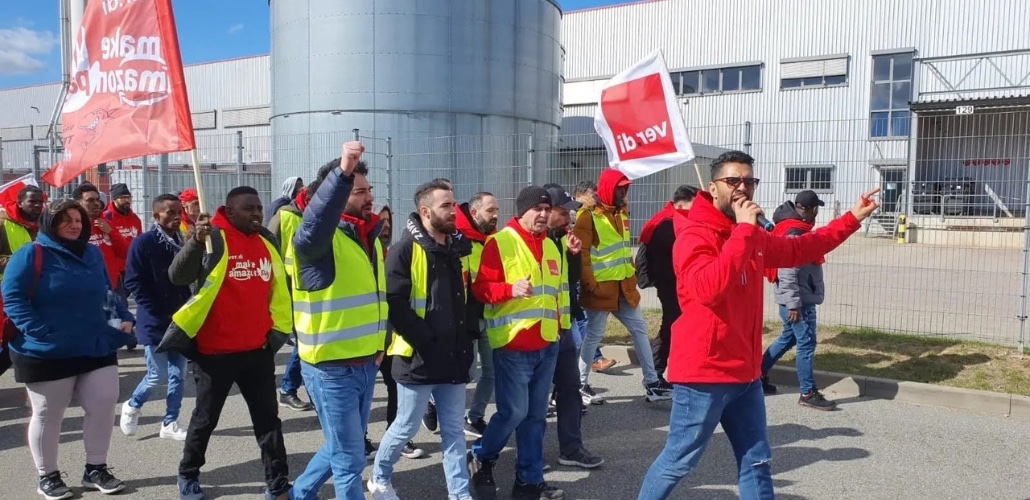
Amazon workers at four delivery and sorting warehouses in Germany are organizing to make every minute count. They’re demanding that Amazon pay them for every minute of work, saying in a petition that the company is stealing their time.
Working even 10 unpaid minutes a day, the workers say, adds up to 4.5 workdays per year of free labor, or about $712 U.S. (618 euros) in stolen wages. And at the most extreme, stolen time can reach up to 45 minutes per day.
The petition identifies three ways Amazon is stealing workers’ time:
1) Threshold time, where if a worker clocks in up to 15 minutes early for a shift or clocks out up to 15 minutes late, the company rounds back down to the scheduled time
2) Changing times to put on safety gear and boots
3) Walking time to pick up and return equipment
Stella de Palma, a delivery worker at a warehouse near Berlin, said workers normally change before clocking in. “Some shifts are only allowed to clock in or out at certain time clocks, which means we have to walk all the way across the shop floor first,” de Palma said.
She doesn’t think it makes sense, especially during peak night shifts from 11:10 p.m. to 9:30 a.m. “We’re already working near the locker rooms, where there are also time clocks.” What ends up happening is that they have to walk a long distance across the shop floor to clock in and then back to the locker room to change.
She has found workarounds: “I started leaving work unfinished instead of completing it, simply because I didn’t feel it was right to work those extra minutes for free.”
Amazon workers are bringing their case to an arbitration board, overseen by a retired judge, to rule on whether these extra minutes when clocking in and out qualify as working time. The workers are demanding a return to the “secondwise” system, where once you clock in, the exact time is logged in.
But whatever the legal outcome, the fact that workers weren’t consulted when Amazon made the change in 2024 has motivated them to redouble their organizing, so that they can block the unilateral authority of management to impose these kinds of workplace changes.
FROM TIME OFF TASK TO THRESHOLD TIMES
Workers said Amazon tells them they need to be more flexible with their schedules to meet customers’ needs. But Nils Carrara, a sort center worker, said when they show up earlier than scheduled in a show of flexibility, they aren’t paid for that time. “Why does a corporation like Amazon need to steal a few euros from me every day?” Carrara asked.
Workers like Carrara earn between $20 and $26 an hour. Amazon’s 1.5 million workers and misclassified contractors worldwide generate the company’s enormous wealth, driving its market valuation to nearly $3 trillion. That value created by workers has been funnelled into a $200 billion investment in artificial intelligence, including software for monitoring workers.
In squeezing workers down to the minute, Amazon is engaging in a long employer tradition. More than a century ago, management consultant Frederick Winslow Taylor popularized “scientific management,” a method of increasing output by following workers around with a clipboard and stopwatch, looking to optimize workers’ movements through incentives and by eliminating any superfluous motion or moment of slack.
Amazon has long subjected workers to a regime of algorithmic surveillance, tracking their every move to wring out more productivity. That has been a key spur to organizing as workers are penalized for “time off task” or missing productivity targets, a form of algorithmic management.
That’s old-fashioned twentieth-century Taylorism. Amazon has updated it from the era of stopwatches and clipboards to today’s algorithms, supplying the simple scripts for workers to follow and tracking them.
COMPANY CONTROL
High-tech wage theft is the latest battleground. Christian Harenberg, a supervisor, member of Verdi union, and vice chairman of the works council at an Amazon delivery station in Berlin, is organizing to revert back to a timekeeping log that records exact times a worker punches in and out. The petition is the opening salvo to revitalize the institutional structures of his site’s works councils.
Works Councils, a creation of German law, are elected representative bodies of workers who meet with management to deal with shop floor issues. As a Verdi union member and vice chairperson, Harenberg is a spokesperson and worker advocate; he and fellow works council members convene four general assemblies per year. (In Germany, supervisors are part of unions.)
Under the “threshold times” system, Harenberg explains, “let’s say your schedule is from 7 p.m. to 1:30 a.m., and you badge out at 1:40 a.m., it automatically jumps back to 1:30 a.m., even if you have worked this extra 10 minutes, and this goes up to 15 minutes before and after the shift.”
It feels particularly unfair, Harenberg said, that “if your manager asks you to do a little bit more, the company says that in case you have 10 minutes of extra work, and the manager is in charge of booking that manually, but you have no way to control that.”
MANAGEMENT SCREW-UP
Under Germany’s Co-Determination Act, the law that allows for works councils, Amazon should have held a hearing with worker representatives before making software changes, altering working hours, or defining when work officially begins and ends.
“If the software is dealing with personal data, the employer needs to get in contact with the works council and cannot decide to turn something on,” said Harenberg. “There has to be an agreement between both parties.”
Workers weren’t told about the change, but some found out by chance. “Some of my co-workers noticed that the extra minutes they worked were no longer being added to their overtime accounts,” de Palma said. “It was only after we asked about it that we were officially informed about the change.”
Other workers got the information inadvertently when managers screwed up and forgot to set to “private” a SIM ticket, Amazon’s internal ticketing and incident-management platform. SIM is used by workers, managers, and engineers to log breakdowns, track maintenance requests, and escalate all kinds of internal problems across warehouses and Amazon Web Services data centers.
“They made calculations, talking about how many minutes they can save with the new system,” recalled Harenberg. The managers talked about how they would have to “make the work council [delivery] stations agree on a certain software to be able to install these threshold times.”
REFUSED TO BE INTIMIDATED
At one delivery station, though, management was forced to back down from implementing the change.
“Strictly speaking, we didn’t block it ourselves,” said Serdal Sardas, a supervisor on the night shift and a vice chairman of the works council, who has worked at Amazon since 2019, after serving eight years in the military.
“The employer blocked it themselves,” by refusing to answer the question of who had access to the employees’ personal data.
Amazon was apparently running afoul of European data protection laws, which require that personal data may only be accessed by people who need it for their work.
“We suspected that the IT or HR teams handling the [threshold times] tickets and adjustments were located outside the EU, in the U.S. or India,” said Sardas. “If the employer had confirmed that employee data was being processed outside the EU, they wouldn’t have stood a chance of enforcing the tool in court or through a conciliation board.”
The works council at this delivery station was proactive and well-organized, compared to other locations where either there was none in place or elected leaders had only been in office for a short time. If there’s no works council, then the co-determination rules don’t apply and management can arbitrarily impose changes on the workplace without consulting workers’ representatives.
“There’s no blaming those colleagues” at the warehouses where threshold times were imposed, Sardas l said. “They simply didn’t know any better back then and were put under a lot of pressure by the employer. Our works council was already well-established and experienced. We knew our rights inside and out, so we refused to be intimidated or rushed into implementing anything prematurely.”
CREATE HAVOC
Verdi divides its organizing departments into a logistics division, which includes the delivery and sort centers, and a commerce division, which includes the fulfillment centers. The fulfillment centers employ thousands of people in each warehouse. Workers there have organized frequent strikes, starting in 2013.
Amazon has had fulfillment centers in Germany for over 20 years. But sort and delivery warehouses are newer, appearing within the last nine years, made up of immigrants from Latin America and Africa. They are much smaller than fulfillment centers; they employ a few hundred workers.
The confluence of these factors—a largely immigrant workforce like in the U.S., and newer facilities with no strike experience—has meant Verdi has struggled to gain a foothold within them, including on the works council, much less establishing a union representation beachhead.
The result of that institutional weakness, says Verdi organizer Boris Bojilov, is that the works councils can become dominated by workers who tend to go along with management. That danger is present across all Amazon facilities, but especially in newer and smaller sites where it’s harder to run works council elections.That has created an opening for Amazon to exploit union vulnerabilities in the logistics sector.
Bojilov thinks the strategy to build worker power at Amazon must depend on using the existing works council structures to create a culture of organizing. “Amazon won’t give in easily on the legal side,” he said. “They are saying it openly in the negotiations with the works councils—if you are successful here, and we have to give you, let’s say, five minutes for changing time, or two minutes for walking times, or two minutes for threshold time—they will have to roll it out at all sites.”
On the organizing front, “we try to create as many rebellious works councils as possible,” he said. “We try to coordinate them in order that they go all for the arbitration committees, so that creates havoc and cost for Amazon. And at one point, they will say, 10 works councils go to the arbitration board, one day costs €12,000 [ or $13,842]. It’s like 10 days of negotiations per year, times 10 stations.”
TWO ROUTES
Verdi organizers and workers are trying to transform the works councils into fighting institutions, arguing they still serve a valuable function as forums that can cohere workers, educate them, and equip them to take collective action.
“You can also use it as a political stage,” said Bojilov about worker assemblies that the works councils hold. “We will talk to the workers to prepare them, because management has their arguments. They will say, ‘When you enter the shop floor, you’re not working. You are talking about your last weekend and what you did with your girlfriend and blah blah blah.’”
He says the union will need to embolden workers who management has long denigrated as “illiterate migrants” who should be “grateful for their lives that Amazon gives them a couple of bucks” to stand up to managers from Munich or Luxembourg.
“That’s how we build union culture,” Bojilov said. “We show the workers that they can rally majorities on their behalf. They can embarrass managers, contradict, and speak up to them.”
As workers gain confidence they can also hold accountable their elected officials in the works council, who Bojilov said can drift into thinking of themselves as “politicians sitting in their rooms, drinking coffee, and philosophizing—forgetting about the shop floor.”
“There are two routes: there is the bureaucratic route and there is the organizing route,” said Bojilov. “But the idea is also to connect them.”
NEED THE MONEY
Another fight is only beginning. Harenberg said that normally delivery station shifts are eight hours, but now Amazon is pushing for 10-hour shifts during the peak season. The legal maximum is 48 hours per week. And workers at the Berlin delivery station need the hours.
“We tried to reduce the hours, especially during peak time, because of health reasons,” said Harenberg. But workers said no. “They want to have these hours. They want to have the money.”
Under German labor law, the work week constitutes working eight hours, Monday-Saturday. On average, Amazon workers put in 48 hours per week.
“The night shifts are being increased to 10 hours during peak,” said de Palma. “Of course, working 10-hour night shifts from 11:10 p.m. to 9:30 a.m. isn’t great for your health.
“In the long run,” she said, “I think we need to look at getting a collective bargaining agreement in place so that we can earn better wages and people don’t have to rely on those extra hours. And we also need to find a better solution for peak season so that people aren’t put in a position where they feel they have to work those extra hours.”
A version of this article appeared in 571. Don't miss an issue, subscribe today. Luis Feliz Leon is a staff writer and organizer with Labor Notes.luis@labornotes.org
Related
Luis Feliz Leon is a staff writer and organizer with Labor Notes.luis@labornotes.org
Related

Viewpoint: What Amazon Workers Can Learn from the Successes (and Failures) of the Fight for 15 »
July 15, 2026
How We Organized a Union at Whole Foods »
February 26, 2026
The Amazon Imperative: Unions Must Join Forces »
February 12, 2026
Coping with Climate Crises on the Job »
July 16, 2025
Amazon Workers Defy Dictates of Automation »
June 26, 2025Read the full story at the source
Source: Labor Notes