
World · Labor Notes · 36m
How Minnesota Unions and Community Groups Stood Up to an ICE Occupation
English (original) · Read in Deutsch ⇄
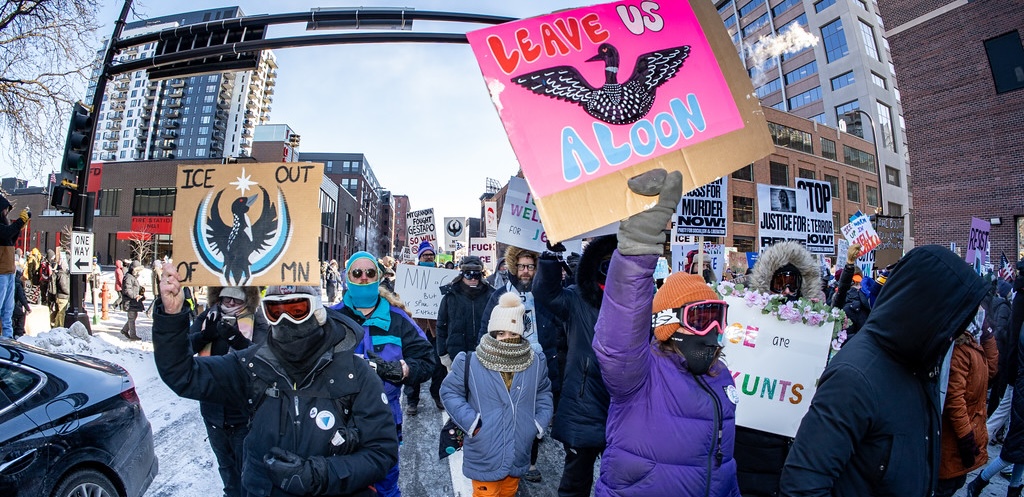
In this excerpt from the new book This Is How We Win: A Guide to Building Working-Class Uprisings, SEIU Local 26 President Greg Nammacher describes how his union, its members battered and exhausted from ICE attacks, went on the offensive against a federal occupation of Minnesota. -Editors
Trump’s Operation Metro Surge was a direct attack on our union. We represent 8,000 property service workers, security guards, janitors, airport workers, and Uber/Lyft drivers in the Twin Cities metro area, and the vast majority of our members are immigrants and people of color. Thirty of our members were abducted by ICE during the onslaught. Rideshare drivers had their windows smashed and were dragged through them by agents who detained them, their cars abandoned on the road behind the airport. Other airport workers, despite having badges indicating full background checks, were repeatedly stopped and harassed for no apparent reason other than that they looked East African. Latino members were stuck in the stores where they work, in some cases for hours on end, as ICE agents circled outside.
It was clear that our union had to do everything possible to support our members in this time of incredible fear and pressure. During the first month, we focused on mutual aid. We helped put together a support system of community volunteers to give members who were afraid to leave the house a ride to work, many in the middle of the night. We pushed employers to let people take leaves of absence or change their shifts. To be clear, people weren’t staying home because of their work or immigration status. They were staying home because we could see that federal agents were stopping and arresting people because of their skin color or accent, regardless of status.
Though we were still on the defensive, we were able to organize two public actions on December 3 and 20. In both cases, we were concerned that ICE would attack us. But people’s courage prevailed. ICE didn’t come, and we got valuable information about how fed up the public was. We learned that members of other unions and community organizations were morally outraged by the invasion. The belligerent ICE presence had made people more willing to speak up for themselves and their neighbors.
By the new year, the work of providing services and mutual aid had started to exhaust us. When ICE murdered Renée Good, it was a wake-up call that we can’t service our way out of an authoritarian occupation of our city. We had to go on offense—create some real pressure on those who were making the decision to occupy our city.
This Is How We Win: A Guide to Building Working-Class Uprisings, edited by Sarah Lazare and Amie Stager, is available from Haymarket Books.
When community and faith groups first made the call in early to mid-January for a day of “no work, no school, no shopping,” we held an emergency meeting of our stewards. It was conducted over Zoom, because people were so afraid to leave their own homes. But 95 percent of the folks on that call said clearly that they planned to not go to work on the day of economic shutdown. It was a measure of how sick and tired everybody was. Plus the December protests boosted our confidence that others in the Twin Cities would join the call.
How did we get to that spot, where members were willing to take action together? In our union’s contract fights for the last decade, we’ve prepared ourselves and gone on strike many times. Members and stewards know that in the United States, withholding our labor is a key part of our power as workers. Obviously we go to the ballot box. Obviously we hold our politicians accountable by pressuring them. We try everything that we can to advance a workers’ agenda. But the best way to get results in a fight with the boss is to withhold our labor. And so, having practiced that, people had that muscle when the moment came.
We had also done internal work in coalition with others to sharpen our analysis of how the Trump administration, through its federal occupations, was implementing a playbook that we’ve seen many times around the world from wannabe dictators. Many of our immigrant members have seen firsthand what happened in their home countries when dictators took over, and it wasn’t pretty. And we know the way to beat these authoritarian, power-hungry types: with large-scale mobilizations that disrupt the status quo. Our stewards not only had the experience of organizing strikes, but they also had an analysis that we were facing an existential decision: go down the path to a dictatorship or take a stand to maintain our democracy and make it better.
The strength of the community, faith groups, and labor acting together made it possible for our members, many immigrant members, to make the decision not to go to work on January 23. The unions that seriously engaged and educated members about their rights in this moment were a very significant group. Over 1,200 of our members and at least 15,000 union workers overall were absent from the job that day or effectively shut down their employers’ operations in advance, according to our internal assessment. But countless other workers not represented by a union were among the estimated 100,000 people who marched that day. There were so many folks marching that organizers rented the Timberwolves stadium to provide a place for people to warm up, and it couldn’t hold a fraction of the marchers!
What we did in Minnesota wasn’t a general strike, but it was a big test of our community’s willingness to nonviolently disrupt the economy. By taking this action together, we expanded people’s conception of what we are capable of when we’re under federal assault. We’re building a new muscle, one that we’ll need in the near future. We have decades of labor law and contracts meant to make workers’ collective action as weak and limited as possible. A lot of obstacles have been set up. But if people are unified, our power is far beyond the limitations of the law.
Look at the way that the actual decision to withdraw the occupying forces was made by the regime. It gives a snapshot of an underlying theory of power. On January 23, the local economy was shut down in a manner that hadn’t been seen in the Twin Cities since the 1950s. This was a real flex of worker power that shook the business community out of complacency.
The Trump administration had ordered the ICE occupation of Minnesota in part as a form of political punishment: to retaliate against Governor Tim Walz, but also against our whole state, because of the progressive reputation we have, thanks to state-level pro-worker advances like free school lunches and paid time off for sickness and crisis. But neither the human toll of the occupation nor the economic damage—the state of Minnesota’s lawsuit against the federal government now alleges more than $600 million in business losses and $243 million in lost wages due to Operation Metro Surge—were sufficient to pressure businesses to call for change.
But after the day of action on January 23 and then CBP’s murder of Alex Pretti the next day, the CEOs of sixty Minnesota-based companies, including Target, General Mills, and Best Buy, released a letter calling for an immediate de-escalation. Activists were rightfully upset with how weakly worded this corporate letter was. But it no doubt figured in the Trump administration’s calculations when CBP official Greg Bovino was transferred out of the state (he was later reportedly forcibly retired) and Trump himself said, “We’re going to de-escalate a little bit.”
It wasn’t just the letter that made the administration shift its policy. January 23 created a national conversation about the power of regular people to fight back. And the murder of Pretti sparked widespread opposition to ICE. All eyes were on Minnesota, thanks to the sacrifices of so many people responding to ICE raids every day. All these factors forced an eventual drawdown.
Activists had been approaching Target and other major companies in the Twin Cities for months, making their voices heard in stores and corporate lobbies, holding press conferences, and moving online petitions to pressure them to publicly break from the Trump administration on the ICE occupation. The corporations were studiously silent. The first time that they broke that silence was after the day of “no work, no school, no shopping.” That’s also when we got a retreat from the Trump regime.
That really tells you who Trump listens to. He’s perfectly happy in moments of chaos and crisis. But if workers fight back against his corporate enablers and push them to break their silence, we can start to turn the corner. Just like the lunch-counter sit-ins during the civil rights movement made segregation a problem for a major business (Woolworth’s), the mass mobilizations in the Twin Cities prompted Minnesota’s Fortune 500 corporations to respond.
The biggest lesson that we can learn from Minnesota is that we can win. I had started to lose hope back in October. We in the United States seemed far from being able to play the incredibly important role that the labor movement has in almost every other country that has successfully prevented authoritarian consolidation in the last fifty years. But I believe that in January, we saw the power of a community standing up. This wasn’t in the history books about the 1960s or the 1930s. This wasn’t in newspaper articles about Argentina or France. This was right here in the Upper Midwest. To see the community move with so much power and unity is really inspiring.
Service and mutual aid are so important. We couldn’t do anything other than that when this kind of occupation starts. But labor had a role to play in the pivot to a more offensive stance, when we were ready to shut down the economy and hold major corporations accountable. Unions alone can’t stop authoritarianism. But during key moments, we can help give some direction and structure to these beautiful social movements that will succeed in stopping the slide toward dictatorship.
My first piece of advice to workers in unions is to begin your preparations now. If you have your own contract fights, that’s an opportunity to strengthen your muscles. The more that you’ve got the muscle of striking for your own contracts, the more that you’ll be ready to stand up and defend yourselves and your rights against our own government.
Number two, start the planning with your closest union allies and community partners. The strength and coordination among you will determine what is and isn’t possible if you have to confront an ICE occupation or the theft of an election or the massive defunding of public institutions that workers have fought for over decades.
How do you do that? Sit down with the other organizations in your community that are the most hungry—that have a real base of working-class people, whether they be unions or churches or community organizations—and begin planning what you would do if this kind of a confrontation comes. It doesn’t matter if you guess exactly right about what sort of confrontation will be needed. The muscles will still be useful.
Discussions should include these questions: What does effective nonviolent disruption look like for us? If you’re a group of churches, how can congregations and clergy contribute to such disruption? What does it look like in the hospital industry? What does it look like in the gig economy? What does it look like at an airport? What does it look like in a school? These are questions that I think each group of workers and each community organization should be thinking about.
All we have is our labor. When we use it together, winning is within our grasp. And we need to start practicing now.
Greg Nammacher is president of SEIU Local 26. The book is available here.
A version of this article appeared in Labor Notes Issue #570, September 2026. Don't miss an issue, subscribe today.Related
Will Republicans in Congress Torch OSHA’s Heat Standard? »
August 31, 2026
Jackson Transit Workers Win Strike, Save Saturday Service »
August 27, 2026
Federal Spies Hunt Minnesota Unions in Search of Conspiracy, But Find Solidarity »
August 14, 2026
‘Give Me a Chance to Survive’: Workers, Employers Dread Deportations’ Effect on Health Care »
July 15, 2026
Power Workers Independence Day Strike Wins Pensions in Pennsylvania »
July 09, 2026Read the full story at the source →
Source: Labor Notes