
World · Labour Hub · · 2h
Hostage Nation
English (original) · Read in Deutsch ⇄
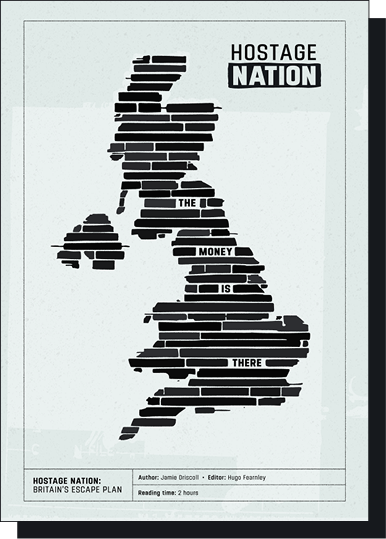
Jamie Driscoll’s bold plan should be widely read.
Hostage Nation: Britain’s Escape Plan is a new report by Jamie Driscoll. It’s billed as “a comprehensive plan for how we can build – and pay for – clean energy, 100,000 council homes a year, integrated public transport and retrofit every home in the country, and create all the secure jobs that go with it.”
From 2019 until 2024, Jamie Driscoll was the elected mayor of the North of Tyne Combined Authority. In 2023, he was barred by the Labour Party apparatus on factionally motivated grounds from standing for re-election. He joined the Greens and in 2026 was elected to Newcastle City Council.
He wrote the report, he told the Left Field website, after realising that “many British politicians on the left and the right lack both the vision and the understanding of how to translate their policy objectives into an action.”
His motivation, he said, was “so that activists are equipped with the understanding and arguments to argue for policy change at any level of politics. The report is also designed as a vision that can be implemented, addressing the British economy as it is, identifying both the existing bottlenecks but also the real opportunities for a more sensible economic plan.”
The report runs to over 200 pages and 33 chapters. It tackles head-on the oft-repeated economic mantra ‘We can’t afford it.’ But as John Maynard Keynes said it in 1942, with the country at war and the outcome uncertain: “Anything we can actually do, we can afford.” What did he mean?
First, affordability constraints are self-imposed. “Britain has had ten sets of fiscal rules since 1997 and abandoned nine of them.” The report supplies the details.
Second, the state can fund what it builds without depending on a volatile market. “The money already exists in British hands: cash sitting in accounts earning less than inflation, and pension funds holding under 5% of their assets in British companies. Offer savers a fair, index-linked return on assets the country needs, and the finance follows.”
Third, this can be done without inflation, by building the capacity first. Skilled workers, supply chains, and an industrial base can all be recruited and built before and alongside the money, not after it. “Funding is released only when the capacity to use it exists.”
Driscoll deconstructs the ill-fated Truss mini-budget of 2022 to dispel the myth that the all-powerful bond markets crashed the economy because they didn’t like it. What really happened, he argues, is that the market reacted adversely to a flood of new tradeable bonds (gilts), precipitating a wave of panic selling as prices fell. The real fault is the policy of the Bank of England and the unwillingness of successive governments to be pro-active in using its economic powers effectively.
Redefining economic wellbeing in terms of national security, Driscoll sees austerity as “a structural assault on national safety. When you cut the budgets of local planning departments, neglect the maintenance of the electricity grid, and allow millions of homes to sit uninsulated, you are actively dismantling the defences of the nation. You are making Britain structurally fragile.”
Economic multipliers and off-market financing
The short answer to the assertion that “Britain can’t afford it” is to recognise that when the government spends money, it doesn’t disappear, it moves. “Every pound the state injects into productive infrastructure sets off a powerful chain reaction known as an economic multiplier” – one reason why government expenditure can’t be compared to a household budget.
Given that this money eventually returns to the state, it can be funded at the outset via off-market financing, using financial instruments that are not traded, but held by individuals and institutions, paying regular interest. One possibility would be a National Infrastructure ISA, a savings account, backed by the Treasury, where the money is ring-fenced for tangible domestic assets.
Driscoll makes some further proposals, which other economists have championed. Why is the Bank of England actively selling its bond portfolio back into a flooded market, locking in capital losses, covered by the taxpayer, of between £50 and £130 billion. “That is around £22 billion a year to cover a loss nobody is obliged to take.” He also suggests restoring to the Chancellor the power to set interest rates, bringing the process back under the control of those with an elective mandate, making the Monetary Policy Committee advisory.
Driscoll’s spending priority is on a comprehensive, street-by-street national home insulation programme. “Modelling submitted to Parliament puts the return on large-scale retrofit at £3.20 of GDP and £1.25 of tax for every pound of government investment,” he suggests. It also lowers bills and global emissions: “The cheapest way to heat a house turns out to be the fastest way to decarbonise a country.”
Driscoll also makes a strong case for public ownership. Nowhere is this more obvious that with council housing. The Government’s own review of housebuilding concluded that developers release homes at the rate the local market will absorb without the price falling or devaluing the land they already own. Any remedy to this would make housebuilders less profitable. It’s clear that the entire model is broken.
Driscoll’s target of 100,000 council homes a year is not far-fetched – even if England did build only 9,561 social homes in 2022-23. From 1946 to 1980, an average of 126,000 council homes a year were constructed.
A programme of transport infrastructure is also essential. In many parts of the country, taking a job means running a car to get to it. As a result, Britain’s transport system has developed to move vehicles, rather than people. Transport for the North found that 3.3 million people in the North of England – 21.3 per cent – live in areas at high risk of social exclusion because of the transport system. In the North East it is 31.5 per cent.
Driscoll’s ideas stand firmly in the tradition of the common sense socialism that underpinned Labour’s 2017 General Election Manifesto. His platform is all the more grounded because he puts costing and capacity at the centre of it. Plus, as he argues, it’s been done before: the 1945-51 Attlee government carried out a transformative programme in conditions of post-war destruction and a balance of payments crisis.
Hostage Nation is a serious piece of work that merits careful reading and wide discussion. It should certainly be in Andy Burnham’s in-tray.
Read the full story at the source
Source: Labour Hub