
World · Jacobin · · 1h
US Empire Has Strangled Cuba
English (original) · Read in Deutsch ⇄
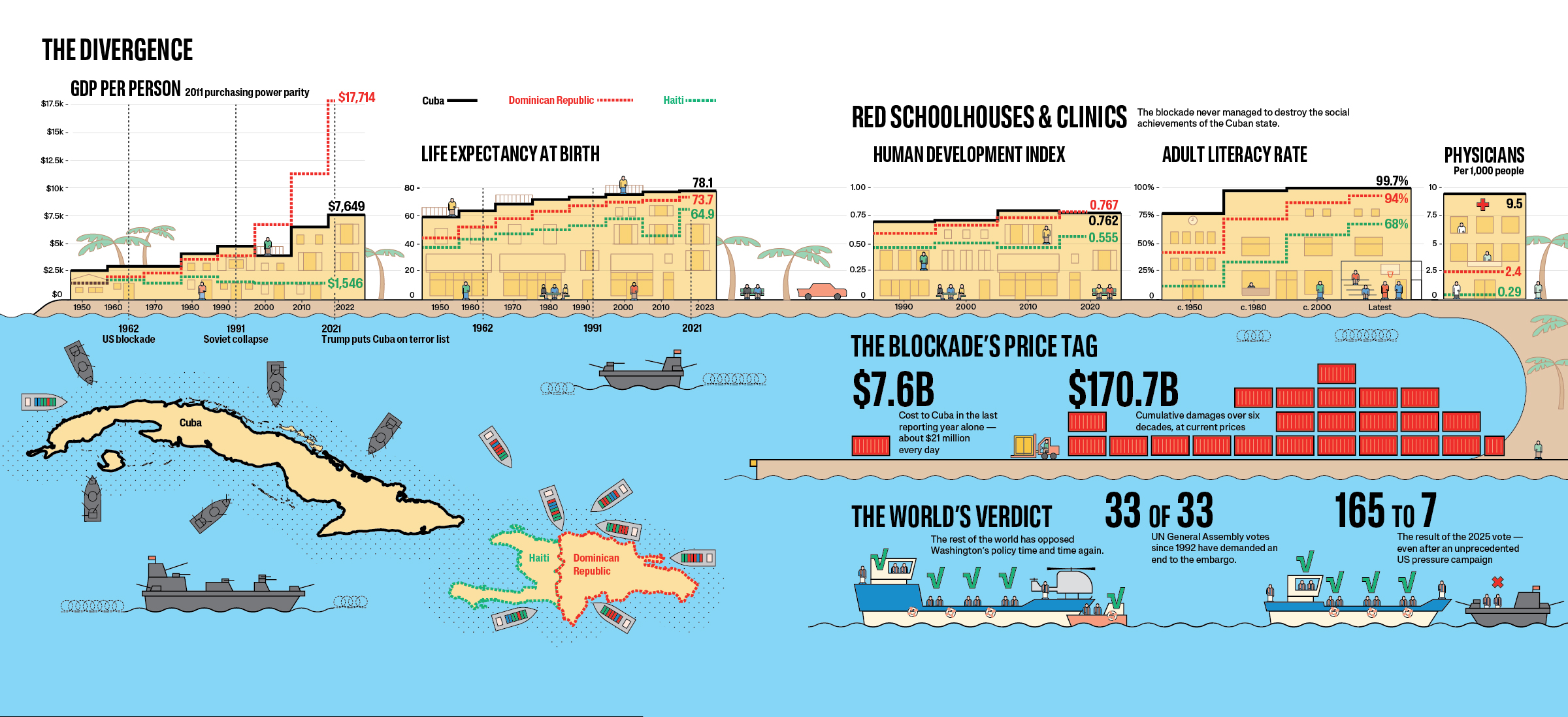
In 1950, as conservatives are keen to point out, Cuba was among the better-off societies in Latin America. Its income per person was ahead of the Dominican Republic’s. Today, by that same measure, the Dominican Republic is more than twice as rich as Cuba.
However, something happened to Cuba that did not happen to its neighbors — not just a 1959 socialist revolution but a US blockade, in force since 1962.
What makes Cuba’s trajectory remarkable is not simply the income gap with its peer nations but what the country achieved in spite of it. Cuban life expectancy, nine years behind that of the United States in 1950, drew level with it by the early 1980s. Infant mortality fell below the US rate around the turn of the century. On the Human Development Index, Cuba still led the Dominican Republic, Costa Rica, and Panama as recently as 2009 — on a fraction of their incomes. These are the egalitarian gains the blockade was never able to erase, though their erosion since the first Donald Trump administration escalated the war on Cuba in 2019 has been obvious. The comparison with the worst example of capitalist development in the region, Haiti, is even more stark.
Yet didn’t Soviet support offset the embargo’s costs? For three decades, this claim had merit. Economist Carmelo Mesa-Lago puts total Soviet assistance at some $65 billion from 1960 to 1990 — about $4.3 billion a year at its late-1980s peak, roughly one-fifth of Cuban output, delivered mostly through above-market sugar prices and cheap oil. That likely exceeded the pain the embargo was imposing.
When Soviet support vanished in 1991, Cuba’s imports fell by three-quarters, output per person nearly halved, and even daily calorie intake dropped by a third. Instead of burying the Cold War hatchet, Washington’s response was to tighten the noose with the 1992 Torricelli Act and Helms–Burton in 1996, which locked the embargo into statute.
Even that accounting understates the blockade’s impact. For 64 years, Cuba has been walled off from its natural market 90 miles away and forced to buy machinery, fuel, food, and medicine from distant suppliers at freight premiums and credit costs no neighbor pays. Every plan had to be drawn with the siege in mind: industries built around whichever partner was still willing to defy the United States and transact rather than any rational division of labor, scarce foreign exchange hoarded against the next round of sanctions, spare parts cannibalized for machines no one would sell to Havana. Many of the inefficiencies of Cuban socialism that critics catalog were the product of this environment.
So how much of Cuba’s under-performance can the embargo explain? Havana’s own tally of direct and indirect costs — $170.7 billion cumulatively, $7.6 billion in the last reporting year alone — appears to be more than plausible. The United Nations’ sanctions rap-porteur, after visiting Cuba in late 2025, described US measures and the third-party overcompliance they trigger as “suffocating the social fabric of Cuban society.”
One does not have to defend the command economy to acknowledge that, over the course of 64 years, the largest economy on earth has deliberately raised the price of everything Cuba buys, sells, and borrows. The UN General Assembly has demanded an end to the embargo 33 times in 33 votes since 1992. Only the United States and Israel have reliably bucked the global consensus.
Read the full story at the source →
Source: Jacobin