
World · Jacobin · · 3h
Trump’s World Cup
English (original) · Read in Deutsch ⇄
The 2026 World Cup was supposed to provide relief from the tournament’s bedevilment by autocratic regimes, following the outrage that greeted FIFA’s selection of Russia for 2018 host and Qatar for 2022. As it happened, hosting rights were awarded to the United States, Canada, and Mexico in 2018, during Donald Trump’s first term, in a process delayed by the scandal that forced FIFA president Sepp Blatter to resign and be replaced by Gianni Infantino.
The tournament was intended to promote unity among the North American nations, even if most of it would happen in the United States. But hopes that it would prove less charged than recent World Cups were dashed when Trump returned to power in January 2025, threatening to attack Mexico and invade Canada. Months before kickoff, the United States had declared war on another participant, Iran — adding to worries about ICE raids and border closures, FIFA’s decision to open an office in Trump Tower, and its awarding of a spurious “FIFA Peace Prize” to Trump. Russia’s and Qatar’s World Cups, the consensus went, had been exercises in “sportswashing,” building support for their governments even as controversies over LGBTQ and alcohol policies went unresolved. The United States, it seemed, was using this World Cup to do the opposite — bending the tournament to its will as a way of asserting its position as the only global superpower.
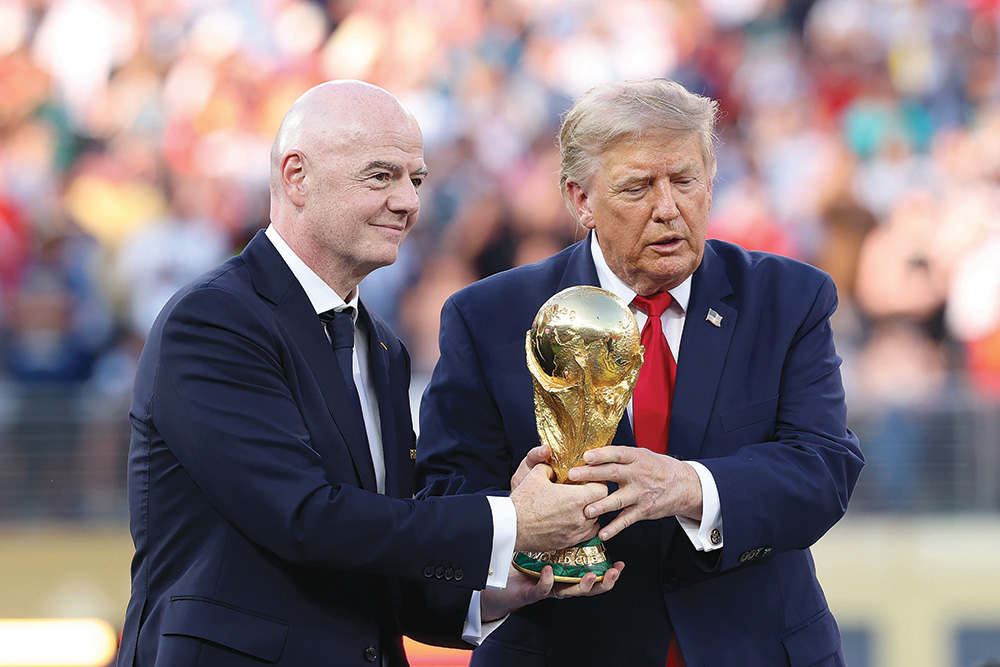
There is often catastrophizing before any global sports tournament, either about the host’s government or its ability to organize the event. But the concerns here were as much about FIFA as the United States. Having spent months brownnosing Trump — letting him present the new Club World Cup trophy at the final in New Jersey after keeping it in the Oval Office for months — it seemed that FIFA was willing to do anything for its American hosts. There was no question of FIFA suspending the United States or Israel for their wars of aggression, as it had Russia. Instead the organization threatened Iran with sanctions if it pulled out of the tournament.
Amid heat advisories, FIFA cynically announced “hydration breaks” — splitting each match into quarters so that broadcasters could fit in more commercials, as in popular American sports — and a Super Bowl–style halftime show that it hoped might aid in its long-term goal of capturing the US market. This reminded fans yet again that FIFA owned the World Cup and could do what it liked, fully aware that getting the best players of the globe’s most popular sport together would produce a compelling spectacle that people would watch, no matter how high the ticket prices.
For the most part, the worst anxieties about the tournament did not come to pass. The expanded forty-eight-team tournament dampened some of the excitement around the group phase, as it meant thirty-two countries advanced to the knockout stage, including several third-place teams. But the quality of play was higher than anticipated, even if most of the debutants didn’t make it through. The main surprise, Cape Verde’s team, managed to tie with pretournament favorite Spain and take the previous champion, Argentina, to extra time in the round of thirty-two, with its forty-year-old goalkeeper, Vozinha, delivering a legendary performance. This made spectators forget that neither Cape Verde nor the other debutants — Curaçao, Jordan, and Uzbekistan — won a single match, in a tournament disappointingly short of major upsets and emerging star players.
Despite some issues around fans not being allowed into the United States, players from nations on the US travel ban list were generally not affected, though there was a huge controversy when Somali referee Omar Artan was denied entry at the border. Iran eventually competed, with team members basing themselves in Mexico and only being let into the United States to play their matches without some of their staff. (They were required to leave the country the same night.) None of this was enough to provoke an organized boycott, and as bad as these controversies were, they paled in comparison with the number of migrant workers killed in building the stadiums for the 2022 World Cup in Qatar — officially thirty-seven, with just three attributed to workplace accidents, but estimated by the Guardian at over 6,500. Fans and journalists were pleasantly surprised by how little interest Trump displayed in the World Cup for much of the tournament.
That changed after the US team’s match against Bosnia and Herzegovina in the round of thirty-two, when Folarin Balogun received a red card after a video review of his tackle on Tarik Muharemović. This meant that Balogun — the US star center forward — would be suspended for the round-of-sixteen match against Belgium. Trump boasted of calling Infantino and getting Balogun’s ban suspended, which FIFA did without providing any reasoning. It had done something similar for Cristiano Ronaldo, who should have missed the first two games of the World Cup after being suspended in a qualifying match but had his ban deferred after meeting Infantino and Trump at the White House. Fortunately for FIFA, the United States lost 4–1 to Belgium, despite Balogun — who would not have been eligible to represent the United States under Trump’s plans to end birthright citizenship — being allowed to play.
If the United States had progressed to the next round, the allegations of corruption would likely have become deafening. As it happened, Trump, who had not attended any of the preceding matches, returned to his position of relative disinterest. Trump clearly does not believe in soft power: his ham-fisted bragging about his call to FIFA is of a piece with his government’s refusal to use the World Cup to project an image of an open, tolerant United States. Moreover, the lack of hypocrisy was, in a strange way, preferable to the disgraces of the last two tournaments.
At the final match, Trump sat with Infantino behind bulletproof glass, a testament to their unpopularity as well as their impunity. It was a blessed relief to see the president of FIFA shepherd the president of the United States away from the Spanish celebrations at the end of a dire game made even worse by the half-hour halftime pause for one last round of the celebrity worship that ran throughout the tournament.
What the 2026 World Cup really accomplished was to remind everyone that soccer doesn’t need the United States, whose national team added little to the competition and was not missed after its elimination. The concessions made to American sporting culture were unpopular — the loud, terrible music that blared during the hydration breaks could not hide the ubiquitous boos for splitting the game into quarters — and will likely not be adopted anywhere else. I was also delighted to see English football legend Wayne Rooney break kayfabe while announcing for the BBC during the final to describe the halftime show as “crap,” which was, if anything, generous. Not unfairly, FIFA will bear the brunt of resentment for this tournament’s most exploitative excesses. But this World Cup has been far from a global propaganda success for an increasingly unpopular, autocratic regime.
Read the full story at the source →
Source: Jacobin