
World · Jacobin · · 49m
Selling the British Empire
English (original) · Read in Deutsch ⇄
The American Empire has never needed a propaganda ministry to justify itself to its subjects. For that, it has the world’s largest culture industry. From Hollywood to hip-hop, it has made millions around the world dream of being American, even those who hate its politics and economics.
But American cultural imperialism comes into focus only when examined against its immediate precursor. For all the British Empire spread — constitutional monarchies, tea drinking, bleakly Protestant Christianity, and ruthless, amoral capitalism — it never made its victims aspire to be British in quite the same way as its American offshoot has. As for justifying itself at home: Who needs state propaganda campaigns when you have Call of Duty and Top Gun?
By contrast, in the twilight of their own imperial phase, the British set up a whole government body to sell their empire to consumers back home and to any unconvinced subjects abroad. It was called the Empire Marketing Board (EMB), a name that sounds hilariously quotidian to any English person of a certain age. While twentieth-century Britain also saw fit to establish state marketing boards for wool and milk, here the product was imperialism itself.
The British Empire was once described by the liberal imperialist John Robert Seeley, in his 1883 bestseller The Expansion of England, as being the consequence of a series of what British liberals like to call “cock-ups.” He wrote, “We seem, as it were, to have conquered and peopled half the world in a fit of absence of mind.” Of course, even an apologist like Seeley didn’t believe that the wars, racial laws, and annexations that built the largest formal empire in history were accidental as such.
What he meant was that the British Empire was disorganized. It was never, in fact, a unified state, politically or economically. But Seeley believed that it should be, so it could compete with the streamlined, industrialized, active United States and the German Empire, whose colonies were mostly contiguous and governed under the same laws (though here there were exceptions too, like Namibia and the Philippines). The British Empire, according to Seeley, needed to be unified through tariffs and state planning. In the 1920s, this idea of an economically planned empire was briefly put into tentative practice by Britain’s Conservative governments, and the EMB was there to popularize it.
The EMB produced posters, advertising campaigns, exhibitions, and documentary films. It was an unusual attempt to fuse two new trends in the interwar years: intensive advertising based on the American model and the propaganda of the Communist International. Its leading figure was an English bureaucrat, Sir Stephen Tallents, who had been convinced of the importance of art, cinema, and aesthetics after his time in Russia during its civil war. The British Empire sent troops to the Caucasus and the Baltic to help crush revolutionary socialism, and, in this capacity, the civil servant Tallents found himself the governor of Riga, the capital of Latvia and formerly a stronghold of Bolshevism. Looking at the agit-trains, kino tracts, and posters of the departed Soviets, Tallents realized that Britain was trailing far behind this powerful machine of persuasion.
When Stanley Baldwin’s Tory government set up the EMB, Tallents was placed at its head. He in turn appointed as head of publicity one Frank Pick, the deputy director of the Underground Group, a private conglomerate that ran much of the capital’s public transportation network. A Fabian socialist who welcomed the London Underground’s nationalization in 1933 and a keen enthusiast for modern art, Pick subsequently brought in many of the artists he had worked with at the Underground.
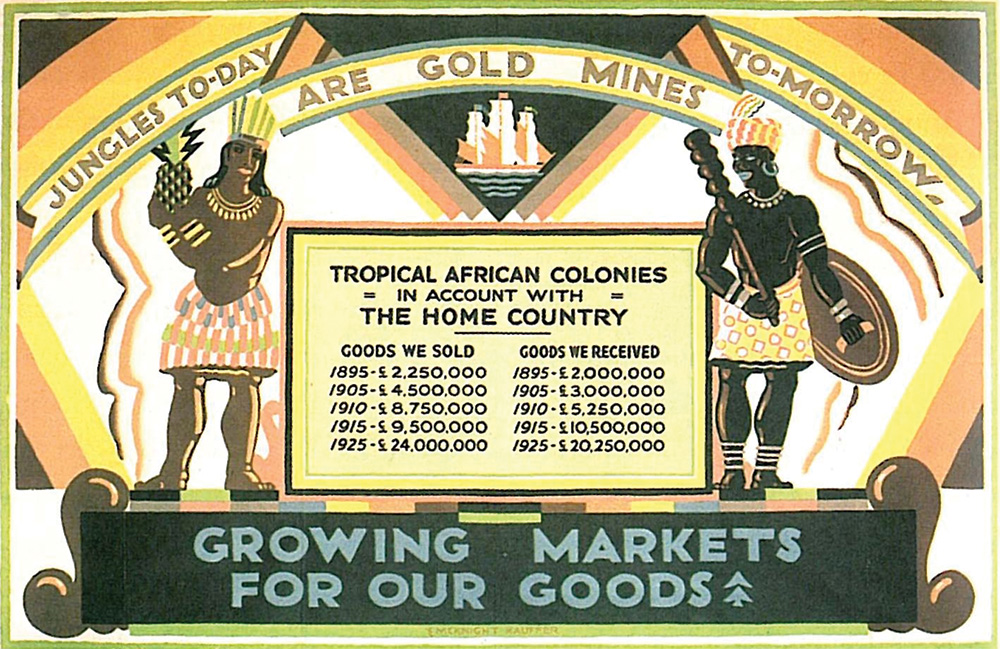
A good example is the 1926 poster by the British American artist E. McKnight Kauffer known as “Jungles Today Are Gold Mines Tomorrow,” referring to the slogan written at the top. The poster deployed the same bright, fauvist style Kauffer used elsewhere to convince London commuters to buy season tickets or move to the suburbs. It features two African figures, one male and one female, the woman in a traditional headdress holding aloft a pineapple, the man carrying a shield and staff; both have stylized features drawn in a manner that now looks distinctly racist. Between the two bodies is a ship and two columns of figures in pounds (goods sold and goods received, with the former mostly higher), indicating the increase in trade between Britain and its African colonies between 1895 — the start of the “Scramble for Africa” — and 1925.
Other posters offered simple messages, presented in the neat serif fonts recently used in World War I propaganda. The most straightforward series asks you to buy the products of various colonies and white-settler dominions. BUY SOUTH AFRICAN ORANGES is emblazoned over a painting of gazelles, BUY CANADIAN HAMS AND BACON over one of a bison, and, more strangely, BUY BRITISH WEST INDIAN ST VINCENT ARROWROOT over an image of a turtle. Another campaign consisted of two posters, EAST AFRICAN TRANSPORT — OLD STYLE and EAST AFRICAN TRANSPORT — NEW STYLE. In the former, a group of Africans are marching with their livestock across the orange grass of a fauvist savannah. By contrast, the “new style” poster shows those same East Africans trading with a benevolent white man in a white shirt who occupies the high ground at the front of the scene.
All of these designs expressed, queasily, Pick and Tallents’s idea of the empire as at once a modern network, linked by international transport, industry, and communications, and a warm, inclusive family in which everyone knows and works for one another, even the members in faraway parts of the globe (who are, of course, to be raised to full “adulthood” by the senior relations).
EMB posters are seldom displayed today, for obvious reasons. But if it is largely forgotten in poster and industrial design, the board is much more significant in the history of British cinema. That’s because Tallents hired the Scottish sociologist, critic, and filmmaker John Grierson to head a specialized EMB Film Unit. The films Grierson produced, under the influence of Soviet directors like Dziga Vertov, are still considered classics, though their imperial provenance is not always emphasized.
Many of the works of the British Documentary Film Movement that emerged in the late 1920s, such as Robert Flaherty’s Industrial Britain (1931), Basil Wright’s Song of Ceylon (1934), and Grierson��s own Drifters (1929), were all made for the EMB. It’s still possible to watch and enjoy The Song of Ceylon, a graceful, careful film that was intended to convince British filmgoers to drink Sri Lankan tea. The propaganda is subtle: the message that the balletic, elegant, rhythmic labor of the plantation workers resulted from the benevolence of empire is merely implicit.
The Empire Marketing Board eventually came to an end not because it failed as propaganda but because the Tory government of the time was only partly committed to the project of imperial union. The notion of a unified trade bloc was fiercely opposed by the banks of London. The reason for this was that much of the formal empire, often acquired for military rather than economic reasons, was not particularly lucrative. On the other hand, the informal empire that would be placed on the other side of tariff walls — heavily British-influenced but officially non-imperial countries like Portugal, Iran, and Argentina — was extremely profitable. It may have fallen by the wayside, but perhaps some aspects of the EMB were unconsciously emulated in that vast, informal US empire after 1945 — not least a stress on the inestimable persuasive impact of cinema.
What the EMB does offer, certainly, is a parallel. The project was created by an empire that knew it was under threat. Having grown rich and powerful on free trade, it now opted for tariffs, controlled markets under British supervision, and a planned industrial policy in order to beat its more technologically innovative competitors. These tactics didn’t work for Britain, and they seem unlikely to work for the declining United States now.
Read the full story at the source →
Source: Jacobin