
World · Jacobin · · 1h
Saudi Arabia, Turkey, and Pakistan Now Have Their Own NATO
English (original) · Read in Deutsch ⇄
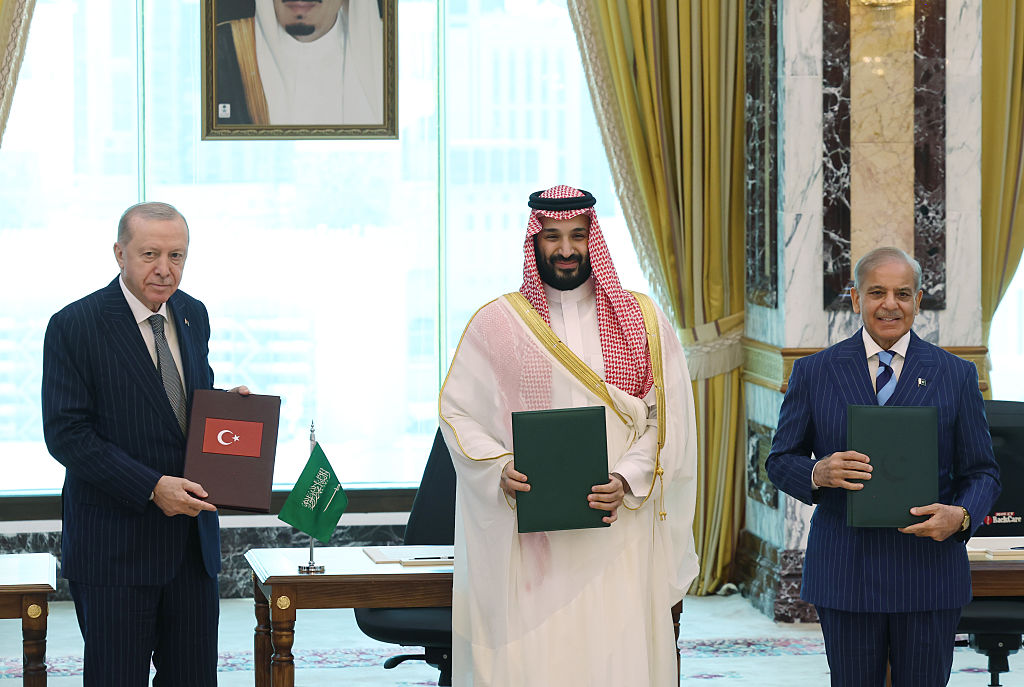
On August 7, Pakistan, Saudi Arabia, and Turkey announced a mutual defense pact called the Mecca Joint Defence Agreement. Turkish Foreign Minister Hakan Fidan compared the arrangement to NATO, specifically citing Article 5’s collective defense clause.
President Donald Trump lauded the pact as a “BIG, BOLD, IMPORTANT FIRST STEP” toward ensuring countries in the Middle East “will finally be able to defend themselves.” On this point, he’s largely right. What he failed to mention is that this shift reflects the growing realization that the United States and Israel are the most significant drivers of instability in the Middle East.
Middle Eastern leaders were once able to ignore this, largely because they believed the US security umbrella would insulate them from the repercussions of American militarism. But Israel’s attack on Qatar last year, followed by the destruction of the ongoing war with Iran, finally punctured this fantasy.
The Mecca Agreement represents a manifestation of regional leaders responding to this newly apparent reality and grappling with a post-American Middle East. The pact is clearly intended to reestablish deterrence against Iran, yet it is also meant to deter Israel. From Turkey’s perspective, Israel presents a more likely aggressor, with figures from Benjamin Netanyahu to Naftali Bennett describing Turkey as a threat comparable to Iran.
The pact is thus a practical reaction to a fraying regional order. The end of American empire in the Middle East means the end of a series of fantasies it was propping up: that Gulf states could spend endlessly on vanity projects; that Israel’s occupation of Palestine could be swept under the rug; that Israeli military adventurism could continue unchecked. The question now facing Middle Eastern leaders is what happens when all those myths collapse at once.
The Mirage of American Security
For years, as Washington waged wars on Afghanistan and Iraq and tried to strangle Iran and Syria with sanctions, the Gulf states had been willing to overlook American bellicosity because they felt protected from its consequences. Their wealth appeared to insulate the members of the Gulf Cooperation Council (GCC) from the region’s chaos, not least because they purchased massive quantities of prestige American military hardware, the physical manifestation of the US security guarantee.
It was under this illusion of stability that Crown Prince Mohammed bin Salman (MBS) dreamed up his grandiose plans for Neom, the Line, and the other megaprojects of Saudi Vision 2030. Now, simultaneous to the crumbling of American-sponsored security, MBS has been forced to acknowledge that the scope of his vision exceeded the kingdom’s fiscal capacity. A recent exposé by The Wall Street Journal revealed that construction on the various megaprojects has largely ceased, while the Saudi state is paying $16 billion merely to cancel construction contracts.
Outsiders may speculate on the crown prince’s political future, given that he staked his image on transforming the kingdom by 2030. Yet under his tenure, the kingdom has indeed undergone massive societal shifts. The government altered the terms of the social contract: previously Saudi men received government salaries generous enough to care for their female relatives, who were legally considered minors. Over the past decade, the state has encouraged women to join public life — female employment rose from approximately 17 percent in 2016 to 31 percent in 2026 — while seeking to promote jobs in the private sector for all Saudis, rather than continued reliance on the state’s largesse. This transformation has had a more profound effect on the citizenry than would a gleaming futuristic city, although Saudis can reasonably ask why their leaders wasted billions on vanity projects that now sit abandoned in the desert. Shorn of the illusion of American security, will Saudi leadership also now embrace more responsible stewardship of the kingdom’s resources?
They may have to: the Saudi economy is struggling, as the Strait of Hormuz remains largely closed and Ansar Allah threatens Saudi tankers trying to exit the Bab el-Mandeb Strait en route to Asia. Saudi ships can proceed north through the Suez Canal and take the much longer journey around Africa, which can add between $500,000 to $2.5 million per trip. In the second quarter of 2026, Saudi Arabia’s GDP experienced its sharpest fall since the second quarter of 2020 at the height of the COVID-19 pandemic. The Saudi economy has traditionally experienced boom-and-bust cycles, due to its dependence on fossil fuel markets; Vision 2030 was supposed to help lessen those shocks. Unfortunately, although more than half of Saudi GDP is now derived from nonoil sectors, tourism and entertainment are just as vulnerable to Iranian missiles as Saudi oil exports.
An Islamic NATO?
Saudi fiscal constraints raise another question: What is Riyadh bringing to the Mecca Agreement, if not massive wealth? Saudi Arabia appears intent on leveraging its religious soft power by naming the pact the Mecca Agreement and carrying out the signing in Islam’s holiest city at the Al-Safa Palace overlooking the Kaaba. Commentators have already dubbed it “the Islamic NATO.”
Turkey and Pakistan provide more tangible assets. Turkey offers both its status as a member of NATO and as a significant military power in its own right. Turkey is eleventh in the world for weapons exports, while both Pakistan and Saudi Arabia import massive amounts of defense articles annually. Pakistan theoretically brings nuclear deterrence, although the text of the agreement does not establish an explicit nuclear umbrella. As Yemeni projectiles continue to strike Saudi tankers in the Red Sea without an apparent response from Ankara or Islamabad, it is unclear how exactly the commitment to mutual defense will be put into practice.
Still, in the absence of a better alternative, other Gulf states may join the pact. On the day the agreement was announced, former Qatari Prime Minister Sheikh Hamad Bin Jassim Al-Thani called for it to become a regional security alliance and said, “May the rest of the Gulf Co-operation Council [GCC] countries take the initiative to join.” Although Qatar might sign on, Oman is less likely to, as it has long maintained a posture of neutrality. Kuwait and Bahrain have traditionally adhered to Saudi preferences, although more recently have drifted into the orbit of the United Arab Emirates (UAE).
The UAE is one GCC member who almost certainly will not join. Although the declaration of the Mecca Agreement was certainly sped up by the Iran war, its development was spurred by the Emirati-Israeli partnership that the Abraham Accords formalized in 2020. The Emirati and Saudi rivalry has grown more intense in recent years, flaring up in Yemen in December when Saudi Arabia fired on Emirati ships and forced the UAE to leave the country, after having engaged in joint military operations against Ansar Allah since 2015. Abu Dhabi views its partnership with Israel as part of a broader strategy: in February, just days before attacking Iran alongside the United States, Netanyahu announced the “hexagon of alliances” between Israel, the UAE, India, Greece, and the Republic of Cyprus. This constellation of countries is clearly at odds with Pakistan and Turkey. Although the “hexagon” ostensibly remains closely tied to the US, it also envisions a region and a world that relies less on the United States.
The announcement of the Mecca Agreement appears to finally bury any lingering speculation that Saudi Arabia might normalize with Israel. From the Saudi perspective, all of Washington’s previous talk about the “India Middle East Corridor” (IMEC) and the “Middle East Security Alliance” (MESA), while framed as promoting regional security and independence, was actually intended to integrate Israel into the region without addressing the festering conflict at the heart of the Middle East: Israel’s ongoing occupation of Palestine.
American policy toward the Middle East has long been guided by Israeli preferences. Washington’s role in the so-called peace process was always primarily intended to safeguard Israel and prioritize its concerns. The end of the era of American domination, which artificially inflated the clout of Israel as well as the small but wealthy Gulf states, may finally allow for a rebalancing of regional power that reflects the realities on the ground.
Should the Left Not Celebrate the Decline of American Empire?
Some may see the end of American military hegemony in the Middle East as inherently destabilizing and a harbinger of an increasingly unstable and unpredictable world. Although the post–World War II world order has been hardly peaceful, at least it successfully prevented what many view as the most lethal of all human activities: war between great powers. To those bemoaning the end of the relative Pax that Americana has preserved, the Mecca Agreement appears alarming.
The foreign policy establishment reacted swiftly. Steve Cook of the Council on Foreign Relations wrote “The U.S.-led Middle East Is Over. The Mecca Agreement Proves It.” Neoconservative Robert Kagan penned “Iran Unleashed” for The Atlantic, predicting, “Instead of an American-Israeli order, this will be an alignment less implacably hostile to Iran, less friendly to Israel, and more independent of the United States.” The wailing from Washington reflects the widespread belief that without the US, the region will descend into chaos. The assumption that the world needs America to act as the global hegemon presumes that no other country is capable of ordering their own international affairs in a manner that provides security and stability. The paternalism inherent in that mindset betrays the underlying imperial logic: “We have to control these people for their own good; they are better off as a result of our control.”
Although Washington has sought to neuter or dismantle international institutions, from the United Nations Relief and Works Agency for Palestine Refugees in the Near East to the International Criminal Court to the United Nations itself, many countries remain committed to the UN system and to international law. While recognizing the urgent need to reform the UN Security Council and other global bodies, the international system could become more influential in the absence of American primacy. The climate crisis is only one of many global problems that requires more effective international cooperation.
It is unlikely that the Mecca Agreement or other regional alignments will bring peace to the Middle East. The end of the era of US hegemony appears likely to spur many such regional realignments, which may provoke future conflict. The possibility that western and southern Asia will split between an Israeli-Emirati-Indian bloc and a Turkish-Saudi-Pakistani bloc could presage war. And yet as support from the United States declines, the moral hazard that has spurred Israeli and Saudi aggression could give way to a more grounded assessment of these nations’ capabilities.
For the region, the era of American domination has been anything but peaceful. Instead, it has been marked by deepening autocracy, neoliberalism, and austerity, and greater militarization at best, brutal war at worst. Therefore, while some may fear the end of the US unipolar moment, for many in the Middle East, the end of US dominance may offer at least the possibility of something better. The Mecca Agreement demonstrates that other countries are in fact capable of implementing new institutional arrangements that can, theoretically, provide order even in the absence of the United States. Unfortunately, however, America’s influence has largely primed the region for more violence rather than less.
Read the full story at the source →
Source: Jacobin