
Labour · Jacobin · · 35m
Mark Carney Is Taking Aim at Canada’s Labor Movement
English (original) · Read in Deutsch ⇄
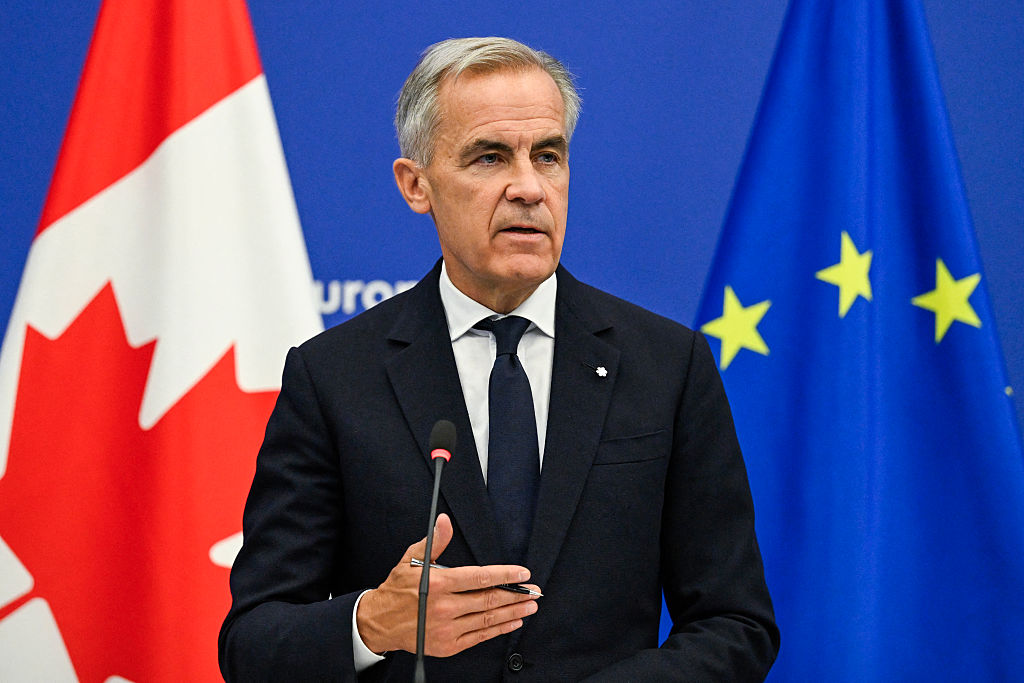
On September 21, Canadian Prime Minister Mark Carney’s government introducedlegislation that could amount to one of the most significant rollbacks of workers’ rights in Canada since the creation of the postwar industrial relations system. Tucked inside the sprawling 232-page Bill C-39 are amendments to the Canada Labour Code that would give the federal labor minister explicit authority to terminate lawful strikes and impose binding dispute resolution when the minister decides a work stoppage threatens the “national interest.”
The legislation would also create a new “special mediator,” adding an additional state-directed phase to collective bargaining. Before workers can strike, the mediator would produce a report on bargaining disputes, which the minister would make public if the parties fail to reach an agreement. The new process would create a new perquisite for eventual government intervention under the controversial Section 107 of the Labour Code.
The government describes these provisions as “guardrails” constraining ministerial power. But they are anything but. The legislation instead doubles down on what has become a pattern of strikebreaking from the Liberals. These proposed changes to labor law fit within Carney’s broader corporate remodeling of Canada.
In response to Donald Trump’s trade war, the Liberals are attempting to attract domestic and international capital through lower investment taxes, accelerated project approvals, privatization, and a political commitment to ensuring that infrastructure gets built quickly.
Workers’ capacity to disrupt the movement of goods and capital poses an obvious complication for such a project. Bill C-39 is the government’s answer.
From Section 107 to the “National Interest”
The attack on the right to strike did not begin with Bill C-39.
Over the past two years, Liberal labor ministers have repeatedly used Section 107 of the Canada Labour Code to terminate strikes or lockouts and send disputes to the Canada Industrial Relations Board, often resulting in binding arbitration. The provision has been deployed in disputes involving railworkers at Canadian National Railway Company and Canadian Pacific Kansas City, West Coast and Quebec port workers, Canada Post employees, WestJet mechanics, and Air Canada flight attendants.
The result has been a creeping normalization of extraordinary government intervention into union negotiations.
Section 107 itself says little more than that the minister may take measures deemed necessary to “maintain or secure industrial peace.” Until recently, the provision was not generally understood as a standing power allowing a minister to effectively accomplish by executive order what governments historically required back-to-work legislation to achieve.
Unions have responded with constitutional challenges. Teamsters Canada challenged the government’s intervention in the 2024 railway dispute; the Canadian Union of Postal Workers challenged the intervention that suspended its 2024 strike; and the Canadian Union of Public Employees (CUPE) has contested Ottawa’s use of Section 107 against Air Canada flight attendants in 2025.
Instead of retreating from this experiment, the government launched a truncated review of the Labour Code seemingly meant to supercharge its recent interventionism.
The process quickly raised alarms among unions. The first consultation ran from April 17 to May 25 of this year and canvassed dozens of potentially consequential changes to federal labor law. A second consultation, focused partly on Section 107, ran from July 3 until August 2.
Unifor complained that the exercise gave unions only limited time to respond to a broad range of questions concerning fundamental changes to collective bargaining law. In its second submission, the union again warned that the abbreviated process was particularly troubling when Charter-protected bargaining and strike rights were at stake.
Bill C-39 shows why those concerns were justified.
The bill creates a special mediation process for certain difficult bargaining relationships. The mediator would attempt to secure an agreement before a strike or lockout begins. Failing that, they would issue a report outlining the issues, the parties’ positions, and recommendations. That report would become public, ostensibly to put pressure on unions to concede.
But the mediator has another significance. Everyone at the bargaining table will know that the next step is binding arbitration.
The rewritten Section 107 would expressly permit the minister, once a strike or lockout begins, to direct the Canada Industrial Relations Board to restore operations, extend a collective agreement, or impose binding arbitration if the minister believes the dispute “adversely affects or may adversely affect the national interest.”
“National interest” is an enormously elastic concept. The legislation identifies economic effects and serious social disruption as considerations, alongside freedom of association, but ultimately leaves the decision solely with the minister.
The danger this poses extends well beyond strikes that get terminated. Employers bargain differently when they believe the state will eventually rescue them from the economic consequences of job action. The threat of intervention therefore tips the bargaining balance in favor of employers before workers even erect a picket line.
Teamsters Canada says this is precisely what happened during the 2024 railway dispute. “The government has created an environment that will no longer provide employers with the incentive to bargain in good faith,” Teamsters Canada President François Laporte said after Bill C-39 was introduced.
Making Canada Safe for Investment
Bill C-39 makes considerably more sense when viewed alongside Carney’s wider economic program.
The Trump administration’s escalating trade war has thrown Canada’s economic model into crisis. For decades, Canadian governments pursued ever-deeper integration with the United States. Carney’s response to the breakdown of that relationship has been to promise that Canada can reinvent itself as a destination for global investment while rapidly expanding energy, mining, transportation, defense, and artificial intelligence infrastructure.
Central to that project is the government’s Major Projects Office, established in 2025 to accelerate what Ottawa calls “nation-building” projects. Bill C-39 extends this agenda by seeking a “one project, one review, one year” standard for federal approvals. The government argues that faster decisions can coexist with environmental protections and indigenous rights.
Critics, however, have questioned whether compressing approval processes can preserve meaningful democratic participation.
Environmental reviews, indigenous consultations, regulatory hearings, and collective bargaining all take time. Strikes can halt ports, railways, airlines, and other infrastructure through which commodities and capital circulate. For a government promising investors “speed, certainty, and predictability,” these democratic and collective processes are obstacles.
Carney made the government’s priorities remarkably explicit at this month’s Canada Investment Summit in Toronto. The event brought together investors from nearly thirty countries managing more than $100 trillion in assets. Ottawa says the summit produced commitments approaching $500 billion and is part of a strategy to catalyze $1 trillion in investment over five years.
Carney told investors that his government was pursuing some of Canada’s most significant regulatory reforms in generations and promised that “when Canada says it wants something built, Canada will get it built.” He also announced a major expansion of business investment deductions that the government says will reduce Canada’s marginal effective tax rate on new investment from roughly 13 percent to 6.4 percent.
And then there is privatization.
At the same summit, Carney announced plans to solicit private investment through long-term concessions to operate Canada’s four largest airports — Toronto, Vancouver, Montreal, and Calgary.
Canadian Centre for Policy Alternatives Senior Economist David Macdonald has warned that airport privatization converts public, nonprofit infrastructure into a vehicle for extracting returns.
Because airports possess considerable monopoly power, he argues, private operators can generate profits through higher charges, reduced service quality, contracting out, layoffs, and downward pressure on wages.
Seen in this context, Bill C-39 is not an isolated labor law reform.
It belongs to a larger political-economic project aimed at reorganizing Canada around corporate priorities. The government is offering investors lower taxes, fewer regulations, new infrastructure opportunities, and access to formerly nonprofit public assets. It is simultaneously proposing greater state power over workers capable of disrupting the transportation networks on which that investment strategy depends.
Canadian business organizations have long complained about strikes at ports, railways and airlines. Bill C-39 translates that concern with “certainty” into regressive labor law reform. The state now reserves the authority to decide when workers’ economic power has become inconsistent with the “national interest.”
Is Canadian Labor Up for the Fight?
Unions have reacted angrily. The Canadian Labour Congress, Unifor, Teamsters Canada, and provincial labor federations have all condemned the proposed restrictions.
The Canadian Union of Public Employees has gone furthest. On September 23, its national executive board unanimously resolved that the union would defy Bill C-39's strike restrictions if Parliament passes the legislation unamended.
That threat could prove consequential. Air Canada flight attendants represented by CUPE refused to immediately return to work after the government used Section 107 against their strike in August 2025, continuing their walkout even after the labor board declared it unlawful. Whether the broader labor movement is willing to commit to bold action remains to be seen.
The stakes are high. The postwar system of industrial legality is being fundamentally challenged by employers and governments alike. Labor rights that governments can suspend whenever they become economically disruptive risk becoming no rights at all.
Bill C-39 therefore poses a strategic challenge for organized labor. Statements, lobbying, and constitutional litigation can all shape what happens next. But the history of union struggles in Canada and beyond shows that the effectiveness of labor rights depends heavily on workers’ capacity to exercise collective power.
The Carney government is attempting to build a political economy organized around reassuring investors that Canada will be fast, predictable, and profitable. Whether workers’ right to withdraw their labor remains an effective counterweight will depend substantially on how unions respond.
Read the full story at the source
Source: Jacobin