
World · Jacobin · · 49m
How Should Socialists Relate to the Market?
English (original) · Read in Deutsch ⇄
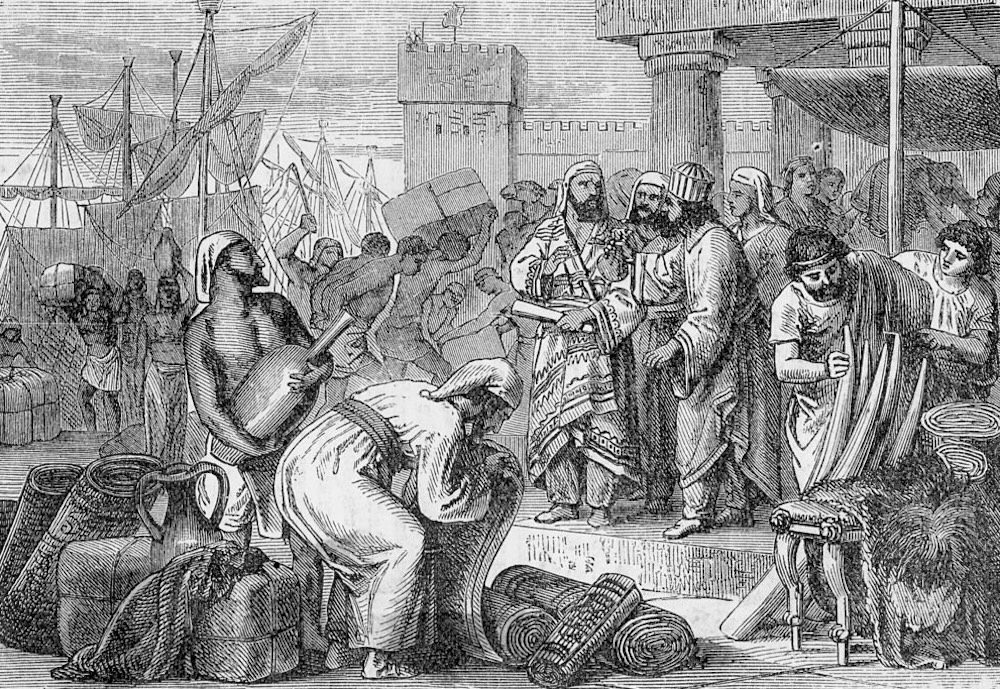
It’s all too common for people to associate the existence of markets with capitalism. But because we know markets had a life before capitalism, we can also imagine them having a life after.
On this latest episode of the Jacobin Radio podcast Confronting Capitalism, Vivek Chibber and Melissa Naschek compare how markets operated in precapitalist economies versus modern capitalist economies to see if markets may prove useful in future socialist societies.
Confronting Capitalism with Vivek Chibber is produced by Catalyst: A Journal of Theory and Strategy and published by Jacobin. You can listen to the full episode here.
Melissa Naschek
In our episode on market socialism, you talked about why markets are not inherently capitalist and why the socialist movement should think seriously about how to incorporate them into socialism. Today we’re going to take more of a theoretical and historical approach and look at what markets are, how they operate within capitalism, and why markets could be compatible with a socialist society.
Vivek Chibber
The neoliberal right and mainstream economics take markets to be synonymous with capitalism. They see capitalism simply as a quantitative expansion of the market. Ironically, there’s a mirror image of this within the Left too. Whenever they see a market, it has to be a capitalist market. And this is where a lot of the objections to market socialism come from.
So I think it’s good to see if we can detach markets from capitalism conceptually and then try to show that the market itself is very limited in its properties. How it functions will depend on how it’s embedded in the wider and more encompassing context of other social relations. And that will help us think better about what aspects of the market are intrinsic to it and what aspects of the market actually are ones that are endowed through capitalism. And hence, if we were to take it outside of capitalism, we can see which aspects of markets will remain and which aspects of market will fall away. And it might turn out that the aspects that remain are actually not only unobjectionable but quite useful.
Precapitalist Markets
Melissa Naschek
Why don’t we start, then, with the markets that existed before capitalism. What did markets look like in a precapitalist society?
Vivek Chibber
In one sense, they looked like markets do anywhere else, which is to say that they were places where people went to buy and sell stuff. But in a deeper sense, the markets were very different prior to the rise of capitalism.
Before capitalism, the buying and selling of things occupied a much more peripheral and marginal place in economic activity. The actual existence of trade is thousands of years old. It’s existed almost since the deepening of settled agriculture. But it’s also known that the trade tended to be of goods that were what you might call “surplus production.”
Prior to the rise of capitalism, the fundamental production unit was the peasant family farm. And the peasant farm overwhelmingly raised crops and made things for its own consumption. This sometimes was taken to be a sign of what’s called a natural economy. Within a natural economy, every unit was taken to be totally self-sufficient. They produced just for themselves, and nobody traded. But we now know that has never been the case. Natural economies are mostly fictional entities.
Even when people were primarily growing and making things for themselves, they always engaged in trade. But the trade they engaged in tended to be of stuff that was left over after their consumption needs were taken care of. They took those to the market. And most markets tended to be rural or village markets. They didn’t go to the cities.
Melissa Naschek
When you say consumption needs, can you just clarify that?
Vivek Chibber
The peasant family primarily engaged in agriculture. It would grow crops. Depending on the country, some of this would be a grain like wheat or rice. And then there would also be other subsidiary crops that they grew on the side, many of which were used for fertilizer. So you would consume some of it, and then the rest, like turnips, you would use for fertilizer.
The family unit also made its own manufactured goods. So prior to the rise of capitalism, manufacture and agriculture were not separated as economic activities. The same unit that did agriculture also did manufacture. And Karl Marx speaks eloquently in Capital about how, with the rise of capitalism, you get a division of labor in which, for the first time, manufacturing activity and agricultural activity become functionally separated from each other. Manufacturing is done in urban areas or in different localities, and agriculture is done as a separate activity.
Melissa Naschek
So in theory, the rural peasant family is self-sustaining just by its own production?
Vivek Chibber
Let’s say it strives toward self-sufficiency, never achieving it.
Melissa Naschek
Right, because then you mentioned that there are subsidiary things that they were going to market for.
Vivek Chibber
Exactly. They would grow their own crops, but then they would also try to build some of their own tools. They would also try to make their own clothes. They would, to the extent that they could, make whatever furniture is possible. But obviously they couldn’t do all of these things. Some of it they would have to get from elsewhere, either from, say, blacksmiths or carpenters within their village.
And in India, you had something called the Jajmani system. The Jajmani system was one in which different groups of people specialized in particular things that they made and were usually organized around caste. And then they would exchange with each other through that specialization, but in a non-monetized way. It would be exchange in kind. This many shoes for this many shirts, that kind of thing.
Melissa Naschek
Would you still consider that a market?
Vivek Chibber
It’s not a market. It’s exchange activity. We call a market something where there is a concentration of exchange in a specialized location. So suppose different families are trading with each other in the same village. It’s not a market. But now suppose you put a place separately where everybody brings their wares when they want to put them up for sale or trade with somebody. Now you’ve got a market. But before the rise of capitalism, there weren’t a lot of markets in that sense. Most exchange took place informally and locally. So first, not much of the product was actually put up for exchange.
What was put up for exchange was stuff left over from the family’s primary production; those things were taken to the market. This means that the production activities were not done with trade in mind.
The implication is that peasant producers didn’t care so much about cost and quality. I made it for myself to my liking, and I made it at a cost that I don’t really worry about being competitive, since that’s an afterthought for me. But that means that the stuff that’s coming to the market is neither very cheap nor very good. It’s just stuff that is there, and if you want to buy it, you can buy it.
Now, what about the cities? Interestingly, the cities, right up until the fifteenth century or so, were of two kinds: large urban cities and the smaller townships. Most urban settlements were small townships before the rise of capitalism, and these townships are actually an extension of the rural areas. They are not, as Max Weber thought, islands of urban activity and mercantile activity separate from, say, the feudal economy. Cities were actually controlled by feudal lords.
Melissa Naschek
What is their role in the feudal society in that case?
Vivek Chibber
Both consumption and production. There were places where feudal lords took some of the stuff that they were having made, but they were also mainly places where people, if they moved out of the village, would come and live, and then they would engage in some kind of mercantile activity. But that mercantile activity was controlled by guilds, and guilds were essentially urban merchant associations or producer associations — carpenters, tradesmen, things like that. And those guilds tightly controlled the markets.
So it’s not the case that there was a flourishing market in urban areas that would then spread into the rural areas, like capitalism spreading from the city to the rural areas. The cities were completely controlled by feudal lords. Their economies were run and controlled by the guilds, and the guilds could only control the urban economy if landlords gave them monopoly powers. The cities could not, therefore, be a source of opposition to feudal lords in the way that Weber thought. Cities were in fact primarily and overwhelmingly controlled and dependent upon feudal lords.
Markets, therefore, were not a dissolving element to feudalism anywhere in the world. They were internal to feudalism. And what that tells us is markets are not a solvent. Wherever you put them, they don’t just spread like a virus across the economic activity. They are as much under the influence and control of political relations as anything else is.
So prior to the rise of capitalism, markets were fully contained, they were limited in what they could do, and they were limited in their impact upon society. But that also means that finding a market prior to the modern era is not evidence that capitalism was coming about or was on its way, because that relies on the assumption that prior to capitalism, there was a natural economy in which there were no markets. That’s wrong. It also relies on the assumption that once you have a market, it has this internal engine that causes it to spread everywhere. That’s not the case. They were limited and contained as long as the class structure and the production relations remained feudal.
Melissa Naschek
The theorists who have argued that capitalism has been steadily developing since the beginning of human civilization have pointed to markets as part of their proof. And what you’re saying here is that capitalism is not just some natural outgrowth of economic relations and exchange but in fact an imposed and discrete political-economic system.
Vivek Chibber
That’s exactly right. Capitalism cannot be understood as simply the result of the natural growth of the market, because — this is the important thing — the market did not grow naturally. It existed, but it actually ebbed and flowed. From about the year 1000 CE to 1350 CE, it grows, but then it recedes for about eighty to a hundred years. Then it starts growing again. From thirty thousand feet on high, you can say, “Okay, if you just look at history long enough, you can see that there’s been a growth of the market.” But that misses the fact that for the market to have grown, it required prior political changes first.
There was nothing natural about the growth of the market and, therefore, nothing natural about the rise of capitalism. When capitalism does come about, it’s because there is a discrete and very specific change in class relations from lord and peasant to capitalist landlord and tenant farmer, then later capitalist and worker. And that took very specific actions. It’s conceivable that it might not have happened for several more centuries.
Capitalist Markets
Melissa Naschek
So how did capitalism transform markets?
Vivek Chibber
This is the really important thing. As I said, prior to the rise of capitalism, market exchange existed. Markets as discrete places in society existed. But the things being traded were things that are surplus, that are left over after you’ve made your stuff. And the things being traded were never made with the intent of selling them. And so they weren’t disciplined in the producer’s mind right from the start with the intention that this commodity has to be good enough to sell, cheap enough to sell, and have a market available. He just made them for himself.
The second thing is that because they were peripheral and marginal, they never really controlled people’s lives. People’s lives were overwhelmingly determined by their own production units — their own consumption habits and consumption needs, by the growing and the creation of stuff for themselves — and by the authority relations around them, which were aristocrats, feudal lords, or, if it’s Rome, maybe slaveholders. But markets did not have much of an impact on people’s lives. People didn’t depend on them for their livelihood. They didn’t depend on markets for their consumption goods.
What changed with capitalism is not just that the market became bigger, more expansive, and consistently growing — although of course that’s true. What changed is that, for the first time, market exchange comes to rule people’s lives in a very fundamental way.
The deepest way in which it rules their lives is this. Before the rise of capitalism, what was a basic production unit? As I said, it’s the family farm, the peasant unit. And within that unit, people grow stuff for themselves and rely on their own labor, which is unpaid. They’re working for themselves.
When capitalism comes about, what’s the basic production unit? Let’s just say stylistically, it’s the factory. And in that unit, what is the typical form of labor now? It’s wage labor. Now of course, wage labor can be found in all sorts of precapitalist societies. It existed, but it was small in the proportion of the labor force that actually engaged in it. And the people who did wage labor often did it as a “side hustle” — they didn’t depend on it.
Now, what’s the defining element of capitalism? People no longer have their own plots of land. They were kicked off the land, which is called expropriation. Peasants became workers. And with that, they had no choice but to sell their labor-power in order to get the money to make the goods. Previously they grew their own goods. Now they have to buy them.
Melissa Naschek
Some of what you’re saying is that, even though capitalism didn’t invent the labor market, the role that the labor market comes to play under a capitalist society has qualitatively changed.
Vivek Chibber
Exactly. Not just quantitatively but also qualitatively changed. It’s possible to have a quantitative expansion of the labor market without it changing its quality. This could involve more peasants doing their side hustles, resulting in the labor market growing, or the wage-labor market growing, but it wouldn’t change in its actual functions in society.
Melissa Naschek
Just like in our day-to-day, when the labor market expands or contracts, it doesn’t signal some kind of major shift within the structures of capitalism.
Vivek Chibber
Yes, that’s just a quantitative expansion or contraction of an institution, but the role of that institution hasn’t changed.
What happened with the rise of capitalism is, for the first time ever, people had to buy the stuff they need to survive, and in order to buy the stuff, they need money. And since money doesn’t grow on trees, the only way they can acquire it is by selling something. The thing they sell is their labor-power.
So capitalism is a system in which everybody sells in order to buy. Everybody’s selling something. Capitalists sell goods and services. Workers sell their labor-power. They become dependent on the labor market in a way that no peasant ever was. And the reason that mattered for the peasant was, if, say, there were no jobs in the urban area or nearby villages, the peasant would still be okay, because they had their plot of land. They would still survive. The farm was essentially their social insurance.
With the wage-labor market, you become completely dependent on the market for your survival. That puts you at the mercy of two things. First of all, it puts you at the mercy of the guy giving you the job, because if he fires you, you’re out on your butt, and you’re not going to survive. Secondly, the wage-labor market makes you dependent on money and having enough to be able to survive. Money within capitalism became a central social institution in a way that it never was before.
So capitalism universalized and expanded two markets. A market for labor, which had never occupied a central place in society. And the other is a market for products. In the past, people took a surplus to the market, stuff that was left over after their consumption needs. They never made things specifically with selling in mind. Now with capitalism, the capitalists who own the factories can’t consume the stuff they’re making, because a lot of the stuff they’re making is things like metal goods. You can’t consume it. The only reason you’re interested in making it is that it’ll get you money.
Melissa Naschek
Can you talk about the relationship between production and exchange within a capitalist system?
Vivek Chibber
Prior to the rise of capitalism, exchange had no deep connection to production. Production was carried out for use, for your own consumption. Exchange occurred as a side activity, and often peasant households would do very little exchange. And as I said, the result of that was that the products that were taken to the market were of uneven quality, oftentimes not cost-efficient, not that concerned with whether there is a market for them.
Within capitalism, every capitalist knows that unless the products he makes sell in sufficient quantity and at a sufficient profit in the market, he’s going to lose his assets or his factory, et cetera. So right from the start, the capitalist has to make things that are cost-efficient and that are of good quality. Now, you might ask, “So what?”
Melissa Naschek
Right, this feels very commonsensical to us because we’re living in a capitalist system.
Vivek Chibber
But there’s a political and social consequence of this. Because every capitalist has to fundamentally be concerned with things like cost-effectiveness, unit costs, and quality, he has to worry about how the work that people are doing for him is being carried out. The capitalist brings labor into the workplace. He could say to the workers, “Hey man, look, I’ve hired you for eight hours. I’m going leave now and I’ll be back at five o’clock. Whatever you’ve made, just hand it over to me and I’ll go sell it.”
Melissa Naschek
Wow, sounds like a great boss.
Vivek Chibber
Yeah, that’s the kind of boss everyone wants. But nobody has that boss. Why? Because the capitalist knows, if I commit to paying this person, I have to have revenues from my sales that are high enough to pay for this person and to have my profits. And those revenues are not going to come easily, because there’s somebody else competing with me on the market to sell the same things that I’m selling. So that means if he’s going to survive, he has to be concerned with cost-effectiveness and quality from top to bottom in all of his operations.
But that means he cannot trust his workers. He cannot trust them to provide labor in the quantity and of the quality that he wants. And that means that he has to exert power over them and make them work faster, harder, and better. And that puts him at loggerheads with the workers.
See what’s happening? This is creating the basis for class struggle.
If capitalists didn’t care about the quality and the quantity of their goods, they’d let workers do whatever they wanted. And if they did that, there would never be conflict between these two classes. Why do they care so much? It’s because production is right from the start shaped by exchange. That was not true before the advent of capitalism.
What happens in capitalism is exchange on the market takes over your life. It takes over your life directly if you’re a wage laborer, in that you’ve got to go sell your laboring activity on the market. It takes over directly for the capitalist because he has to make sure that whatever goods are being made under his authority are sellable, are good enough. And then indirectly, it is the institution, the factor that creates the conflict between labor and capital, because if the capitalist is going to survive, he’s got to make his profits. If he’s going to make his profits, he’s got to sweat the worker’s labor. If he’s going to sweat the worker’s labor, there’s going to be a conflict.
The capitalist market fundamentally changes all social relations because, once you have people dependent on the market, everything else changes around them. Their culture is going to change. How they think about the world is going to change. The social institutions they make are going to change. Everything changes. And that’s why Marx thought that until you dramatically reduce the place of the market or roll it back altogether, you’re not going to be able to bring about the kind of social changes that we would associate with a more humane and just society.
Melissa Naschek
Speaking of Marx, I wanted to ask: How did he understand markets, and how does a Marxist understanding of the economy differ from that of conservative economists?
Vivek Chibber
Marx’s theorization of the market is the most profound analysis of market activity that social science has ever come up with. And it’s something of an achievement of modern social science that it manages to marginalize and ignore Marx on this issue. It takes real dedication to marginalize such a profoundly insightful theory. But universities have managed to do that.
There is a deep difference between Marx’s view of the market and the conservative one. The conservative view of the market sees it fundamentally as an arena of opportunity and freedom. How? Well, for the conservatives, there are no power relations involved in the market. You go to the market, you bring your stuff along, and either somebody’s going to buy it or not. Nobody’s forcing anyone to buy anything. Nobody’s forcing anyone to sell anything. And if you find that your stuff is not selling, you’ll go back home and you’ll make something else. And you bring that.
The beauty of the market is that, through an iterative process, sellers find out what society wants. Because if some stuff doesn’t sell, it means no one wants it. If the stuff does sell, it means it’s meeting a need. And then because all the sellers want to make a profit, they keep looking for things that will sell. And through that process, they end up making things that are actually desired and actually needed. From the buyer’s standpoint, they go to the market knowing exactly what they want. And if what they want isn’t there, they let it be known that, “Hey, we’d really like to have some shoes. There are no shoes here.” And somebody will make shoes for them because it’s a market waiting to be tapped, as they say.
So there’s this iterative process from both sides. And everybody gains. Everybody’s happy. Nobody can force any one thing on the other. That’s the conservative side, including the labor market.
From the conservative standpoint, labor markets are as much a realm of freedom as product markets. Why? Because if I come to work for you, and I don’t like the way you’re treating me, I can just quit and go work for somebody else. Nobody’s forcing me. I’m not a serf. I’m not a slave. I can quit and go work for somebody else. And that’ll be punishment to you as a bad employer. You’ll have to change your ways. Vice versa, if you hire me and you don’t like the work I’m doing, you can get rid of me. You can fire me, and you’ll hire somebody else. In these fully free exchanges, each person has an exit option. And it’s exactly like when you go to a stall in a flea market. If you don’t like what you’re getting, you go to the next stall. If a capitalist doesn’t like the work that the worker is doing, he’ll go to the next worker. If the worker doesn’t like the way his employer is behaving, he’ll go to the next employer. No coercion, all voluntary action, and it’s a realm of freedom. As Paul Samuelson famously said, employees hire their employers as much as the employers hire them.
Melissa Naschek
Sounds nice.
Vivek Chibber
It does sound nice. The thing is, it’s based on a completely hallucinatory understanding of how labor markets actually work. But before I explain that, let me say, it’s not that the entire description is wrong. There is an aspect of the market, especially the product market — the market for goods and services — that is really free and expansive. And Marx admired that. He understood that.
Melissa Naschek
Right, as much as we talk about exploitation, we’re not saying that wage labor and slavery are comparable institutions.
Vivek Chibber
Exactly. The fact that I can quit my job, go to somebody else, is a massive advance over being enslaved or over being somebody’s serf. That’s real. That said, there is a genuinely fictional component of the conservative description.
It is true to say that I can quit my job working for you and go work for somebody else. But it does not follow from that that there are no power relations between us. Actually, Adam Smith had the best explanation for this, and Smith is known as the founding father of modern economics and a trailblazer for defending capitalism. In fact, Smith hated capitalism — he just said that it was better than the alternative at the time, which was feudalism, and he admired its efficiency gains.
Smith said that anytime there is a standoff between an employer and an employee, it’s pretty clear who’s going to win: the employer wins every time. And the reason the employer wins is that he has so much more wealth at his disposal that if his workers refuse to work for him, he can just rely on his stocks of wealth. Back then, it was his inventories, his corn, whatever he had in his granary. But today we would say it’s his assets, it’s his stock portfolio, his savings. Whereas workers have no savings, and if they do, it’s usually only enough to tide them over for a week, two weeks, or a month.
In that situation, the employer is always going to win precisely because of his greater wealth and assets. He can hold off longer. So the mere fact that I can change my employment venue from you to somebody else doesn’t mean that the power that the two of you have over me disappears. All it means is I’m going from one situation in which I’m the inferior party to another situation in which I’m again the inferior party. What might change is the degree to which I am mistreated by one or the other, or the degree to which I’m vulnerable to you or the other. But the vulnerability itself never goes away.
This means that the labor market is intrinsically and inalterably a site of domination. It’s a site where power is wielded by one party over the other regardless of what the rate of unemployment is. In mainstream economics, if every worker has a job, it equalizes the bargaining relationship. But it never really does, precisely because even if everyone has a job, and they’re able to raise their wages, they never equalize the power relation between themselves and their employers. And that’s why Marx thought the only way to actually democratize economic relations is by eliminating the workers’ dependence on finding an employer for themselves.
Melissa Naschek
So would it be fair to say that Marx’s critique is centered on the labor market? What about nonlabor commodities?
Vivek Chibber
The pillar on which the moral critique of capitalism rests for Marx is exploitation. And exploitation occurs between labor and the employer. So you could say that the labor market is the foundation, is the central institution, that Marx is aiming at when he criticizes capitalism.
But of course it’s not the only one. Marx also thinks that there’s something about the human beings relating to each other through things, through the commodity, through buying and selling, through only meeting each other in a very instrumental way as sellers and buyers of commodities, that’s also, he thinks, dehumanizing. We abstract away from our personhood, from our individuality. And that means that the richness of potential sociability between us is now set aside in favor of this very crass instrumental need. And for Marx that’s a dimension of what he calls alienation.
Then there’s also the problem of the immorality of my having to rely on the market for my basic necessities. Imagine if there’s no wage labor at all. I’m given some kind of basic minimum support, but I still need to find all the stuff I need on the market. And there’s no guarantee that it’s going to be made. To give you a great example, suppose it’s decided by the people who control markets that certain pharmaceuticals are just not profitable enough for them, and they’re not going to make them. Even though wage labor has been abolished, the production of goods is still completely dependent on profitability and whether or not those goods bring adequate profits to the person, instead of being ruled by people’s needs. Marx also objected to that.
I think it’s true that most of Marx’s moral and political theory revolves around the extraction of work, the consequences of that, both at the micro level and the macro level. But he thinks there are aspects of markets and market dependence writ large that also have evils of their own. And that’s why, in his mind, it really was an imperative to reduce or abolish the market altogether.
Melissa Naschek
So let’s keep talking about exploitation. What role does the market play in capitalists exploiting their workers?
Vivek Chibber
People normally think of exploitation in a very commonsensical way, as when you’re really treating somebody badly. In Marx’s economics, there is a dimension of that in exploitation. That’s why he calls it exploitation. In Marx’s view, when workers are being exploited, they are being treated badly in some way. But it’s not just like they are pushed around or being dominated. For him, it’s something quite specific in addition to the fact that they’re dominated — because they are dominated. Workers are exploited because they end up providing capitalists their labor in such a quantity that capitalists don’t have to work anymore. Capitalists derive their income and livelihood from the work done by workers.
What does that mean? It means that you come and work for me and you make stuff. And when I sell the stuff, the revenues from it are enough to both feed you and to give me an income, regardless of whether or not I’ve worked. So in mainstream economics, they’ll often say, ‘Well, the capitalists’ profits are just his wages. They’re wages from the fact that he also contributes to production. He manages, he supervises, he thinks hard. . . . ” Okay, you can say that. But here’s the difference.
If a worker isn’t working, he doesn’t get a wage. That’s simple enough. If a capitalist decides not to work, he can still claim his profit, because his profits were never based on the fact that he’s working. They were based on the fact that he owns the factory. If he does work alongside the worker, whether it’s management or anything else, that’s just something he decided to do. He could just as well hire somebody else to do it and pay them.
Capitalist income is always a claim on property. Workers’ income flows from their actual laboring activity. And the test is: if workers stop working, they starve. If the capitalist stops working, he just sits around all day, and the income still keeps coming in. That’s exploitation. The exploitation is the extraction of labor. You work for me, and you work long and hard enough that your labor actually provides an income for both of us.
The question is: Why do capitalists do it? The answer is simple. If they don’t do it, their operations go under. So if I hire people to work for me, but I do not extract labor from them — what’s called a surplus — then I don’t have the profits and the revenues to plow back into the factory as reinvestment, nor do I have enough for me to live on. I can pinch pennies on my end. But at the end of the day, if you are not making enough stuff for me with an efficiency and of the quality that I need, that I can sell at a profit, my factory will go under. And that means if I want to succeed, I’ve got to get you to make stuff for me that is cheap, that is competitive, and that customers will buy. That requires that I supervise you; that I make sure you work really hard as fast as possible; not just fast enough, not just well enough, but at the highest possible level, because that’s how I beat my competitors.
It’s because I’m obsessing over my competitors that I treat you the way I do. Because otherwise, I could just leave, come back at five and say, “Hey Melissa, I’ll see you in eight hours. Work if you want, work if you don’t want, but at the end of the day, as long as there’s enough for us to live on, we’ll be happy.” Why does no capitalist do that? It’s because they’re competing with each other. It’s because they have to get not just some labor out of their employees but the maximum labor out of their employees.
Markets force them to do it, which again brings Marx back to saying, “Don’t tell capitalists to be better people. Don’t tell them to behave better; they’re not behaving the way they are because of their personalities. They’re behaving the way they are because the pressure is on them to make a profit.” And so if you want better employers, if you want a society in which the work relation itself is more humane, you’ve got to eliminate the pressure of profit maximization, that pressure of constantly extracting more labor, and that comes from the capitalist market.
Postcapitalist Markets
Melissa Naschek
If markets are playing this huge role in exploitation and essentially forcing the owners of industry to exploit their workforce, how can we think that markets would be a neutral or even good thing under socialism?
Vivek Chibber
That’s a very good question. And indeed, the onus is on market socialists like myself to justify having markets. Just as I said, I laid the gauntlet down to people who support planning to say they need to make an argument for why they think planning could work when it never actually has anywhere else. So I think the justification for markets is twofold.
One is that if it is indeed correct that central planning is a nonstarter, then it’s just a matter of necessity. You’re going to have to have markets to a greater or lesser extent whether you like it or not, because the alternative, which is a fully planned economy, is not a workable alternative. Now, that’s just a recognition of reality. And so a lot of socialists treat the issue of markets and planning as if they’re items on a menu. How can you say you don’t want central planning? It assumes a choice where there might not be one. And it’d be really, really great if people on the Left could just be pragmatic about this and realize that you cannot treat this as if it’s just all up to you, whether you can opt for door number one, which is markets, or door number two, which is planning.
I think it’s perfectly fine to say we would prefer to have planning, and then ask: Could we actually have it? And that’s a great way to then say, “Okay, let’s plan those things that can be planned. And if we find that there’s things that are not amenable to it, then we accept the market in those domains, but, most importantly, we have to then neutralize those components, those aspects of the market that are obnoxious, that generate all these bad outcomes morally, politically, economically inside capitalism.”
Melissa Naschek
I took from what you said on market socialism that it’s also not quite an either-or; that markets are in fact a tool that can be used, if not fully to plan an economy, then to facilitate a more planned economy compared to what we have now.
Vivek Chibber
Yeah, compared to what we have now — because in a market socialist economy, there will be more planning than there is in a capitalist economy. I don’t know if I put it as they facilitate planning. What they do is they complement planning.
So one part of the economy is planned — and I said this would be things like transportation, utilities, media, and medical care. These are easy to plan because they’re substantially planned even inside capitalism. But when it comes to a lot of consumption goods, like services, like restaurants and hotels and small operations, like sporting goods stores and things like that, I just don’t see how you’ll ever be able to plan those. The goal, then, is that you have those things be put up in the market, but the employment relation and the ownership relations within them have to be different than they are in capitalism.
So perhaps you can have enterprises producing goods for the market, but they’re all going to be co-ops. There won’t be an owner inside them. They’ll be paying their workers wages, but the wage will have a fixed component to it, where every enterprise has to give their workers something like a living wage, no matter what. And then on top of the living wage, the co-op can decide, if it wants to take some of its revenues and distribute them as wages, or if it want to take its revenues and perhaps put them in investment or something like that.
The key thing is that there will be no owning class. If there’s no owning class, then all the key decisions about how fast to work, when to work, what to make, they’re all made democratically by the workers themselves. The enterprises will compete with each other.
Now, won’t competition force them to do the same things that competition forces owners to do in capitalism? No, because your entire fate is not bound up with the success of your enterprise. So in market socialism, people who are working in the market sector would get a nominal wage, but they would also get a huge social wage. That is, guaranteed access to goods like housing, health care, childcare. All of these sorts of things will be citizenship rights. That means, then, that when you’re making your decisions in your co-op about how to distribute your revenues and how to use them, you won’t be burdened with this idea that unless you put all of that stuff back into investment, so that you can drive down the cost of your goods, you’re going to be out on your butt without any kind of survival chances. Because even if your enterprise goes under, you will still have access to certain basic goods as a citizenship right. That means competition won’t exert the same force on you that it does in capitalism.
These are just ideas, and I think we have to think through them further. The reason I’m very serious about it is that you can’t just wave your hand and say we’re going to have central planning. Either it works or it doesn’t. And not to have discussions of a fallback option like market socialism is just irresponsible. Because if you take this leap in the dark again at a fully planned economy and it fails again, the result of it is not neutral. People will turn against not just planning, but the whole socialist idea itself. And they’ll say, “Screw it, let’s go back to capitalism.” And you’ll have a movement backward, a new constitution, new rules, new laws, and you’ll bring back capitalism because at least it works.
I would just tell socialists: Don’t make the same mistake that mainstream economists do, which is that whenever they see a market, they think it’s capitalism in germinal form. Markets, depending on the wider context, just do different things. It’s still called a market because it has a thin veneer that is common across different systems. But if you just look vertically and how it’s embedded in those systems, it’s those vertical ties to the deeper system that really give it whatever functions it has.
What that means then is: Don’t think that if we have markets in socialism, we’re bringing in capitalism. That’s just not true.
Read the full story at the source
Source: Jacobin