
World · Jacobin · · 1h
An Empire of Yield
English (original) · Read in Deutsch ⇄
It is scarcely possible to explain the convulsions of the twenty-first century without accounting for the pivotal role of the global dollar system. The financial crisis, the emergence of a new global monied elite, and the rise of China are inseparable from the dollar’s status as the world’s preeminent currency and the benefits and burdens it confers on different actors. The Trump administration has made maintaining the dollar’s primacy a central plank of its policy ambitions. “If we lost the world standard dollar,” said the president last year, “that would be like losing a war, a major world war.”
Donald Trump’s fears about the dollar have proven unfounded. The United States is experiencing undeniable geopolitical decline. Its ability to economically and militarily coerce both its allies and its enemies is foundering: Europe is slowly uncoupling, China won the trade standoff, and Iran has thwarted US-Israeli war efforts. And yet the dollar’s role at the center of the global economy remains undiminished.
This seems like a paradox. But what maintains the global dollar system is in fact precisely what is driving American decline from the inside out: an increasingly unequal domestic political economy characterized by rent extraction and high corporate profits. The dominance of the dollar is exacting an ever-higher price, paid largely by Americans themselves.
The resolution to this paradox lies in what accounts for and maintains the dollar’s status to begin with. It is bound up with the trade imbalances that Trump has, for decades, bemoaned as the cause of the country’s ills. But the relationship between the dollar, the domestic economy, the external economic position, and imperial power is much deeper than the obsession with trade balances would suggest. To understand this, we must first rid ourselves of some unexamined notions about what the dollar is and who benefits from it.
Reign of Credit
The dollar is often referred to as a “fiat currency,” a term that implies that its value is derived from the formal authority and credibility of the United States as an economic and military superpower. This is a limited and outdated conception of key currencies as mere stores of value. What actually maintains dollar primacy is an interlocking set of network effects that constitute its role as the international unit of account in global trade and finance, one for which a credible alternative has yet to emerge.
In other words, everyone uses dollars because everyone else does. Most cross-border economic transactions are invoiced and denominated in dollars. That, in turn, compels economic actors to fund themselves in dollars. It even incentivizes them to hold precautionary balances for moments of crisis, when dollar liquidity deteriorates — that is, when dollar assets become harder to buy and sell. Rather than a fiat currency, the dollar is therefore more aptly described as a credit currency. Its power comes from the endless demand for dollar funding. Indeed, the stock of global non-US or offshore dollar credit is valued in the tens of trillions.
These dollar debts are legally enforceable obligations to pay. A bank in London or Singapore can generate them with a keystroke, creating a vast offshore network known as the “eurodollar” market, without any involvement from the Federal Reserve. But when those debts actually come due, the money has to move through the United States, through banks that hold accounts with the Fed. It is one of the more baffling facts about the contemporary global economy that virtually every wholesale dollar payment on earth is ultimately settled through systems tied to the New York Federal Reserve. A system that spans the planet clears through one hulking building in downtown Manhattan.
The dollar’s role as the world’s reserve currency — above all, its funding currency — and the nature of the system’s settlement infrastructure are the basis of the conventional view of the dollar as a geopolitical leash and occasional cudgel. The formidable reach of US sanctions is underwritten by the ability to excommunicate firms, banks, or individuals from the system that allows them to settle dollar payments, which is within US jurisdiction.
The Federal Reserve’s power is further augmented by its ability to provide much-needed liquidity to other central banks during a crisis, when even the deepest and most liquid markets for dollar assets, such as the market for US Treasury bonds, cannot accommodate demand. But notice that even in the hegemonic system we’re describing, America’s leverage isn’t really built on its intrinsic strength. It’s a side effect of the world’s dependence on dollar credit. The United States didn’t build this power by decree; it inherited it from the market behavior of the rest of the world.
As we will see, this provenance is also what creates problems for the hegemon.
Exorbitant Mythmaking
That entrenches dollar primacy more than anything, then, is the ceaseless demand for dollar assets. At the center of the system are US debt securities. Their pivotal role within the global financial system is the basis for the canonical view, expressed by French finance minister and later president Valéry Giscard d’Estaing in 1965, that the United States enjoys the “exorbitant privilege” of being able to indebt itself in its own currency. This, in theory, augments its spending power and allows it to run large deficits vis-à-vis the rest of the world without having to worry about financing them. In other words, the dollar lets the United States borrow cheaply and live beyond its means.
But there are problems with this story. For one, there is reason to doubt that the United States runs large trade and fiscal deficits as a function of having the world’s key currency. After all, in 1965 the United States was not yet a deficit country importing more than it exported. What’s more, Giscard d’Estaing was speaking in a simpler time. Since then, the underlying mechanism reinforcing dollar privilege has changed from a system built on official reserves to one built on private demand.
In the postwar Bretton Woods era, cross-border capital mobility was constrained, global finance was tame, and international currencies were pegged to the dollar, whose value was in turn pegged to gold. In that dollar-centric system of fixed exchange rates, dollar demand was driven by countries needing to defend their currencies’ parity with the dollar, which required them to accumulate dollar reserves. The main drivers of this dynamic were surplus countries: by exporting more than they imported, they ended up holding large foreign currency balances, which they then recycled into holdings of dollar assets.
This trend persisted well beyond the end of the Bretton Woods monetary order in the 1970s. A key historical referent is petrodollar recycling: Middle Eastern oil exporters, from the 1970s onward, received a dollar windfall far larger than they could absorb domestically. These ended up as dollar deposits in banks in London, to this day the center of the eurodollar market. Some left-wing historiography suggests that the decision of Saudi Arabia and others to price their oil in dollars and keep those proceeds in dollar assets was part of a grand geopolitical bargain aimed at shoring up the value of the dollar in exchange for military aid. But the truth is likely far simpler: oil had been priced in dollars for a while, and there was simply no alternative currency.
The official and private accumulation of US Treasuries by the large manufacturing trade surplus economies, above all Japan and Germany, played an even more prominent role. Trump’s current grievances about the US trade balance in fact date to the 1980s, when the deficit with these two countries became a matter of national concern. Demand for dollar assets by export economies increased through the late 1990s and 2000s, driven in large part by fast-growing East Asian economies eager to avoid a repeat of the currency and debt crises that befell them in 1997. The role of the dollar in this period — sometimes referred to as Bretton Woods 2.0 — was very much that of the classical reserve currency, with US Treasuries serving as the benchmark for safe assets.
But the current dollar is the product of a new era. In today’s system of market-based finance, credit is created at enormous scale outside the traditional banks, and money managers can move it across borders instantly, ferrying the global elite’s glut of savings to wherever returns are highest. The 2008 crisis was indicative: a domestic property bubble and frenzy of financial speculation and crime became a global credit crisis because US banks were able to create seemingly safe dollar-denominated mortgage-based debt securities to satiate the demand of international investors.
This episode also reflected a profound change in the US domestic economy. It was preceded by several decades of rapid financialization and deindustrialization, in tandem with the erosion of labor power and the growth in corporate market concentration. These developments greatly exaggerated existing features of the US economy. Relative to its peers among the advanced economies, it was already marked by higher levels of wage repression and more pronounced rent extraction by professional-class intermediaries with outsize power to set the prices of key services like health care, education, and legal counsel. Decades later, these dynamics have only intensified.
Meanwhile, the information technology revolution created new rents, which the United States protected and continues to protect internationally with a large stick. A globally asymmetric intellectual property rights regime, often backed by coercive elements within the US state, has been a prominent guarantor of US profits. In a particularly infamous case, the Office of the US Trade Representative in 2001 strong-armed the European Parliament into passing legislation making it illegal for European firms to modify digital products, thereby locking them into US tech silos.
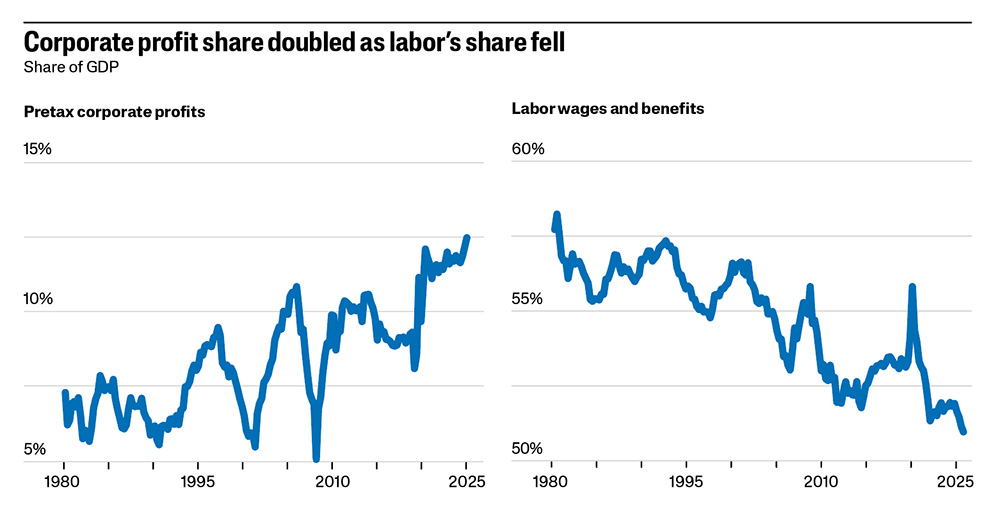
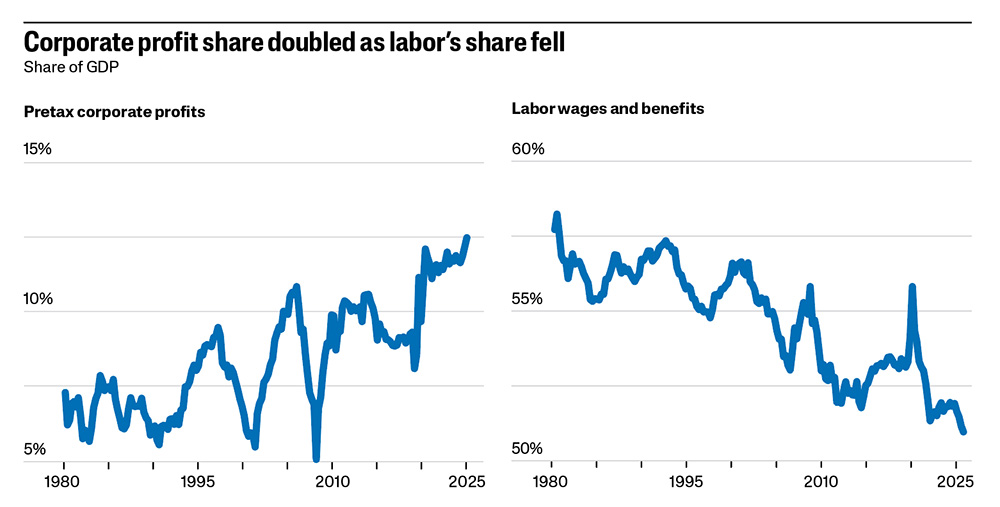
The cumulative result was a marked increase in income and wealth inequality and a rise in corporate profits. There is some debate about the extent to which inequality has grown, but the labor share of income, meaning the size of employee compensation relative to the economy as a whole, has fallen continuously since 1980, while the share of corporate profits almost doubled during the same period. Even after the large fiscal stimulus and uneven real wage gains of the Biden era, the prime-age employment rate remains lower than in other wealthy countries, and cost-of-living pressures have escalated, particularly in cities.
This top-heavy economy, along with the inability of a captured and entrenched political system to address the social dislocations of recent decades, has given rise to political dysfunction. That dysfunction has resulted in Trump and his reckless and self-destructive assault on the global trading system. His tariff policies reflect a consensus among US political elites that it is not the country’s economic model but its trading partners that are principally to blame for decline.
Of course, China’s entry into the global economy in 2001 did cost the United States manufacturing jobs. But industrial employment had been declining long before then. Meanwhile, other advanced economies, most of which were at least as open to global trade as the United States, suffered less social dislocation from economic change. The reason, again, is the harshness of the American model: the pain from the trade shock was regionally concentrated, redistribution measures were lacking, and the safety net wasn’t extensive enough.
The same domestic processes drove up the corporate profit share, and foreign investors have been buying claims on that profit stream.
Selling the Profit Stream
In its current form, the dollar system exists to enable and protect the rents of US financial capital and those who profit from it, both at home and abroad. These elites are empowered by the mobility of international portfolio flows and the legal and financial architecture that allow for the ceaseless growth of dollar liabilities. This arrangement has been described as an “empire by invitation”: rather than functioning as a trap that ensnares countries that need the dollar to participate in the global economy but then suffer due to their dependence on the United States, this system produces spoils shared among international monied elites. The dollar is the currency not of a country but of a class, and that class has members across the globe.
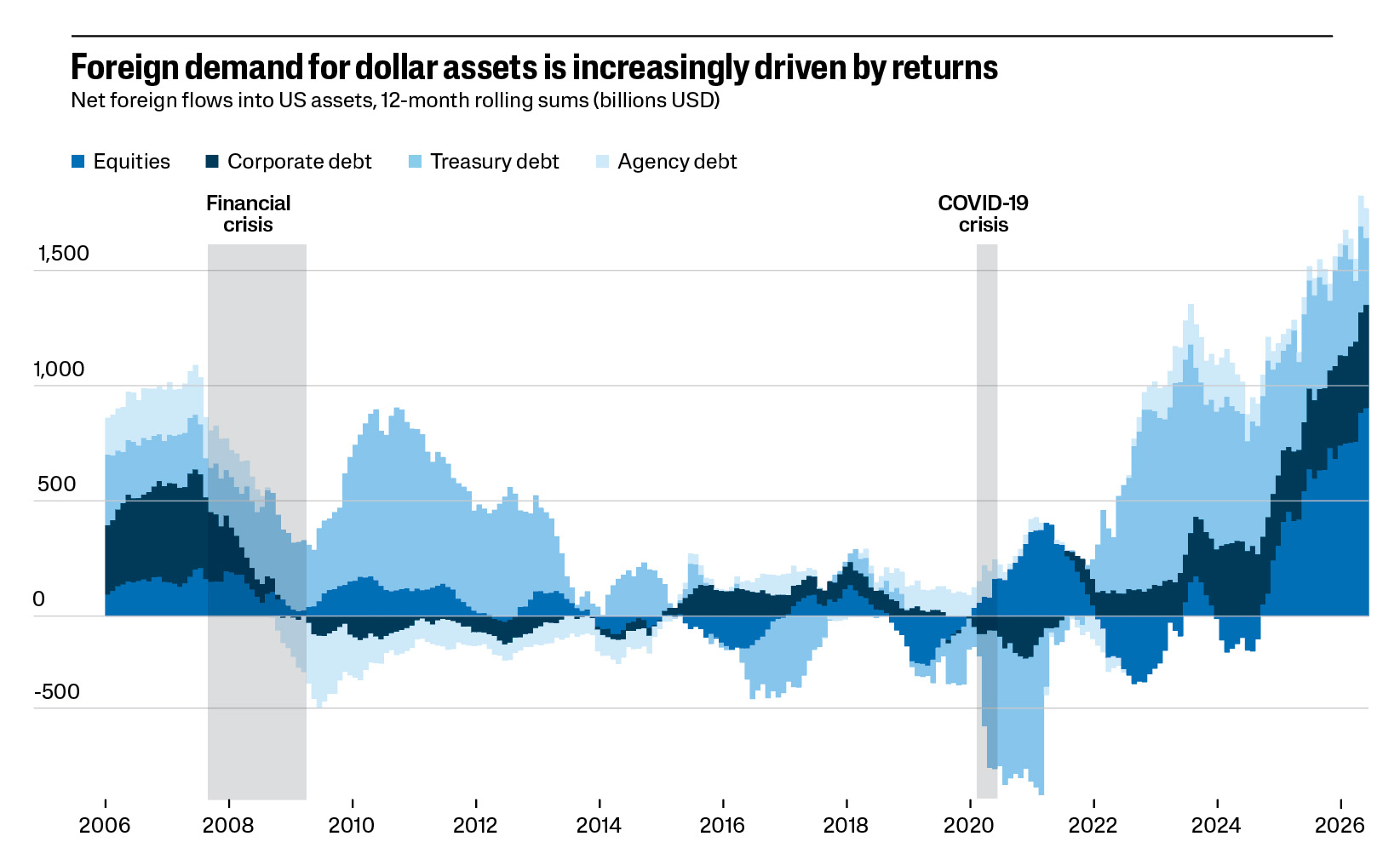
The high returns have transformed the United States’ external economic position. As economists Andrew Atkeson, Jonathan Heathcote, and Fabrizio Perri demonstrate in a 2022 paper, foreigners have increasingly bought US assets for the superior yields they offer — and they have benefited richly. That is not to say the dollar isn’t also the key currency for reserves. However, the data for official foreign exchange reserves held by monetary authorities show that, in the aggregate, there has been no global dollar reserve accumulation since around 2014, with the total stable at around $7.5 trillion.
Instead, as data from the Treasury and the Federal Reserve show, foreign demand for dollar assets has come to be dominated by corporate equities (stocks) and corporate debt. Relative to US gross domestic product, which has grown substantially over the last twenty years, recent net foreign inflows are not quite as large as they were before the 2007 crisis, but the trend is unambiguous: the current share of corporate assets (debt and equities) is 77 percent, quite a bit higher than its precrisis peak of 63 percent in June 2007.
If we want to understand how the dollar shapes American power, it is necessary to demystify the notion of exorbitant privilege. For this purpose, the most instructive part of the US economic balance is not the trade balance but the net international investment position, or NIIP. It shows the value of all financial claims US residents hold on the rest of the world minus all claims the rest of the world holds on US residents, in everything from stocks to bank loans.
The US NIIP is deeply negative, to the tune of $26 trillion, or in the region of 85 percent of GDP, as of late 2025. This is to be expected for the country with the largest current account deficit in the world, driven overwhelmingly by the goods trade balance. This external deficit needs to be financed, which means selling assets to foreigners or borrowing from them. As a result, nonresidents end up holding more and more financial claims on domestic productive assets, which, as deficits persist and grow, results in foreign claims on the United States exceeding its claims on the rest of the world. In other words, the United States is the debtor nation par excellence.
Ordinarily, a debtor country has negative investment income: it earns less on its assets abroad than it yields to its creditors. For the longest time, however, the United States has been the exception. Its exorbitant privilege consists in the ability to finance its negative NIIP with its own debt: it pays low fixed-income yields and earns higher yields on equities and foreign direct investment abroad. This gap, which international economics scholar Hélène Rey and former IMF chief economist Pierre-Olivier Gourinchas term the “excess return” on its foreign assets, is arguably the real core of dollar privilege.
The buyers of dollar-denominated safe assets have historically accepted lower yields in return for the nonpecuniary benefits that holding Treasuries in the dollar system affords them: liquidity, collateral value, safety, and the ability to settle payments. In effect, they were paying the perpetually indebted United States a convenience yield, resulting in lower effective borrowing costs, observable in the yields on US bonds. But this old privilege is fading. The US NIIP is now funded increasingly by claims on corporate assets paying juicy returns. And the United States is starting to service its external position the way ordinary debtors do.
As Atkeson et al. describe in their 2022 paper, these rising US share prices are driven by a climbing corporate profit share. In tandem with rising foreign ownership, the stock market boom has made the representative American household poorer in consumption terms, not richer. American household incomes were redistributed from wages to profits at exactly the moment the United States sold an unprecedented share of its profit stream to foreigners. Meanwhile, for US households that do own equities, the top 10 percent of the income distribution owns around 89 percent, with the top 1 percent alone owning over 50 percent. The bottom 50 percent of all American households own less than 1 percent.
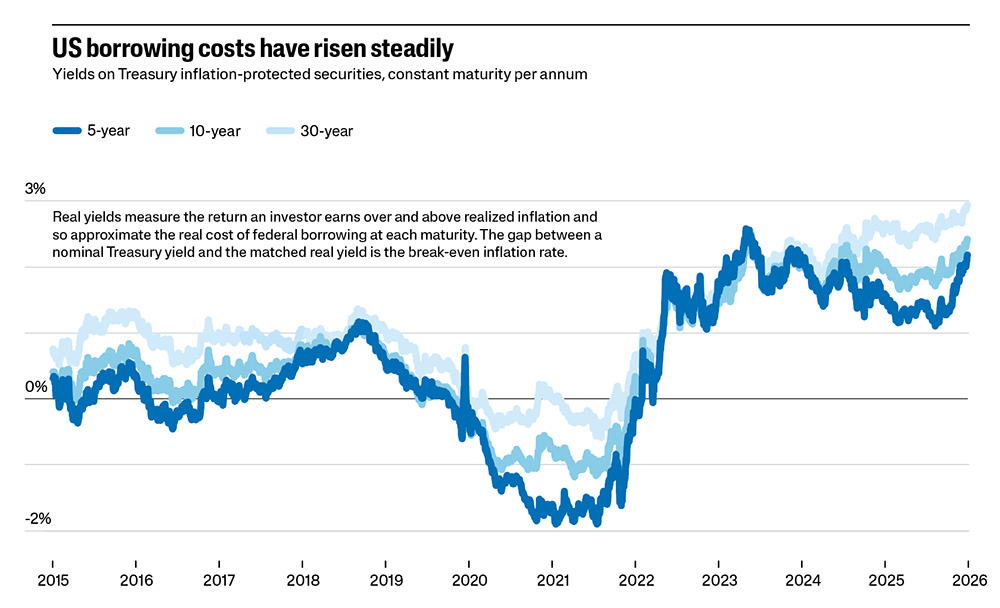
Moreover, there is reason to believe that the convenience yield has evaporated. For one, real yields on US bonds have been rising steadily over the last few years. More instructive, however, is the source of the broader measure of dollar privilege: the excess return. As research by Brad Setser, Michael Weilandt, and Aidan Regan has shown, the United States’ positive net investment income disappears once you exclude the income “earned” in tax havens such as Ireland, Bermuda, and the Cayman Islands. In fact, when accounting for tax avoidance in the seven most important low-tax jurisdictions, where US firms locate their intellectual property and then book profits, the excess-return gap disappears: as a share of GDP, US net investment income has been negative since 1995.
Perhaps the real exorbitant privilege, then, is the ability of US corporations to become very large and very profitable without having to pay taxes. But as the accompanying figures make plain, these benefits do not accrue to most Americans. On the contrary, it appears the dollar’s dominance is being financed out of ordinary Americans’ pockets.
The dollar has changed, but the system seems immovable. Even China, whose spectacular rise occurred on its own terms and against the US-led neoliberal trade order, built that ascent on the accumulation of Treasuries. It accumulates them still, at scale, through custodial accounts in Europe that keep its holdings out of the official statistics. And behind China’s closed capital account, which restricts the movement of speculative financial flows across China’s border, hundreds of billions of dollars in export earnings sit waiting for the chance to get in on the US stock market bonanza. It is not hyperbole to say that China is the center of the current global dollar system. Properly understood, this is not a paradox.
The status quo, in which demand for dollar assets persists and the unimpeded movement of cross-border capital is sacrosanct, is the preferred arrangement of Wall Street, the wealthiest thirty to forty million Americans, and the global investor class on the other side of those $26 trillion in net foreign claims. Overcoming this coalition is akin to storming the heavens. But it is the prerequisite for reforming America’s grossly imbalanced political economy and arresting a potentially terminal social decline.
Read the full story at the source →
Source: Jacobin