
World · Jacobin · · 2h
Amazon Is Perfecting Total Surveillance of Its Workforce
English (original) · Read in Deutsch ⇄
Although Amazon is increasingly synonymous with worker surveillance, the logistics behemoth has never been a pioneer in that space. UPS was the first fleet to install GPS in their vehicles back in 1991. Netradyne, the company that makes the AI-powered product Driver.i installed in most vehicles in Amazon’s fleet, had already logged over a hundred million minutes of driving time before Amazon signed the firm on.
But with each new iteration of its delivery-aid-cum-surveillance tech, Amazon has proven its knack for taking an existing product and deploying it in a dystopian direction. And other companies tend to follow its lead.
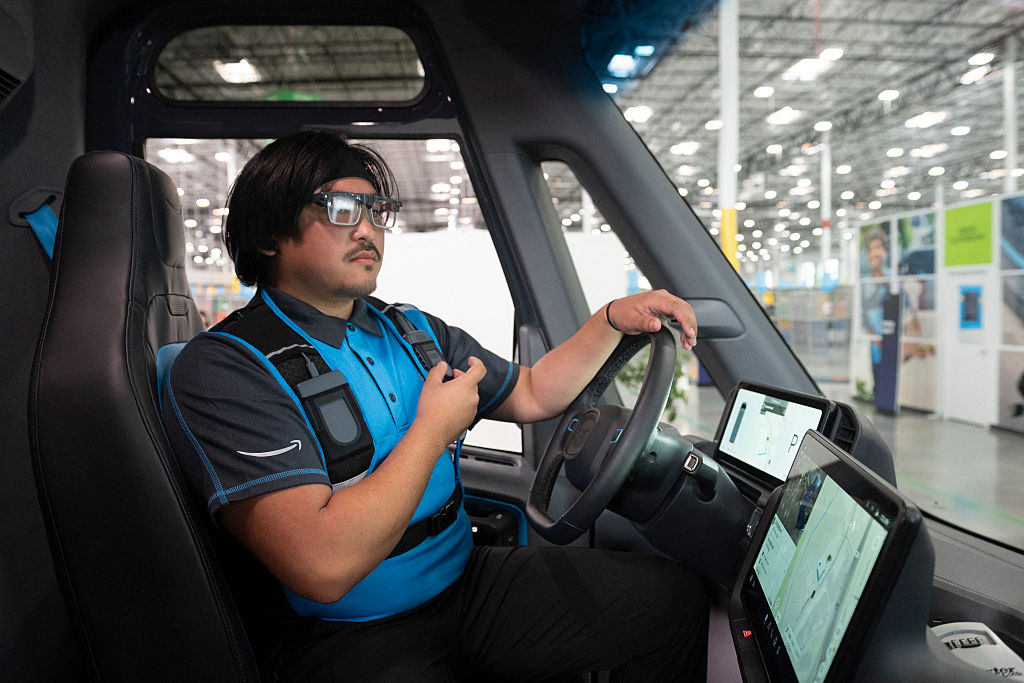
“Smart delivery glasses,” Amazon’s latest gadget, which come with a specialized vest with a built-in battery-pack, was introduced on their in-house news site last October to little fanfare; only a couple of niche tech websites covered it. According to a recent post on r/AmazonDSPDrivers, a Reddit community for Amazon’s scattered global network of Delivery Service Partner (DSP) drivers, training with the smart glasses at some DSPs has begun. It’s not unlikely that a nationwide rollout may come as soon as this year’s holiday season.
On the surface, the aim of smart delivery glasses is to replace the use of the smartphone on the job, allowing the driver to pay attention to their surroundings instead of looking at their phone. For DSP drivers, the smartphone is everything: It identifies packages, provides a walking path from the vehicle to the delivery location, instructs drivers on where and how to deliver items, photographs packages at the designated drop-off location, and requires a swipe to confirm completion of a delivery.
With smart delivery glasses, Amazon promises to make delivering “safer and more seamless,” which is very likely true — I imagine, as a former DSP driver myself, that at least they will make it less annoying to sort through an overpacked cargo area. But the smart glasses reflect a larger philosophical position, one ubiquitous in Big Tech and fueled by the artificial intelligence gold rush: that the human is not enough, and that we need to be aided — and disciplined — by AI.
A Formidable Surveillance Arsenal
Each device in Amazon’s surveillance arsenal serves a unique function. The Amazon app tracks a driver’s location and pace in real time, sending that information to Amazon and the driver’s DSP. Then comes Driver.i. With one camera pointed at the road, one camera at the driver, and two side-view cameras, the platform records drivers at all times, analyzing 100 percent of driving time. When an infraction occurs — whether an actual infraction or one that Driver.i has made up — the Driver.i robot scolds you in real time, sending video of your alleged infraction to Amazon, to you, and to your DSP.
Right now, the surveillance stops there. But with the introduction of smart delivery glasses, surveillance never has to end. Put your delivery vehicle in park, and the glasses automatically turn on. Like Alejandro Jodorowsky’s sketches of his never-created Dune, the latest technology is Amazon’s mad vision come to life: the ouroboros of watching people at work.
Amazon’s model is more than surveillance. At the core of its vision, Amazon is doing what it has always done best: both spearheading and reflecting the worst antihuman impulses of our age. Its proliferation is the result of what David Moscrop calls our “shared pastureland” breaking. Ring cameras, for one, have been a subsidiary of Amazon since 2018; the desire to protect one’s packages from would-be thieves prompts many people to purchase Ring cameras. Last year, Ring announced a partnership with Flock Safety, the increasingly maligned surveillance company, which was canceled this February after a public backlash over a Super Bowl ad. (Flock has an entire page dedicated to how it serves Amazon.)
Isolation is central to both the consumer and employee experiences. Amazon, which does not directly hire any of the hundreds of thousands of workers who deliver its packages, nevertheless pays millions of dollars yearly to union-busting consulting firms to ensure workers’ isolation, claiming that its tactics are protected by the First Amendment. Just last year, Amazon fired 150 workers who had organized with a Queens-based DSP. The year before, eighty-four workers at a DSP in Palmdale, California, successfully negotiated a union contract with its DSP; the DSP’s contract with Amazon was quickly terminated. And when workers in Quebec unionized a warehouse, the company responded by shutting down its operations across the whole province.
Not only does Amazon use technology to push humans to the limits of their productive capacity at work, but it also creates tandem machine-human systems that encourage humans to become nonthinking bodies: isolated and automated. Every critical decision, from deciding how many workers will deliver in a given day (a common DSP practice is to schedule more workers than it needs, waiting for the algorithm to decide how many it can put into vehicles), to configuring routes, to punishing driving infractions, is configured by an automated AI system. For example: If the AI decides you’ve run a red light, and you can’t prove you didn’t, it’s an immediate termination.
A Human Future for Work?
Amazon’s plan to surveil and automate work at every step is a vision mid-implementation. The logical end point of this AI-driven efficiency is pure automation: in other words, brainlessness. The last stop of ultimate efficiency is what some people might call animal, and others might call lobotomized. Both terms gesture toward the same thing: at best, that human workers are too slow, and at worst, that human workers are not to be trusted. The source of this tendency is, of course, the long-standing capitalist goal of asserting ever-greater control over workers and replacing them entirely where possible.
UPS workers, who are unionized, have demonstrated an alternate vision for the future of work. When UPS decided to install its own Lytx DriveCam monitoring system in 2022 (followed shortly thereafter by FedEx and Walmart), the Teamsters union disputed the use of the technology, claiming that it infringed on workers’ rights. What workers and the company eventually settled on was to record only when a driving infraction was detected, such as a vehicle swerving or impact, to protect the driver as much as to surveil them.
To evaluate the difference between each technology, you might ask: When a new AI-first technology is implemented, does the technology actually aim to make drivers safer — giving them more protection in the event of an accident? Or is its point to punish drivers by using negative reinforcement to curb bad driving habits? You might then look at how the implementation of the technology aligns with the company’s long-term vision. For instance: Is the point of technology like Driver.i — whose creator Netradyne began with self-driving aspirations — to make the driver safe, or to ultimately make the driver obsolete?
Despite our moral qualms with these labor practices, Americans can’t seem to get over using Amazon. When I worked for a DSP last summer because I was desperate (and it was one of the better-paying jobs in the area), I felt a little like my Amazon job was penance for all of the Amazon shopping that I had done over the years: for all of the delivery drivers who had come to my various houses and apartments in the extreme heat and cold; who hadn’t had a break in ten hours; who had nowhere to pee.
Yet there’s no fundamental reason why efficient package delivery needs to involve dehumanizing surveillance, AI discipline, and otherwise degrading labor conditions. The unionized UPS drivers who have successfully fought back against surveillance, and the growing efforts to organize Amazon itself, point to the possibility of a more human future for work, one where collective action limits management’s ability to spy on and control its workforce.
Read the full story at the source
Source: Jacobin