
Politics · Jacobin · · 1h
A New Leader Wants to Move Bulgaria Left
English (original) · Read in Deutsch ⇄
Bulgaria might not be the first country you associate with the socialist movement. But left-wingers have played an outsize role in the southeastern European country, ever since some twenty activists founded the Bulgarian Social Democratic Workers’ Party at a clandestine mountain rendezvous in 1891. After the Russian Revolution, the newly formed Bulgarian Communist Party (BCP) launched a failed uprising in 1923, and, after playing a decisive role in the antifascist partisan resistance during World War II, took power with Soviet backing.
Lasting from 1944 to 1990 and combining Soviet-style planning with nationalist policies that, over time, grew increasingly hostile toward the country’s Turkish minority, the BCP’s rule nevertheless fundamentally transformed Bulgaria. Starting from an overwhelmingly rural peasant country, its version of socialism built an industrial economy in a matter of years, eliminated illiteracy, provided affordable housing to millions, and carried out vast infrastructure projects that Bulgarians still rely on today. When the winds of change began to blow in 1989, BCP leaders proved more farsighted than many of their Eastern Bloc peers, renaming themselves the Bulgarian Socialist Party (BSP) and initiating democratic elections that they then won handily.
The BSP alternated between government and opposition for the better part of the next three decades, remaining the country’s only mass-membership party. Yet politically it drifted further to the right — first leading Bulgaria into the European Union and becoming an enthusiastic proponent of neoliberal austerity, and then, in the late 2010s, under leader Korneliya Ninova, morphing into a staunch defender of “traditional Bulgarian values” against Western “gender ideology.” Meanwhile, Bulgaria descended into political dysfunction, with eight parliamentary elections between 2020 and 2026.
That all came to an end in April, when what remained of the BSP’s electorate defected to former President Rumen Radev’s new party, Progressive Bulgaria, and ejected the Socialists from parliament for the first time in living memory. The party’s current leader, Krum Zarkov, had only been elected in February on a platform calling for a return to the BSP’s socialist roots. Since then, he published a manifesto entitled “The Socialism of Our Century” and toured the country, seeking to win the membership over to his vision of a renewed and decidedly more socialist BSP.
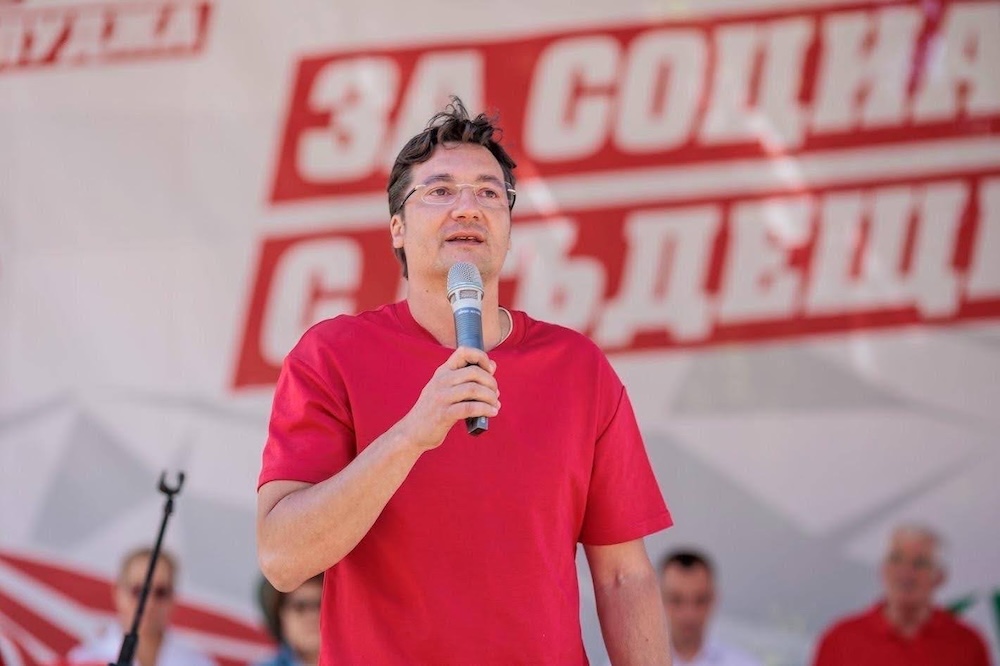
Last month, during the party’s 135th anniversary celebrations at Buzludzha Peak in the Central Balkan Mountains, Zarkov spoke with Jacobin’s Loren Balhorn and Madlen Nikolova about how he hopes to reintroduce socialist ideas into one of Europe’s poorest and most unequal countries.
Loren Balhorn
Could you tell us a little bit about yourself? How did you become a socialist, and what drew you to the Bulgarian Socialist Party specifically?
Krum Zarkov
To understand that, you have to understand what the BSP stands for in Bulgarian politics. In 1990, the BSP inherited the legacy of the Bulgarian Communist Party, which emerged from the original Social Democratic Workers’ Party. This series of transformations is quite unique. With the dawn of the so-called end of history in the 1990s, the BSP transformed not only itself but the Bulgarian political system from a one-party regime to a multiparty democracy. During this process, it sought to unite all left-wing currents, from social democratic to communist, in a confederated structure.
I was born in 1982. By the time I came of age, the BSP was essentially the only party on the Left. Like many Bulgarians born in the 1980s, I studied abroad, and in France I encountered ideas that drew me to the Left. When I came back to Bulgaria, I knew where I stood. For me, the BSP had a threefold attraction: it was big enough to govern or be the main opposition; it had a vibrant internal life that could not be found anywhere else; and thirdly, I had relatives in the BSP — as did many people in a country of eight million, of whom 1.5 million were BSP supporters at one point.
Loren Balhorn
You described the BSP as a confederation of left currents. Internationally, the party belongs to mainstream social democracy, but among the base the old Communist traditions are still very much alive. The motto of this weekend’s festivities is “socialism with a future.” So which socialism are you referring to?
Krum Zarkov
The BSP’s main strength was to recognize those differences rather than ignore them. Different party leaders have leaned closer to different currents. Sergey Stanishev, the BSP’s leader in the mid-2000s, went on to become the president of the Party of European Socialists. More recently, Korneliya Ninova was much more nationalistic.
Communism in Bulgaria was a state-driven, one-party system built around the idea of national exceptionalism. Such “conservative socialists” may be hard to understand in Western Europe; I personally don’t think this current really has a future, but it exists. In this sense, the BSP evolves via its leaders but not in isolation from the national and European context. The BSP’s conservative turn coincided with a conservative wave across Europe. We can learn a lot from that chapter, but it is now closed.
I’m now trying to ride another wave, which perhaps came from across the Atlantic but is now arriving here. The end of history has ended. The political crisis in Bulgaria, with fresh elections every six months, is a clear indicator of systemic dysfunction. It cannot be fixed simply by electing less corrupt, more intelligent politicians. Figures like Bernie Sanders have been trying to mainstream this idea for decades, and their efforts are now paying off.
Madlen Nikolova
Reading your manifesto and following party debates, it seems like there’s a recognition that this kind of systemic, structural analysis doesn’t come naturally to people. Do you see the BSP’s role as “educating the masses”?
Krum Zarkov
A political party has three main tasks. One is to represent, another is to define a legitimate interest to be represented, and the third is pedagogical. The BSP is the only party in Bulgaria with a clear ideology for its membership, but many members find it strange, too — they treat our manifesto like an intellectual exercise, not a pragmatic political move.
Today our pedagogical task is to remember what politics are for. We’re forced to remember because the voters expelled us from parliament. For many members, this meant the end of the party. That’s understandable: this party was in power for forty-five years and then the main opposition or the governing party for the next thirty-five years.
The people who met at this mountain 135 years ago were neither MPs nor ministers, but we continue to celebrate their ideas. Of course we should modernize — be more flexible, better organized, more present on social media — but we shouldn’t forget why we’re doing it. My internal opponents say, “This new leader does nothing. What we need isn’t a manifesto but a manifestation” [as in “demonstration”]. But against what? I’m saying against capitalism, and for a new type of society.
Loren Balhorn
The last election saw Rumen Radev’s catchall party, Progressive Bulgaria, win 44 percent of the vote, and the BSP is no longer in parliament. But some MPs had already defected to Radev’s camp even prior to that. Could this be a blessing in disguise, clarifying who was sincere about socialist politics and who used the party as a vehicle for self-advancement?
Krum Zarkov
Well, that would be the best-case scenario — but there may be another scenario. It was a great blow not to enter parliament. We would have been able to do what we are doing now while also having the tribune of parliament. So, no, it’s not a blessing. But if you ask whether it was unjust for us to be expelled, I would also say no; it was quite logical and could have been expected.
Madlen Nikolova
At your presentation yesterday, you said the important question is not how the party went from 7 to 3 percent but from 27 to 7 percent. How do you answer that question?
Krum Zarkov
It’s easy to explain why we went from 7 to 3 percent: because we were part of a coalition with oligarchs. When you claim to be socialists and oppose oligarchy but enter a government like that, you get punished worse than the other parties, because the expectations for them are different.
The reasons for the BSP’s dramatic long-term decline are more complex, though similar tendencies can be observed across Central and Eastern Europe. Socialist parties in the region inherited the legacy of socialism and were forced to develop a kind of doublespeak. In the 1990s, inside the party we were nostalgic for that period, claiming everything was perfect and insisting we had somehow been robbed. Outside the party, however, we rejected almost everything associated with socialism. Thus we created an expectation that we would fight for the socialist legacy, but once we came to power, we ended up dismantling much of it. This contradiction — in a sense, deception — was ultimately punished by voters.
That wasn’t the responsibility of a single party leader or executive committee, it was the zeitgeist. The West, to which the BSP looked for legitimacy, tasked the party with implementing the neoliberal shock doctrine: privatizing, creating markets, and opening the economy to foreign investment. The complete opposite of socialism.
At the same time, this historical contradiction made the BSP the only former Eastern Bloc ruling party to survive thirty-five years after the fall of socialism and thus have a chance to transform itself. What I’m proposing is that we anticipate the right moment for this transformation, much as the Communists in the 1980s did by implementing changes they could sense were coming. We may assess these changes positively or negatively in hindsight. But what matters now is that we have an opportunity to emerge from defeat and face up to what the party and Bulgaria have become.
Madlen Nikolova
The BSP initially hesitated to implement shock therapy in the 1990s, opting for what it called “capitalism with a human face,” but was ultimately forced to capitulate to market pressures. Do you think that conditions in the country and globally today are more conducive to a progressive shift in Bulgaria?
Krum Zarkov
Well, yes. I recently read that in Bulgaria, the gap between the 1 percent and the 99 percent is wider than in the United States. Now, the United States is the most unequal society imaginable, but it has a population of 350 million people — the 1 percent and the 99 percent don’t see each other. Bulgaria has a population of 5.5 million — you actually see the 1 percent! How long is the majority going to put up with this? The elites have appropriated all the power, all the capital, they control all foreign investments. What kind of parliamentary democracy can you have under these conditions?
The real power structure in Bulgaria is totally divorced from parliament. Before, we had two entities: the state and the mafia. But now they’ve made it official. They’re building their own parties and buying elections, vote by vote! In regions with only one major employer, how do you imagine social dialogue?
Bulgarians are becoming more and more aware of the real power structure. I’ll admit, few see the BSP as capable of fighting this structure, but they sense it is necessary to fight. The political struggle is over who gets to lead that fight, and we might stand a chance if we pose the right questions. Since we published the manifesto, journalists have been asking me “What are you talking about? Are you crazy, overcoming capitalism?” They��re astonished!
Loren Balhorn
It seems like most Bulgarians view politics through the lens of corruption and anti-corruption. They see the rich and politicians as corrupt but don’t seem to think in terms of class or identify themselves with a specific social group, let alone conflict. A bit like where I grew up in the United States, people see themselves not as workers but merely temporarily embarrassed millionaires. Do you think the BSP can break through this mindset and reintroduce socialist ideas?
Krum Zarkov
Your observation is accurate, but it’s not the people’s fault. They identify problems as they appear in everyday life, such as when they’re asked to pay extra under the table for public services. I am the chairman of the Bulgarian Socialist Party, but I am also a lawyer. I served as minister of justice, and some of my major political fights have been against corruption and for the rule of law. We have to eradicate corruption, it’s a sine qua non for progressive change, but it’s not enough.
Our slogan today is “Socialism with a future.” I realize we won’t be in parliament for the next few years, but I’m betting on the future, that we will finally overcome corruption because people are simply unwilling to accept it anymore. If not, we will continue to have this rudimentary dialogue of “honest” versus “corrupt.” A real democratic dialogue requires ideologies or parties that fight for their agendas beyond categories of “good” and “evil.” At the same time, we cannot make a plausible case for democratic socialism in a country where you can bribe your way out of regulations. Socialism needs rules, and rules require the rule of law.
In a perfect world, a socialist party would fight corruption while fighting for socialism. But in the Bulgarian context, anti-corruption comes first. At the last elections, citizens mobilized against corruption very clearly and ousted the corrupt parties from power. You can still feel the tension in the air; we’re one scandal away from another eruption of anger. It’s become unbearable.
Madlen Nikolova
You speak a lot about challenging corporate power, even if in Bulgaria, as you said yourself, that power is concentrated among five people.
Krum Zarkov
Well, not five, let’s say fifteen. (Laughs)
Madlen Nikolova
Either way, opposition politicians who posed less of a threat to corporate power have faced harsh state repression, like the mayor of Varna, Blagomir Kotsev, who was arrested last year. How will you deal with that?
Krum Zarkov
I speak out against the mafia and I’m not afraid of corporate leaders. I’m not afraid to call out foreign companies either. I identify the real problem: monopolies impacting workers negatively. The free market is supposed to be about competition, but where is the competition? The balance of power between foreign companies and local entrepreneurs is such that there is in fact no free competition. One surrenders to the other.
On how to fight inequality: politically speaking, the classic answer is the tax system. That is where corporate interests will be challenged. Bulgaria has the most unequal tax system in Europe, maybe the world. We have a flat tax of 10 percent on individual incomes, but also a corporate tax of 10 percent, and a 5 percent capital gains tax, while value-added tax (VAT) is 20 percent! It’s not even a flat tax, it’s brutally regressive.
The BSP is the only party putting this question on the table at a time when the national deficit is exploding. The parties in parliament are not concerned, the only solution they see is neoliberal austerity and cuts to social spending. Currently, the state takes out loans to cover social spending. The big question is: Who will bear the burden of overcoming the deficit? Obviously it won’t be the 1 percent, but the working class.
The neoliberal brainwashing machine in Bulgaria propagates that capitalism and democracy are two sides of the same coin. If you’re not an enthusiastic proponent of capitalism, you’re painted as antidemocratic, a communist nostalgic. The flat tax represents modernity and progress, while the progressive tax means raising taxes for everyone. Those are difficult clichés to overcome, and we’ll have to work very hard. Just raising the question, on which there has been a total consensus for fifteen years, represents a small victory.
Madlen Nikolova
The new manifesto talks a lot about the climate crisis, an issue that has been practically absent from public debate in Bulgaria since this cycle of instability began. Yet the environmentalist movement was one of the few successful social movements in Bulgaria’s recent history. Have you thought about revisiting its legacy when building alliances around that issue?
Krum Zarkov
In fact, those movements spawned the first major dissidents under Communist rule, and some of them joined the BSP after the transition. Our manifesto is built around the understanding that capitalism, now more than ever, is destructive. It destroys the international legal order, it destroys society via inequality, it destroys the planet.
You’re right, “green” has taken on a pejorative connotation over the past ten years, it’s now seen as something that harms the majority. The European Green Deal was also viewed, and rightly so, as a bigger problem than climate change itself. The problem with the Green Deal was that it suggested that those suffering should pay for the transformation — if it took place at all. I agree that we need to change the way we consume, live, and interact with our environment. But then comes the classic Marxist question: Who will pay for it? Will it be the polluters or those who suffer from pollution?
That said, Bulgaria’s attachment to coal plants is economic, social, and cultural. Their immediate closure would set off a social and economic bomb. The trade unions fighting for coal jobs have reasonable demands, and we need to work with them. European Commission proposals to retrain miners as gardeners are unworkable and unserious. We’re talking about people who are proud of their work and their contribution to the national economy.
Loren Balhorn
In your speech, you identified three tasks for the party: consolidate, organize, and realize. You also said the party can’t afford to have chapters with more members than voters anymore. Behind that statement is the fact that the BSP has a rigid structure inherited from a one-party state and all of the baggage that entails. How will you go about turning it into a modern socialist organization?
Krum Zarkov
Well, isn’t that the million-dollar question? But yes, our structure is no longer adequate. The mismatch between the number of party members and voters is due to the perverse incentives in the way representation works. More members means more delegates and hence more influence. If you’re not a particularly honest party activist, you may be inclined to come up with a long list of members for your chapter. Thus our first order of business is to reorganize the party to reflect the fact that it no longer has a million members, but rather a hundred thousand supporters.
Secondly, the party should reflect political realities. In democracies, citizens are not only active once every four years at the ballot box. They engage in politics many times per day, even if it’s just online. We need to enter those virtual spaces. The organization should reflect this networked aspect of politics and abandon strictly hierarchical structures in favor of a much more flexible and reactive model.
This means being able to say the right things in debates but at the same time being recognized not only as an influencer but as a real structure, something that can be touched. I think this is somewhat easier to do in Bulgaria, not only because we are a smaller society but because, even after the election, there are many people — the nurse at the clinic, the taxi driver — who didn’t vote BSP this time but still identify with us. The question is how to reengage them in some way or another.
Why does that prove so difficult? Simply put, party leaders don’t like it because they can’t control it. I will propose changes to the party statutes this fall. To make sure they are sustainable, I will try to include all party members in decisions, as I did with the manifesto, rather than first get approval from our national council. That also means that I take full personal responsibility. If it fails, I leave. I’m all-in.
Madlen Nikolova
There’s an oft-quoted saying by Dimitar Blagoev, the founder of Bulgarian socialism, that three-quarters of Bulgarian domestic politics is decided on the world stage. But just like the climate crisis, international politics is practically invisible in Bulgarian politics, except maybe for the war in Ukraine. Do you want to bring world affairs more to the fore? You’re probably the only Bulgarian politician who dares to utter the word imperialism, for example.
Krum Zarkov
It’s not a question of whether I want to, it’s coming. The war in Ukraine cannot be frozen: it will either end one way or another, or it will expand. A military confrontation between the European states and Russia would be such a devastating scenario for everyone that the only reasonable political stance is to try and prevent it.
The wars in Iran and Gaza are also catalysts for the renewed interest in international politics. Bulgarians are watching what’s happening in Gaza, but they don’t talk about it. There are two possible explanations for that. Bulgarians perhaps understand that the country’s not a decisive factor in those conflicts, which I understand. Another explanation, however, might be that Bulgaria’s membership in NATO and the EU prevents it from acting as a sovereign state — we just follow the will of the stronger states.
I argue that Bulgaria has the tools to influence these organizations. We can challenge their official stance, and that’s increasingly what Bulgarians expect from their government. This is new and is a result of the fear surrounding these wars.
Loren Balhorn
You talked about the antifascist tradition in your speech, and it’s also one of the themes of the manifesto. The far right is on the rise everywhere, but in Bulgaria, it looks relatively insignificant. How would you gauge the fascist threat here today? Is it a big concern for the Left?
Krum Zarkov
It is, and it should be. The threat of fascism is manifest not only in the far-right parties but in many forces that promote discrimination, prejudice, and pro-corporate policies. I am not inclined to call everything I disagree with fascist, but I cannot remain blind to the revival of dehumanizing ideologies. The BSP’s historical mission is to fight these.
The memory of antifascism can be abused politically, and it requires a lot of honesty and wisdom to separate good-faith antifascism from attempts to deny your opponent legitimacy. Still, we need to wage a real political struggle against fascism — whether in its overt and frightening forms like the annual far-right march in Sofia, where people in black uniforms with Nazi symbols carry torches, or in more insidious ways embedded in society’s denial of others’ right to exist.
Madlen Nikolova
It oftentimes feels like our future is imploding under the weight of climate collapse, corporate capture of democratic institutions, and endless wars. What gives you hope that we can still turn things around?
Krum Zarkov
For Bulgaria, what gives me hope is that the democratic reflex has really grown inside our society. Bulgarians will not accept losing their freedom — politically, first of all, but eventually, they will see that their freedom is also denied economically. And that’s where we come into play.
Read the full story at the source
Source: Jacobin