
World · Jacobin · · 3h
A Decade of Bernie Sanders’s Transformation of America
English (original) · Read in Deutsch ⇄
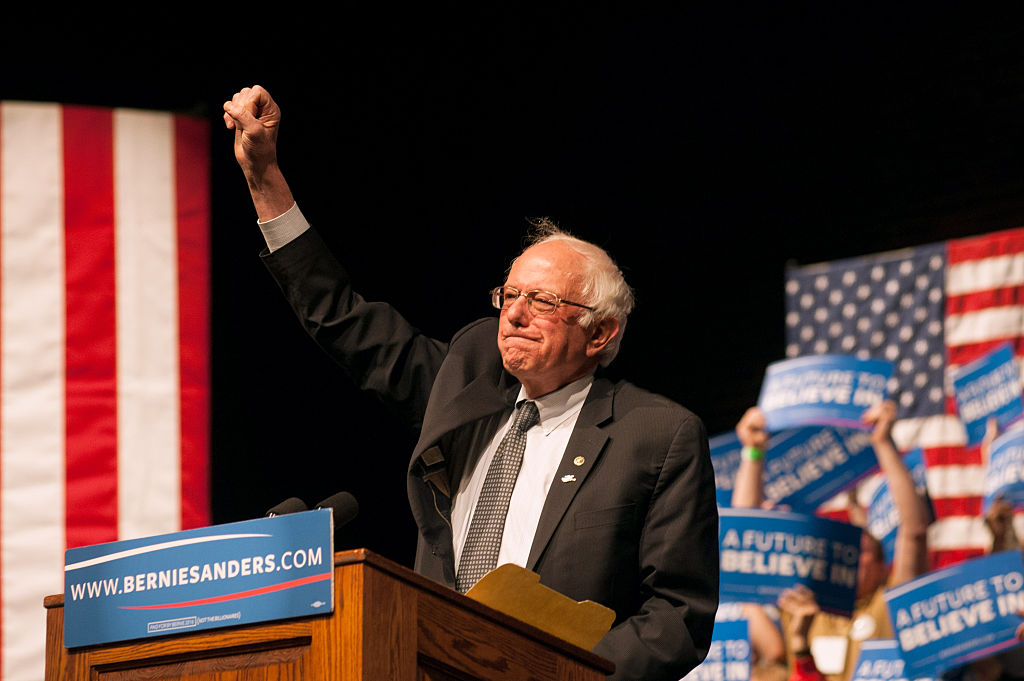
Over the past decade since his first presidential run, no one has done more to reshape the American left than Bernie Sanders. He is the most influential left-wing leader this country has seen since the 1960s, if not longer.
While Sanders’s political career began decades earlier, his influence took on national dimensions ten years ago, when Sanders first campaigned for president against Hillary Clinton in the Democratic primary. He lost that campaign, but few losses have looked so much like a victory. Clinton has no political heirs openly claiming her legacy; indeed, today’s technocratic centrists squirm away from the association. Meanwhile, Sanders has dozens of self-professed acolytes at the federal level, hundreds or even thousands at the state and local levels, and an organization in the Democratic Socialists of America that, though he has never been a member, has grown from obscurity to 120,000 members since he first ran.
Bernie Sanders’s first presidential campaign, then, is a significant event in twenty-first century American politics and the broader history of the American left, and its ten-year anniversary is a notable milestone. But Sanders himself hasn’t marked the occasion. Unlike most politicians, he demurs from telling his own story or touting his achievements. He’s also busy, playing a leading role in demanding artificial intelligence regulation and ending the war in Iran, with the next fight and the one after that.
That laser focus on the present is why we love Bernie; it also means that commemorating and reflecting on the campaign that changed everything falls to us.
At the top of any accounting of Sanders’s achievements since 2016 is the wave of young socialist elected officials he has inspired. Rep. Alexandria Ocasio-Cortez was a volunteer organizer for Sanders’s 2016 campaign, which she credits with motivating her to run for office. New York City Mayor Zohran Mamdani has called Sanders “the single most influential political figure in my life” and has said it was “Bernie’s campaign for the presidency in 2016 that gave me the language of democratic socialism to describe my politics.”
Sanders’s protégés in Congress now span two generations. There are the upperclassmen elected around 2018, including Ocasio-Cortez, Ilhan Omar, and Rashida Tlaib. And pending November confirmation in their deep-blue districts, there’s now an incoming freshman class including Claire Valdez and Darializa Avila Chevalier, while several other Sanders acolytes, chief among them Abdul El-Sayed in Michigan, are fighting through their general elections with a good shot at victory.
Valdez best summarized this cohort’s indebtedness to Sanders when she said, “Three things made me a democratic socialist: sh–y jobs, the labor movement, and Bernie Sanders’s runs for president. His political revolution changed my life — and showed millions of Americans what’s possible when working people organize.”
Sanders’s influence, however, is hardly restricted to office-seekers. His political orientation has reshaped the culture and strategic orientation of the American left as a whole.
To appreciate how, recall what that culture looked like before he arrived. From the Battle of Seattle in 1999 through Occupy Wall Street in 2011, the American left was dominated by horizontalism, an anarchist-inflected politics that distrusted not only politicians and parties but mass politics itself. The Occupy-era left was suspicious of formal leadership, considered demands a concession to the system, and rarely organized itself beyond the affinity group or temporary action committees.
The mobilizations of this period produced indelible images and genuinely radicalized participants, but they left behind no institutions capable of seriously contesting power. Meanwhile, those progressives who did continue to wage fights within the Democratic Party did so timidly and without ambition, failing to advance a robust legislative program and inspiring moral vision. Sanders offered an exit from both culs-de-sac.
By running for president on a far-reaching program of reforms that were coherent and achievable but also highly audacious and transformative, he demonstrated that the Left could flourish by articulating clear demands and waging campaigns for Democratic Party nominations that were mostly independent of Democratic Party leadership. He showed that we could seek majorities and contest for power rather than just protest it — and that millions of ordinary people, mostly indifferent to the subcultural preoccupations of the already-existing activist left, would respond when we did.
If horizontalism was the radical left’s dominant tendency when Sanders arrived, identity politics was its successor in the decade that followed. The Right makes no distinction between the two emergent politics of the 2010s, Sanders-style democratic socialism and “wokeness.” In reality, however, Bernie Sanders has provided an alternate example for a left that otherwise finds it difficult to avoid the seductions of identity-based oppression rankings, elaborate deference pageantry, and shallow representational concerns. A universalist at heart, Sanders instead has modeled a politics genuinely progressive on civil rights and social equality that nonetheless declines the invitation to the culture wars, fixing its attention instead on what unites the broad working class rather than on the infinite ways it can be subdivided.
That Sanders’s politics, forged in the crucible of the Free Speech and Civil Rights movements, remained wholly intact through the Left’s darkest decades is a testament to his idiosyncratic personality as much as his political convictions. Through sheer force of will, he has served as a bridge between the 1960s and our time. We’re lucky that a veteran of the nation’s last great left upsurge was still around to guide a new generation of democratic socialists — and that he had spent decades in office sorting what earlier generations got right from what they got wrong.
There’s no one like Bernie Sanders. He remains singular today, even among the crop of leaders and activists who strive to emulate him. His obdurate universalism, unique and even comical ability to stay on message, and unyielding focus on issues of real importance to the long project of class struggle remain aspirational qualities. Society has not evolved past the need for Bernie Sanders.
To mark the decade anniversary of Sanders’s first presidential campaign, we will be publishing a number of articles in the coming days by Jacobin contributors and contemporary socialist leaders reflecting on how the American left has changed since Bernie first ran. These articles will cover his impact on socialist organizations, his part in the still-unfinished effort to revitalize the labor movement, personal essays by socialist elected officials on his influence on them, and more.
Though he’s far from finished remaking American politics, Sanders has already left a profound legacy that will not recede when he does eventually exit the public stage. Above all, he has broken the spell of demoralization that had settled over the American left, and over the working class itself. He has rekindled in millions of Americans the belief that things can change — that domination can be challenged, inequality overturned, injustice repaired, and power structures transformed in the interests of the many, not just the wealthy few.
This article originally appeared in Jacobin, a democratic socialist magazine publishing long-form essays and analysis on politics, economics, and culture. Subscribe to the print edition for $20 a year.
Read the full story at the source
Source: Jacobin