
Politics · In Defence of Marxism · · 2h
Bond market troubles reveal impending crisis
English (original) · Read in Deutsch ⇄
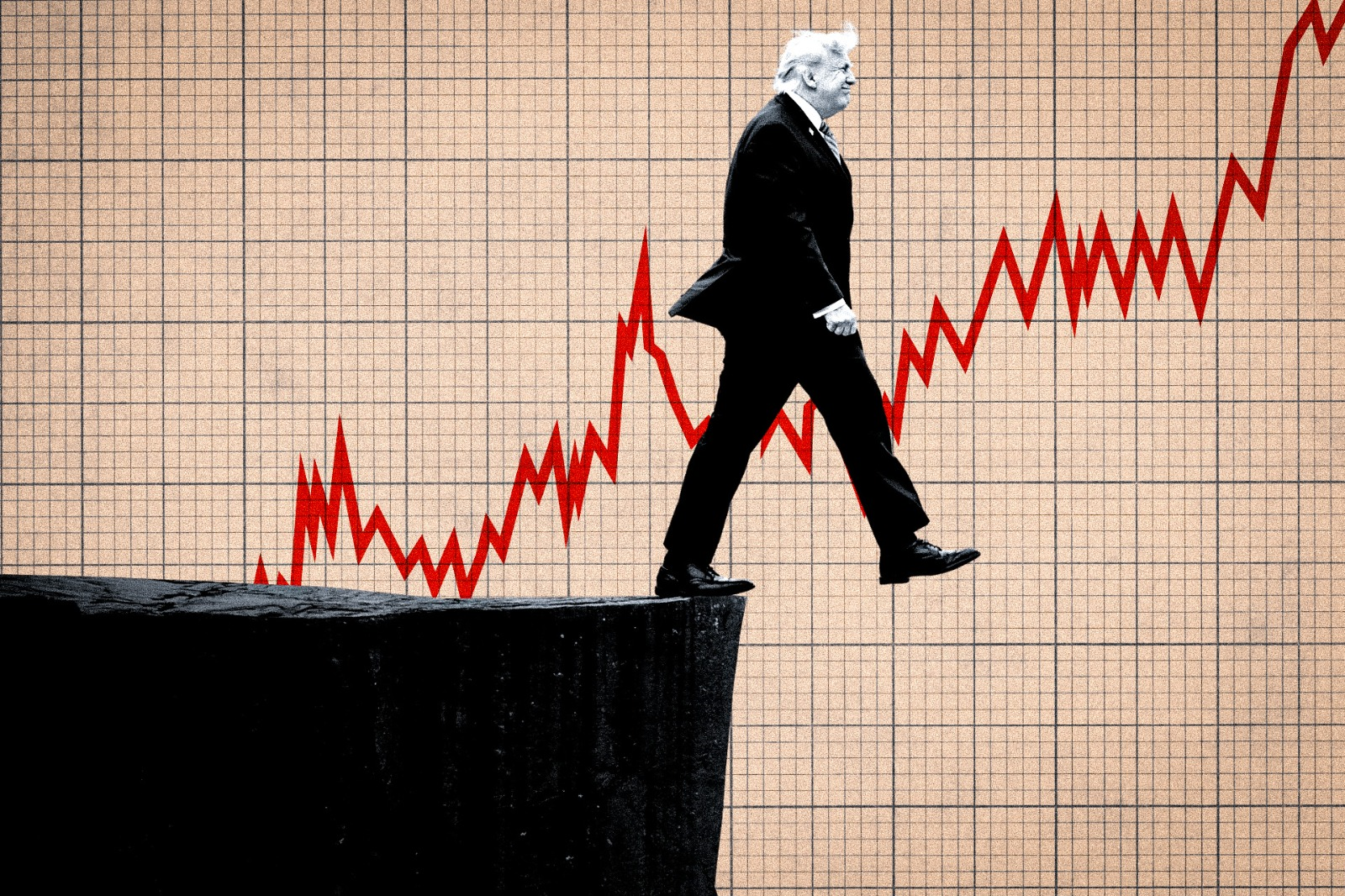
The US government is having to pay increasing amounts of interest to borrow money. For the first time since 2007, interest on its 10-year debt has reached five percent. The crisis in the bond markets reflects the pressures arising from the Hormuz crisis, protectionism and the chaotic AI buildout. It is revealing all the contradictions in the world economy that is heading towards a crisis.
In August, US Secretary to the Treasury Scott Bessent announced that he would buy back $6 billion of 10- and 20-year bonds in an effort to keep the interest rate (yield, as they call it) from rising further. Then he said he would double the amount. At that time, the rate stood at 4.85 percent, but it has risen further since. His efforts, in other words, failed. This shouldn’t surprise anyone, given that the US government issues $2.7 trillion worth of debt of various kinds every month.
Bessent’s intervention followed a previous intervention by the US Treasury in buying Japanese currency. They helped the Japanese government raise the value of the Yen, which had been falling since February. In a speech last month, Bessent even taunted investors, saying that they shouldn’t bet against him because he knew things they didn’t. It was a veiled threat that the Japanese central bank would raise interest rates soon.
Bessant’s intervention was sparked by a change in the economic situation in Japan, driven by the Iran War. Japanese inflation has picked up for the first time in decades, reaching 1.9 percent. With the central bank interest rate also at one percent, investors are pulling their money out. This caused a fall in the value of the currency, meaning more inflation.
The Japanese central bank stepped in to back its currency, but needed cash to do so. So, it sold US government bonds. Even with the help of the US Treasury, it seems the Japanese government sold as much as $90 billion worth of US government debt to keep up the value of the Yen. Compare that to the $6 billion that Bessent was throwing at the problem.
Less publicised was Bessent’s deal with the United Arab Emirates, which is also under pressure from the Iran War. He gave the UAE a ‘swap line’ which enables it to exchange its own currency for dollars. This is so that the UAE could defend the value of its currency without having to sell US Treasury bonds.
In other words, Bessent is making deals with lots of governments right now to prevent them from selling US government bonds, at the same time as he’s using the US government’s money to buy back its own bonds.
If this sounds a bit desperate, it’s not without reason. Bessent is trying to keep the cost of US government borrowing down. He’s also, particularly ahead of the mid-term elections, trying to keep US mortgage rates down. They tend to follow the US 10-year Treasury (with a bit added on top for the banks).
Bessent is fighting against the stream, as he’s probably aware. Economic forces are pushing against him. US economic growth is barely ticking away at 1.5 percent, and inflation is running at 3.4 percent. That would suggest that the interest rate ought to be something like five percent. And that’s precisely where the 10-year bond is.
US economic growth is barely ticking away at 1.5 percent, and inflation is running at 3.4 percent / Image: Flying Logos, Wikimedia Commons
Asking for 5 percent interest to lend money for 10 years suggests that the markets are now expecting inflation to remain around three percent for the coming decade, or that it might be even higher. The Federal Reserve is therefore forced to raise rates in an attempt to suppress inflation. It’s a mistake to think that the central banks control the economy. It’s the other way around, as Ted Grant pointed out long ago.
Ironically, the only way to lower the long-term interest rate (mortgages, 10-year bonds, etc.) is to raise the more immediate rates the Federal Reserve controls to show, as they say, that they are ‘serious’ about fighting inflation. If the Federal Reserve raises interest rates, it puts downward pressure on growth, and thereby expectations of inflation go down. Some commentators insist that only a recession can bring inflation down to the target. The fact that the rates haven’t gone down since the announcement will force the Federal Reserve to make more hikes in the near future
If the interest rates are driven by inflation, then what drives inflation?
There is one simple answer: the war with Iran. Oil, gas and all kinds of other commodities that no one considered the production and transit of before were transported through the Strait of Hormuz. Now it is blocked, the massive loss in production of some commodities, and the rerouting of supply chains for others, have meant a massive rise in costs. And we have yet to see the full extent of its impact.
Diesel prices, which fuel every part of the economy, are particularly badly affected, as refineries in the Middle East have become inaccessible. The remaining ones are running at max capacity and are charging a bomb for it. Whereas before a refiner might be paid $20-40 to refine a barrel of oil, they are now being paid $100. It’s one of many reasons the profit margins of energy companies have risen dramatically.
Crude oil prices once again jumped up above $100 per barrel in September. This follows the closure of the Saudi oil pipeline to the Red Sea, which carried about 4-5 million barrels of oil per day during the first five months of the conflict.
Even before that happened, the producer price index, which measures the cost of unfinished goods and services, rose 5.4 percent compared to last year. For goods, it rose 1.1 percent in August alone. This shows us that inflation isn’t going anywhere.
Sanctions on Russia are also playing a part, cutting off large sections of the world from Russian raw materials of all kinds. Ukrainian attacks on Russian refineries are putting even more pressure on fuel prices.
But it isn’t just conventional war that is driving inflation. Trade wars are forcing companies to rely on more expensive sources of raw materials and components, whether that is because they have to ‘buy American’, pay extra tariffs or move their production to less advantageous places.
And there’s the AI boom, which is causing a massive increase in the price of components. The most dramatic rise is that of computer memory chips, which are expected to quadruple in price this year. Things like electricity infrastructure, as well as the electricity itself, are also becoming more expensive as more and more data centres are built.
Then we have military expenditure, which is competing for resources with infrastructure spending and other investments. Producing scrap metal has always been inflationary as it redirects resources from productive parts of the economy. Even more so when they are being used to attempt to destroy the economies of whole countries, in the Middle East, in Ukraine or in Russia.
The only remaining hope for the bourgeois is that at least wages aren’t increasing. Every time there’s an inflation report, they rub their hands, congratulating themselves that wages aren’t keeping up with inflation. They are, in other words, pleased that they have managed to dump the problem of inflation onto the working class, through higher prices and stagnating wages.
But fundamentally, none of the problems that drive inflation have an easy solution. Maybe Trump will admit defeat in Iran, or the Europeans and Zelensky will admit defeat in Ukraine. But that would only prepare the way for another conflict somewhere else.
The only thing that could make a dent in inflation is a deep recession, which is on the cards.
Before we turn to the question of the recession, let’s consider what these higher interest rates mean.
Financial commentators have confidently declared: ‘this is just a return to normal’. Rather than being a problem, they claim, it is a sign of a healthy economy.
Now the government has to compete for the money with those making real investments in the economy, they argue. Investors can choose who they lend their money to, as the AI-driven investment in the US is increasingly driven by debt.
The only thing that could make a dent in inflation is a deep recession, which is on the cards / Image: unsplash
No doubt, the low interest rates in the period from 2008 to 2022 were exceptional. But that was a symptom of how deep the crisis was at that time. And part of the reason for higher inflation over the last couple of years has been the AI boom, which constitutes investment in the economy.
Leaving aside for the moment the question of the sustainability of AI investment, this position ignores a fundamental difference between today and 2007: government debt.
In 2007, the US federal debt-to-GDP ratio was 63 percent. Today, that figure is 122 percent. In other words, it has almost doubled compared to the size of the US economy. Or, in dollar terms it has gone up to $40 trillion. In 2007, the budget deficit was the equivalent to one percent of GDP. Today it is six percent.
To top it off, moving from an environment of low interest rates to one of high interest rates means that when old bonds come up for renewal, they need to be renewed not at one or two percent, which might be what governments are paying right now, but at five percent.
At the moment, the average that the government is paying is 3.4 percent, and every month we move closer to the five percent mark. This means that the budget deficit is getting bigger and bigger, even without a new massive spending package on the military. And interest payments have grown to be the second-biggest item of expenditure in the US government budget.
Now, investors are looking at this scenario, and they’re thinking: ‘maybe, just maybe, investing in US government debt isn’t as secure as it once was. There’s something here that doesn’t add up. The government can’t just keep spending and spending. At some point even the US government won’t be able to keep this up.’
Worse is the situation for Japan, which is sitting on a debt-to-GDP ratio of over 230 percent. Even if it is also owed a lot of money ($1 trillion by the US government for example), rising interest rates are becoming a massive headache for the government.
Europe is in a worse position still. In Britain, the new Prime Minister, Andy Burnham, inherited a huge debt and a large deficit from his predecessors. On top of that, the British economy has barely grown since 2008. Investors really are unsure about how the government is planning to deal with the deficit.
During the brief government of Liz Truss, investors went on strike, and demanded higher rates to keep lending the government money. In the end, they forced Truss to resign, along with her cabinet. The Labour government wants to avoid a similar fate, but it is walking a tightrope.
France is in a similar situation. Macron has barely been able to hold together a government or pass a budget. He definitely can’t pass a budget of massive cuts, which is what the markets are demanding and what the capitalist crisis requires.
The point for all those of us who don’t have a million or two to lend to the government is the impact that this will have outside of the bond markets. It is an inherently unstable situation. It is preparing a fiscal crisis and the consequent draconian cuts that would lead to a collapse of the economy. Let’s remember when the austerity imposed by the IMF and the EU on Greece led to a 25 percent collapse of the Greek economy.
The Greek crisis had implications for the European economy, but Greece is a small economy. A crisis of that kind in France, or Britain would be a whole different proposition.
In all of these countries, it’s not so much that the governments are concerned about the wellbeing of their citizens. It is that they realise they will lose their parliamentary seats. You can look at the Socialist Party in France, the Conservatives in Britain or PASOK in Greece if you want to see how parties with a long historical tradition can be decimated by attempting to carry out what the ruling class has tasked them with doing.
But also they realise the impact it will have on the class struggle: millions of people on the streets, general strikes and so on.
Now, some clever people on the left insist that a sovereign government can’t default because they can control their own currency. And there are quite a few bourgeois economists who in one way or another say the same thing. What they are hinting at is that the government can print money to finance their deficit.
This isn’t just theory: they did so during the pandemic. The Federal Reserve in the US printed something like $5 trillion, which it handed over to the federal government. Trump and Biden could spend money like there was no tomorrow. But this also had the very predictable outcome of pushing up inflation to a level not seen since the 1980s.
That is part of what the bond markets are taking into account. If these deficits run out of control, the government might not default as such, but it could very well start thinking that printing money, and the inflation that follows, is the lesser of two evils. That is, however, a recipe for hyperinflation.
Thanks to the dollar, the US government has a massive advantage over the rest of the world. But they have already begun the process of using up the political and economic reserves that they had built up.
Central banks and governments used to buy a lot of US government bonds. It was a useful way to help smooth out international trade, and keep their currencies from strengthening towards the dollar. This is no longer the case.
The decision of the government of the Netherlands to move their gold reserves out of the US reflects this trend. One might ask why they think that London is a safer place for it, but they clearly don’t trust US governments with their gold anymore. In a crisis or a conflict, might the US not simply seize the Dutch gold reserves and use them themselves? This has, after all, been done to Russia, Iran and Venezuela. Could it not also happen to the Dutch?
The BRICS countries are also busy trying to make small changes that will make them less dependent on the dollar, for similar reasons. They haven’t got a suitable replacement, but they are finding ways and means of using it less.
All this undermines the ability of the US to utilise the strength of the dollar to cushion the blows of their fundamentally unsustainable government finances.
Rising interest rates also have a massive impact on working class people. It forces them to pay more for their mortgages, their car loans, their student loans, and all the other debt that we get lumbered with in order to try to make ends meet.
And this is another point: some commentators are worried about the consequences of the Fed’s interest rate hike. Their argument goes like this: the rate hike will mainly affect consumers, but AI investments won’t be much affected. It also won’t have any noticeable impact on the oil price. But it is the oil price (read: wars) and AI investment that are pushing up inflation.
At the same time, the ‘consumer’, as they call it, i.e. workers, has had to dig into their savings in a big way to keep up their spending when prices have shot up. They can, in other words, not afford a rate rise.
Many workers around the world must be thinking about the present situation. They look at the stock markets booming, making almost unprecedented profits, and then at their own situation. Something doesn’t add up.
One of the stock exchange gurus, Ed Yardeni is fond of coining phrases. He declared that the stock exchange is not driven by the fear of missing out (that is, the stock exchange is not irrational) but by ‘fabulous earnings’.
He has a thesis which he calls the ‘Roaring 20s’, a reference to the 1920s when the US economy grew dramatically, and profits grew alongside it. It was also a time of exuberance and speculative mania. Famously, it ended with the 1929 crash, which he doesn’t comment on. Presumably because whatever might happen in three or four years’ time, good money can be made in the meantime.
The stock market has been absolutely giddy because of the massive profits that have been made over the past year or two. Dell tripled its profits, as did Broadcom. Profits for energy companies in general (oil, electricity) more than doubled, as did profits for the communication services (internet, telecoms, media) and Consumer Discretionary (cars, clothes, fast food) sectors. It was indeed ‘fabulous earnings’ for millionaires and billionaires.
We might ask ourselves, how can earnings be fabulous when I have less and less in my bank account at the end of every month?
There are two sides to this boom in profits: partly it is the AI investment which has driven up prices and allowed companies to charge above and beyond what they normally could (chip makers, energy companies, etc). But that doesn’t explain the fact that these rising profits began some years ago, and affected companies far beyond AI.
The reality is that for decades now, the bourgeois has been deliberately driving up profits in the way they know best: by squeezing the working class. Workers have faced longer hours, falling real wages (as wages haven’t kept up with inflation) and intensification of work. All these drive up the rate of exploitation of the working class, and consequently the profits of the capitalists. The state has also doled out tax cuts for corporations and the rich, and increased subsidies of all sorts to corporations.
It is not strange that profits have shot through the roof, even before the AI boom came along. And all this was a conscious policy to promote capital accumulation – to make the rich richer – so that they might invest some of this wealth back into the economy.
This has created what economists refer to as the ‘K-shaped economy’. It’s an economy where 10 percent of society is doing well, or exceptionally well, and 90 percent are struggling to make ends meet. But in the end, there are limits to how much the top 10 percent can consume.
This exuberance hides the reality of the economy, which is extremely fragile. Fundamentally, because workers have no money to buy back the products they produce.
The boom in AI has led to a lot of optimism among a layer of the ruling class. They see the investment, and they say this is the start of a boom. Things are going well, if you compare it to the period that came before.
The US for decades has had very small investments in fixed capital (machinery, factories, infrastructure etc.) compared to China. Now, with the building of these new datacentres, it is rising, and rising fast.
The US economy is now heavily dependent on these investments. Already, over the past year, they have made up over 10 percent of business investments in fixed capital (or two percent of GDP), but it’s increasing by about 30 percent per year.
For a country where investment has become synonymous with stock exchange speculation, this introduces a whole new feeling of optimism. It has papered over a lot of the cracks in an economy with huge problems.
But investment can’t solve the problem of overproduction, particularly not when it is accompanied by attacks on real wages. If AI were to deliver on its promises to improve productivity – and one could certainly see that it has the potential to do so – that would mean producing more goods (or services) but with fewer workers. Under conditions like the present, it would create more unemployment, not less, leading to a vicious cycle of layoffs.
But there is also a question mark over whether these massive investments are sustainable. The Bank of International Settlements (the ‘central bank of central banks’) warned about AI investment in their annual report. They are not convinced, for good reason, that these trillion dollar investments in AI will pay off.
The risks are on many levels. There are the makers of the models, like Anthropic and OpenAI who struggle to make money. Then there’s the owners of the data centres who are making a lot of money from selling their ‘compute’ (computing power), primarily to Anthropic and OpenAI. To make things even more uncertain, data centre owners also invest money in Anthropic and OpenAI, which enables the latter to pay their bills even when they are making a big loss.
Finally, there are the makers of the hardware: companies like NVIDIA, Broadcom, SK Hynix, Samsung etc. They are making ridiculous amounts of money at the moment, where they can price their products at practically whatever price they like. And they are in turn investing in their customers and their customer’s customers. It all looks very much like a castle built on sand.
The castle is very vulnerable to shocks, particularly as the buck stops with a few companies with no proven record of making money, who have signed themselves up to contracts with suppliers many times the value of their own revenues. When this starts to unravel, it will have reverberations in the US and into East Asia.
The economic situation is teetering on the edge. There are three serious threats to the world economy.
There’s inflation, which is being driven by a number of factors, but particularly the increasing imperialist conflicts, which are getting worse.
There’s government debt and deficits, which are getting worse, not better. The world economy is completely dependent on this deficit financing by the state. Cuts, particularly in the US, would have disastrous consequences. But with rising interest rates, they will soon be left with no good choices.
Then finally, there is the AI boom, which has buoyed up a large part of the world economy, but it is a ticking time bomb in more ways than one.
When will the crash come? One would need a crystal ball to make such predictions. Nor can we know in advance what the spark will be. There is plenty of combustible material to ignite when it comes.
From a joyless boom, from which workers didn’t benefit, capitalism is now rushing headlong into a crash. It will no doubt have a devastating impact on the world economy and the working class. Regardless of where it starts, it will intensify the unravelling of the old economic order.
With strikes, layoffs, wars and conflicts, it will be, as we so often say, a finished recipe for class struggle.
Read the full story at the source
Source: In Defence of Marxism