
World · Green Left (Australia) · · 2h
Macklemore strikes a blow for the cultural intifada
English (original) · Read in Deutsch ⇄
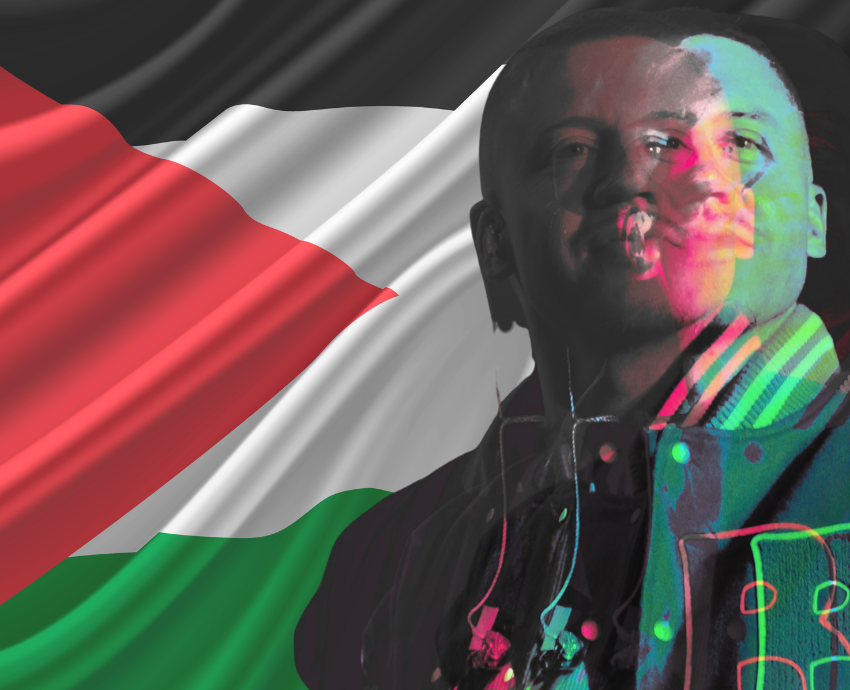
When United States rap artist Macklemore was dropped from pop singer Ed Sheeran’s US tour for saying “Free Palestine” during a concert, it sparked a global wave of support for Macklemore, and widespread condemnation of Sheeran’s refusal to take a stand on Palestine.
Billionaire Zionist Robert Kraft, owner of the Gillette Stadium where Macklemore was scheduled to perform, claimed the rapper had performed “hate speech” and pushed for his removal. The Israeli-American Council (IAC) petitioned against Macklemore, and pop singer PINK amplified social media posts by the Zionist StopAntisemitism group, claiming Macklemore had “accused Israel of a false ‘genocide’”, and “turned a mainstream event into a political nightmare against the Jewish state”.
Sheeran subsequently released a weak public response, playing down the genocide as a “conflict” and claiming he was trying to use his platform as a “sanctuary” outside politics. But as the Palestinian Campaign for the Academic and Cultural Boycott of Israel (PACBI) pointed out, Sheeran’s statement “both-sides Israel’s ongoing genocide against Palestinians in Gaza” and repeats “anti-Palestinian Israel lobby talking points that deny the genocide and want to whitewash apartheid”.
The attempt to silence Macklemore galvanised Palestinian and non-Palestinian artists and their supporters. It also brought to the fore the words of Paul Robeson, delivered at a rally during the Spanish Civil War, in 1937: “the artist must take sides. He must elect to fight for freedom or slavery.”
When faced with the ongoing genocide in Gaza, many artists have joined what can described as a cultural intifada — an uprising, or struggle within the cultural field for Palestine liberation.
Palestinian actor and director Juliano Mer-Khamis coined the term cultural intifada in 2006. Mer-Khamis argued that the “third Intifada will be a cultural intifada” and that artists must “join, by all means, the Palestinian struggle for liberation, which is our liberation struggle. We are not healers. We are not good Christians. We are freedom fighters.”
This concept has a long tradition in Palestinian art and literature. Following the 1948 Nakba (catastrophe), prominent figures such as writer, journalist and Popular Front for the Liberation of Palestine (PFLP) leader Ghassan Kanafani practised and advocated “Palestinian resistance poetry”, which expressed the lives and struggles of Palestinian refugees, peasants and workers and served the Palestinian collective struggle for liberation.
Kanafani believed that this could combat Zionist propaganda, because it transcended poetry’s traditional emotional and aesthetic concerns.“It is a closely welded literature based on reasoning and not on sheer emotion,” he said.
Kanafani was murdered by Mossad agents in 1972. Marwan Abd el-‘Al, a member of the Political Bureau of the PFLP, explained that Kanafani’s “martyrdom was part of a targeted campaign of erasure of those committed to political literature and political culture...”
Although the Zionist attempt to suppress Palestinian revolutionary cultural production existed before the Nakba, and never stopped, it intensified after October 7, 2023.
Macklemore’s cancellation is just the most recent example of the global crackdown on pro-Palestinian artists.
In Australia, Palestinian academic and writer Randa Abdel-Fattah, visual artist Khaled Sabsabi, and pianist Jason Gyllam were all censored for speaking out on Palestine. And while high profile artists such as Macklemore garner attention, there are many more unknown working-class artists refused work, opportunities and careers for taking a stance against genocide.
The global culture industry — including the commercial art market, music industry and elite art, cultural and educational institutions — works in the service of capitalism and imperialism; building social license for war, militarism, genocide, big banks, oil and gas companies, the destruction of the environment and more.
Although activists and artists have campaigned for many years for cultural institutions to remove big oil, gas and weapons companies as patrons and sponsors, and have had some modest success, the industry remains controlled by representatives of ruling class interests, such as CEOs and billionaires like Kraft, rather than cultural workers and artists.
So-called “apolitical artists” such as Sheeran are (often willingly) used by the culture industry to perpetuate the capitalist and imperialist status quo. But it is not possible to be apolitical in art under capitalism because, in the words of Surrealist poet Louis Aragon “apolitical works are really militant works for the benefit of the bourgeoisie in power”.
In the neoliberal era, art is also celebrated and promoted as an expression of liberal notions of “creativity and freedom”. A certain amount of cultural diversity, political and even anti-capitalist content is allowed, to give the illusion of a liberal and democratic cultural life.
Paradoxically, this strengthens the culture industry’s ability to provide social license and cover for the ruling class’s political agendas and ideology.
Pro-Palestine cultural production, like other truly revolutionary content, can’t be tolerated because it implicates the entire system. The risks to capitalist and imperial ideological hegemony are too great.
This is why the big capitalists running the culture industry have been on a mission to silence Palestinian and pro-Palestinian artists.
The case against Macklemore has unmasked this fact for all to see.
Since at least 2004, Palestinian groups such as Palestinian Campaign for the Academic and Cultural Boycott of Israel (PACBI) have advocated for an international intellectual and cultural boycott of Israel, “as a contribution to the struggle to end Israel's occupation, colonisation and system of apartheid”.
PACBI notes that “Israel overtly uses culture as a form of propaganda to whitewash, or artwash, its genocide in Gaza and underlying regime of settler-colonialism, apartheid, and military occupation over the Indigenous Palestinian people.”
To combat Sheeran’s role in Israel’s artwashing, the Boycott, Divestments and Sanctions movement is calling for a complete boycott of his current world tour.
Israel’s artwashing extends to its bi-yearly inclusion in the Venice Biennale — an international event often considered the pinnacle of international contemporary art scene. In May, thousands of pro-Palestine artists, artworkers and activists led an historic strike and protest against Israel’s inclusion, and a petition from the Art Not Genocide Alliance attracted hundreds of signatures.
In spite of the protests, the organisers of the Biennale allowed Israel to exhibit the work of Romanian-born Israeli artist Belu-Simion Fainaru. Fainaru’s artwork titled “The Rose of Nothingness” comprised a black pool of water that collects water droplets from a dripper array. The work alluded (in bad faith) to the poetry of Holocaust survivor Paul Celan, while celebrating Israeli drip-irrigation technology, promoting the myth that “Israel made the desert bloom”.
Israel’s participation in Eurovision is another example. Many artists and countries boycotted Eurovision 2026 in protest, but Israel was still allowed to compete. The moral bankruptcy and double standards of the European Broadcasting Union (EBU), the organising body behind the song contest, was clear when compared to Russia’s explusion from Eurovision in 2022, following its invasion of Ukraine.
Since October 7, Israel has murdered or maimed countless Gazan artists and their families. Poet Refaat Alareer was murdered by Israel in a targeted assassination, Hiba Abu Nada, a poet and novelist, was murdered along with her son in an air strike, painter Heba Zagout was killed in an air strike.
Even Gazan artists who escape the genocide as refugees face difficulties and hostility from authorities in their countries of refuge. Fayez Elhasani, former head of the Association of Palestinian Visual Artists in the Gaza Strip, was severely injured following the bombardment of his house by the Israeli Occupation Forces. The bombing killed many family members, and destroyed many of his paintings. But since being evacuated to Australia, he struggles to exhibit his artwork, due to Australian authorities and politicians labelling his work as “antisemitic”.
The Palestinian Ministry of Culture (PMC) reported in January 2024, just three months after the start of Israel’s genocidal war, that “all aspects of Palestinian culture have been systematically destroyed during the genocide war waged by the occupation state against our people”.
The PMC reported that many prominent artists, writers, musicians, dancers and cultural workers were killed along with their entire families and that their studios, archives and artistic works were completely destroyed.
The PMC also noted that Gaza had a thriving cultural and artistic scene prior to October 7 — an incredible feat of resilience given Israel’s ongoing siege and blockade of the Gaza strip.
The Institute for Palestinian Studies, as at October last year, reported at least 57 prominent cultural sector martyrs, who were targeted and killed, at least 36 destroyed cultural and art institutions, at least 21 destroyed archives and libraries and at least 49 destroyed archaeological sites and museums.
In August, the Palestine NGOs Network reported that 70% of Palestinian cultural heritage was damaged, and concluded that this destruction “can only be the result of a systemic and deliberate policy”.
Evidence for this included: “the scale of the attacks on cultural heritage sites, recurring patterns in the targeting and methods of destruction, including a number of sites being subjected to repeated and escalating attacks, and the fact that sites attacked were clearly identified as cultural or religious landmarks.”
Israel’s systematic attempt to extinguish living Palestinian cultural and artistic life and heritage constitutes a cultural genocide. This needs a cultural uprising in response, and it is up to all artists and cultural workers to take part and take a side.
Read the full story at the source
Source: Green Left (Australia)