
World Autonomies
Profanations
From the Paris Commune to October 17 from lundimatin #540, 02/11/2026 From a purely accounting perspective, the haul from the looting on 17 October remains fairly modest. Any flood, drought, environme
English (original) ·Read in Deutsch ⇄

From the Paris Commune to October 17
from lundimatin #540, 02/11/2026
From a purely accounting perspective, the haul from the looting on 17 October remains fairly modest. Any flood, drought, environmental disaster or hack of supermarket fridges comes with its share of lost goods. How, then, can we explain why recent events have sparked such terror in government departments and on television programmes? Perhaps the October protesters did not merely steal, redistribute or destroy goods, but first and foremost profaned something sacred.
What are these hordes of vandals doing, in this month of March 1871, sweeping down from the Aventine Hills of Greater Paris onto the centre of the capital? It is the city liberating the city; it is the periphery reclaiming its city.
What are these hordes of vandals doing, in this month of October 2026, sweeping down from the ultra-Parisian Aventines onto the centre of Paris? It is the hold up of the city by the suburbs; it is the outcasts liberating themselves.
What does “to liberate” mean? To liberate means to restore to the common world that which a pernicious operation had previously cut off from use, from the world, from everyday life: to liberate means to profane.
The Communards – men and women alike –, those who took to the streets, the boroughs [arrondissements] and the dioceses, who were now swarming across the expanse of Paris, and who finally seized the Hôtel de Ville that evening, on 18 March 1871, proclaimed, genuinely and above all without the need for any official ceremony, that this city belonged to them. These Communards complete – for 72 days at the very least – the reconquest of the city by the city.[1] This is what ‘Commune’ means: not what belongs to us by right, but what we take back. Profanation is an action; it requires contesting something that the authorities had rendered inaccessible, that is to say, sacred.
People have often wondered whether the Commune marked the twilight of political revolutions or the dawn of social revolutions? A futile question, insofar as those who toiled on the barricades, occupied churches, clashed in political clubs, organised charity offices, ran soup kitchens, patrolled in stationary battalions or marched in those of war, had no interest in setting the record straight for future historians. What these people were doing was restoring to the free use of men and women a space that had been “mineralised” [petrified],[2] turned into a museum; or, to put it in more 19th-century terms, “Haussmannised”.[3]
Paris was “liberated” well before 1944. The city had first been sacrificed to the forces of the Empire and the Church, “Haussmannised” twice over: urban rationalisation plus religious rationalisation. The destruction of the old buildings and the construction of immense avenues pierced through the city to make it legible and fluid for the flow of goods and the working classes. These openings were also religious, sacred. The diocese set out to explore this teeming new city, populated by newcomers who had made their way to the capital and were settling in the suburban towns, soon to be incorporated into the “Greater Paris” of the time – Batignolles, Montmartre, Belleville, Charonne…
These missionary and police enclaves were part of a process of turning the city into a sanctuary – Paris had been, quite literally, sacrificed, that is to say, partly withdrawn from the use by the people who lived there. The consecration of Paris—capital of the nineteenth century, host to the World’s Fairs, a showcase for the luxury trade and colonialism—mineralised the city: beautifying its centre whilst leaving its outskirts in a state of disrepair. Paris became a museum. The “‘Museum’”, writes Giorgio Agamben, “here is not a given physical space or place but the separate dimension to which what was once- but is no longer- felt as true and decisive has moved. In this sense, the Museum”, he adds, “can coincide with an entire city.”[4] The Parisians of the northern and eastern hills could not care less whether they were the forerunners of the 20th-century revolutions; what they did know, however, was that the Museum had to be destroyed. The joy of the occupation; the unorganised revolutionary celebration; the looting of sacred sites; the redemptive iconoclasm targeting statues and other monuments; the exhumation of corpses and their grotesque public displays; the drinking binges and carnivals in the occupied churches – all these underscore the desire to neutralise all these fetishes by making a thoroughly incongruous use of the sacred: people urinate in the holy water fonts, get drunk in the sacristy, and parody the Mass, much like those Spanish anarchists posing in cassocks in front of a church in Madrid that had been seized in 1936, liturgical objects in hand.[5]
Conversely, to sacralise is to remove the bodies, to distance oneself from them as far as possible. This is why mortals are not permitted to touch sacrificed bodies or relics. To profane, on the other hand, is to expose the liminal lie of the sacred. The sacred is not solely a matter of heaven, and to remove something from the world—to expel it into the heavens—required a human act. For relics, we speak of “translation” [translation as the movement or transfer of bodies]; for places, we speak of “consecration”; for humans, we speak of “sacrifice” or “sanctification”. In every case, the act is the same, precisely because it is an act, a manipulation—and thus a rite—that creates a myth and, above all, reproduces it and recharges it.[6] To cause a ruckus, to plunder, to parody, to dress up in front of the police, to sing obscene choruses in a church—this is to reveal that primal lie of the sacred; it is to expose the seams of sacredness and thus its weakness. To do all this is to show oneself to be careless, distracted [7] in the face of the myth’s solemnity. It is a return to the egalitarian, profane, disrespectful “joking relationship”[8], mocking the formalities of hierarchy, which presupposes avoidance, respect and deference. To plunder or retake Paris is to show that one no longer takes the myth seriously. It is to do out loud what everyone secretly dreams of, but dares not do in the face of the difference implied by the “relationship of avoidance”[9]. The worst thing one can do to the sacred is not to take it seriously. Then it collapses. And, at last, one breathes a sigh of relief, and at last one laughs.
To reclaim Paris is to assert, precisely, that Paris is a city; and not a territory annihilated by power and commodities as mere representations. To hold Paris to ransom is to smash the shop window that keeps commodities—the objects of desire—at a distance, making them all the more desirable. This, moreover, is capitalism’s masterstroke, explains Agamben: the fact that it has succeeded in blurring the sacred-profane dialectic: “the capitalist religion in its extreme phase aims at creating something absolutely unprofanable.” Capitalism sanctifies that which must be regarded as eminently desirable; precisely that which most people cannot possibly acquire. And for those who can, to consume is, each time, to destroy, to remove something from common use. The spectacle is both the sacred and the profane.[10] The separation brought about by the commodification of a thing, a place or a function is not abolished at the moment of its acquisition, but is reproduced. Unlike sacrifice, touching a commodity, possessing it or acquiring it does not mean bringing it back into the world, but simply opening a new cycle of empty sacralisation by reigniting the need and reactivating infinite production. Buying is not desecrating, but cutting away yet a little more. And it is despairing. And often, we give up.
Looting, on the other hand, is a way of circumventing this problem. It is certainly a way of fulfilling a desire without the usual mediation—the toll—of money. But it is also taking possession of the spaces that protect these goods. It is shattering the spatial separation that excludes us from entire cities dedicated to the (Universal) display of products. These separations are tangible: armoured doors, airlocks, security guards, security cameras, security gates, anti-theft devices, cameras and other surveillance and control devices, the ethos instilled in us as “good” consumers, metal shutters that come down, kilometres of plywood nailed up the day before demonstrations, as if these shopkeepers were, deep down, aware of the obvious futility of their enterprise. All these measures are admissions of sacredness. They materially admit that the sacred exists only because it is produced, protected, preserved and defended. That it is a thoroughly human operation. Thus, to steal is to scorn these measures, to disregard them, and to gain access, without any mediation whatsoever, to the naked truth of the value system: real use can come only from a reclaiming, from a profaning.
The bourgeoisie’s cries of panic merely reflect, amongst other things, a crass racism and the panic at the revelation of the emptiness that constitutes their world. The desecration of a space lays bare these voids: churches, shops and centres of power are devoid of gods. And the panic stems from the fear that these spaces might be put to some other use. That the flattened fantasies of spatial planning[11] might be transformed into Communes, into open and desecrated spaces. This is why the movement of 17 October, and that of the early days of the Commune, worked so well: because they unfolded without the guidance of authorised militant leaderships, who, more often than not, immediately set about tinkering with the sacred once again. The Great Revolutions have exhibited the reflex of the transfer of sacredness and secularisation,[12] which consists solely of shifting the places and objects of sacralisation, “leaving power intact”[13]. Power panics not because people are looting, but because they are desecrating a form of sacredness that is specific to it—whether it calls itself secular, religious or republican, it doesn’t matter. Those in power panic because looting does not speak to them; it acts without them; it makes no demands; it takes place outside (beyond) the authorised sphere of recognition. This is also why journalists who foolishly ask secondary school pupils, right in the midst of 17 October, “what are your demands?”, receive only hesitant, stereotypical and (from the perspective of their expectations) unconvincing answers; because looting does not take place on the same level. Looting circumvents politics, scorns and mocks authority, and even neutralises it by bypassing the process of sanctification upon which its myths are based. Power hates being rebuffed. So it sees red, flies into a rage, shouts and gouges out eyes. That is why it is now sending us back to wander listlessly around the sanctuary, along the Maréchaux, in a sort of “march of humiliation”, as one comrade put it, in exasperation, on 31 October. This humiliation is the sacred re-establishing its Haussmannian order by making us take the opposite route: children, it is now time to return to your peripheries, to climb your Aventines once more, to cross the ring road again. The obscene bodies, these “space invaders”[14] are leaving, battered by repression and with hearts full of hatred. But the sacred cannot exist without the profane. For the moment, the Commune has once again become Paris.
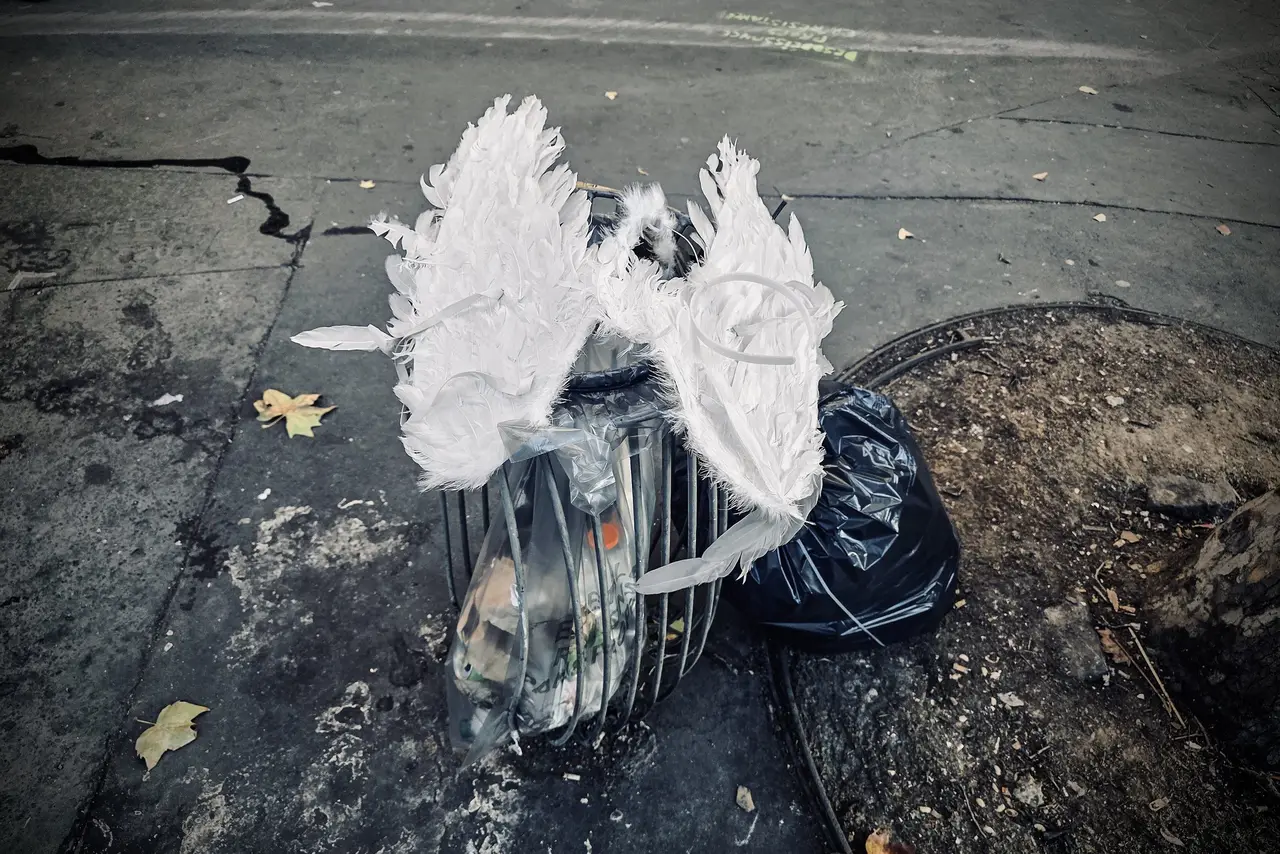
Photo: Bernard Chevalier
[1] Jacques Rougerie, Paris livre 1871, Paris, Seuil, Points Politique, 2004 [1971], p. 19.
[2] Manuel Charpy, « De la ville incertaine à la ville minérale », dans Sylvie Aprile, Emmanuelle Retaillaud-Bajac (dir.), Clandestinités urbaines, Rennes, Presses Universitaires de Rennes, 2008.
[3] [Trans. Note: A reference to “Haussmann’s renovation of Paris (known in French as the travaux haussmanniens, …, lit. ‘Haussmannian works’) was a vast public works programme commissioned by French Emperor Napoleon III and directed by his prefect of Seine, Georges-Eugène Haussmann, between 1853 and 1870. Wikipedia]
[4] Giorgio Agamben, Profanations, Paris, Rivages poche, p. 110. [Giorgio Agamben, Profanations, New York, Zone Books, 2007, p, 84.]
[5] Enzo Traverso, « chapitre II. Éveil. Formes de l’iconoclasme révolutionnaire », dans, Survivances de la révolte, Paris La Découverte, 2026, p. 149-241.
[6] Philippe, Boutry, ’Une recharge sacrale. Restauration des reliques et renouveau des polémiques dans la France du XIXè siècle’, in Pierre-Antoine Fabre, Dominique Julia (dir.), Reliques modernes : cultes et usages chrétiens des corps saints des réformes aux révolutions, Paris, EHESS, 2009, p. 121-173.
[7] Giorgio Agamben, op. cit., p. 97. [Giorgio Agamben, op. cit., p. 75.]
[8] David Graeber, Possibilités. Essais sur la hiérarchies, la rébellion et le désir, Paris, Payot & Rivages Poche, 2023. [David Graeber, Possibilities: Essays on Hierarchy, Rebellion, and Desire, AK Press, 2007.]
[9] Ibid.
[10] Giorgio Agamben, op. cit., p. 107. [Giorgio Agamben, op. cit., p. 82.]
[11] Jean-Baptiste Vidalou, Être forêts. Habiter des territoires en lutte, Paris, La Découverte, « Zones », 2017.
[12] Giorgio Agamben, op. cit., p. 100. [Giorgio Agamben, op. cit., p. 77.]
[13] Ibid.
[14] Nirmal Puwar, Space Invaders : Race, Gender and Bodies Out of Place, Londres, Berg, 2004, cité in Guy Di Meo,« Subjectivité, socialité, spatialité : le corps, cet impensé de la géographie », Annales de géographie, vol. 675, no 5, novembre 2010, p. 466?491.