
Politics · Autonomies · · 3h
Lessons from high school students in rebellion
English (original) · Read in Deutsch ⇄
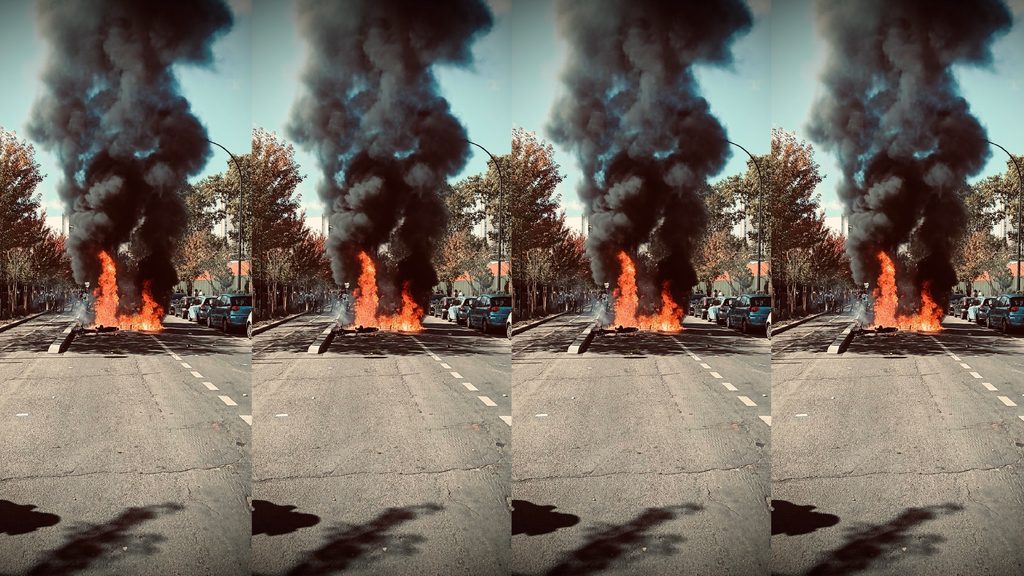

from lundimatin #536, 05/10/2026
A surprise lesson. It was the surprise of the start of the school year, one that no one saw coming, let alone predicted. While everyone seemed resigned to waiting for the next presidential election to hope for change, high school students burst onto the scene and shook all political agendas. Starting in a few high schools in the Paris suburbs, the revolt quickly spread throughout France. Without any leading organisation, without a party or union pulling the strings; just groups of students self-organising, blocking the entrance to their schools, and spreading the word among themselves and on social media; a sign that embers were beginning to rekindle beneath the ashes, just waiting for a spark to ignite the blaze.
This has been a spontaneous, unpredictable, and sudden revolt, like all revolts. As with the emergence of the Yellow Vest movement in the fall of 2018, and so many other social uprisings before it, in the fall of 2026, all political attention seemed destined to focus, inevitably, on the upcoming presidential elections, once again reducing aspirations for change to the bleak choice of the ballot box, to delegating power over one’s own destiny to others.
Defying all predictions, and disregarding the electoral calendar with a carefree attitude, the high school students wanted to say, first and foremost, that they existed, that their present and future lives had value. Even though, as minors, they had no right to vote and no added value for political parties.
They had reasons to revolt. Those put forward, relayed by the student unions, denounced overcrowded classrooms, fragmented and restrictive schedules, unfilled teaching positions, and dilapidated and unsanitary school buildings. They also denounced the humiliation and incongruity of the cell phone ban in schools, given that their teachers, like the parliamentarians who voted for it, were constantly glued to their phones. They were treated like children who needed to be punished and disciplined, even though they were young adults who refused to resign themselves to a bleak and undesirable future.
Clearly, behind the structural reasons for the lack of resources and the state’s disinvestment in national education, lie deeper criticisms. At its core, it is a denunciation of the school system of a so-called Republic which, under the guise of formal equality, merely reproduces and perpetuates class and racial privilege and discrimination.
A lesson in sociology. What is entirely new in the history of student revolts, from 1968 to the present day, is that the movement of autumn 2026 is not led by students from the city center, by offspring of the bourgeoisie who have (temporarily) deviated from their social class, but by high school students from working-class neighbourhoods. Moreover, those most mobilised in the struggle appear to be students from vocational high schools, already steered toward work and excluded from higher education. Furthermore, images of the blockades show that many of the rebellious high school students have Black or brown skin. These are young French people, of course, representing this new France which, while not recognised and appreciated by white supremacists (except, marginally, for the performances of PSG football players and the national football team), embodies its history and its future.
This is very likely why the State and its government decided, from the very first blockades, not to listen to the voices, the grievances, the demands of the striking high school students, but to repress them immediately and brutally. It’s unspoken, hidden, certainly not openly displayed, but how can one not suspect that behind the (completely unnecessary) decision to immediately resort to force in response to the students’ demands, there lies a deep-seated racism embodied by the Minister-Prefect of Police and so many officers under his command? That, like Éric Zemmour and many other descendants of Oran settlers, Laurent Nuñez is consumed by resentment and a visceral hatred towards Arabs and Muslims? That the police, accustomed to hunting down young Arabs and Black people in the housing projects under the pretext of fighting drugs, do not feel justified in beating high school students who fit the same physical profile?
A grammar lesson. To unleash the full force of the repression, ministers, police officers, and complicit journalists set up the discrediting machine. While acknowledging that high school students might have legitimate reasons to complain about their learning conditions, government officials and complicit media outlets attributed the revolt to “LFI and its far-left proxies.” To the perennial denial of the autonomy of social movements, to the ritualistic conspiratorial insinuation of a deus ex maquina using poor, naive individuals for its perfidious ends, the system’s spokespeople, disguised as independent journalists, added the label “far-left proxies.” A deliberate choice of terminology: until now, this term referred to Hamas, Hezbollah, the Houthis, and other politico-military groups fighting against Israel and American imperialism, allegedly manipulated by Iranian devils. Just another layer of paint intended to discredit the protesters.
Faced with the inevitable reaction of the protesting high school students—beaten, tear-gassed, tackled to the ground, handcuffed, and taken into custody at police stations—the tired old trope of “rioters” was trotted out once again: masked revolutionary militants supposedly infiltrated the movement. From the very first blockades of the high schools, what we witnessed were not demonstrations by rebellious students, but rather “riots,” “urban violence,” “an outburst of hatred against the police,” who were supposedly there only to protect the population, and in particular “our children,” from the evil rioters. Thus, faced with heavily armed police officers and gendarmes protected from head to toe in body armour, the protesters allegedly used formidable weapons such as “mortars,” without mentioning that these were firework mortars, far less dangerous than any of the projectiles used by the police.
A lesson in semantics. Drawing a distinction between good, well-behaved high school students, concerned with their studies, and “individuals, groups from outside the schools, seeking only to sow chaos and attack law enforcement,” aims to justify police repression. A fierce and massive repression: in one week there were 5,000 arrests, hundreds of people injured and brutalised, two high school students blinded in one eye and another left without a tooth; a ruthless and disproportionate crackdown that fell upon girls and boys, most of whom were minors. But the perversity of the Ministry of the Interior, echoed by the mainstream media, relentlessly focuses on the daily toll of burning garbage cans and injured police officers (where, how, and by whom is never specified) at the hands of “villainous masked rioters.”
The height of this reversal of responsibility for violence against individuals was reached in Belfort, where the Prefect of Police and the Public Prosecutor opened an investigation against protesters accused of “attempted murder of a person holding public authority.” This individual, who had been punched and kicked, was in fact a high-ranking local police officer, without a uniform, without even an armband, masked, and disguised as a black bloc member to infiltrate the protesters. Before being identified and beaten, he had assaulted a high school student, holding his head underwater in a stream for an extended period. Subsequently, the charge was reduced to “intentional violence,” two minor high school students were imprisoned, the police officer received his eight days of sick leave, and the congratulations of his superiors.
A philosophy lesson. What do these rebellious high school students want? Their grievances, demands, and objectives are clearly written on the banners and signs displayed in front of their schools. Complaints about their study conditions, criticisms of unfair treatment between city center and suburban high schools, protests against the selection process of Parcoursup [the French university admissions platform], and the lack of resources and teachers are juxtaposed with slogans like “Free Palestine,” “ACAB,” and “Stop police brutality.” The list of objectives continues with the fight against patriarchy, gender-based violence, colonialism, racism, and all forms of discrimination and injustice; a whole program written by high school students, young people, legal minors, not taken into account by all the authorities supposedly deciding their fate.
Anti-authoritarianism, the driving force of the ’68 generation, is resurfacing. Should we be outraged if head-teachers have been booed, sometimes even mistreated, by students? Must we agree with the self-righteous moralisers that setting fire to the gate of a “public” school is unacceptable and must be severely punished? Or should we try to consider the reasons for these actions? Can we imagine the resentment, the bitterness, the hatred accumulated by a secondary school student who, throughout their schooling, has silently endured bullying, humiliation, and contempt from the adults who are supposed to educate them, not mold them into obedience to the authorities?
The revolt of French high school students this autumn of 2026 cannot be confined to the school environment. It is overflowing everywhere. This new generation of rebels seems to concentrate and amplify the legacy of many struggles, both old and new. From anti-capitalism to anti-racism, from anti-sexism to anti-authoritarianism, it embodies principles of solidarity with all the oppressed worldwide. It emerges as a social movement of free people, without imposed or constructed cages, without leaders, without the need for representatives. It makes struggles, the construction of analyses, discourses, and collective actions the means to envision a desirable future.
This nascent movement seems to bear the traces of movements that preceded it, drawing inspiration from and renewing discourses, methods, and practices. There is a certain blend of the uprisings in working-class neighbourhoods, particularly following the murder of Nahel, and the Yellow Vest movement. A beautiful mix of colours, too, smiling faces, and groups of solidarity. These “young people” are demonstrating, day after day, without giving up, a courage and determination in the face of police repression that only their conviction in the justice of their struggle can sustain.
Are these “young, determined, and revolutionary” people, as they chant in unison on the barricades, opening new paths to dismantle this world ruled by a consortium of powerful men—economic, political, military, and media? Will they attract students, teachers, cleaning staff, the unemployed, precarious workers, skilled labourers, artisans, and retirees? Could the “young” teach the “old” a lesson?
Alessandro Stella
Read the full story at the source
Source: Autonomies