
Politics · In Defence of Marxism · · 39m
France: a decisive week – with echoes of May ’68
English (original) · Read in Deutsch ⇄
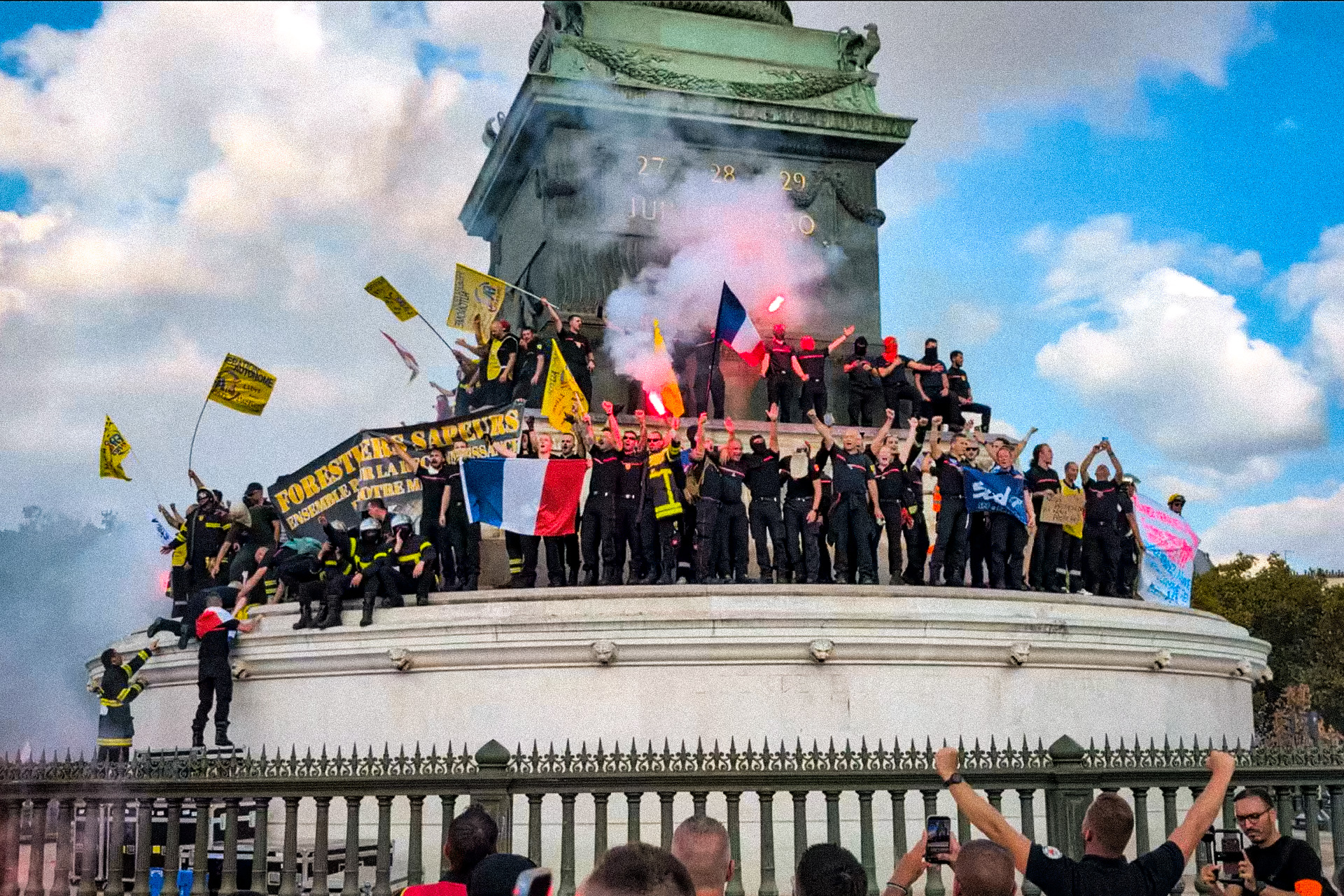
The extreme police brutality unleashed on protesting high school students was intended to stifle the movement. The opposite happened: the movement drew new strength from it, won the support of many teachers, and spread to hundreds more high schools. University students – naturally in solidarity with the high school students – have begun to mobilise.
[Originally published in French on marxiste.org]
The images of police violence sent a powerful shockwave through the overwhelming majority of the population. Millions of young people and workers are appalled and outraged by the government’s abhorrent response to a movement denouncing study conditions unworthy of a ‘developed’ country, as well as the increasing inequality in the education system.
Under pressure from widespread anger, the leadership of the CGT trade union confederation is calling on workers to mobilise – “including through strike action” – to take part in the high school students’ demonstrations organised for 6 October. Branches of the CGT and other trade union confederations are calling more directly for a strike to protect the mobilised youth and support their legitimate demands.
By resorting to tear gas, beatings, injuries and arrests, the government has brought to the fore precisely what it was seeking to avoid: the possible spread of the protests to the entire working class.
Anyone familiar with the history of May ’68 cannot fail to be struck by the similarities in the sequence of events up to this point. In early May 1968, a mobilisation of the students was fiercely suppressed by the CRS, the French riot police. The police brutality during the ‘night of the barricades’ on 10 May sparked such a powerful wave of outrage that the trade union leaders were forced to organise a 24-hour general strike in protest, on 13 May. This proved to be a huge success – and marked the beginning of a revolutionary crisis (much to the chagrin of the trade union leaders).
Anyone familiar with the history of May ’68 cannot fail to be struck by the similarities in the sequence of events up to this point / Image: Jacek E. Giedrojc Gallery
Then, as now, the newspaper Le Monde, fearing social unrest, called on the government to tone down the crackdown and change its strategy. Then, as now, the head of state’s authority had been completely eroded. In power since 1 June 1958, De Gaulle was lambasted by the demonstrators, who chanted: ‘ten years is enough!’ Give or take a few months, this slogan is perfectly suited to the current movement and to the feelings of hatred that Macron arouses in large sections of the population.
These similarities are no coincidence: they are characteristic of the onset of a pre-revolutionary crisis. This does not necessarily mean that the country will, in the coming days, embark on a movement on the scale of the great general strike of May and June 1968. But it is clearly a possibility, against the backdrop of soaring fuel prices, an austerity budget and social unrest that has been evident since the beginning of September – as demonstrated by the enormous success of the calls for a mass popular mobilisation on 17 October.
As in May ’68, the leaders of the trade union confederations are doing nothing to fan the flames of revolt. On the contrary, they are seeking to control the movement. They are turning to the government and asking it to ‘calm things down’. In May ’68, this strategy failed: the movement completely slipped out of the trade union leaders’ control.
We cannot predict what will happen in the coming days and weeks. However, we can outline what, in our view, the strategy and programme of the most militant political and trade union activists should be.
Let us start with the obvious: no ‘day of action’, however massive, will make the government of the rich back down by so much as a centimetre. It has only one thing in mind: imposing an austerity budget to attempt to contain the public debt crisis, which is worsening by the day.
If high school pupils and students find themselves alone on the frontline in the wake of 6 October, the government will endeavour to break the movement by combining police repression, empty promises and symbolic ‘concessions’. Only a massive and sustained mobilisation of the working class will make it possible to thwart this scenario.
It is true that a ‘general strike cannot be decreed’, as trade union leaders constantly remind us. Yet they offer no alternative. It cannot be ‘decreed’, but we can endeavour to organise it. A broad campaign of agitation, based on an offensive programme, must be launched across all sectors of the economy. This is the only way to gauge the fighting spirit of the various sections of the working class – and, consequently, to draw up a concrete battle plan.
The most militant sections of the working class, those most prepared for struggle, must be mobilised right now – on 6 October and in the days that follow – alongside school pupils and students, if only to protect them from police violence. If hundreds of thousands of workers lead by example in the days following 6 October, they will send a powerful message to our entire class.
The movement’s programme for the struggle is a central part of the equation. Young people are demanding decent conditions for their studies, but also an end to police violence and harassment, state racism, the Parcoursup admissions system, unemployment and the precarious jobs to which they are condemned. After a hellish summer, they are also demanding radical measures to tackle the environmental crisis. In short, they are demanding a future worthy of the name.
The most militant activists must take all the necessary initiatives to protect and support the mobilisation of high school and university students / Image: fair use
No ‘concessions’ from the government of the rich will seriously address these demands. Only a government of workers could pursue economic and social policies in line with the fundamental aspirations of young people.
In other words, all the immediate demands of the mobilised youth – massive investment in the national education system, the repeal of Parcoursup and Mon Master, the rejection of Lecornu’s austerity budget, etc. – must be linked with the objective of overthrowing the current government. This same objective must be linked to immediate demands, which affect all workers: a significant increase in wages and their indexation to inflation, the repeal of all the counter-reforms of the last ten years, the nationalisation – under workers’ control – of energy monopolies like TotalEnergies, etc.
We are well aware that this is neither the programme nor the strategy of the official leadership of the labour movement. This morning, for example, Sophie Binet (CGT) called on the government to “send a signal to high school pupils” to calm things down. But this government will ‘send’ the pupils nothing but symbolic ‘concessions’, empty promises and, above all, riot police, armed to the teeth.
Sophie Binet knows this full well, but like the official leaders of the labour movement in May ’68, she fears nothing more than a social upheaval spiralling out of her control. Consequently, instead of doing everything in her power to intensify the struggle, she implores the government to ‘send a signal’ – just as others pray to Heaven for a miracle.
The ball is in the court of the left wing of the trade union movement, but also of La France Insoumise. Whilst exerting maximum pressure on the leaders of the trade union confederations to organise the struggle properly, the most militant activists must take all the necessary initiatives to protect and support the mobilisation of high school and university students. At the same time, they must draw up a battle plan aimed at paralysing the economy, overthrowing the government and creating the conditions for a decisive victory for our class.
Read the full story at the source
Source: In Defence of Marxism