
World · Unicorn Riot · · 1h
Treesit Blocks US-Mexico Border Wall Construction for Six Weeks in Arizona
English (original) · Read in Deutsch ⇄
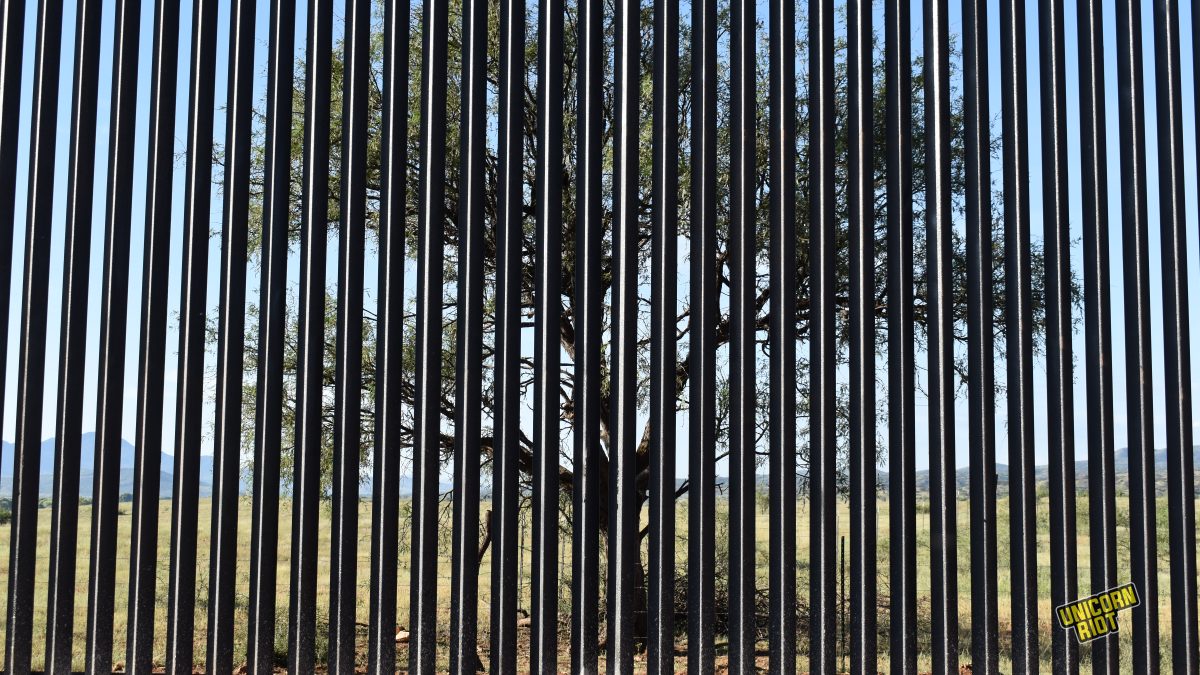
Santa Cruz County, AZ – On a cool, cloudy morning in the San Rafael Valley in Southern Arizona, a young person popped their head over the edge of a platform in a tree, perched fifty feet above the rolling prairieland below. “Hi! Thanks for coming!” they shouted down to the group of newcomers approaching the ancient cottonwood tree they now live in. When asked how they’re doing up there, they reported feeling calm and that they had everything they need. “I do miss hugs,” they said.
Since July 27, land defenders have been living in the ancient cottonwood trees they affectionately call “Grandmothers” along the U.S.-Mexico border near the old townsite of Lochiel, Arizona, 85 miles south of Tucson. The trees are estimated to be over 200 years old.
For over a month, the land defenders have been preventing the construction of two 30-foot-tall steel-and-concrete bollard walls construction companies contracted by the Trump administration are building along Arizona’s southern border. Construction has been halted along a three-mile stretch or borderland. Although many parts of the border have a “primary” bollard wall that was constructed during the first Trump administration, only a shoddy, collapsing fence marks the boundary between the U.S. and Mexico south of Lochiel. Here, construction crews had been building both walls at once.
On the day the treesit began, employees of Fisher Sand and Gravel, the private contractors that won the $352.49 million contract from the Department of Homeland Security to construct the secondary border wall, cut down three ancient cottonwood trees. In response, one protester stood in the way of construction work to prevent the destruction of another ancient cottonwood. He was briefly arrested by Santa Cruz County Sheriff’s Deputies before being released twelve hours later without charges.
The action galvanized dozens of land defenders to flock to the area and establish a treesit, where defenders rotate their presence in shifts.
Leah, a protester who helped establish the treesit, told Unicorn Riot that a small handful of people set up the platform in the middle of the night, under a bright, nearly full moon. At first, Leah said, they had some trouble getting the treesit platform–made of rectangular plywood reinforced by 2 x 4s–rigged into the tree. They also had to work around a hive of bees that called the tree home. Eventually, by around 4 a.m., the treesit was established. Setting up the treesit “felt almost like a game in a funny way,” said Leah.
Since that night, supporters have established an encampment around the Grandmother tree, which Kate Scott, co-founder of the Madrean Archipelago Wildlife Center calls “Hope Zone” or “Esperanza Zone.”
In the zone, campers sleep, cook for each other, sing and play music, and experiment with a new way of being together in this expanse of savannah known as the San Rafael Valley. The camp “gives people a chance to say what they want to say and share what they want to share, and meld it into what we all co-create together,” said Scott. “It’s a non-hierarchical camp … we’re all leaders.”
When asked how it feels to him to be at camp, Miguel, a tree-sitter who spent several weeks there, some of it perched high in the cottonwood, said “One of the best words I can use to describe the feeling there is love. People have so much love for the land and for the people resisting–a lot of care and solidarity.” Miguel said his family came to the U.S. from Mexico in the 1980s, when crossing the border was much simpler. “These sorts of issues feel very personal to me,” Miguel said.
The two parallel walls will be built using “Smart Wall” technology – AI-powered camera surveillance, bright lights, and detection devices, coupled with the double-border “enforcement zone” design. The contract for this double border wall is one of 34 Smart Wall projects comprising new border wall construction funded by billions of dollars allocated from the One Big Beautiful Bill Act for militarized border construction.
Lochiel is an old town site in the San Rafael Valley, which serves as a critical ecosystem, home to one of the most important wildlife corridors in the borderlands. Stretching across the border, the Valley is home to bears, porcupines, jaguars, ocelots, javelinas, jackrabbits, snakes, and many other creatures.
In the midst of the second Trump administration, at a time when new repressive and ecocidal policies seem to emerge daily amidst an increasingly unfavorable economy, the treesit in Lochiel represents for many a beacon of hope. “People are in such a beaten down, hopeless place,” said Miguel. “This is something they can believe in in a time when there is very little that is giving people hope… And that’s the main reason people are coming and can’t leave. They come for a night or two and stay for a week. There’s something powerful and magical happening there.”
On August 18, about three weeks after the first treesit was established, protesters began a second treesit on the La Noria, Mexico side of the border, just 100 feet from the original camp. Land defenders strung a long rope between cottonwoods on the north and south sides of the US/Mexican border to suspend a banner high in the air that read “From MN to MX, resistance is fertile.” The banner connected the recent popular uprising against the federal invasion of Minneapolis by Immigration and Customs Enforcement (ICE) officers to the struggle against the border in Lochiel. Another banner, strung beneath the treesit on the US side, reads simply “Borders Kill.”
It’s unclear whether the treesit on the south side of the easement road is entirely in Mexico or whether part of the tree it’s perched within falls along the Roosevelt Reservation – a 60-foot-wide stretch of federal land that runs along the border. Nonetheless, it stands directly in the path of the “primary” border wall Fisher Sand and Gravel had been building, just a quarter mile to the west, before land defenders stopped them. The fate of both these ancient cottonwoods is tied up with the fate of the protest camp that has emerged to protect them.
The treesit on the Mexican side was abandoned four days after it was first occupied following pressure from U.S. Border Patrol and Mexican State Police. Protesters vacated the privately owned land shortly after armed Mexican military and state police had arrived to search the property. But the treesit platform still sits high in the tall and ancient cottonwood tree whose base is covered with banners declaring the unity of neighbors on both sides of the border.
According to Miguel, this is the first time a bi-national tree sit has ever been erected along the border and the first time those fighting against the border have such a distinct tactical advantage. “It’s a unique situation that ties together things like environmentalism, migration, and land defense,” said Miguel. “And so it feels like a unique and important opportunity to fight back and hopefully stop the creation of this insane double border wall.”
For weeks, employees of Fisher Sand and Gravel would start work early, between 3:00 a.m. and 5:00 a.m., using bulldozers to scrape the lush pasture land, topple trees, and grind insects and small animals to death under their metal tracks.
Weeks after establishing the treesit, land defenders realized that they couldn’t protect the cottonwoods with the treesit alone. Construction was approaching and the bulldozers were threatening to damage the tree by driving over and chopping into its root zone.
A land defender whose family is originally from Mexico and who asked to be identified by their Oaxacan name, Uni Yuchi, was on the ground at that moment.
“As the equipment was getting closer, a couple of comrades were doing ground support for the tree and the equipment was coming right at the tree,” Uni Yuchi told Unicorn Riot. “And so the two of us who were there looked at each other and we were like, ‘We need to tell them to stop.’ And that’s how it started.”
They stepped in front of the bulldozers “and told them that they couldn’t pass,” said Uni Yuchi. “And then that kept happening for about two, two and a half hours that Friday [August 14]. And it worked. And so since then what’s happened is folks have done soft blockades using body obstruction where they jumped in front of moving equipment. They’ve told the workers that they’re not allowed to work, told them that they can’t pass, that they won’t move.”
By simply standing in the way of construction, protesters have been able to halt construction along a 3-mile strip of the border for weeks.
Miguel described these tactics as “soft blockades, where people are standing in the way or putting up semi-permeable barriers or objects into the road.” Miguel said the soft blockades have been successful so far. “Often it means they can’t work for hours or have to figure out how to go around us, and it’s really messed things up for them.”
On August 28, after several consecutive days of protesters disrupting construction, Fisher Sand and Gravel retreated from the work area, leaving their construction equipment behind. For the next three days, land defenders set up camp around the heavy equipment, even sleeping in and among the machines.
“They left that forklift,” said Uni Yuchi. “And so then that forklift was used as a pillar to build shed or shading and housing for people who then built a small encampment there and where they ate, slept, played music, read for about three days.”
For Uni Yuchi, the ability to easily coordinate in those moments is a product of the intimacy of camp life. “Being in camp together produces that kind of level of organic coordination and connection in these moments of conflict,” said Uni Yuchi. “People then are able to be brave and step into their own power.”
Since then, land defenders have continued to develop these tactics. On August 25, land defenders again put their bodies on the line, stopping the work of twenty machines and blocking destruction at a nearby local cemetery. Protesters then established a new camp in the easement road that runs along the border wall, blocking all traffic. This camp was cleared several days later when Border Patrol brought in at least 40 officers in a show of force that ultimately led to no arrests and no citations. Land defenders moved back on the private land north of the easement road.
“The work of 60 men was initially blocked by one person, who let their heart and spirit lead. They simply put their body between machines and the earth,” said Saorsie, a protester present during the actions that day, according to a press release distributed the next day by the Sonoran Desert Press Office. “It didn’t take many of us to stop work today. But, we need many more to stop this wall from being built! We welcome more people to follow where their heart and spirit lead, down to Lochiel!”
Land defenders also intervened, albeit in a different way, by protesters in Tempe, Arizona, who invaded the offices of Fisher Sand and Gravel on August 5, just a few days after the treesit was first established. The group issued a communique describing the action that was posted on Saguaros and Sabotage:
The border is like an open wound, sliced through the desert with no consideration for its people or ecology. Folks watched in anger as the ancient cottonwoods of Lochiel were bulldozed, save for the last Grandmother Tree, which is protected by the courageous land defenders who climbed its branches. Fisher Industries is the contractor responsible for this wanton destruction in furtherance of colonial ecocide. In response, the anarchists and troublemakers of the metropolis decided to bring resistance to their offices, in solidarity.
A small group pulled up outside and quickly sprinted into their parking lot. Together, they stormed through the front door, invading the building. They chanted, “PROTECT THE TREES, NO BORDER WALL!” trashed their lobby, flyered and stickered their glass, telling them to quit their jobs and abandon their complicity in ecocide. While some acted inside, others outside attached a poster to the front door, issuing a notice of eviction by the people to the company. As a bewildered employee retreated back into an inaccessible part of the building, presumably to call for help, they exited as swiftly as they entered and hightailed it back home.
A message to Fisher Industries: Your deplorable actions have not gone unnoticed, and you will be held accountable for your perpetration of ecocide in support of the fascist settler state. Cease your destruction of the land or face further repercussions.
To those in the tree and the camp, blocking the machinery of death with your bodies: The people of so-called Phoenix stand in solidarity, and their hearts beat in time with yours. Stand strong.
Until the last border wall is torn down, the last tree is felled, and the land is once again free.
Cottonwood trees are fragile, and some land defenders have been concerned about the safety of the tree-sitting tactic. “Sitting in the tree comes with obvious risk,” Miguel told Unicorn Riot. “The cottonwood trees are brittle and drop limbs, so some land defenders think it’s not wise or safe to sit in a cottonwood. But the stakes couldn’t be higher.”
Limbs can break, but the more pressing risk is from the police and construction crews, who have a vested interest in getting the sitter out of the tree. “We have to be ready to be attacked at any moment, so although it’s in some ways just sitting in a tree, it’s also very much an active defensive position,” said Miguel. “I’m looking out for threats–police, cherry picker, security–and so it’s a unique situation where I’m feeling all of the vulnerabilities of the area, you know, if something comes for me I have no where to go. I’m just in the tree and have to accept my fate.”
Miguel explained that he and the other treesitters accept the risks of what they’re doing. “This is something, in my opinion, that must happen. So the decision to go up in the tree felt like there was no question, I had to do it. There was no question for me. I was gonna sit when it was my turn, when I was needed. So I trained up, I had some climbing experience prior, and got trained up on how to go up.”
When his turn came, Miguel started to make the ascent up the tree. “So under the cover of darkness,” said Miguel, “I climbed up to the platform and swapped out with another comrade who had been sitting up there for a couple days and I settled into the platform. It’s probably 8 feet by 4 feet, so a relatively small space, and every inch is used for something–to store stuff. So I took my time settling in.”
Solidarity of campers on the ground has been integral to the continuation of the treesit, Miguel said. “What made it all possible, and what makes the treesit possible, is that we have a ground crew. The support of my comrades on the ground made it all possible, and I felt supported and loved and that made it not as scary as it could be.”
“I think going up in the tree was one of the most powerful things I’ve ever done,” said Miguel.
Since July 27, when Santa Cruz County Sheriff’s Deputies arrested a protester before releasing him later without charges, the Sheriff’s office has refused to respond to calls about protesters blocking construction.
“The Santa Cruz County Sheriff is adamantly against the border wall and border wall construction,” explained Uni Yuchi, “and also they’re a small department that doesn’t have a lot of resources that is about an hour away from Lochiel. So it’s both a logistical capacity reality and then also a political one.”
Meanwhile, a private security firm called Vision Quest accompanies employees of Fisher Sand and Gravel as they work, but has no legal jurisdiction to do law enforcement. “The first people who tried to say that it was trespassing was Vision Quest,” Uni Yuchi explained. “All people had to do was say, ‘who’s giving you authority? Under what authority are you saying this?’ And ‘show us, show us the law, show us where it says we can’t be here.’ And they couldn’t, they couldn’t produce it.”
One Vision Quest security guard was photographed patrolling the easement wearing a t-shirt emblazoned with a half-U.S.-half-Israeli flag. Journalists and activists have long drawn connections between the militarization of the U.S.-Mexico border and the militarization of Palestine by the Israeli government. It is unclear why the guard was wearing the t-shirt.
The Army 101 Airborne Unit has also been present on the ground in Lochiel, but have mostly held a security perimeter, done patrols, and offered back up to Border Patrol. The Unit was deployed to the borderlands earlier this summer, replacing the 2nd Brigade, 1st Armored Division that was previously deployed there. The Department of Defense Inspector General’s Office has reported substandard conditions for troops deployed along the border.
In the resulting law enforcement vacuum, Border Patrol has relied upon dramatic shows of force, such as showing up with an estimated 40 officers, and continual threats to issue citations to anyone on the easement, a threat they have yet to carry out. It remains unclear whether Border Patrol has the legal jurisdiction to enforce non-immigration-related misdemeanor laws. As of now, it appears that the resulting jurisdictional confusion has given protesters the upper hand, a development that may be a sign of things to come as an increasing percentage of the American population becomes disillusioned with federal policies.
Meanwhile in Quitobaquito Springs, about 145 miles west along the border as the crow flies, Border Patrol has carried out similar shows of force against those opposing border wall construction on the Tohono O’Odham Reservation. The Springs are an important ceremonial and sacred site for the O’odham people.
On September 3, a reporter on contract with Unicorn Riot documented the destruction of a 150-foot swath of desert north of the easement road that runs along the border just south of Quitobaquito Springs by contractors employed by Sundt Construction, a construction company based in Tempe, Arizona. A bulldozer driver explained to Unicorn Riot that he knew he needed to avoid both saguaros and ocotillos, but all other plant and animal life in the biodiverse area can be bulldozed. “The rest of them I can just get rid of,” he explained in Spanish.
This conversation took place as the bulldozer was set to crush an approximately 50-year-old jumping cholla (Cylindropuntia fulgida) that hadn’t made the protected species list. Observers stood between the bulldozer and the cacti for about 30 minutes before leaving the scene.
The saguaros and ocotillos that the National Park service deem healthy enough will be “relocated,” but at least a half-dozen were spotted in a trash pile this week by reporters with the Arizona Daily Star.
Russ McSpadden, an environmentalist with the Center for Biological Diversity, said that his quick estimate of the number of saguaros slated for removal in the Organ Pipe National Monument is roughly 8,900.
McSpadden explained that a National Parks Service study “counted 111 saguaros in three Organ Pipe study plots—a density of about 41 saguaros per acre. If 60 feet of habitat were cleared along the monument’s roughly 30-mile border for a second wall and access road, that would encompass about 218 acres, potentially affecting roughly 8,900 saguaros based on that documented density.” “This doesn’t include the additional 56 miles of international border through Cabeza Prieta National Wildlife Refuge just west of Organ Pipe,” said McSpadden. “It’s a nightmare.”
According to a report from the Arizona-Sonoran Desert Museum, the survival rate of saguaros that are transplanted is less than ten percent. “The success rate of transplanting large saguaros is disappointing and the practice should be discouraged,” the report concluded. “The five-year survival rate of saguaros over 15 feet (4.6 m) tall is less than 10 percent, despite the best care the Desert Museum can provide.” A majority of the saguaros currently tagged for removal in the clearance zone are over 15 feet tall.
That means that an estimated 8,010 saguaros will likely die as a result of border wall construction in the Organ Pipe National Monument. That figure does not include any other areas, nor does it include the ocotillos marked for removal or the many, many plants and animals that will not be relocated but will simply be crushed to death.
In 2021, the Tohono O’odham Legislative Council ratified a resolution officially recognizing the personhood of the saguaro, or Ha:san in the Tohono O’odham language.
The bulldozing near the springs is being carried out by Sundt Construction, which was awarded a $443.1 million contract for border wall construction in the area. The work was slated to begin May 28, 2026 and be completed by August 31, 2028. The construction of a second border wall at Quitobaquito Springs risks disturbing the nearly-extinct Sonoyta pupfish and springsnails species. The Springs are their only home on the planet. Cottonwood trees and their riparian forest ecosystems in the Sonoran desert have already faced decimation by 90% due to groundwater extraction and diversion for development and mining in the region.
O’odham people are also protesting border wall construction at the Ko:li Ki:jig camp, where several Indigenous people are maintaining a sacred fire and keeping watch, carefully reporting sightings of Border Patrol and construction contractors via Instagram.
On August 26, Customs and Border Protection (CBP) sent a SWAT team consisting of 20 armed, masked federal agents to shield construction on the reservation. According to a press release from the Tohono O’odham tribal government, both the deployment of CBP officers and the construction workers themselves are trespassing on federal land. The incursion violates the Tohono O’odham Code, Title 4, Chapter 2. The violation occurred despite the Nation posting “No Trespassing” signs on Reservation land and sending letters to inform the US federal government of the construction project’s violation of tribal sovereignty.
Thus far, CBP has flown a helicopter above camp, dusting land defenders with rotor wash – a tactic regularly used against migrants crossing the border in the Sonoran desert in which a helicopter flies close to the ground to kick up thick dust clouds. The same tactic was used against water protectors protesting the Line 3 pipeline in Minnesota.
In September 2020, a Hia-Ced O’odham land defender named Amber Ortega was arrested by National Parks Service police and charged with federal misdemeanors for sitting in front of construction equipment poised to desecrate the sacred site. Ortega was found not guilty in federal court two years later after she argued that the Religious Freedom Restoration Act (RFRA) protected her as she acted upon her “sincerely held religious beliefs.”
For Uni Yuchi, the fight against the border at Lochiel cannot be separated from the fight at Quitobaquito Springs, the fight in Big Bend, the one at Friendship Park in Tijuana/San Diego, or anywhere else along the 2,000 miles of U.S.-Mexico Border.
“We need to continue to build those connections,” they explained, “so it isn’t that folks are just fighting in Big Bend, and that’s one isolated campaign, and folks in Lochiel are fighting, and that’s another isolated campaign. But actually, the people are resisting against the border period, and there are multiple sites of that. And so that it becomes one movement with plurality and multiplicity, but one movement moving against the border and the border wall.”
Uni Yuchi also explained that the fight against the border, the wall, and the militarization of the Southwestern U.S. is not isolated to the border itself. “The border is everywhere,” they explained, “meaning that there are agencies and contractors, subcontractors that have offices and projects in their backyard. We’re saying no to the border and the border wall and to genocide and acting from the place we’re at. And so if you can’t come to Lochiel, if you can’t come to Quitobaquito, then what are those places where you can intervene and cut off the heads of the hydra that are building the border wall?”
Overall, Uni Yuchi wants everyone to understand that a better world, the one that lies in wait beyond the current world of borders, police, and the state, is coming.
“I can feel it in my body,” they told Unicorn Riot. “When you’re sleeping on that easement or you’re just hanging out in the easement and you see this valley, all the facade of the society we live in currently just falls away,” they said.
“The state’s power falls away. Their ability to hurt us falls away, their ability to imprison us falls away, and you actually feel free. And I think that’s what the birds feel like and the butterflies feel like. To them and to us, all this wall is is a nuisance, you know? And you start to think ‘all walls fall,’ you know, all walls fall. You feel that all walls fall. And I just, I wanna spread that. I wanna spread that feeling.”
More Unicorn Riot coverage from the border.
Follow us on X (aka Twitter), Facebook, YouTube, Vimeo, Instagram, Mastodon, Threads, BlueSky and Patreon.
Please consider a tax-deductible donation to help sustain our horizontally-organized, non-profit media organization:
Read the full story at the source →
Source: Unicorn Riot