
Politics · Unicorn Riot · · 1h
Nikos Romanos Acquitted As Greek Government Pushes Terrorism Cases
English (original) · Read in Deutsch ⇄
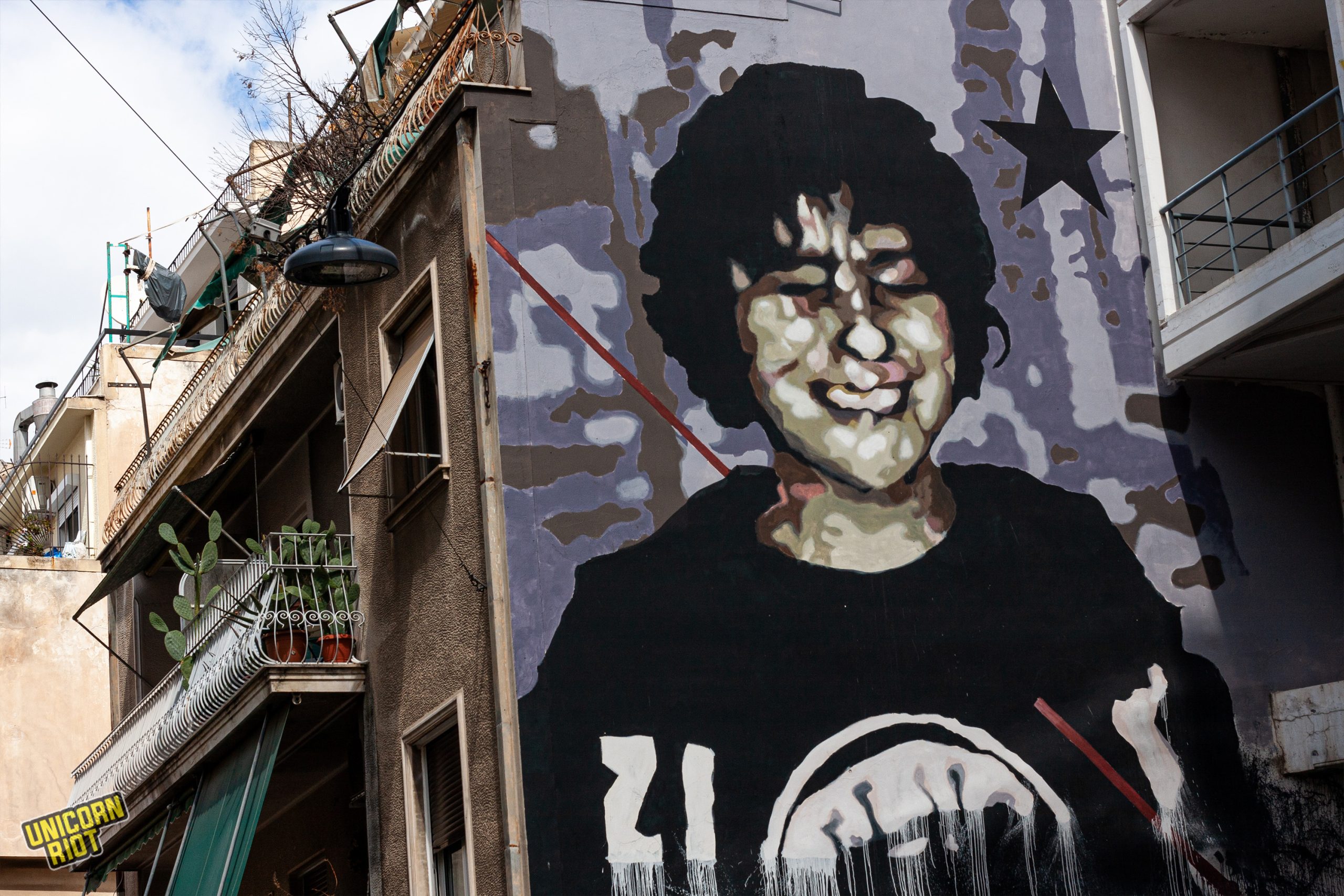
Athens, Greece — Testing Greece’s controversial terrorism law, Greek anarchist Nikos Romanos, alongside Argyrios K. and Dimitris P., was acquitted of terrorism charges earlier this year in connection with an explosion in an apartment in Athens in October 2024.
For the same case, Marianna Manoura was sentenced to 19 years in prison on explosives and terrorism charges, while Dimitra Zarafeta received an eight-year sentence.
The charges against Romanos were centered on a partial fingerprint found on a plastic bag where the accidental explosion occurred in the Ampelokipi neighborhood. The investigation turned into a terrorism case and renewed attention on Romanos who previously gained notoriety in 2008 after witnessing the police kill his friend Alexandros Grigoropoulos, which triggered weeks of unrest across Greece.
During the trial, anarchists and supporters gathered against riot police outside the courthouse while defendants inside faced terrorism charges under Article 187A of Greece’s Criminal Code, with penalties up to life imprisonment.
Article 187A, the Criminal Code provision concerning terrorism, was amended seven years ago and requires more than the commission of a serious offense. For an act to qualify as terrorism, it must create a “serious danger” to the country or an international organization and be carried out with a specific purpose, such as seriously intimidating a population, coercing public authorities, or seriously harming a country’s fundamental constitutional, political or economic structures.
Evangelia Kontaki, a lawyer who reviewed Article 187A for Unicorn Riot, argues that the provision’s language leaves significant room for interpretation. She points to requirements that an act create a “serious danger” and be intended to “seriously harm” a country’s fundamental constitutional, political or economic structures, questioning what objective criteria determine when those thresholds are met.
Kontaki argues that criminal liability should be grounded in an identifiable action rather than a person’s thoughts, beliefs or intentions. “A crime requires a physical action or an unlawful failure to act,” she said.
During the trial, many questioned how a partial fingerprint led to a terrorism prosecution, and what role Romanos’ political history had played in his prolonged 17-month detention.
The partial fingerprint became a key point of contention and the defense challenged what the print could infer.
Romanos denied any involvement, arguing that the fingerprint could not establish when, where or under what circumstances he had touched the bag. Although a weapon was found inside the bag in the apartment, his fingerprints were not found on the weapon itself.
Prosecutors argued that the fingerprint connected Romanos to the apartment’s occupants and the site where explosives were being prepared. The prosecutor eventually raised doubts about the fingerprint evidence, noting that other unidentified fingerprints had been found on the same bag. The court acquitted Romanos.
Romanos described the case as “political revenge” and argued that his political past and continued activism influenced the authorities’ decision to return him to pre-trial detention.
Speaking by phone, Anny Paparousou, a lawyer for Dimitra Zarafeta in the Ampelokipi trial, pointed to what she viewed as signs of bias in the investigation, both the decision to send the anti-terrorism unit to the apartment rather than forensic investigators and the absence of a police witness at trial.
Paparousou said the proceedings were problematic from the outset and has been vocal in her criticism of the application of Article 187A, challenging its use in the case.
She argued that Greek authorities have historically treated anarchists and left-wing movements as political threats.
Cynthia Bousiou covered the trial for the independent news outlet The Press Project and said prosecutors can often rely heavily on assumptions about what defendants knew or intended.
“They don’t prosecute what happened. They prosecute what they want. They prosecute what they believe the people thought,” she said, adding that “you cannot prosecute thoughts and beliefs,” but only proven actions.
She said Romanos’ past, including his relationship to Alexandros Grigoropoulos, had made him central to the media narrative surrounding the case.
However, Romanos’ case was not the first to raise questions about terrorism prosecutions involving anarchists under the version of Article 187A that preceded the 2019 amendments.
Greek anarchist Tasos Theofilou was arrested and charged with terrorism, murder, and robbery in connection with a 2012 bank robbery on Paros and allegedly belonging to the Conspiracy of Cells of Fire (CCF). After years of proceedings and an initial 25-year sentence, Theofilou was ultimately acquitted of all charges on appeal in 2017.
In a 2017 interview, Unicorn Riot spoke to activist and writer Panagiotis Koustas, who argued that authorities were beginning to criminalize people’s personal associations with the movement. He argued that relationships with people accused of belonging to the CCF could themselves become part of the case for terrorist involvement.
Koustas warned that such cases could test how far the boundaries of repression could be pushed, and that practices developed around them could eventually extend to other forms of activism and become normalized in courtrooms. “No one will be unaffected,” he stated.
The similarities between Theofilou’s case and the Ampelokipi prosecution highlight how terrorism charges can extend beyond the alleged act itself. More than a decade after Theofilou’s prosecution, Romanos faced a similar controversy over whether political associations and disputed evidence could be used to establish a connection to a terrorism case.
These two cases are part of a more general history of terrorism prosecutions involving anarchists and left-wing or anti-authoritarian activists in Greece. Both illustrate a concern repeatedly raised by lawyers and activists of whether political associations and a defendant’s history can become part of the evidentiary picture alongside the alleged offense itself.
In spite of years of state pressure, resistance networks have not disappeared in Greece. While radical dissent today may differ from the more militant forms of the past, solidarity and mutual aid continue to grow through grassroots initiatives that provide housing, food, medical care, and support for people in need — as seen in communities like Prosfygika, where Romanos appeared after his release to show his solidarity with the two hunger strikers.
In his speech at the squatted community, Romanos concluded with the slogan repeated by the hunger strikers, “We will win, or we will win.”
Cover image by Niko Georgiades for Unicorn Riot using photos by Elvis Takahashi Mantello and Georgiades.
Read the full story at the source
Source: Unicorn Riot