
Migration Unicorn Riot
ICE Agent Falsely Accused Federal Defender of Helping Client Evade Arrest and Deportation
A Minnesota judge apologized to a federal public defender after an ICE agent falsely accused the defender of 'aiding and abetting' a client to evade arrest and deportation. The post ICE Agent Falsely
English (original) ·Read in Deutsch ⇄
Minneapolis, MN — It was supposed to be another routine court appearance.
Assistant Federal Defender Michael Deates and his Salvadoran client settled inside the Minneapolis courtroom on April 28. ICE Deportation Officer Michael O’Neal sat inside the gallery when he heard a familiar name: Ezequiel Portillo-Rodriguez.
He pulled out his government phone and then searched for the name. A Certificate of Nonexistence (CTNE) that he filed in April 2025 popped up. To O’Neal, this meant that there were no official records of Portillo-Rodriguez ever holding a visa, green card or U.S. citizenship. He texted agent Blake Willwerscheid, asking if he knew about the case. Willwersheid told him that Homeland Security Investigations (HSI) Special Agent Brubaker was in charge of the case. A prosecutor later testified that this HSI Agent thought he was talking to an agent Witt in St. Paul.
Had O’Neal looked through court records he would have found something more relevant than a CTNE. On Sept. 2, 2025, Portillo-Rodriguez started his six-month stint inside the notorious Golden State Annex in McFarland, Ca. He filed an asylum claim while inside the private immigration jail run by GEO Group. Attorneys wrote that Portillo-Rodriguez had a “fear of persecution and torture” if he were deported back to El Salvador. Two weeks later an asylum officer denied this claim.
An immigration judge overturned that denial on November 7, 2025, finding his fears credible.
Portillo-Rodriguez filed a habeas corpus petition on Jan. 26, 2026. His attorney Deborah Czuba filed an emergency motion for a temporary restraining order on March 12. Four days later the government decided not to contest the review.
In California, U.S. District Judge Dale Drozd declared that the government had violated Portillo-Rodriguez’s Fifth Amendment Due Process rights by subjecting him to indefinite detention without a proper hearing.
On March 18, Judge Drozd issued an injunction releasing Portillo-Rodriguez and barring ICE from re-arresting him on immigration charges.
A month later, O’Neal was texting his boss, Supervisory Detention and Deportation Officer Nicholas Carey, looking for a green light to arrest Portillo-Rodriguez. He got no response while court was in session. Once the hearing adjourned, O’Neal cornered the prosecuting attorneys, asking if this was a case where Enforcement and Removal Operations (ERO) was barred from placing a detainer. The prosecutors told him they didn’t know.
O’Neal then approached U.S. Deputy Marshal Cassandra Stone, telling her he planned to take Portillo-Rodriguez into custody. Stone told him an arrest could be made at the U.S. Probation and Pretrial Services office. O’Neal claimed that Deates was standing close enough to eavesdrop.
“Deates was listening to the conversation I was having with Deputy Marshal Stone, made eye contact with me, then told his client Portillo-Rodriguez they needed to leave and follow him downstairs,” O’Neal wrote.
Deates denied this in his sworn declaration.
“I did not overhear, and had no knowledge at the time of, any conversation,” he wrote.
Deates and Portillo-Rodriguez walked downstairs to eat lunch at the Federal Defender’s Office. O’Neal rushed to the courthouse cellblock. He called Carey, demanding an immediate administrative warrant. Minutes later, Carey emailed a signed Form I-200 straight to O’Neal’s inbox.
The plainclothes task force scrambled to spring a familiar trap. O’Neal left the courtroom with Deputy Marshals Cassandra Stone and Gnika. Stone went to the Marshals Office to scan the live security video feeds, spotting Deates and his client in the public lobby.
By the time O’Neal and the marshals rushed down to the ground floor, the lobby was empty. The marshals searched the interior corridors while O’Neal glanced out a window. He caught sight of the pair walking along the sidewalk next to Minneapolis City Hall toward the light rail platform.
The three rushed outside before a red light stopped them at the intersection of 3rd Avenue and 4th Street. The light turned green. Trains departed in both directions. O’Neal saw Deates standing alone on the light rail platform. Portillo-Rodriguez was on his way back home to California.
After the failed trap, O’Neal contacted Special Agent Brubaker for an update. Brubaker informed him that Portillo-Rodriguez had been released in California on a habeas corpus petition.
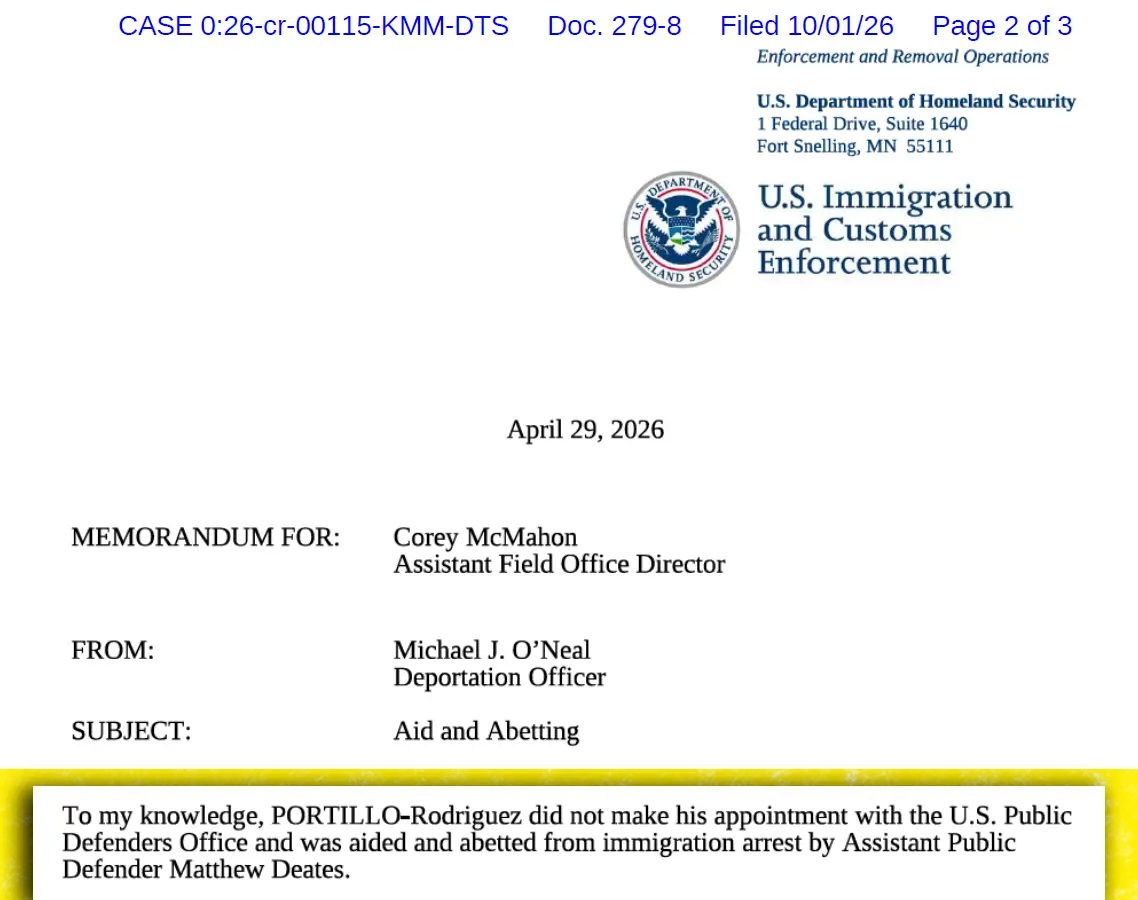
The next day O’Neal sent a memo to Assistant ICE Field Officer Director Corey McMahon with the subject line “Aid and Abetting.”
“Portillo-Rodriguez did not make his appointment with the U.S. Public Defenders Office and was aided and abetted from immigration arrest by Assistant Public Defender Matthew Deates,” O’Neal wrote.
O’Neal told McMahon that the hearing took place in front of former U.S. Magistrate Judge Raymond Erickson. That case was in front of U.S. Magistrate Judge David Schultz. Raymond retired in 2010.
No one knew of O’Neal’s mistakes for four months until prosecutors accidentally filed the memo as evidence in the Minnesota 15 federal conspiracy case on Aug. 20. U.S. Attorney Daniel Rosen and Assistant U.S. Attorney Tory Sailer wrote that the memo “does not reflect the position of the U.S. Attorney’s Office.”
Deates broke his silence on Oct. 1, filing a sworn affidavit demanding the U.S. government correct the record and clear his name.
“My professional reputation depends on the trust of this Court, opposing counsel, and my clients,” Deates wrote. “The O’Neal Memorandum’s accusations about me are false … The government’s … letter, which says nothing about the falsity of the accusations against me, does not correct the record.”
Supporters of the Minnesota 15 packed both an overflow room and Judge Schultz’s courtroom on Oct. 20. Some laughed at the revelations. Others shook their heads in disbelief.
Sailer told Schultz that the government possessed zero evidence linking Deates to criminal obstruction or aiding and abetting an escape. Schultz then asked about his client.
“If you take the facts that are disclosed in the O’Neal memo, is there a factual basis for asserting that Mr Portillo-Rodriguez evaded a lawful arrest?” Schultz asked.
Sailer called his position “unpopular,” saying “it does get into constitutional issues.”
“It’s not that it’s not popular. It’s ludicrous,” Schultz said.
“I don’t agree with that,” Sailer replied.
“Agent O’Neal can decide which orders of Article 3 are lawful?” Schultz asked. “INS [Immigration Naturalization Services] rules trump the California judge’s order?”
“I have my own personal views about this. The legal analysis I don’t think is clear,” Sailer said. “I’ve done this in Texas. Expedited removals happened all the time… I am just relaying that the executive has quite a bit of authority with regards to immigration matters.”
Sailer maintained that O’Neal detaining Portillo-Rodriguez on April 28 qualified as a legal arrest.
Yet, O’Neal carved out a critical admission at the end of his memo: “I contacted Special Agent Brubaker, I inquired about the case and she stated Portillo-Rodriguez had been in custody in California and released on a Habeas Corpus and made his way to Minnesota to attend an initial appearance. At no time prior to the incident had I been aware of that information.”
“If Agent O’Neal thought that it was somehow lawful for him to immediately arrest and deport Mr. Portillo-Rodriguez, then why in his memorandum made a point of saying I was unaware of the fact of a restraining order? Why would he cover his trail?” said Schultz.
Kevin Riach told Schultz that he would cross-examine O’Neal if his name was tied to the Minnesota 15 case.
“It confirms that this entire investigation is being driven by people who have no idea what they’re doing,” Riach said. “The agents don’t even know the names of who they’re talking to. It’s like an ever-ending fountain of impeachment material.”
Riach’s client felt amused. Isaac Sant has described the case against the 15 as purely political and an attack on the working class.
“It is both humbling and a little embarrassing to learn that I was arrested by the dumbest cops alive,” Isaac Sant said.
Joshua Panduro Preston, co-counsel for Macalester Professor and Minnesota 15 defendant Erik Davis, said that Schultz berating the U.S. Attorney’s Office was justified and also unprecedented.
“We’re witnessing at this moment in time the judiciary asserting itself in a way it hasn’t done before. Historically, there’s been the presumption of regularity.” Preston said. “Now we’ve reached a point where all that trust is out the window and we see the court rake these prosecutors over the coals. I mean, that is not stuff you normally see.”
“The government has no plans to go forward with these ridiculous changes. The government is unwilling to say that Mr. Deates done nothing wrong. That is besmirching the reputation of one of the finest lawyers in this district,” Schultz said before turning to Deates. “On behalf of the United States: I apologize to you. This should not have happened.”
Read the court documents and exhibits related to this motion to compel a correction from the government.
Cover image by Niko Georgiades for Unicorn Riot.
Follow us on X (aka Twitter), Facebook, YouTube, Vimeo, Instagram, Mastodon, Threads, BlueSky and Patreon.
Please consider a tax-deductible donation to help sustain our horizontally-organized, non-profit media organization: