
Politics · Unicorn Riot · · 2h
A Failed Reception System in Crete Turns People on the Move Into Political Targets
English (original) · Read in Deutsch ⇄
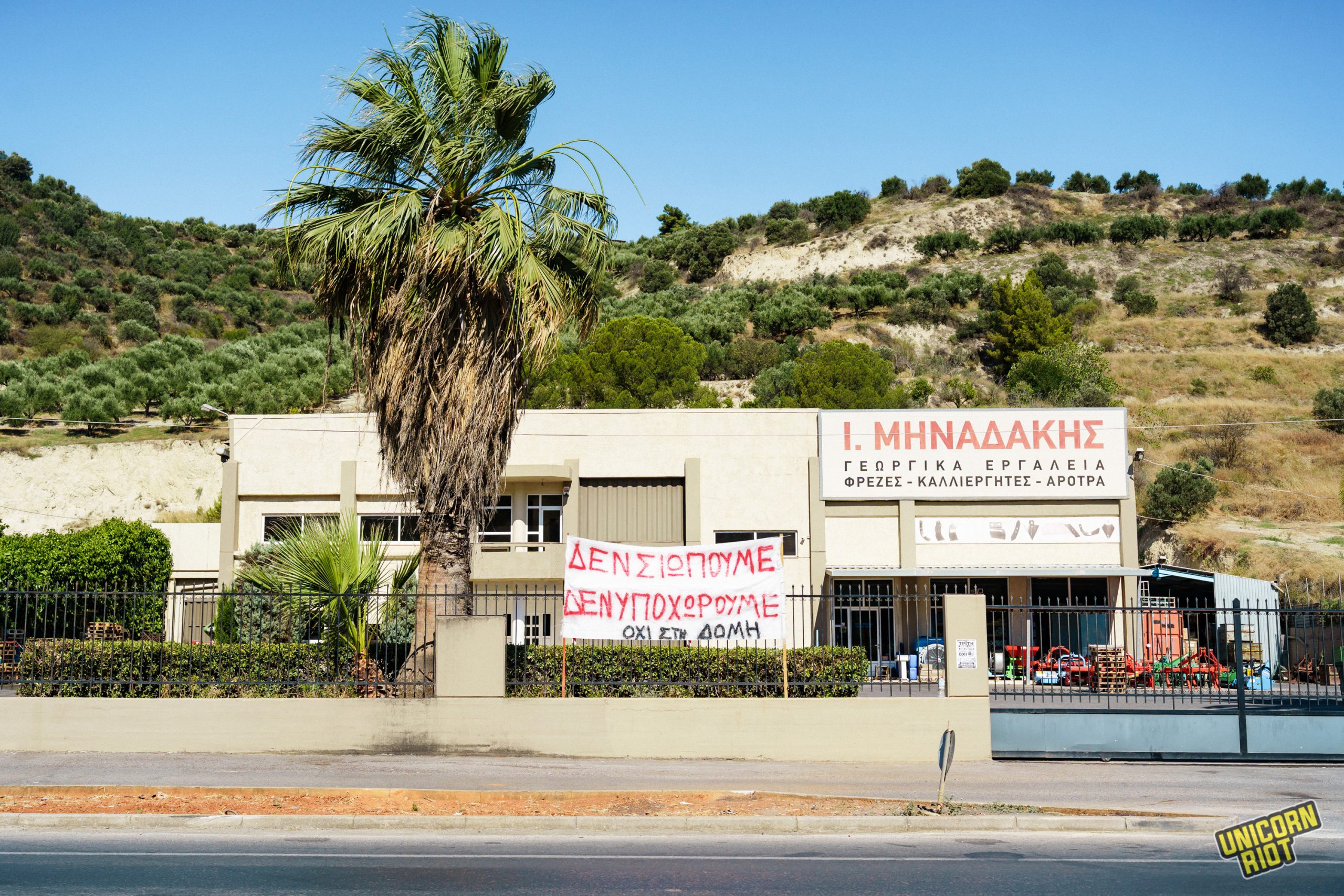
Athanatoi, Greece — Residents of a small village in Northern Crete, near Herakleion, are fighting the Greek government’s plan to convert a disused factory into a reception center for people on the move, escalating a monthslong standoff that pits xenophobic backlash against an increasingly securitized European border regime.
“We’re not staying silent. We’re not backing down. No to the camp.” The slogan, painted in red and black across a large banner, hangs from the gate of a factory facing the Candia-Mires state highway, near the village of Athanatoi in northern Crete. A few yards away, a second banner reads: “No camp — the people have a voice.”
Across the road stands the disused Skouloudis industrial complex, recently identified by Greece’s Ministry of Migration and Asylum as a site to be converted into a reception center for migrants crossing the stretch of sea between Libya and Greece and landing on the island’s southern coast. Since Minister Thanos Plevris announced the plan in mid-June 2026, Skouloudis has been at the center of a bitter standoff between authorities and local communities.
The choice of this industrial site, however, is only the latest development in a long and contested decision-making process that began in the summer of 2025, when arrivals in Crete far outpaced those recorded along the Aegean route — the sea passage from Turkey to the Greek islands of Lesbos, Samos and Chios that has long been the country’s primary migration corridor — making the island Greece’s main point of entry.
Against a backdrop of chronic absence of adequate first-reception facilities on the island, the handling of landings has fallen to entirely unsustainable emergency measures.
The main temporary holding site in Heraklion remains the former psygeio — a Coast Guard cold-storage building in the port area. Meant to hold just 70 to 80 people, the site held more than 450 in the first months of 2026, forcing men, women and children to sleep on the floor.
The lack of adequate sanitation and ventilation created dire health conditions, while pressure to find an alternative mounted further as the Port Authority pursued legal action to clear the site. Faced with this infrastructural collapse, authorities found themselves forced to publicly propose a solution.
In the summer of 2025, the government announced the conversion of several military sites, but that announcement was followed by months of silence and effective inaction. Only in February 2026 did the Greek Parliament approve the opening of two centers, without specifying their location or how they would be built.
The first details came only months later: in Chania, authorities settled on retrofitting Agya, a former exhibition center already in use as a temporary reception facility; in Heraklion, the disused Skouloudis industrial plant was identified instead.
“These delays and constant changes of plan shouldn’t be read as political strategy, but as failure,” Michalis Markodimitrakis, a member of the Heraklion-based collective Thalassa of Solidarity and a researcher at the Hellenic Mediterranean University, told Unicorn Riot.
“Local communities and representatives of Crete’s tourism and cultural sector are pushing back hard, because they see the presence of migrants as damaging to the island’s image and a threat to their economic interests.”
Back in July 2025, the day after the first announcement floated the opening of the centers, a network of tourism industry associations sent an open letter to Prime Minister Kyriakos Mitsotakis and Migration and Asylum Minister Thanos Plevris, voicing strong concern over the “chaotic images” of “mass landings” that, they claimed, were already damaging the island’s reputation as a “safe and attractive” tourist destination. The letter closed by demanding that plans to build the centers be suspended, that all asylum seekers be immediately transferred to facilities on mainland Greece, and that tougher border-enforcement measures be adopted.
During that same period, between June and July 2025, two incidents took place. The first, in Rethymno, involved roughly 100 protesters who gathered outside a temporary tent camp set up to house 500 people who had just landed on the island. The group threw smoke flares at the tents and slashed the tires of trucks delivering portable toilets to the camp.
A few weeks later, other residents gathered at a landing point in southern Crete, blocking 150 people who had just arrived from Libya from boarding buses that were meant to take them north.
It’s against this backdrop that local opposition to opening a center at the former Skouloudis plant has taken shape, drawing support so far from roughly 10,000 residents.
“The protests are framed around seemingly humanitarian arguments, but underneath them is a racist core,” said Markodimitrakis. “We shouldn’t forget that Golden Dawn [the far-right, neo-Nazi political party designated a criminal organization by a Greek court in 2020] has had a presence in the city for over a decade, and today we still have young affiliates patrolling the streets, organized into paramilitary groups.”
While the protests are officially framed around serious infrastructure shortfalls and environmental risks — including the lack of a connection to the public sewage network, insufficient water supply, and proximity to a stream at risk of flooding — they’re also backed by arguments centered on the area’s social and economic impact.
Residents, farmers and business associations say the decision-making process has lacked transparency and public participation, warning of serious economic damage to local artisanal businesses and negative effects on tourism.
“Political propaganda and media narratives around refugees and migrants have gotten a lot worse compared to 10 years ago,” added Eleftheria Iatraki, a member of the Thalassa of Solidarity collective, drawing a comparison with the start of the so-called 2015 refugee crisis — when more than a million people, most fleeing war in Syria, Afghanistan and Iraq, crossed into Europe, with Greece’s eastern Aegean islands serving as one of the main entry points — and noting that even then, Crete was a secondary destination for asylum seekers who had entered through Turkey.
“Back then, the local community was more willing to welcome and help Syrians and Afghans. Today, there’s total rejection instead. And that’s happening mainly because the media narrative is focused on criminalizing these people.”
Indeed, one only has to look at the language used as early as the summer of 2025 by two of Greece’s major national outlets, Kathimerini and CNN Greece, to see how the narrative pushed by the conservative New Democracy government, in power since 2019, has shaped media coverage — reinforced in turn by an increasingly restrictive, security-driven turn across Europe. In describing the situation in Crete, words like “invasion,” “asphyxiation” and “suffocation” come up again and again.
“The kind of racist reactions we’re seeing today aren’t rooted in any real, lived perception,” Markodimitrakis continued, referring to the findings of his research. “Over the past year I’ve talked with many people who work in tourism, and when I asked them, ‘how many refugees do you see on the street in the course of a day?’ not one of them knew how to answer. And yet the word ‘invasion’ keeps getting used.”
This invisibility, moreover, is also the product of a deliberate institutional management of space. Speaking with Unicorn Riot, Eleni Zervoudaki, Chania’s deputy mayor for social policy, acknowledged that the peripheral location of the former Agya exhibition center has helped head off backlash and protest from the local community: “Agya is outside the city, in an area without many houses. Whenever we’re dealing with situations like this, there are always people in favor and people against it, so it’s important not to make too much noise. In that sense, Agya’s location has helped us.”
While in Chania, authorities manage the situation quietly, aided by peripheral isolation. In Heraklion, the attempt to apply the same strategy has turned into an exhausting political and bureaucratic standoff. Between late August and early September 2026, the saga of the former Skouloudis warehouses reached its point of maximum tension.
Despite street protests, opposing resolutions from the City Council, and findings from the Urban Planning Office — which cited serious building code violations and fined the property owner more than €282,000 — the Migration Ministry held firm.
In August, the government formalized its acceptance of the lease on the building and assigned 18 border guards to secure the site. The institutional standoff then came to a head at a September 8 meeting in Athens, where Minister Thanos Plevris reaffirmed that the decision on Skouloudis was final, giving Cretan officials just a 10-day ultimatum to present a counterproposal.
And yet, in this endless back-and-forth of objections, bureaucracy and institutional resolutions, the public debate seems to have completely lost sight of what the issue is actually about: people.
While authorities stall on managing an unwanted piece of infrastructure and local politicians compete to push it out of their own territory, it’s the people who keep landing on the island’s coasts who pay the highest price for this permanent emergency.
Packed into closed, overcrowded facilities, asylum seekers remain the only real hostages of this institutional inaction — their condition showing that, beyond government proclamations and zoning technicalities, the Greek and European containment model keeps offloading the full weight of its own contradictions onto the bodies of people seeking protection.
Cover image by Niko Georgiades for Unicorn Riot featuring photos by Romanos Lioutas and Google maps.
Related: Inside Greece’s Refugee Camps, Gender-Based Violence Is Built Into the System
Follow us on X (aka Twitter), Facebook, YouTube, Vimeo, Instagram, Mastodon, Threads, BlueSky and Patreon.
Please consider a tax-deductible donation to help sustain our horizontally-organized, non-profit media organization:
Read the full story at the source
Source: Unicorn Riot