
War & Militarism Tribune
Zionism Is Class War
The effort to ‘normalise’ Israel is really an attempt to legitimise poverty, plunder and repression.
English (original) ·Read in Deutsch ⇄
‘Don’t do anything crazy, boy.’ These were reportedly the last words the Egyptian president Anwar El Sadat said to his killer before being gunned down at a military parade in Nasr City in 1981. The assassination squad had pulled up in front of the presidential grandstand and opened fire on the assembled officials. Sadat initially thought they were part of the show and greeted them with a salute. He had refused to wear his bulletproof vest that day, despite pleas from his wife. This ‘hero of war and peace’ felt he had little to fear from his people.
In the end, the Egyptian public didn’t even show up to Sadat’s funeral; it was mostly attended by foreign dignitaries. (The BBC would later cover the events in a documentary titled Why Was Cairo Calm?) The motive for his killing, carried out by a small Islamist cell with support from the army, was simple: Sadat had normalised relations with Israel, abandoning the Arab struggle and aligning the country with America’s Cold War camp. A month earlier he had launched a violent crackdown in which more than 1,500 opposition figures were arrested in a single sweep: leftists, Islamists, journalists and even Coptic clergy. The writer Mohamed Hassanein Heikal described it as ‘the autumn of fury’.
But while the assassins fulfilled their mission, it was Sadat’s vision for Egypt that ultimately prevailed. His successor Hosni Mubarak extended the agreements of 1978–9: the Camp David Accords and subsequent peace treaty with Israel, which turned the country into an outpost of empire and sealed the Palestinians’ subjugation. Today, Egypt remains a Camp David Republic: a tinpot dictatorship, a craven collaborator, and a model that the US strives to replicate not only in West Asia, but across the wider world.
Compradors
The story of normalisation goes back to the 1973 oil crisis: an event that convinced Henry Kissinger to develop a more individualised approach to the Arab states, co-opting them one by one rather than dealing with them collectively. What better place to start than Egypt, the largest and most influential of these nations, with a leadership that seemed more than willing to be bought off. The rollout wasn’t easy. Before the ink had dried on Camp David, the Shah had fled Tehran and Khomeini had established the Islamic Republic, removing a crucial US proxy. Yet the success of the comprador strategy in Cairo was hugely significant. The Nobel Peace Prize and other Western accolades showered on Sadat created the sense that building relations with Israel was a step towards reconciliation between the peoples of the region. Its real purpose — forced integration into the US-dominated world order — was obscured.
Next came the Oslo Accords of 1993. The Palestine Liberation Organisation, increasingly isolated in the Arab world, agreed to recognise Israel’s right to exist in exchange for limited self-rule. The Palestinian Authority was set up as a five-year interim body before the promised transition to statehood. But statehood never arrived. Instead, the PA became yet another arm of the occupation, financially dependent on Israel and enforcing ‘security’ on its terms. As in Egypt, the dividends of so-called peace flowed upward to a new elite, which forfeited sovereignty and got imperial patronage in return. A year after Oslo, the same pattern played out in Jordan, as a deal was struck with King Hussein over the heads of the public which bought Israel its second quiet border.
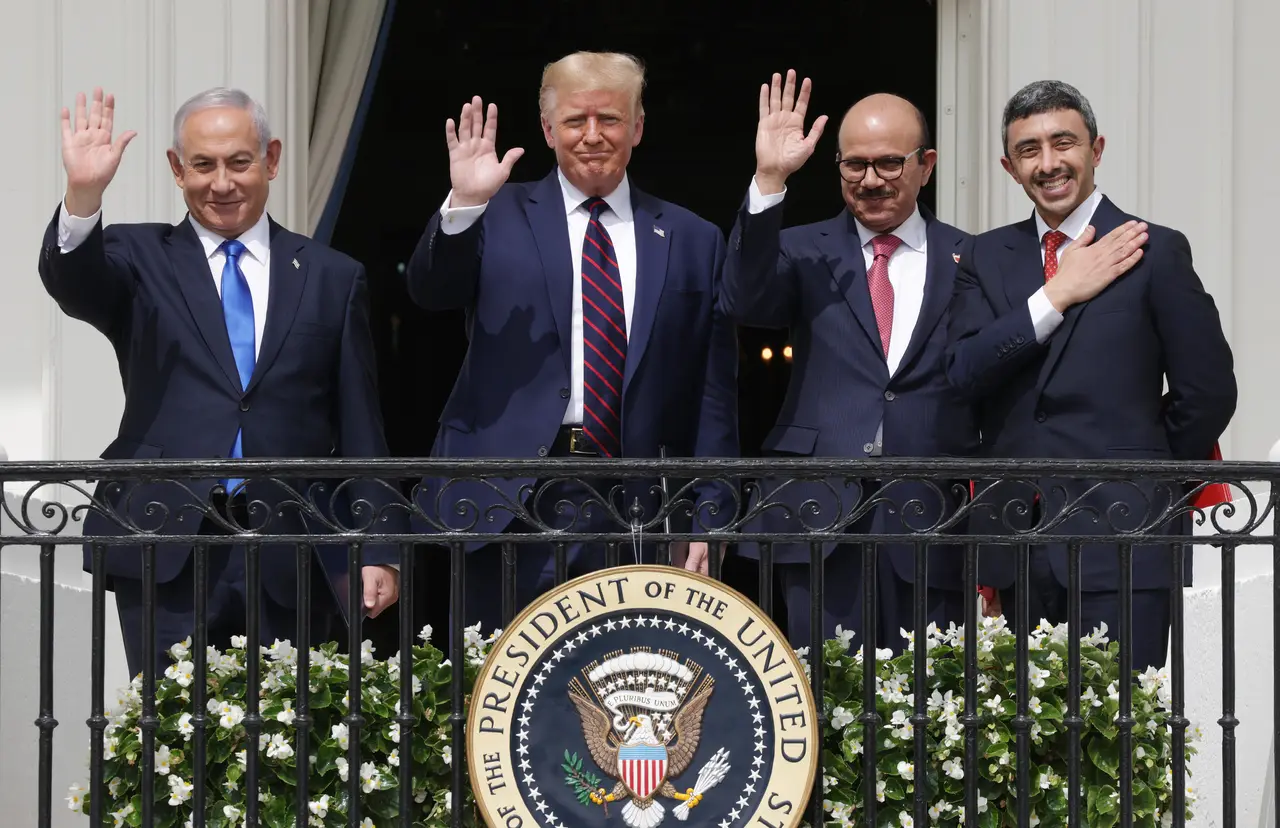
The Abraham Accords of 2020 were a further variation on this theme, normalising relations between Israel, the UAE, Bahrain, Morocco and Sudan. This time there was more of an attempt to sell Israel to the masses: trade fairs, investment, direct flights, tourism campaigns. By forming this web of economic and political dependency, the empire hoped to build a strategic alliance against Iran. The real prize here was Saudi Arabia, whose integration would have allowed the world to finally move on from the problem of Palestine and leave its people to their fate. Everything seemed to be on track — until al-Aqsa Flood ignited the region, and put Gaza centre stage.
Since then, the politics of West Asia has revolved in large part around whether the empire can accelerate normalisation or whether the resistance can disrupt it. Syria’s Ahmed al-Sharaa, who was leading an Islamist insurgency before he stormed Damascus’s presidential palace, pursued a security deal with Israel after taking power. Though Israel reportedly backed out at the last minute (preferring to see Syria fully balkanized), al-Sharaa has nonetheless been repaid by Washington, which lifted sanctions and scrapped a $10 million bounty for his arrest. The reward structure is identical to Sadat’s, but the timeline has now shortened from years to months.
In September, Israel began briefing that Kuwait could soon join the Abraham Accords. Backroom diplomacy with the Saudis has restarted, and the Lebanese government is under intense pressure to neutralise Hezbollah and sacrifice the South to Israel, so that the country can be fully assimilated into the imperial order. With nothing to show from its war on Iran, the US is all the more determined to secure these gains. By linking together its two preferred poles, Israel and the Gulf monarchies, it could unite them against any local project it dislikes, while reducing the costs of its regional hegemony.
The Colonised Mind
Though normalisation takes place through a series of separate treaties, it is in fact one continuous project: a nexus of security, capital and infrastructure that embeds imperial power in a part of the world that has long resisted it. Railways, desalination plants, energy fields and ports are used to bind these countries together and paper over the political contradictions between them. The issues that the Arab masses care most about — occupation, dispossession, sovereignty, the right of return — are bypassed through ‘economic peace’. Dependency is remade as interdependency.
The scholar Rafeef Ziadah has documented these growing connections. In September 2021, the UAE’s sovereign wealth fund took a 22 percent stake in Israel’s Tamar offshore field; two years later, Abu Dhabi’s national oil company joined with BP to bid $2 billion for half of NewMed Energy, the Israeli firm that holds the largest stake in the vast Leviathan gas field. Egypt meanwhile signed the largest gas export deal in Israeli history in August 2025: $35 billion for 130 billion cubic metres of Leviathan gas through 2040. Jordan has imported Israeli gas under a long-running Chevron-brokered supply deal, shrugging off public opposition.
Peace has thus come to mean Egyptian and Jordanian energy grids wired permanently into Israeli supply, with all the leverage on one side. Normalisation is class war in the classic sense: an elite project that plunders the wealth and resources of the people. The reason Israel is so loathed across the region is not merely ‘ideological’. It’s because Zionism is the avowed enemy of the Arab working classes, the primary force of de-development, which has impoverished this war-torn part of the world.
If Arab rulers cannot persuade the ruled to embrace normalisation, they can at least strive for passive acceptance. The BDS movement has described this as a process of colonising the mind: presenting integration with Israel as the only possible outcome, the sole ‘realistic’ option. Expectations must be lowered and alternatives must be eclipsed. ‘Peace with Israel’ becomes a proxy for demobilising the masses and securing their respect for established power, even as it unleashes more sadistic violence than ever before.
For the first time, this same formula is now being used beyond West Asia. The far-right Argentine president Javier Milei has launched the ‘Isaac Accords’: a trade, technology and security framework to bind Latin America to Israel, countering Iranian and Chinese influence across the hemisphere. The days of the Pink Tide, when chavismo severed relations with Israel and moved closer to Iran, have come to seem like a distant memory. As part of her plan to open up the country to US drilling, Venezuela’s new leader has shipped crude oil to Israel’s Haifa refinery and restored ties with Tel Aviv.
The conclusion could not be clearer: normalisation is the fee for entry to the imperial world-system. Forty-five years ago, Sadat was assassinated by his own countrymen for making peace with Israel. This year, Ali Khamenei was assassinated by the US for making the opposite decision. Both leaders made many mistakes in their different contexts — yet, seen solely through this lens, the distinction between their deaths is stark, separating the destiny of the traitor from the fate of the martyr.