
World · Tribune · · 50m
Without Public Ownership, ‘Public Control’ is an Illusion
English (original) · Read in Deutsch ⇄
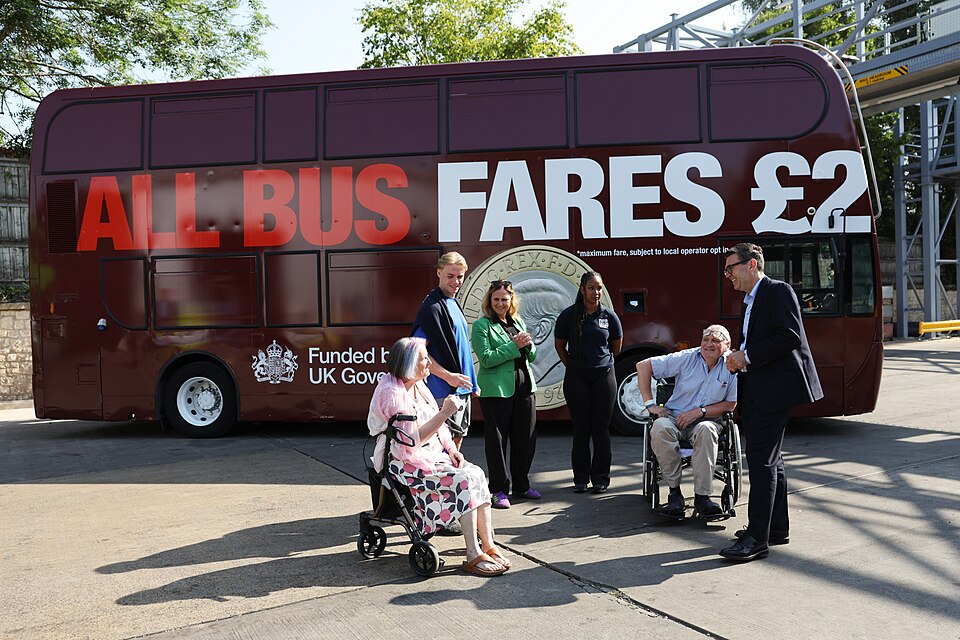
Last month, West Midlands Mayor Richard Parker took most of the West Midlands’ buses into public ownership. For £24 million, the West Midlands Combined Authority (WMCA) has acquired National Express’s entire regional operation, taking on their 1,400 buses and responsibility for 94 per cent of local journeys.
Backed by £11.5 million from No. 10 North, this is one of the largest transfers of bus services into public hands since the era of privatisation began.
This is good. For too long, municipal ownership has been treated as an impossibility. Until recently, councils were banned from even setting up bus companies. Only a handful of operators survived Thatcher’s purge, like Nottingham and Reading, and remain in public hands.
But there is a contradiction here. West Midlands Bus Limited, the new publicly-owned company, will ‘not bid for franchised routes’ when bus franchising begins in 2027. It makes the purchase look more like a stopgap, with the mayoralty acting as an operator of last resort until it can find a private company to take it back over.
The circumstances of the sale suggest crisis management more than a commitment to public buses. Mobico, National Express’s parent company, wanted to bail on the region. It openly describes the sale as part of a strategy to ‘monetise’ its bus assets and ‘de-risk’ before franchising came in.
It’s a playbook we’re seeing right across the country. The public carries the risk; private companies take the returns. If the balance sheet is threatened, they leave. Private capital has a strategy for bus services. Westminster needs one of its own.
Franchising has been seen as an answer. In his last job as Greater Manchester Mayor, Burnham made a success of the Bee Network. As Prime Minister, he claims he will place public control at the heart of his vision of ‘Manchesterism’, using it as a lever for economic growth.
In his first speech as Prime Minister, he identified part of what went wrong under Thatcher. ‘Political power was centralised, economic power privatised’, resulting in a ‘failed economic model’ which ‘allows wealth to be extracted and siphoned out.’ His answer is that we need to ‘be relentless’ at giving people and places ‘ownership and control.’
The basic diagnosis is right. But ownership and control are not the same. Franchising gives public authorities control over the network. But the buses are still run by private companies, who make a profit from doing so. Public ownership goes further: money derived from running the service can stay in the service.
We should be relentless about giving communities control. But you cannot truly have control over something you do not own.
The story of bus services over recent decades has been one of managed decline. Bus mileage, the total distance covered by our bus network, peaked around the millennium. By 2014/15, coverage had fallen to 1.29 billion miles; by 2024/25, it was down to one billion. In a decade, the UK lost almost a quarter of its bus network.
Greater Manchester has begun to reverse that decline. Bus mileage increased by 7 percent during the first year of franchising. But restoring a network costs money — and under franchising a large chunk of that is still gifted to private capital rather than being reinvested to improve the network.
Greater Manchester spends £227m each year subsidising its bus network; London spends almost £1.2 billion. There is nothing wrong with investing in public transport, but this isn’t that. More than 40 percent of bus operator revenues come from public subsidy. And when Stagecoach, First, and Arriva still record seven- or eight-figure profits, the limits of franchising become clear: public transport is still being run to generate shareholder profit.
We need a new story to tell. Before Manchesterism, there was the People’s Republic of South Yorkshire. In the 1980s, South Yorkshire understood that public transport could shape a region. In those days public subsidy meant low fares. At 10p for adults and just 2p for children, South Yorkshire’s buses were the envy of the country.
Thatcher declared war on council-owned buses. In 1986 she deregulated bus services, stripping councils of the power to set routes, fares and timetables; and in 1989 her government ordered South Yorkshire to privatise its bus company — or face her Ministers breaking it up by force.
Because South Yorkshire’s bus company was about more than providing a service. It reflected a belief that local government should transform people’s surroundings and raise expectations. Being able to travel, for whatever purpose, without having to spend half your wages or owning a car, changed what people could do with their lives.
It would cost £3 billion per year to make all bus services in England free at the point of delivery. In the context of government spending, that is a small sum to pay to transform how millions of people get around. And considering how much good public transport boosts productivity the economic benefits could easily outweigh the cost.
But doing so would mean recognising that public transport is an enabling service — that it functions, in Mick Lynch’s words, as ‘a tool of liberation’.
This is something that we had once. Something that was taken from all of us. Richard Parker taking the West Midlands buses into public ownership is a brave first step towards getting it back.
But after four decades of decline, we cannot settle for half measures. It is time to put the public back in charge of public transport. We need public ownership now.
Read the full story at the source
Source: Tribune