
Labour · Tribune · · 1h
Will The Arts Survive In Northern Ireland?
English (original) · Read in Deutsch ⇄
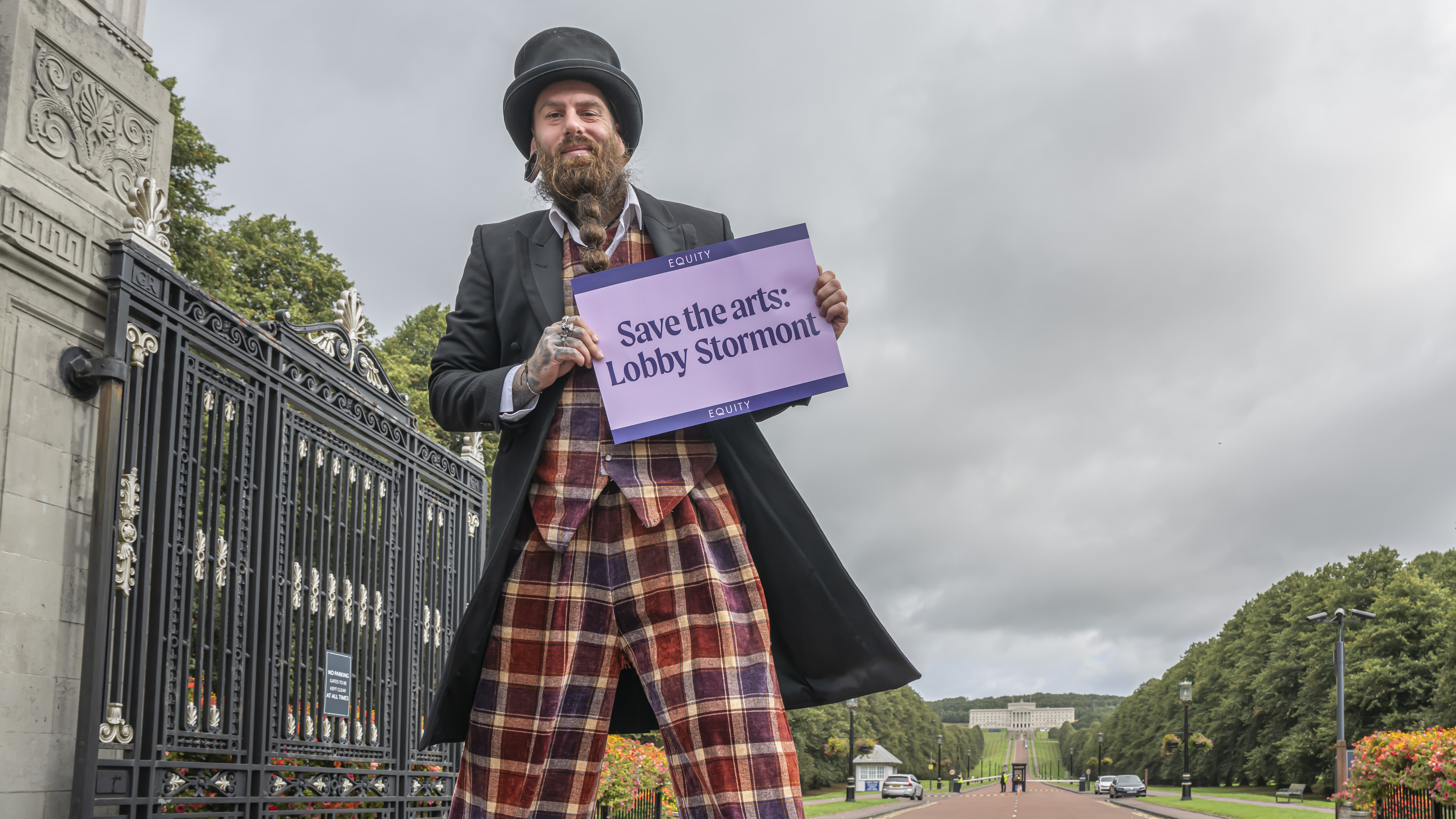
On 8 September, a group of actors, singers, painters, writers, performers, and other supporters climbed the hill to Belfast’s Stormont parliament buildings and delivered a letter of no-confidence in Minister for Communities Gordon Lyons to the Northern Ireland Executive. Marching on stilts and in costumes, the protestors chanted an urgent, unified message: ‘save the arts’.
The day of action was organised by the Northern Ireland branch of the performing arts and entertainment trade union Equity. Their letter, signed by more than 1,500 people and organisations, outlined Lyons’ ‘continued failure to provide the leadership, strategic direction and sustainable investment required to protect and develop Northern Ireland’s arts and cultural sector.’ Artists also made the case directly to their Members of the Legislative Assembly (MLA) throughout the morning, demanding an end to the funding crisis and a vision for the future set out in policy. The results, however, were not encouraging.
‘What we heard today is that there won’t be a policy until March 2027, and if that remains the case then I suspect that the letter of no confidence is not going to be sufficient,’ said Equity UK’s Northern Ireland official Alice Adams Lemon later that day.
This union’s ‘Save the Arts: Lobby Stormont’ campaign is a response to an increasingly dire situation. In February 2025, the NI Executive agreed on a Programme for Government for 2024 to 2027 but omitted any explicit mention of investment in the arts, culture or heritage sectors. In July 2025, a number of MLAs asked Lyons to create a dedicated arts and culture strategy with proper funding, but one has yet to appear. Meanwhile, the NI Executive has allocated the Arts Council of NI (ACNI) the same funding as last year, equivalent to a real terms cut. This is nothing new: years of underfunding have amounted to cuts of over 40% to arts funding over the past decade.
Comparisons to England and the Republic of Ireland reveal the true extent of the crisis. ACNI received around £12 million in funding from the Department for Communities for 2024/25, equivalent to about £5 spent on the arts per person. Arts Council of England, however, spent twice as much on the arts per person, while south of the border the figure rises to roughly £22 per person. But the difference between the north and south is set to diverge even further. Earlier this year, the Republic of Ireland announced that following a successful four year pilot, the government will introduce a permanent basic income for the arts scheme providing a weekly payment of €325 (£280) to 2,000 artists in an attempt to recognise the benefits that the arts bring to the Irish economy and Irish society as a whole.
People in the north have taken notice. In March, Belfast City Council passed a motion calling on the NI Executive to introduce a similar scheme for artists. In response, the Department for Communities responded that there was no budget for such a scheme, but that ‘the Minister fully recognises, understands, and values the work of artists and the vital contribution they make.’ Artists, however, need more than recognition, understanding and statements of appreciation.
‘Nobody is asking to live the high life, they’re simply asking for a living wage,’ explained actor Catriona Hinds. ‘We just need enough to be able to survive.’
In July 2024, the ACNI published a report on ‘Working and Living Conditions of Artists in NI’, which found that the lack of investment has had a huge impact on artists’ ability to stay and contribute at home. Just over half of those surveyed by ACNI indicated that they have considered permanently relocating outside of Northern Ireland for better career prospects, a figure which rose to 65% for those aged 18–34.
‘I think people who aren’t in the industry aren’t feeling it yet, but further down the line it’s going to be obvious. People are going to realise and start investing in the arts, but it’ll be too little too late,’ said actor and stage manager Christine Clark. ‘As somebody bringing up a one-year-old, I’m worried about the future of her seeing her mum struggling in her job and that shouldn’t be the case.’
The widespread social and economic benefits of the arts aren’t hypothetical. In August, Belfast hosted the Fleadh Cheoil na hÉireann, the world’s largest celebration of traditional music. More than one million visitors are estimated to have come through the city in just a week, producing an anticipated return of up to £100 million for Belfast businesses on just £1 million invested into the festival from the Department for the Economy. Over the past few years, the north of Ireland has also become an international hub for film and television production, with projects like A Knight of the Seven Kingdoms and The Death of Robin Hood recently filmed here. Between 2022 and 2026, productions backed by Northern Ireland Screen, the national film development agency, have generated £477 million for the Northern Irish economy. But without proper reinvestment of this money into artists actually living and working in the north, and without a targeted policy that recognises the economic and societal value of their work, a future for local performers is far from guaranteed.
‘We see shows watched internationally like Derry Girls, but where are those accents and the people telling the stories of those communities going to come from?’ asks Adams Lemon. ‘The Fleadh [Cheoil na hÉireann] showed us what the arts can do. Money can come back into the economy, but also there’s a sense of pride, togetherness, and community. If we don’t invest in it, it’s going to disappear.’
While dozens of Equity members and supporters marched up the hill to the parliament buildings at Stormont, just one person stood at the gates to deliver the letter of no confidence, representing what will be left of the Northern Irish arts sector without proper investment. The stakes couldn’t be any clearer.
Read the full story at the source
Source: Tribune