
World · Tribune · · 2h
Why Bolsonarismo Won’t Die
English (original) · Read in Deutsch ⇄
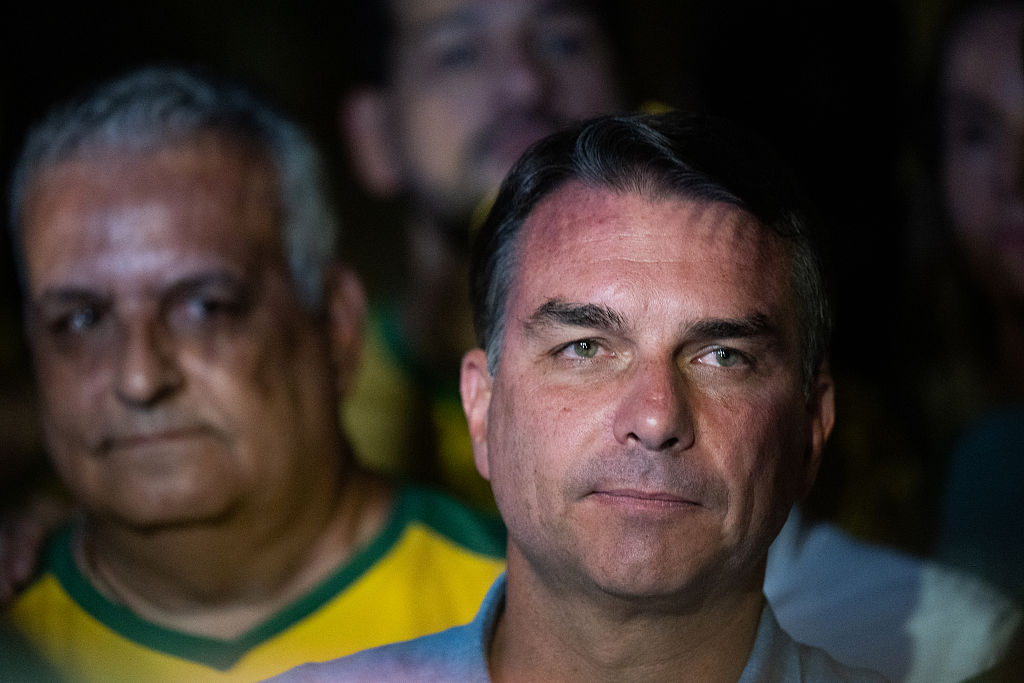
‘Very big victory. . . . amazing actually.’ This was how Donald Trump described the outcome of the Brazilian election this week. The far-right Flávio Bolsonaro finished the first round on 47.03 per cent, ahead of the left-wing incumbent Lula Inácio da Silva on 45.16 percent. More than 56 million people cast their votes for the eldest son of Jair Bolsonaro, the former president convicted for plotting a military coup. Lula called the result ‘unexpected’ and said he had been convinced he would win outright. If the current polls are correct, he and his Workers’ Party (PT) are on course to lose the presidential runoffs at the end of the month.
The bolsonarista Liberal Party (PL) meanwhile grew from 98 to 121 deputies in the Congress, making it the largest party in the chamber, while the right took firm control of the Senate. Though the former president is still barred from holding office, the family business is thriving. Michelle and Carlos Bolsonaro won seats in the upper house while Jair Renan Bolsonaro and Renato Antonio Bolsonaro were elected to the lower house.
Flávio is in some ways an unlikely figurehead for this right-wing surge. A senator for the State of Rio de Janeiro, he lacks his father’s comic menace and flair for spectacle, not to mention the baggage that comes with his candidacy, from long-running corruption scandals to documented ties to Rio’s criminal militias. He is under investigation over the financing of Dark Horse, a heroic biopic of his father, with police examining a R$61 million transfer linked to a former investment magnate which may amount to the largest fraud case in Brazil’s financial system.
But neither this litany of charges nor his father’s disastrous record could stop Flávio’s rise. The Brazil that Lula inherited when he won the presidency for a third time in 2022 had seen 700,000 people killed by the pandemic as Bolsonaro downplayed the virus and delayed vaccines; the state-backed persecution of Indigenous people, with the Senate accusing Bolsonaro of crimes against humanity; the accelerating destruction of the Amazon by right-wing agribusiness interests; and the rise of food scarcity among 33 million of its people, placing Brazil back on the UN Hunger Map. During its time in power bolsonarismo mounted a full-scale assault on the country’s democratic institutions, and concluded by trying to seize power via the military.
Contrast this with Lula’s record over the past four years and the recent election results seem baffling. Since 2023, Brazil has had the lowest rates of poverty and unemployment on record plus the highest rates of spending on social programmes. Income inequality has fallen. The tax system has been modernised and made more progressive. Benefits like the Bolsa Família have been rolled out on a mass scale and democratic institutions have been gradually rebuilt. Lula has refused to submit to intimidation from the White House, taking a strong stance against Trump’s punitive tariffs and pursuing a foreign policy aimed at creating new power centres in the Global South.
Why then have so many Brazilians opted for bolsonarismo round two? Flávio’s manifesto helps to unlock the mystery. It outlines a journey ‘da proteção à autonomia’, from protection to autonomy. The average citizen, it says, should learn to walk ‘pelas próprias pernas’, on his own two legs. It wants to put ‘the worker first, not the trade union’, turning ordinary people into owners and entrepreneurs. Reliance on the state is presented as something shameful, something to grow out of.
Writing in Catalyst, the sociologist René Rojas argues that the left’s social base shifted from the 1960s and 70s to the Pink Tide of the 2000s. The first period saw industrial workers who wielded immense power over production become self-organised in unions and parties. The second period came after the shuttering of factories and the spread of informal work, creating a more fragmented working class, still capable of large mobilisations but with less ability to force lasting concessions from capital. This, writes Rojas, pushed left governments towards a more top-down model in which redistribution was used to incorporate people into the state, rather than to build popular power.
This process of incorporation was never stable. Rifts opened up between indigenous communities and urban workers, between the expectations of the masses and the capacities of governments. Most importantly, the end of the 2000s commodities boom — a period in which Latin American raw materials were coveted on the world market — undermined economic growth across the continent, putting immense pressure on social programmes. Rojas observes that while the classical left was destroyed by elites, the Pink Tide was steadily abandoned by its own base. Lulismo thus returned to power in the 2020s weakened and diminished.
In one sense the vote for Flávio fits with this analysis: the downwardly mobile worker, fearing that the welfare state will not protect his social position, deserts the left and marches right, seeing the latter as a force of re-empowerment. Yet this is only part of the story. Bolsonarismo now extends much further than this particular class fraction, expressing an anti-establishment impulse that spans rich and poor, business executives and gig economy workers. The most effective tool in forging this coalition is the discourse of ‘protection’.
One of the most revealing passages in the manifesto zeroes in on the issue of phone theft. The phone is the place where the ordinary person keeps their photographs, their memories, their bank details; they may even depend on it to earn a living. But there are a wide range of forces — criminals, addicts, racialised people, communists — who want to snatch it away. A hard moral boundary needs to be drawn between one group and the other. And that boundary needs to be materially fortified with fences and prisons and military police. Only then can we separate those that truly belong to the national community from those that don’t. The manifesto asserts that anyone who doesn’t fall in line will be ‘disconnected from society’.
Therein lies the continuing appeal of Bolsonaro for people who have not been effectively assimilated into the state built by the PT. The latter appears to them as a fortress of ministries, courts and agencies, a web of complex programmes remote from their everyday lives. Lula’s self-presentation as the defender of Brazilian democracy looked, to many, like a simple pledge to protect these institutions of the establishment. Bolsonarismo, by contrast, promises to protect the people themselves — by eradicating the alien elements that threaten their safety and prosperity. Its appeal is more direct. Its emphasis on destroying outsiders to the nation seems to resonate more widely than the PT’s patient construction of a fair society.
Thus we have a striking inversion. Lula, a former metalworker and trade union leader who spent years battling with the state, has now become identified with it, while Bolsonaro, a dynastic career politician, can cast himself as its opponent. When Bolsonaro describes the PT as weak on crime, he is making a more fundamental claim about the inability of democratic government to offer this kind of protection. This is a service that only the radical right, comfortable with violence and proximate to criminality itself, can provide. Whereas lulismo uses the state to regulate and redistribute, bolsonarismo wields it as a weapon against internal enemies.
The far right embodies this unique blend of order and chaos. Flávio’s manifesto contains a chapter called ‘Brasil que Cumpre a Constituição’, a Brazil that ‘obeys the constitution’, which seems like a self-conscious provocation coming from a political faction that tried to overturn the last election. The success of this project reflects the fact that, as Rojas argues, the electoral coalition assembled by the Pink Tide has become progressively detached from the left, as the state became a vehicle for assimilating workers rather than strengthening their autonomous organisations. Bolsonarismo and its allies now promise protection without solidarity, power without collectivity, security without welfare — and its myths are cutting through.
Today, the left tells people that the state will give them something. The right tells them that the state will punish those who try to take away what little they have. It’s easy to see why many Brazilians find one of these claims more credible than the other.
Read the full story at the source
Source: Tribune