
World · Tribune · · 1h
What’s Left of the Climate Movement?
English (original) · Read in Deutsch ⇄
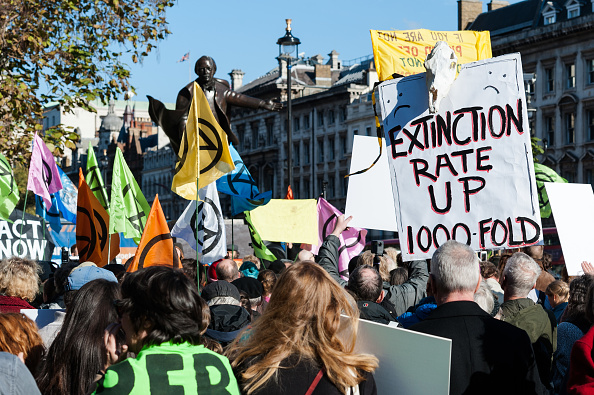
In 2019, the UK’s climate movement reached its peak: activists shut down central London, students nationwide walked out of classrooms and the country saw its biggest-ever environmental protest, with over 300,000 people taking to the streets. The UK parliament became the first in the world to declare a climate emergency.
Seven years on, the movement has been beaten back by state repression, economic collapse and the intensification of US and British imperialist aggression across the world. Yet the issue has not gone away: heatwaves, droughts and the construction of data centres across ‘tinderbox’ Britain have reasserted its relevance. Can climate activism renew itself to meet the moment?
Stagnation
Parts of the movement had previously assumed that climate science could speak for itself, and that enough public awareness would precipitate political change. The task was to leverage popular power to appeal to the state and private capital. This produced campaigns centred on the Green New Deal, a framework that revived Keynesian stimulus policies to turbocharge investment in renewables.
The mainstream British climate movement relied on vague appeals to ‘common but differentiated responsibilities’ towards the planet. Yet this universalism papered over the role of imperialism in driving the climate crisis and its uneven effects across gendered, racialised and class lines. Demands to protect ‘our future’ from ecological disaster elided those in the Global South for whom that future had already arrived. The GND was a reflection of this narrow politics, based on national emissions targets and green jobs within Britain.
This solely national perspective opened the door to the strange convergences we see today: militaries commended for adopting sustainable aviation fuel reforms while remaining some of the largest contributors to the climate crisis and so-called ‘green transitions’ powered by extractivism of critical minerals in the Global South. A truly eco-socialist agenda, resting on democratisation, decommodification and decolonisation, was meanwhile pushed to the margins. The movement’s strategy of pressuring the state for concessions suffered a further setback when Keir Starmer scaled back his major green investment strategy and energy companies doubled down on profits from oil and gas.
Partly owing to its middle-class character and ‘post-material’ concerns, the British climate movement began to stagnate in the 2020s, becoming little more than a single-issue campaign. It missed a crucial opportunity to develop working-class power through an expansive green program. Its isolation from national liberation struggles in the Global South, and its failure to recognise the root causes of the climate crisis in capitalism and imperialism, echoed a larger structural weakness on the left.
This stagnation was deepened by surveillance, criminalisation and policing. Groups like Just Stop Oil were heavily repressed. The external assault combined with internal challenges: professionalisation, cults of leadership, unsustainable organising methods. Many young people radicalised by the climate crisis were absorbed into professionalised spaces, while grassroots collectives failed to translate the mass demonstrations into long-lasting structures capable of tackling the task at hand.
Covid-19 also exposed the fundamental limitations of a strategy based on demanding concessions from the state. As Andreas Malm has noted, capitalist states are repearedly proved incapable of anything more than ‘treating the symptoms’ of planetary crises ‘once they had blasted through the bodies of populations’. But even that seems generous: many Global North states preferred to let the pandemic run riot rather than risk the most minor disruption to accumulation.
Co-opted and hollowed out, the climate movement was powerless to resist the sequence of events that followed. The US, Europe and Britain abandoned meagre commitments to climate action, turning instead to a programme of rearmament unprecedented in the twenty-first century. Economic stagnation created space for climate denialism and fossil fuel accelerationism to take hold in British electoral politics, accelerating the rise of the far-right. Labour governments, first under Starmer and now under Burnham, have rowed back on climate commitments in pursuit of the illusory goal of ‘growth’.
Fault Lines
October 7th crystallised existing contradictions both across the left and within the climate movement. Some climate organisations recognised that the same systems of fossil fuel extraction and militarism driving the climate crisis were also fuelling the genocide in Gaza; but the political space to make those demands was highly restricted.
When activists organised an open letter in solidarity with Palestine in December that year, leading climate organisations were notably absent. Their leaderships overruled internal dissent or found themselves constrained by funding models that place serious risks on criticism of Israel or support for Palestinian self-determination. This exposed a generational rupture, with the environmentalist old guard increasingly disconnected from a younger, more militant base radicalised in opposition to the genocide. While some leaders still urged activists to focus on simply lobbying national policymakers, Gaza revealed the need for internationalist climate justice, as the US, Britain and Israel collaborated in the annihilation of life and the eclipse of our planetary future.
This fundamentally altered the direction of the climate movement. Seasoned climate organisers pivoted to supporting Palestinian liberation: shutting down arms factories, resisting the expansion of state repression and forming new groups demonstrating the links between far-right politics, oil lobbyists and billionaires profiting from genocide.
This wasn’t all new: many who joined Palestine Action’s early direct action before 2023 were involved with Extinction Rebellion, knowing that British militarism and Israeli arms companies were among the primary drivers of the climate crisis. Yet 7 October expanded the boundaries of the climate movement, making its overlap with anti-imperialism more explicit. Since then, US aggression has escalated from Palestine to Iran, Venezuela to Cuba. While there has not yet been a unified response from climate organisations, individual climate activists like Greta Thunberg, who rose to prominence through the 2019 Fridays for Future school strikes, have actively tried to break the sieges on Gaza and Cuba, illustrating both the necessity to expand the remit of climate politics and the institutional inertia preventing a movement-wide shift.
These wars of aggression have demonstrated the extent to which US militarism is driving the climate crisis. The US military is the single largest institutional consumer of fossil fuels worldwide, its bases and warships frontline emitters of greenhouse gases. Our Resisting Rearmament report with Climate Vanguard details how Britain has subordinated itself to US monopoly capital, pursuing rearmament to maintain its ‘special relationship’ in this new and even more dangerous phase of empire.
If climate justice is concerned with protecting the conditions for human and ecological life, then struggles supporting the national sovereignty and liberation of the Global South are inherently climate struggles. The people of the global South are fighting to secure a future for us all against US-led global hegemony.
Redirecting the Movement
Eco-populism has recently surged under Zack Polanski’s Green Party. Parts of the climate movement have pivoted towards this electoral project and sharpened their emphasis on class politics. At the same time, ambitious ecological organising projects have emerged: Anakbayan UK has campaigned against British mining in the Philippines, the Palestinian Youth Movement has launched the People’s Embargo for Palestine, and local groups across Britain that have used direct action to target RAF bases and mass picket arms factories. Climate Vanguard have also developed radical political education for young people, who have in turn formed the Orbit cadre group with the aim of driving eco-socialist politics in various other left organisations.
In the labour movement, workers are now organising around anti-imperialist and ecological demands. Unite Hospitality members in Glasgow have launched a BDS-aligned service boycott at the Glasgow Film Theatre and are building an industrial strategy for Palestine. Workers for a Free Palestine is organising civil service workers to engage in work refusals; and Healthcare Workers for a Free Palestine is coordinating across the NHS to end the renewal of the government’s contract with Palantir. The Heat Strike campaign is pushing for a legally recognised maximum workplace temperature and a heatwave furlough scheme, providing a clear possibility for anti-war and climate organisations to link Britain’s involvement in the war on Iran and hosting of US bases to climate breakdown and rising prices.
The aim must be to bring these currents together in recognising that Britain’s role in the imperial system must be dismantled as a precondition of climate justice. We must push beyond eco-populism and build towards eco-socialism. By orienting the climate movement towards this horizon, we can begin to confront the underlying weaknesses that led to its stagnation. The old climate movement — with its professionalisation, its isolation from the left and its inability to confront imperialism — cannot and should not be revived. Something new must take its place.
Energy Embargo for Palestine was formed in the wake of Israel’s intensified genocide in Gaza at the intersection of climate, anti-imperialist, and Palestine organising. Since launching, we have run a concerted campaign targeting BP’s operations and its complicity in fuelling the genocide — targeting institutional partnerships with BP, mapping and exposing the supply of oil to Israel via the Baku-Tbilisi-Ceyhan pipeline, and identifying points of disruption within Britain.
Climate justice should not be understood as an end in itself, a demand to be won and then set aside. It is a front in our broader struggle against capitalism and imperialism. The mass engagement of young people activated by the climate crisis, and the infrastructure developed from the past decade of movements, must be leveraged in a project that sees climate justice as inseparable from global class struggle, particularly the national liberation struggles of the Global South. The role of ecological organisations — and of those on the left more broadly — is to create the conditions for this project to emerge, and to join the fight for a just future.
Read the full story at the source
Source: Tribune