
Climate Tribune
Ultra-Fossil Empire
Trump is the vanguard of a new phase of imperialism, which is burning the planet to a cinder.
English (original) ·Read in Deutsch ⇄
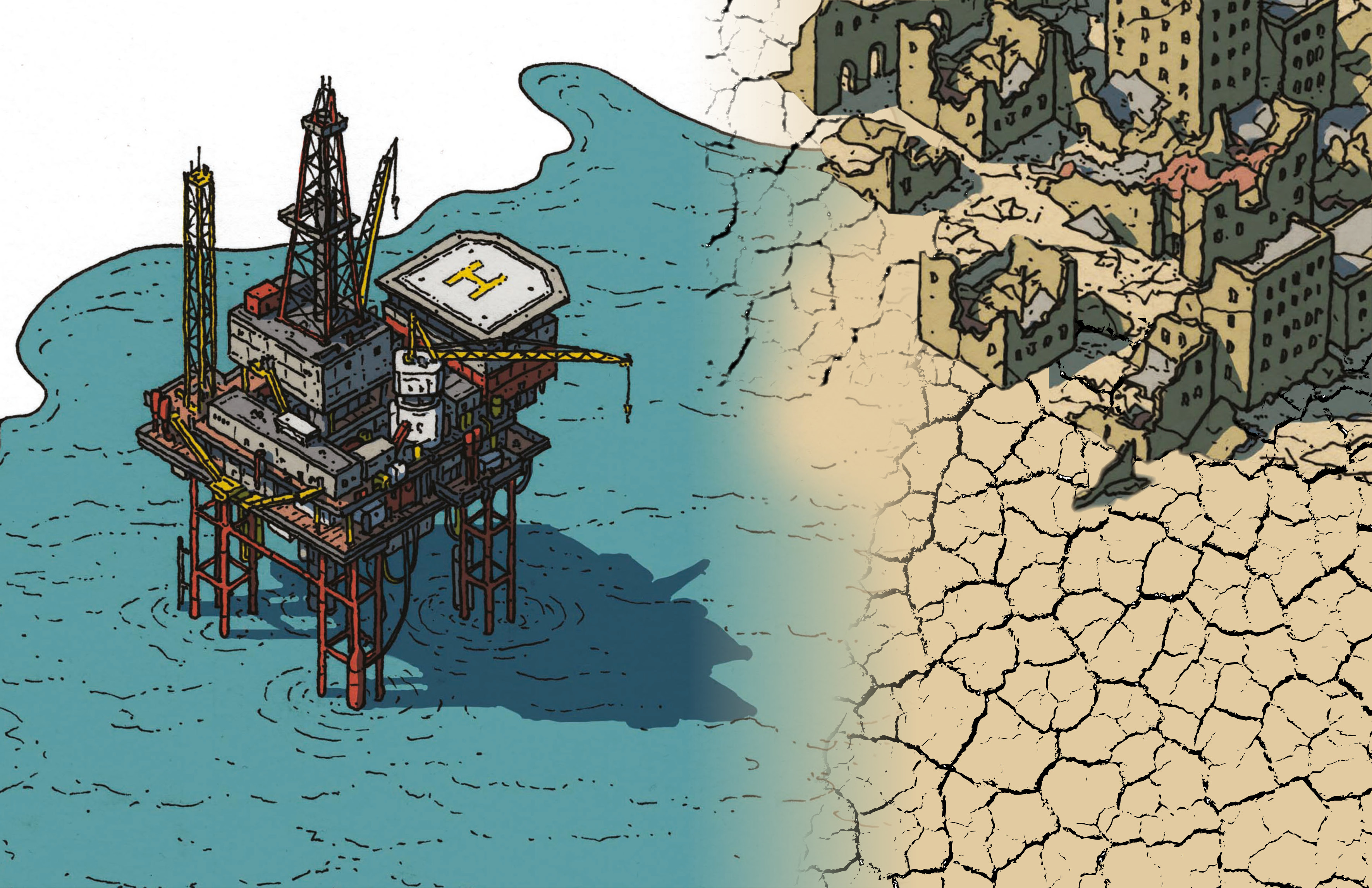
On New Year’s Day 2026, the countries with the largest proven oil reserves were Venezuela, Saudi Arabia and Iran. Saudi Arabia was already in the pocket of the US. Two days later, American military forces invaded Venezuela in Operation Absolute Resolve; another 56 days into the year, they descended on Iran in Operation Epic Fury. Was this sheer coincidence? Petro-determinism — the notion that everything is caused and conditioned by oil — should obviously be avoided. But the bulk of commentary on this unprecedented spurt of imperialist aggression has, not the least on the left, erred in the opposite direction: speaking of oil as a minor or tangential matter, vaguely embarrassing to mention, too crude for good analytical taste.
Meanwhile, the summer of 2026 offered another bouquet of reminders that the prevailing order is busily destroying the foundations of human existence from Bordeaux to Borneo, whether it’s water or food or breathable air, liveable temperatures or safe ground to walk on. It is part of the moment to not speak much about such things. Fossil fuels and climate are so 2018. The ‘overshoot’ conjuncture — when the dominant classes give up any pretence to mitigation and let temperatures shoot above the previously agreed limits of 1.5 and 2 degrees, pouring growing quantities of capital into the extraction of fossil fuels while climate disasters strike with ever greater fury — is predicated upon and reconfirms this slip to the bottom of the agenda. But what if we were to see the new imperial wars as part and parcel of that same dynamic? What if we refuse to respect the decorum of bracketing fossil fuels and instead view them as the material story of our times? We might then begin to understand this latest phase of escalation as the emergence of ultra-fossil empire.
Two Traumas
Consider, to begin with, the backdrop to the largest war waged by the US empire in more than two decades: Iran. Any assessment of its causes must reach farther back than 11 February 2026, when Benjamin Netanyahu — so we are told by many interpreters of mainstream media reports — supposedly manipulated a meeting in the Oval Office so effectively that Donald Trump overcame his reluctance about military adventures in the Middle East and decided on a full-scale assault. The evident starting point is 1953, the primordial trauma in the relationship between the US and Iran — from the perspective of the latter, that is — when the CIA led a coup against the democratically elected Mohammad Mossadegh and handed power to the autocratic Shah. The book to read is Ervand Abrahamian’s Oil Crisis in Iran (2021). Sifting through a trove of recently declassified documents, the eminent historian asks: what were the real motives for the regime-change operation? To protect Western property in the Iranian oil fields, or to stave off a communist takeover?
The latter has long been the conventional explanation, buttressed by public pronouncements from the US and the UK that the intervention was all about preventing the loss of Iran to the Soviet camp. But Abrahamian can demonstrate the opposite. The American and British intelligence services knew full well that the communist Tudeh Party was nowhere close to seizing power (just as they knew full well that Iran was nowhere close to building a nuclear bomb in early 2026). But the orchestrators of the coup were up in arms over the imminent loss of property. If the oil fields of Iran were nationalised, as Mossadegh demanded, investments of enormous magnitude would go up in smoke — not only in Iran, but in Venezuela, Iraq and other major producers inspired by his example. ‘The internal documents bring out the central significance of oil and relative insignificance of communism in the whole crisis’, concludes Abrahamian, following honed historiographical procedure: if the authors of an action make their intentions behind it explicit in the surviving sources, they count as causes. The immediate effect was the transfer of the Iranian oil industry to US capital. For the next two and a half decades, Iran was the second largest oil exporter, and the profits it generated for the West were astronomical.
From the perspective of the Americans, the primordial trauma is, of course, the revolution of 1979 — the last great twentieth-century revolution à la 1917, in the informed judgement of Eric Hobsbawm; a seismic rupture that ended, in one stroke, the status of Iran as a gas station for the West. The National Iranian Oil Company assumed control over every step in oil production: exploring, drilling, processing, selling, all now in native hands. Foreign companies were sent packing as quickly as the American and Israeli military personnel that had propped up the Shah. The black gold of the Islamic Republic would belong to no one else. Henceforth Western investors had to bend the knee to get any kind of access. Profits were diverted from global circuits of accumulation towards the eccentric priorities of the emerging post-revolutionary state, the oil revenues pumped into Pasdaran and other branches of the military, the welfare institutions covering the countryside in a dense net of basic services and ventures for economic self-sufficiency in sectors such as auto, software, pharmaceuticals. In its very constitution, the Islamic Republic pledged itself to the ‘prevention of the foreign domination of the country’s economy.’
When Shora Esmailian and I wrote Iran on the Brink in 2006, reporting on the social unrest that swept the country and the ominous signs of an American attack after the invasion of Iraq, we identified this as the main driver of the antagonism. The mullahs in charge would at most let a few select foreign companies render them technical services on the oil fields, under temporary ‘buyback contracts’ generating only the stingiest returns. ‘Read the international business press and whenever Iran is mentioned frustration is vented’, we wrote: ‘Why do these mullahs persist in displaying such titillating objects of investment, without ever offering them for real?’ The tensions were deepened as the US tried to asphyxiate the regime through sanctions. Because it relied so heavily on oil incomes — an inheritance from decades of gas station status — cutting them off threatened to undo the revolution. The combined result of the penurious contracts and the punishing economic restrictions was that the world’s third largest oil reserves ended up behind a shop window with no entrance. ‘They yearn for Iran, but they cannot have it’, Esmailian and I observed at the time. ‘Reconciliation, lifting the sanctions, the full reintegration of Iran into world capitalism all seem out of the question, as long as the Islamic Republic remains the Islamic Republic, and thus frustration is bound to escalate further. In this contradictory situation, the US has one break-out option: regime change.’
The frustration, it should be noted, did not concern absolute quantities of oil as such. The US did not need Iranian crude in any objective, physical sense. The American economy and its oil and gas companies had access to supplies that were often surplus to requirements. Nor was the intensified hostility in the years following the occupation of Iraq caused by an approaching ‘peak oil’ (a claim we mistakenly made in Iran on the Brink). Rather, as in 1953, property qua source of profit was the raw nerve. If 200 billion barrels of oil are blocked from the ownership of Western companies, these are so many billion barrels that cannot yield them a profit. It is an outrage against their raison d’être, simply by denying them the freedom to accumulate capital through such a vast material substratum. Taking a leaf from Rosa Luxemburg, we can say that the longstanding antagonism between the US and Iran is shaped by a situation in which the latter ‘cannot, because of the entire social structure and the forms of ownership, offer for sale the productive forces in which capital is primarily interested. The most important of these productive forces is of course the land, its hidden mineral treasure’ — we know its colour — and in this state of relative deprivation, robbed of a large venue for expanding value, capital develops an itch, an impatience, a restless lust. It is unable to wait for any ‘slow internal disintegration’ of the economy outside its reach. ‘Force is the only solution open to capital’: Luxemburg’s most enduringly powerful dictum.
Oil Lust
Thus the pressure has built up ever since 1979. How did Donald Trump, in the 1980s an up-and-coming middle-aged real estate magnate with vague political aspirations, feel about it then? Nowadays it is de rigueur to consider him erratic, fickle, void of substance, changing his opinions from one late-night spin on Truth Social to the next. But when it comes to certain causes, he deserves credit for his remarkable fidelity. ‘Why couldn’t we go in and take over some of their oil, which is along the sea’, he challenged an ABC interviewer in 1987. When the host asked, dumbfounded, how that would work, Trump blithely responded, ‘You take their oil . . . The next time Iran attacks this country, go in and grab one of their big oil installations, and I mean grab it and keep it, and get back your losses, because this country has lost plenty because of Iran.’
In a 1988 interview with the Guardian, Trump signalled his ambitions to become president and vowed to teach Iran ‘respect’ for America. ‘I’d be harsh on Iran. They’ve been beating us psychologically, making us look a bunch of fools. One bullet shot at one of our men or ships and I’d do a number on Kharg Island’, the hub of the Iranian oil industry; ‘I’d go in and take it.’ Fast-forward to 29 March 2026, when US-Israeli forces were assiduously bombing petrochemical units, power stations, water reservoirs, universities and other civilian targets in Iran, and the 47th president told the Financial Times: ‘To be honest with you, my favourite thing is to take the oil in Iran’, starting with a seizure of Kharg Island. On 3 April, he committed his thoughts to the screen in characteristically capitalised letters: ‘With a little more time, we can easily OPEN THE HORMUZ STRAIT, TAKE THE OIL, & MAKE A FORTUNE.’ Three days later, he used the occasion of the annual White House Easter egg roll to declare that ‘if it were up to me, I’d take the oil, I’d keep the oil, it would bring plenty of money.’ And so on.
What did primitive fossil capital have to say? No entity better represents the interests of US oil and gas companies than their trade association, the American Petroleum Institute, pioneer of climate denial in the late twentieth century. This class fraction was initially lukewarm about an invasion of Venezuela. Not so about Iran. ‘Our industry is committed to being a stabilising force in Iran if they decide to overturn the regime’, said the Institute’s president Mike Sommers on 13 January, ‘stabilising’ here a euphemism for a very solid and stable material interest: ‘It’s an important oil player in the world, about the sixth-largest producer now — they could absolutely do more.’ Salivating over its prospective returns, primitive fossil capital was enraged when Iran resisted the invasion, refused to collapse and, crime of crimes, closed the Strait of Hormuz. ‘If you talk to API member CEOs’, said Sommers on 24 March, ‘they also want to make sure that we’re finishing the job in Iran. We can’t leave Iran in a position where they can control the strait with any given drone that they shoot into the strait on any given day’. His position tallied perfectly with the president’s, his speech only slightly more cultured.
Or we might turn to the pages of the Wall Street Journal, mouthpiece of the US capitalist class in general and its oiliest fraction in particular. On 10 March, it conceded that the war had led to turmoil; ‘but beyond the immediate crisis lies a staggering economic prize — unlocking the oil industry in a nation with one of the world’s largest proven reserves.’ The Journal noted that production costs in Iran hovered around $10 to $30 a barrel. Compare this to break-even costs of $60 to $70 per barrel for US shale oil. Readers could do the maths: with such low costs, an American owner of Iranian oil would make astounding profits at almost any conceivable market price — stunning superprofits if oil sold at $90 per barrel, as it did on that day. The higher the war drove prices, the greater the lure of black gold as easily extracted as in Iran.
Or we could listen to the late Lindsey Graham, peddler-in-chief of regime change, who told Fox News around the same time that ‘when this regime goes down, we are going to have a new Mid-East, and we are going to make a ton of money. Venezuela and Iran have 31 percent of the world’s oil reserves’, so regime change in the latter would produce ‘prosperity unlike anyone could ever imagine.’ Or to the then White House press secretary Karoline Leavitt, who reassured journalists that Operation Epic Fury ‘will be a very good thing for the energy and oil markets’ once ‘you no longer have a terrorist regime that is restricting the free flow of energy’, et cetera, ad infinitum. How should we assess this abundance of evidence of the crudest of intentions, not buried in documents historians might discover half a century from now, but churned out in full public view?
Trial run
Before we look at the implications of this oil fixation, it is worth recalling some of the alternative accounts of the war’s origins. One of the most prominent theories has invoked the Israel lobby, claiming that Netanyahu and his allies dragged the US into a war on Iran against its better judgement and truest interests. ‘America’s policy in the Middle East is determined more directly than ever from Tel Aviv’, wrote Susan Watkins, editor of New Left Review, a journal that tends to view events in the region through this periscope. She recycled the cliché of the Israeli tail wagging the American dog but had little to say about the quest for hydrocarbons. Historian David McNally, writing for the Rosa Luxemburg Stiftung, dismissed that factor out of hand: ‘All too often explanations are superficial in nature. Claims to the effect that this is simply an oil grab or that Trump is an egomaniac fail to probe the deep reconfigurations of imperial rivalry in our times’ — the attacks on Iran and Venezuela supposedly being an attempt to withhold resources from China. In Jacobin, Matt Huber argued that neither the invasion of Iraq nor those of Venezuela and Iran were rooted in oil but rather ‘in the nature of American imperial power itself’, expressed in the ‘absolute autonomy of the state’, which now acts without any class alignment, floating freely on its own froth. (In the New York Times, he also advised the left to shut up about climate: ‘When it comes to climate change, for now, it might be better to say nothing at all.’) In early January, Huber predicted that ‘there will not be much interest among major US oil companies to invest in new drilling’ in Venezuela.
But Venezuela is the great fossil and imperial success of 2026. Though the country had not experienced a popular revolution like that of 1979, it nevertheless ran on tracks somewhat parallel to Iran until just recently. After rising to the presidency in 1999, Hugo Chávez instructed his national company to assert stricter control of the oil sector and funnel incomes to social programmes and allied states in the region; no longer free to accumulate capital through these reserves, foreign investors had to accept majority ownership of the Venezuelan state in all joint ventures. ExxonMobil and ConocoPhillips left in disgust in 2007. Chevron stayed on, biding its time. Successive US administrations then tried to topple the Venezuelan regime through tightening sanctions, crippling the industry and throttling output. This pushed the contradiction to breaking-point: more than ever, the oil fields were locked out of the circuits of global capital in general and American capital in particular. Then, in mid-December 2025, Trump boasted about surrounding Venezuela with ‘the largest Armada ever assembled in the History of South America’ and made clear that the siege would end only when the country returned its ‘stolen Oil Fields’. Top ideologist Stephen Miller expounded on the notion that the fields in fact belonged to the US, for ‘American sweat, ingenuity and toil created the oil industry in Venezuela’, the expropriation of which was ‘the largest recorded theft of American wealth and property.’ Right after the capture of Nicolás Maduro, Trump vowed that ‘we will rebuild it in a very profitable way. We’re going to be using oil, and we’re going to be taking oil.’
At first, the companies that had previously fled Venezuela were hesitant. The infrastructure seemed so dilapidated, the extra-heavy crude of the Orinoco demanding such advanced technology as to rule out a quick return to form. ‘Today, it’s uninvestable’, reckoned Darren Woods, the CEO of ExxonMobil. But before long the Venezuelan regime prostrated itself before the empire. Barely had Delcy Rodríguez succeeded the abducted president before her legislature rolled back nationalisation and gave private companies full freedom to own and operate wells. Representatives from ExxonMobil and ConocoPhillips flew in to shake hands with the government, at which point Woods made a volte-face: ‘Venezuela is a huge resource that has now opened up more freely to the world’, holding ‘attractive investment opportunities.’
ENI, Repsol, BP, Shell, SLB, a clan of wildcatters all rushed to the site. Acting as the hegemon of old, the US opened the gates to Venezuela for corporations from across the Atlantic, and in they streamed like blokes finally getting into the pub. Each of them scrambled to pick up lucrative contracts, Repsol planning to triple production in the country within a couple of years. But the leader of the pack was Chevron, already on the inside and capable of driving an instant Venezuelan oil boom: within four months of the raid on Caracas, exports had reached a level unseen in eight years. After another four months, half of all output was sent to American refineries working round the clock to process the thick, sour crude and sell it on global markets as diesel, gasoline, jet fuel. Output was up by a third; but most importantly, it was rerouted through the proper circuits of accumulation. The profits from Orinoco would now end up where they belonged.
Behind the thickening fog of an unending war with Iran, the extraordinary success of Venezuela has often been forgotten. Here was a country that for decades posed as the standard-bearer of Latin American anti-imperialism while sitting on the world’s single largest oil reserves — ‘becoming a client state’, noted the FT, ‘almost literally overnight’. No internal or external force managed to throw even a handful of sand in the gears of this invasion. While not yet the 51st state, as Trump had sometimes said he wants it to be, Venezuela is now effectively governed from Washington, with the executive director of the US council for ‘energy dominance’, Jarrod Agen, shuttling between Houston and Caracas to oversee the transfer of assets. On one of many visits to the de facto colony, Agen was asked to sign a guest book. He wrote ‘Drill Baby Drill.’ By late August, the US had abrogated nearly one third of Venezuela’s proven reserves.
There can be little doubt that Venezuela provided the model for Operation Epic Fury, Washington operating on the assumption that it could walk over Iran just as effortlessly and install some Persian Delcy Rodríguez to give it everything it wished for. In March, Agen tried to allay concerns over the Strait of Hormuz: ‘This is a long-term game because what we want to do is get such massive oil reserves in Iran out of the hands of terrorists and so what we’re going to experience here in the short term is highly outweighed by the long-term benefits’ — ‘Look at what happened in Venezuela, the actions the president took in early January has unleashed Venezuela’s potential.’ But the Islamic Republic was not the Bolivarian Republic. It would not be rolled over.
A Blow to Empire
The two invasions differed from the outset on many counts. Operation Epic Fury marked the release of nearly half a century of accumulated imperial fury over the loss of Iran to a popular revolution. It was a counter-revolutionary war, meant to negate the very real achievements of 1979 — decolonisation and national independence, above all — which had become a personal obsession for the two men in charge, the president and his secretary of war Pete Hegseth. Trump had been brooding over the humiliation ever since the 1980s, as we have seen. When he ordered the assassination of Qasem Soleimani in January 2020, he warned that any retaliation would be met with the bombing of 52 cultural sites, ‘representing the 52 American hostages taken by Iran many years ago’. The empire never forgets such an affront. Hegseth cited the revolutionary slogan Marg bar Amrika, ‘Down with America’, as a casus belli in and of itself; ‘the real endless war is the war Iran has waged on the United States for 47 years’, he told journalists, leaving no uncertainty about the starting point of the confrontation.
The unbroken links to 1979 have some bearing on the sharp bifurcation between Venezuela and Iran in the early months of 2026, reflecting the different subjective resources at the disposal of each state. ‘The achievements of October now revealed their historic superiority amidst the death and violence of war’, wrote Ernest Mandel — no fan of the Stalinist regime — of the Red Army and the partisans fighting back against Operation Barbarossa. Mutatis mutandis, the achievements of 1979 revealed a certain superiority this spring. Whatever one might think of the Islamic Republic, there is no gainsaying its formidability as an enemy of the US empire. Imam Hussein proved himself vastly superior to Simón Bolivar as a figure of resistance, the Karbala paradigm to Latin American anti-imperialism. One oil-rich country invaded by the empire had a doctrine and tradition of asymmetric warfare; the other did not. This is a matter of more than historiography. Even the sternest critics of the Islamic Republic on the left should acknowledge its capacity to sustain a spirit of resistance exceedingly uncommon, not to say existentially endangered in this world. Had the regime fallen after the assassination of Ayatollah Khamenei, as the US and Israel hoped, it would have been much easier to imagine the unopposed end of the world — particularly in the Middle East, where the end is unfolding at the highest speed — than any kind of resistance.
Instead Iran, with a little help from its regional partisans, turned the tables on the empire. It did not open every subterranean crevice to foreign investment: it did the opposite. Its oil reserves were not transferred to Western control; in fact, Iran extended its control to oil reserves across the Gulf. With the closure of the strait, the Islamic Republic not only denied the empire the victory it expected but inverted it. With the destruction of the US bases that have encircled Iran since 1979, it pushed the Pentagon towards a relocation bordering on withdrawal from the oil-richest region of the world — not a cancellation but an extension of the losses from the revolution; potentially the largest blow to empire since the fall of the Shah.
This was, of course, an intolerable outcome. Hence the seething frustration of Trump and those around him, the oscillation between threats to exterminate the Iranian civilisation and ceasefires worth less than a tweet, the bombing campaigns paused and resumed, the umpteenth attempts to sanction Iran to death, the remaining possibilities of a ground invasion and a disintegration of Iranian society and other scenarios for ‘finishing the job’. Here we are in late 2026, and the antagonism has reached an impasse. Can anyone still write off oil as a trivial variable? Rarely has any war in history been so conspicuously and constitutively a war over the control of hydrocarbons as this drawn-out war over the strait.
We can then make a provisional assessment of the causes of imperial aggression in 2026. ‘Their design is clear’, said Esmaeil Baghaei, spokesman of Iran’s foreign ministry, in March, ‘their enterprise is quite obvious — they aim at partitioning our country to take illegal possession of our oil riches. Their objective is to violate our sovereignty, defeat our people and undermine our humanity.’ Was he not right? As for the other front, Marxist economist Paramjit Singh, in an article written just before the abduction of Maduro, concluded that the strategic objective was ‘to reconstitute Venezuela as an energy colony of the United States, ensuring guaranteed and privileged access to its oil reserves for oil giants.’ The outcomes diverged; the drivers were essentially the same.
Vanguard Trump
Ultra-fossil empire takes the systemic compulsion to produce surplus-value through the production of fossil fuels as its guiding principle. It turns it into a geopolitical compass, orienting kinetic firepower and diplomatic leverage and other forms of extra-economic pressure towards frontiers of extraction. It does not seek access to quantities of fossil fuels because these are ‘needed’, in some absolute sense of the term. Rather, it is the imperative of making maximum money from oil and gas that guides the aggression. Ultra-fossil empire hypostasises this circuit of accumulation into brazenly acquisitive and bellicose projects, the underlying forces in the base taking up unconcealed positions in the highest tiers of the superstructure. ‘Take the oil’ becomes the watchword and the platform — an ideology in itself, in which the workings of primitive fossil capital are condensed, and which corresponds to the growing power of this fraction within the imperial metropolis.
This situation poses certain challenges for Marxist theory. In 2002, Donald Rumsfeld vigorously denied any connection between the urge to invade Iraq and the presence of hydrocarbons there: ‘It has nothing to do with oil, literally nothing to do with oil.’ He later insisted that ‘We don’t take our force and go around the world and try to take other people’s . . . oil. That’s just not what the United States does.’ Back then, ‘no blood for oil’ could become both a political rallying cry and an analytical framework, allowing Marxists to do what they are trained to: pierce the veil of bourgeois falsity. But what if there is no longer any veil to pierce? When a US president brags about profiting from plundered oil and entertains his crowd by declaring ‘We’re like pirates!’, what’s left for Marxists to say? The hermeneutics of suspicion leaves the building in shame. Ultra-fossil empire seems to work in favour of only the most vulgar iterations of Marxism; and who wants to follow the bourgeoisie down this regressive path? When oil-grabbing comes to the surface, it becomes ‘superficial’ to talk about it. The endpoint of this short-circuiting is Huber’s theory of the ‘absolute autonomy’ of the capitalist state, which logically terminates the historical-materialist understanding of that state. Are we to believe that now, of all times, when politicians trumpet the business interests behind their decisions, coarse class interests play no role in the executive committee? (And then we haven’t even mentioned the oil money that funded this presidency up to its ears.)
Still, Huber is right to reject instrumentalism. The relationship between the US capitalist class and the executive is not one of mere instrumentality, the former wielding the latter as its tool. Nor does it make much sense to apply Nicos Poulantzas’s concept of ‘relative autonomy’, meant for a period when the state was a terrain for class struggle and the proletariat took up forward posts within it, notably in some social-democratic welfare states. Trump stands for purified class power, not its vitiation. We might perhaps think of the relation in terms of vanguardism: the US state is advancing ahead of the class it represents — taking the initiative, acting offensively, seeking to open up fields for accumulation, always geared towards the material (as distinct from the MAGA) base. To use a blasphemous analogy, Trump offering Venezuela to stunned CEOs is somewhat like Lenin seizing power and giving it to the All-Russian Congress of Soviets. This is an agent that has in no way disconnected from its class (the leading fraction in particular), but the exact opposite, so deeply absorbing the impulses and drives of that class that it dares to act on them when the opportunity arises. Similarly, the US state does not deny the reality of the climate crisis because ExxonMobil and Chevron instruct it to. They no longer indulge that kind of denial, but it objectively serves their interests as much as ever, and no Woods or Sommers would deplore this loyalty to the line. When the rear mumbles, the vanguard raises the banners high and charges. The instincts for taking oil and denying science have leapt out of the boardrooms and formed what appears to be an independent-minded agency, with an escalatory momentum of its own.
Such a vanguardist character of the capitalist state — in the stage of imperialism in particular — is nothing new, of course. It has often behaved in this way, bulldozing through the peripheries so that capital can make a killing, taking risks and mobilising resources in a way that no individual capitalist could. The novelty of the arrangement rather lies in its crystallising and culminating lateness. The analytical challenge is to grasp how the most impersonal dynamics of accumulation have come to the fore — all fetters removed — at this moment of extreme personalisation of politics. Only a man of such resounding emptiness could embody such deep political substance.
Yet so dazzling is the form of the imperial spectacle that it takes precedence over the content in much thinking on the left. The interpretive framework most in vogue today, Anton Jäger’s ‘hyperpolitics’, has many acute insights into digitally driven polarisation, but it has less to say about processes of physical metabolism, generally observing a strict silence on questions of energy and climate. Jäger sees both far left and far right as ‘deinstitutionalised’ forces whose strong passions are at odds with their inability to effect tangible change. In reality, though, the contemporary far right is more institutionalised than at any point since 1945, to the extent that it is now remaking the very materiality of the planet. Few political moves are as consequential and long-lasting in their effects as revving-up fossil fuel extraction at 1.5 degrees.
In this anti-hall of mirrors, bourgeois commentators can sometimes catch sight of events with a more natural ease. In Regime Change (2026), the airport bestseller by Maggie Haberman and Jonathan Swan, we get to follow Trump into his recesses:
‘This is my favourite industry’, he said breezily as he entered the Cabinet Room and took his seat. If there was a constituency that Trump would move heaven and earth for, it was the executives in this room. Chevron. ConocoPhillips. ExxonMobil. From the moment the meeting began, the deference paid to the companies that would make good on Trump’s Drill, baby, drill promise was remarkable. Their wishes were Trump’s command. There was no regulation he wouldn’t overturn, no law he wouldn’t challenge, if doing so would accelerate their pursuit of hydrocarbons
— a vanguardist president servicing his peers. And himself. In early August, the Guardian revealed that ‘Greenland Energy’, a company set up last year in Texas by a crew of wildcatters from Trump’s inner circle, had begun to offload equipment for oil drilling on that island, without permission from local authorities. Trump’s envoy claimed production would commence within a year. These were men committed to the idea of annexing Greenland to the US; now they had put the first boots on the ground. Another enterprise led by Trump confidantes is at work on a gas pipeline through Bosnia (while promoting the fascist revivalism of Republika Srpska). But the most neglected triumph might be that in Iraq.
In July, the prime minister of a supposedly sovereign nation, the young entrepreneur Ali al-Zaidi — Iraq’s own version of Trump, who owes the post directly to his interference — sat grovelling in the White House. His master gloated over the country being so securely in American hands that a military presence was no longer needed. ‘We’re going to be taking out a lot of oil. A lot of oil is coming out, and the American companies are doing it.’ In the following days, al-Zaidi’s delegation signed 48 deals with such companies — Chevron, ConocoPhillips, ExxonMobil and others partaking of the goods in the country with the fifth largest reserves, inaccessible before the invasion of 2003. Over the years Trump’s statements about Iraq had echoed those about Iran: ‘You hear me, I would take the oil’, he told the Wall Street Journal in 2011; ‘You win the war and you take it’, he said on the campaign trail in 2015. Hence there were not one but two models for Operation Epic Fury: one on the other side of the Atlantic but temporally proximate, one more than two decades in the making but right across the border. Under the second Trump administration, ultra-fossil empire reaches maturity. But it does not, yet, win every battle.
Overshoot
Ultra-fossil empire arises in the post-2020 overshoot period. This empire has always been fossil; but it becomes ultra-fossil only when it makes a priority of violently cranking up extraction at the threshold to 1.5 degrees and beyond. The inescapable and defining context of ultra-fossil empire is the transgression of every limit on global heating. Indeed, it is but the geopolitical dimension of that transgression. The reason the capitalist mode of production cannot wean itself off fossil fuels and shift to renewables — as Wim Carton and I described in our book Overshoot (2024) — is that the former generate such irresistibly superior profits: the same profits that now form the magnetic pole of US foreign policy. The breakdown and the escalation constitute an identity.
Wars like those of 2026 pour fuel on the burning planet, contrary to initial forecasts. When oil prices surpassed $100 in March, pundits announced the imminent phasing out of fossil fuels, as the world would now have clear reason to switch to renewables cheap as chips and insulated from supply shocks; sunlight does not pass through a narrow strait, as the saying went.
This was the third time in six years the fantasy of an agentless transition took hold. When the agent — the climate movement and its allies — fell into a coma in early 2020, hopes for a transition away from fossil fuels were instead pinned on the system itself. We were told that capitalism would have to see sense, first after Covid (does anyone remember the ‘green recovery’?), then after the invasion of Ukraine (when rising prices heralded ‘the end of the fossil fuel era’, according to the International Energy Agency) and finally after the Strait of Hormuz. AP summed up the mood back in March: ‘The Iran war and its costly energy crunch have some experts wondering if selfishness and nationalism may be a more likely way to save the planet, by boosting support for homegrown renewables over imported fossil fuels’. Oh, if only fossil capital would die a natural death. But no matter how many lessons we’re given, our generation never seems to learn that it will not.
Granted, the crisis of this spring may have encouraged electrification in parts of the world-economy — where coal kept expanding as a source of electricity in the first half of 2026: in China, India, Japan, even the Netherlands — and stimulated the roll-out of solar and wind here and there. Pakistani peasants managed to shield themselves against both high prices and unbearable heat by installing panels. Cuba tried the same to survive the American strangulation. Turkey, Jordan, Morocco were among the other countries that pivoted towards renewables. But none of this could blunt the force of another profit bonanza. During the second quarter of this year, eight oil giants — Saudi Aramco, BP, Shell, Equinor, Total, ENI, Chevron, ExxonMobil — saw their combined profits nearly double relative to the same period in 2025. The feast would continue as the crisis in the Gulf ground on. This was a surge comparable only to that of 2022, when the Ukraine war generated some of the largest superprofits ever made in the history of the capitalist mode of production. Capital, self-evidently, flows towards the sources of energy that yield the most profit, not the lowest price, and this is now bound to happen again: the larger the excess earnings of extractors, refiners, exporters, the greater the interest in building drills, pipelines, platforms, the stronger the commitment of banks and asset managers and other investors to fresh rounds of expanded reproduction: the more money going to more fuels for the fireplaces of this planet.
For the companies, the ideal was to possess oil fields with low production costs far from the price-raising strait. Total had such cash cows in Brazil, Angola, Libya; ExxonMobil in Guyana, Indonesia, Papua New Guinea; Equinor in, well, Norway. There is a special place in hell for Norway. Equinor pumped larger amounts of oil and gas, Norwegian capital accumulated at higher speed, Europe’s largest fossil fuel producer swam in more money than ever before in the first half of this year; and as night follows day, the government gave the green light to exploration in 70 new locations up and down the North Sea, the Norwegian Sea, Barents Sea, including in highly sensitive ecosystems on the coasts. Equinor teamed up with some fellow giants to lobby the EU to lift its taboo on drilling in the Arctic.
To the south, Greece and Italy opened concessions in the Mediterranean; but the circuit was, of course, spinning at the biggest scale in the largest producer of all, encompassing the entirety of the US capitalist class. In the second quarter of 2026, JP Morgan, the world’s top investor in fossil fuels, a symbiotic partner of ExxonMobil, made the largest quarterly profits in the history of the company and indeed in all of American banking. Here is a tragic irony of the Iranian resistance. Inasmuch as it thwarted the designs of the empire, clogging up more oil veins than were opened, it gave another shot in the arm to fossil capital, its US department above all. Ultra-fossil empire seemed to win even as it lost. This enemy was still victorious even when, for once, it wasn’t.
The continent where the conquests were most extensive — inadvertently lubricated by the closure of the strait — was Latin America. Far from the Gulf, the fields of the Vaca Muerta, the Amazon, the Orinoco, the deep waters off Brazil are now poised for an all-time supercycle, while more of the continent falls under the spell of the far right. With the defeat of the left in Colombia, the one exception to the continental and indeed global rule — maximum extraction at maximum speed — has now been reversed, the revanchist foot soldiers of the empire itching to enter the fields of Magdalena Medio. The more prices rise from the Gulf, the more supplies along the straits are in peril, the heavier the tilt towards other frontiers. The year 2026 has thus seen an accelerated fossilisation of Latin America. As in the north, it runs in tandem with fascisation; and here we can make out the contours of yet another doom loop. For every war that induces a price shock and then a profit bonanza, the relative weight of primitive fossil capital within the capitalist class grows; as the fraction closest to the nationalist right, it will throw its weight behind military ventures — the loop connecting 2022 to 2026 — causing prices to spike again, and so on. Along the way, the ascendant far right will double down on climate denial, rip up any mitigation policies, roll back renewables, lash out against non-white populations and other designated enemies of the nation with increasing ferocity.
Ultra-fossil empire is the geopolitical cognate of fossil fascism, as theorised by the Zetkin Collective. The shift from Biden to Trump marks another swing of the pendulum from capitalist climate governance to this fascist strain; but the latter now comes of age and spans the globe, seizing or nearing power from Bogotá to Berlin, reaching a level of intensity far higher than during the first Trump administration. The only guaranteed losers here are the lifeforms that depend on a stable climate and the subalterns who live on the frontlines of its breakdown. Every dollar sunk into an oil or gas field is one more missile fired against them.
Attack Dog
We should not therefore be petro-determinists. An inquiry into the meaning of the Iran war in the spirit of Mandel would have to account for an array of causative dimensions: racist (Islamophobia), financial (dollar hegemony), religious (Christian nationalism, dispensationalism), psychic (narcissism, omnipotence, death drive. . . . ). The Zionist entity would occupy a central place in any such account. But it is about time the left makes a clean break with the lobby theory. Suffice it to say that if the lobby was so mighty as to manoeuvre the US into a war against its own interests, it would have done so long ago. Netanyahu has been craving an invasion for more than two decades. Why was his dream fulfilled only in February 2026? No one could reasonably argue that the influence of this presumed outside presence was more ironclad this year than in, say, 2006 — nor can the theory’s exponents explain why Operation Epic Fury was conjoined to and modelled on an operation in Venezuela (or indeed why it seemed to be winding down in late April, against the express wishes of Israel). The analysis sketched above should be enough to suggest that the US moved towards a confrontation with Iran of its own accord, propelled by interests endogenous to its dominant classes, at work since the early 1950s and crossing the line in early 2026 after a shove from conjunctural factors. Palestine was certainly one of them.
There is another recurrence here that cannot be mistaken for coincidence. In the past four decades, the Palestinian people have made three herculean attempts to shake off the occupation: the first intifada, the second intifada and Tufan al-Aqsa. In the same period, the US has orchestrated three major invasions in the Middle East: the first invasion of Iraq, the second invasion of Iraq and that of Iran. Now pair these events in the calendar. Three years and two months separated the outbreak of the first intifada from Operation Desert Storm, two years and six months the onset of the second intifada from Operation Iraqi Freedom, two years and five months Tufan al-Aqsa from Operation Epic Fury. No lobby theory can make sense of this rhythm. The truth is that the Palestinian revolution is a threat to the entire architecture of imperial power in the Middle East: and so it has to be buried through wars that drive the stake of empire even deeper into the region. Each revolutionary episode has revived the spectre of self-determination in this part of the globe. Each invasion has struck it back down. The two attacks on Iraq contributed to entombing the Palestinians, while the war on Iran was meant to top off the genocide with a deathblow to the axis of resistance.
The synchronicity of Israeli and American aggression indicates a profound harmony of interests. This is not a tail wagging a dog; if it has to be a canine metaphor, let it be Israel the attack dog straining on the leash of its owner. We might indeed think of a whole series of interlocked vanguardist relations: the settlers in the West Bank build the outposts of the Zionist entity; this entity runs in front of the US empire; this empire blazes the trails for primitive fossil capital; this fraction supplies the energy to the capitalist class; this class presides over bourgeois civilisation. Between them, there are inevitable family quarrels and tactical disagreements. But an abiding unity of interests links them together. Structural contradictions lie elsewhere, not along this axis.
Another conjunctural factor provides further adhesion: the generalised war on all remaining pockets of resistance and opposition. The assaults on Venezuela, Iran, Cuba and other holdouts from the era of anti-colonial revolutions are of a piece with heightened repression against remainders of social movements — for climate, for Palestine — in the core. This war is not waged from a position of weakness and fragility, as some would have it, but by an empire so drunk on its historical victories as to no longer brook any autonomy or dissent. Like a Ben-Gvir or a Smotrich, it does not know when to stop. It has to go all the way.
One might also cite rivalry with China as a further development that pushed Washington to assert power over these regions, which might otherwise drift into a different sphere of influence, but this writer suspects that announcements of US decline are vastly exaggerated. The ultra-fossil empire is American, and it is not about to fall, any more than fossil fuels are on their way out of the world-economy. If the People’s Republic relied on resources from Venezuela and Iran, and if the wars aimed to cut it off from those lands so as to harm its economy, and if it had the capacity to challenge US dominance, then surely it would have lifted at least a finger to help one or both of them. It did not. All indications are that Iran was not a significant asset for China, but one that could be abandoned to its own fate — a fate it fought alone. Moreover, even if the US were engaged in a life-or-death struggle with a rising China, it would still engage in some concrete accumulation of capital, for this is presumably what a rivalry between capitalist empires is about: winning the competition. American imperial power is nothing without its raw material. It is projected into other countries to grease the most favoured wheels of accumulation. An impressive sign of the durability of the US empire is its ability to reinvent itself as the world’s top producer of both oil and gas — controlling not only the levers of finance, culture, digital technology and military power, but also of energy production, the deepest, lowest base. The early twenty-first century oil boom in the US does not obviate a grasp for more resources elsewhere: it is one with it.
The state that invades countries to take their oil is the same state that shatters any limitations on fossil fuel extraction at home, liquidates offshore wind, combats solar, revives the coal industry — defying all predictions that this could never happen — sabotages climate diplomacy, erases the science, smothers the issue under a blanket of silence: frantically speeds up the destruction of the earth on every front. The pendant of residential districts in Iran — and Lebanon, and Palestine. . . . — pulverised by American-Israeli bombs is a valley in Nepal pulverised by an avalanche from melting glaciers. With every new oil and gas field opened, more death will rain from the sky. The world we live in is the world being torn apart by ultra-fossil empire.