
War & Militarism Tribune
The Media is Still Whitewashing the Gaza Genocide
Author Assal Rad speaks to Hamza Yusuf about her new book, Don’t Say Palestine.
English (original) ·Read in Deutsch ⇄
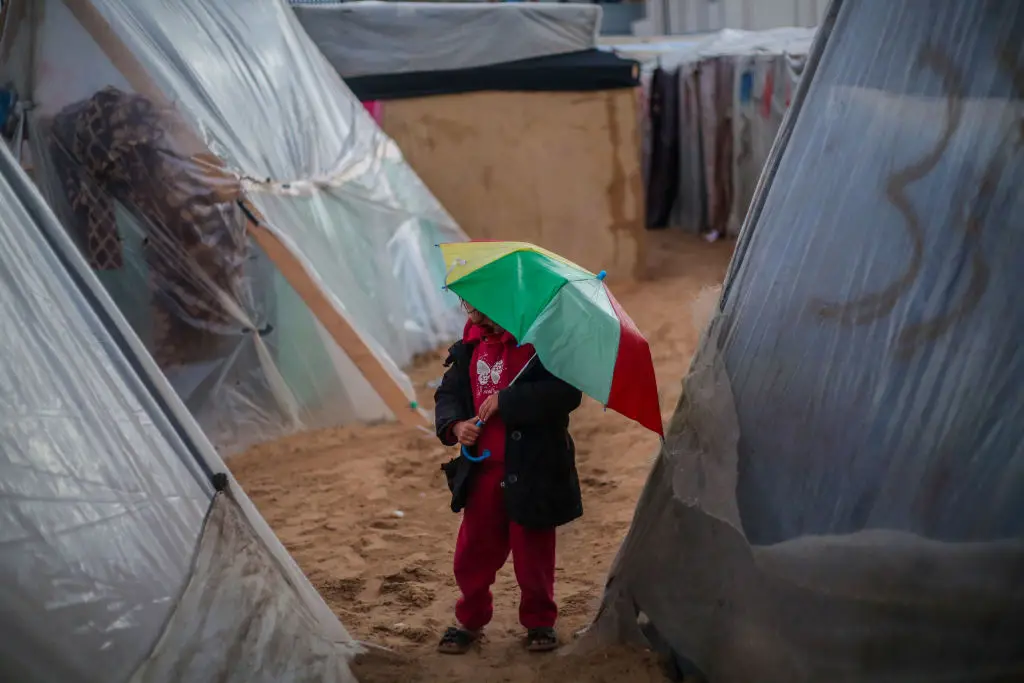
As we enter the fourth year of Israel’s genocide in Gaza, Palestinians continue to be incinerated by Israeli bombs while their children watch on helplessly. Malnutrition and starvation are still at catastrophic levels, and renewed cuts to food assistance threaten to plunge hundreds of thousands into famine. 2 million people are living in an estimated 270,000 tents, at constant risk of hypothermia, torrential rain, floods and the deadly collapse of make-shift infrastructure. The remains of the deceased are still being pulled from the rubble.
Yet those with power continue to conceal war crimes past and present, launder Israel’s reputation under the pretence of an ‘opposition’ bloc, and dismiss the experiences of Palestinians on a daily basis. The Western media ecosystem is central to this effort.
Nobody has documented the media’s failings better than historian and policy researcher Assal Rad. Her new book, Don’t Say Palestine: How the Media Manufactured Consent for Genocide provides an indispensable account of the ways in which the Western media distorts the truth and whitewashes the genocide, answering the question of how this catastrophe was allowed to happen. She spoke to Tribune about the individual acts that cohere into systematic pro-Israel bias and her efforts to set the record straight.
Hamza Yusuf
You’ve been raising awareness about the media’s failings for a long time. Was there a specific moment after the assault on Gaza began in 2023 when you felt a book like this was needed?
Assal Rad
There was no singular moment, but an accumulation of episodes in which the media illustrated its aversion to reporting accurately on Israel’s crimes. It was the repetition of waking up, checking the news, posting about the malpractice, and following that same formula each day.
The Al-Ahli hospital bombing on 17 October 2023 comes to mind, though. Israel had a track record of bombing hospitals — a war crime — and yet the media regurgitated the narrative that Israel would never attack a hospital. In doing so, it contributed to the fog of war and added ambiguity to a massacre that killed nearly 500 Palestinians. I simply posted old screenshots of articles from 2006, 2009, 2014, when Israel previously struck hospitals in Gaza, under the line ‘Israel would never attack a hospital’. It went viral and it was basically that every day, highlighting how absurd the coverage was.
Hamza Yusuf
You cite the Iraq War early on in the book, suggesting the playbook hasn’t changed and the tools for manufacturing consent by the media remained the same. How important is it to go backwards to go forwards?
Assal Rad
As a historian, I think you have to have that background. We all remember they said Iraq had weapons of mass destruction, that they lied to us to illegally invade and it was disastrous. However, the context is very different between 2003 and now. There was no social media then; people weren’t sharing images online. With Abu Ghraib, for example, the only way you’d see those images was if the news put them on TV or in a paper.
As a result, the majority of Americans believed Iraq had weapons of mass destruction, which was a brazen lie. A majority also believed Iraq had a role in 9/11, another lie. The Bush administration said these things, the global media repeated them, and that’s why a large majority of Americans supported the invasion. Wars usually produce a rally-round-the-flag effect.
By contrast, you don’t see that today with Iran at all, even though they’re peddling the same lies that Iran is a nuclear threat, Iran was two weeks from a bomb, etc. The Trump administration didn’t try very hard to do this, but the idea of Iran as a nuclear threat has been built up for a long time. And it completely failed. From the outset, only 41 percent of Americans supported the war, the lowest support for a US war ever recorded in polling. What explains that? Gaza. The collapse of trust in institutions and in the media itself means that machine no longer works the same way.
Hamza Yusuf
So is it reasonable to conclude manufacturing consent for genocide failed? Is there something to be said about media consumption habits changing?
Assal Rad
The argument can be made that what we’re really discussing is how media tried to manufacture consent for genocide. The traditional machine couldn’t keep up with a new generation, Gen Z effectively coming of age. You see the impact not just here but in other global political conflicts, as a younger generation understands and engages with current affairs in completely different fashion.
And what’s different now is that Palestinian journalists on the ground were live-streaming what was happening. People saw the raw footage and could compare it with how the same legacy media represented it. Seeing that duality in real time broke the barrier down. Manipulating reality couldn’t work to the same degree.
That’s not to say it doesn’t work at all, however. Rather, it doesn’t work in the way it did. Recent US polls found 43 percent of Americans believe Israel has committed genocide. That’s significant in a country as heavily propagandised as the US, a country that is literally arming and facilitating the genocide. But it’s also an insignificant number when you consider that Israel is committing genocide and everyone knows it. If I told you 43 percent of Americans believe the Nazis committed genocide, you’d say something had gone wrong — that we’re not teaching this properly.
Hamza Yusuf
Is what you’re describing a media failure or is this the media functioning as intended? You argue that the nature of the coverage can’t be passed off as negligence, but rather is editorial policy.
Assal Rad
It’s a deliberate and conscious decision to whitewash genocide. It can’t be anything else, because it’s not that they don’t know. They know, and they’re avoiding it entirely. The BBC recently reprimanded one of its anchors for using the word ‘genocide’ and called that impartiality. That’s why I raise the question of the free press. If you’re just going to tell me ‘he said, she said,’ or repeat an Israeli press statement, we don’t actually need you. I can go to Israel’s website or its press briefings myself.
Look at Palestinian journalists. They show you raw footage of what is happening. That’s the job. You can draw your own conclusions, but they’re showing you the truth. What Western newsrooms do is filter and rewrite that.
And we don’t really need to speculate: it’s not that they don’t use the language of war crimes, starvation as a weapon of war, or deception and lies to describe what a government does. It’s not that they don’t use the phrase ‘ceasefire violations’. They just don’t apply any of it to Israel. As I show in the book comparatively, all that language is in their own repertoire, but selectively applied. That’s what partiality is: refusing to use accurate language because the actor carrying out these acts is your ally.
Hamza Yusuf
On social media, you’re known for correcting headlines, changing passive ones into active ones, and naming Israel as the perpetrator when it commits an atrocity when outlets like the New York Times might omit it. Why are headlines so crucial?
Assal Rad
Most people don’t read beyond the headline. That’s not a judgement; I don’t read beyond many headlines myself, especially on topics I’m not following closely. The headline frames the whole story. It’s the most important nugget of information, telling you what the story is about. When the headline is convoluted, people don’t know what the story is. This is where perceptions are formed.
How does the public consume information now? You’re scrolling on your phone. You’re getting push notifications. You’re grabbing a coffee and there’s a TV in the background with a news ticker along the bottom. That language is passively entrenched in the public mind. It’s always there. For many people, those distorted headlines that leave out the full picture are their only source of information.
Hamza Yusuf
It’s not just what they report and how they do it, but also what they deliberately leave out. What are the main omissions you notice, and what kind of strategic role do they play in perpetuating bias?
Assal Rad
One omission is not mentioning Israel at all. When they report babies dying of hypothermia, people starving to death or a hunger crisis, they frame it like a natural disaster, tragic events that are the horrible but inevitable consequences of war. In reality these are deliberate policies and starvation is engineered. Trucks are waiting at the Gaza border and being deliberately blocked. That’s left out entirely.
Then there’s simply not reporting things, including major investigations. For example, Amnesty published a report on Israel forcibly expelling and transferring the population of southern Lebanon, which is a war crime, and it got no coverage. Since the so-called ceasefire in October 2025, Amnesty has said this is not a ceasefire but an ongoing genocide, and B’Tselem said the same. They just don’t report it. That under-reporting is another form of omission.
Ultimately it’s about context. They omit the most essential details that would make the story make sense, and treat each incident as a one-off. The calculated, engineered annihilation becomes a different story entirely.
Hamza Yusuf
Finally, you discuss particular atrocities, including the 2025 massacre of medics, and media investigations that come after the fact that often ‘reveal’ what Palestinians said long ago. Yet these revelations rarely seem to change the wider media narrative. Do you think these investigations actually help news organisations maintain an appearance of credibility while leaving their underlying coverage unchanged?
Assal Rad
It’s not that the good work itself is problematic. It’s that it gets used as proof of an honest, respectable journalism: ‘see, we’re doing X, Y and Z.’ But they’re not, because the overall narration remains the same, and that story is that Israel has the right to do everything it is doing and Palestinians are a problem to be solved.
The ultimate example is the word ‘genocide’. The media refuses to call it by its name, but report that ‘Amnesty International accuses Israel of genocide’. They won’t adopt the language themselves, even though it’s accurate. This creates an image of legitimacy, which is why it worked for so long, but it’s been broken down by the sheer scale of the violence and atrocities that Israel has committed. Once you see the raw footage, it all becomes undeniable.