
World Tribune
The Fight Against Chevron’s Destruction of the Amazon Is Back On
Chevron made environmental lawyer Steven Donziger a corporate prisoner. Now free, he’s working with indigenous communities to make the oil giant pay.
English (original) ·Read in Deutsch ⇄
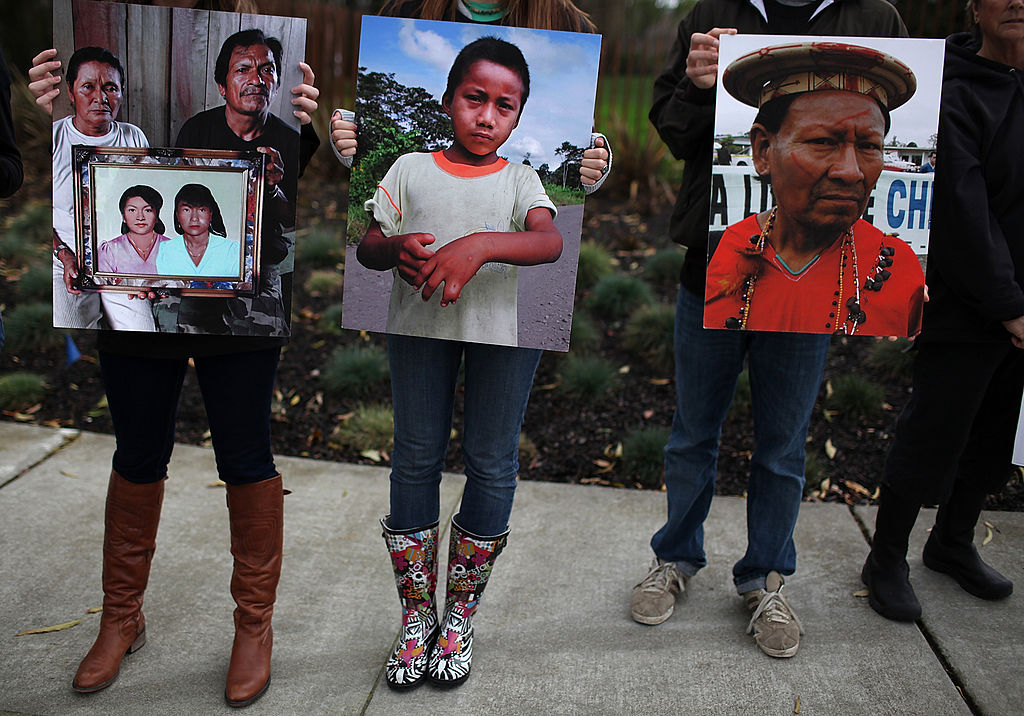
In 2011, an Ecuadorian court found Chevron guilty of dumping billions of gallons of toxic waste water and crude oil directly into the streams and rivers of the Amazon rainforest. The court ordered Chevron to pay $19 billion in damages to the people of the Lago Agrio region, who experienced spikes in cancer rates and birth defects as the water around them turned black. Even when a 2013 ruling decreased the liability to $9.5 billion, the judgment marked an unprecedented victory for indigenous communities over corporate abuse and environmental destruction.
Fifteen years later, Chevron has yet to pay a cent. After the ruling, the oil giant marshalled its enormous resources to delegitimise the decision, evade responsibility and exact retribution against those who dared to hold the company accountable for its crimes. Steven Donziger, the American environmental and human rights lawyer who represented the Amazon communities, became Chevron’s primary target.
Over the next decade, Chevron relentlessly pursued Donziger through New York City courts. In 2014, it filed a racketeering suit alleging that the Ecuador judgment had been secured through corruption and bribes. When Donziger refused to turn his laptop and electronic devices over to Chevron in order to protect his clients, the court charged him with contempt. Though federal prosecutors declined to pursue the case, US District Judge Lewis A. Kaplan appointed a team of private prosecutors with ties to Chevron to act as the ‘government’ — a first in US legal history. They proceeded to strip Donziger of his law license, place a lien on his home, freeze his bank accounts, confiscate his passport and place him under house arrest.
In total, Donziger spent over 900 days in home detention — more than four times the maximum sentence — and an additional forty-five days in prison. After years as a corporate prisoner, he finally regained his freedom in 2022.
Now once again in possession of his passport, Donziger is travelling the world to hold Chevron accountable. During a recent trip to London, he spoke to Tribune about the health of the communities in Ecuador, renewed efforts to collect on the judgment, and the state of the rule of law in the US and the UK.
Evan Robins
Where does the case against Chevron stand?
Steven Donziger
The Amazon communities have won a $9.5 billion judgment, plus interest. In total it’s probably worth $12 billion now. It was affirmed unanimously by Ecuador’s Supreme Court and by Ecuador’s Constitutional Court, but Chevron refuses to pay. As a result, the communities’ only option is to file lawsuits in other countries where Chevron has assets and ask courts to seize those assets to force them to comply with the law in Ecuador. This type of foreign enforcement proceeding is standard procedure in a commercial dispute context. But in this landmark human rights case, Chevron is spending millions on lawyers to erect all sorts of roadblocks to evade the court judgement.
However, there is no statute of limitations on foreign enforcement actions. This is a critically important fact and it terrifies Chevron, because it will face the financial risk of the Ecuador judgement forever unless it deals with it. However, Chevron had me detained for close to three years and had my passport confiscated for seven years. I simply couldn’t travel to do the work. This led the case to enter a state of abeyance. The communities are now trying to get it moving again. I’m also travelling again and went to Ecuador recently for the first time in years.
Evan Robins
In what capacity are you able to re-enter this work? Does your involvement put you at risk?
Steven Donziger
Chevron’s attacks, which were unprecedented from a legal standpoint and also unprecedented in their viciousness, resulted in serious hardship for me and my family. Chevron was able to take my law license without a hearing, so I’m not here as a lawyer. I’m here as an advocate for the communities of Ecuador searching for support so they can enlist law firms in different countries to represent them and force Chevron to pay the judgment that it owes. Is this a threat to me personally? No, I don’t believe so. No more so than living in New York and continuing to speak out about the environmental crimes and human rights atrocity that Chevron perpetrated in Ecuador. If Chevron wanted to go after me again, they could do it. I would defend myself, and I think I would be able to prevail. It’s not without risk, but I’ve been very open about what I’m doing now. And a lot of people around the world support our team – including sixty-eight Nobel Laureates, dozens of members of the US Congress, and dozens of legal associations around the world who have spoken out against Chevron’s abuses.
Evan Robins
How has the situation developed for the communities in Ecuador over the years of this legal battle?
Steven Donziger
When Chevron had me detained in 2019, the communities were really hurting. Cancer rates were high. But last March I went back to the Amazon for the first time in seven years, and it’s gone from very bad to catastrophic; levels of cancer are off the charts. Several people I knew prior to my arrest have since passed away. What’s taking place in the area where Chevron operated is really a quiet massacre where a handful of people die every week, and over the years, thousands of people have reportedly died from the pollution. It’s not like a spectacular event where there’s mass casualties for all the world to see. It’s a slow, incremental degradation of human life and the environment. Those who have been hurt, and their surviving family members, need to be compensated. The environment that continues to harm people and poison people needs to be remediated. This is a moral imperative. It’s also a legal requirement. So this is not only about saving lives. It’s also about corporate accountability and the need to uphold the rule of law.
Evan Robins
Not only has Chevron not complied with the Ecuador judgement, but now it’s leading the charge into Venezuela.
Steven Donziger
Chevron is as profitable as it’s ever been in its history. The last seven years have been incredibly lucrative. They’re in tight with Trump and they’re marauding the world for oil and profits. Not only are they deeply embedded in Venezuela, but they also are deeply embedded in Israel with gas fields off the coast of Gaza. They’re essentially complicit with the Israeli government in stealing Palestinian-owned gas. Things are good for them from a profit-loss standpoint, but they’re also causing a tremendous amount of harm around the world, and they don’t really seem to care about that part because legal enforcement of environmental laws has become so lax. They operate as if they have impunity. And you know what? There’s nothing that any government or prosecutor has done to prove otherwise. We did hold them accountable to a great extent, but we never collected on the judgment. Now there’s a president of Ecuador who’s essentially a mini version of Trump, so Chevron thinks it’s protected even in Ecuador. But I don’t think that’s entirely true.
Evan Robins
Can you say more about the current relationship between Ecuador’s government, Trump, and Chevron?
Steven Donziger
For the duration of this long legal case, Chevron’s posture vis-à-vis Ecuador’s government was to pressure it to join forces with the company to repress the rights of its own citizens to bring suit against an environmental polluter. That is, Chevron constantly tried to get Ecuador’s government to put its thumb on the scales of justice to favor the company. Ecuador, like the United States, holds itself out as a democracy with a system of separation of powers and checks and balances. But in my opinion, Chevron has no respect for separation of powers. For years the company’s entire strategy was to strong-arm Ecuador’s president to interfere with the country’s independent judiciary and snuff out the case in violation of its Constitution.
One way they tried to do this was by offering what I would call bribes, but what they might call inducements. During the Obama presidency, for example, Chevron tried to arrange a $700 million aid package in conjunction with the State Department as a way to coax Ecuador’s president to interfere with the judicial branch and kill off the case. Ecuador’s current president, Daniel Noboa, has a governing style modeled to a great degree on Trump. He’s actually trying to help Chevron evade the judgement we won to the point of reportedly offering Chevron $200 million as compensation for the ‘harm’ of letting Ecuador’s own citizens sue Chevron in his country’s courts. This appears to be a total capitulation to corporate colonialismIt’s very clear that Trump is close with Chevron, Trump is close with Naboa, and Noboa is close with Chevron. They are class allies united in their disdain for the humble among us. In the meantime, we fight on.
Evan Robins
You’ve often spoken about the power of corporations over American democracy and the rule of law. How are you seeing this develop during Trump’s second term?
Steven Donziger
What we’re seeing now has been a fifty-year plan by the corporate elites and the oligarchs to take power in the US. They don’t want to just lobby Congress, they want to control Congress. They don’t want to just lobby the president, they want to control or at least have enormous influence over the executive branch. It’s the same with the judiciary. The judiciary is particularly vulnerable because if you can control only five of the nine justices on the Supreme Court, you essentially can control policy and law for an entire population of 350 million people. That’s what has happened in recent years in the United States. Trump did not cause it; he’s just the latest vehicle being used for its implementation.
The corporate strategy to take control of government was born in the 1970s with the Lewis Powell memo, which led to the creation of the Federalist Society and the Koch brothers funding movement. Powell himself became a Supreme Court justice. The plan was to try to organise our society to align it more with corporate profits, with the focus being on the federal judiciary and Supreme Court. The plan was, and is, bold and clever.
I would argue that we don’t have a democracy right now in the United States. Our Supreme Court is no longer a court, but in my view is a political arm of the Trump movement that is manipulating the law to support a far-right extremist political agenda. As a lawyer, I am repulsed by what’s happening.
My case was one illustration of their power. I was incarcerated for three years by an oil company. I’m the only person ever prosecuted criminally by a corporation in US history. The judge charged me with criminal contempt for refusing his order that I turn over my confidential case file, an order that was unprecedented and legally baseless. The regular prosecutor rejected the case. So the judge appointed a Chevron lawyer to step into the shoes of the US government and prosecute me. As a result, I spent more than four times my maximum sentence locked up in a very irregular, and I would argue, corrupt, legal proceeding. I became what many lawyers described as a corporate political prisoner. I knew when it was happening that it was a playbook that could be applied elsewhere and I felt in many respects like an animal in a legal lab test. When my detention ended in 2022, after almost three years locked up in my house and in prison, it was clear that we were entering a period in the United States — particularly if Trump were to be elected again — where the rule of law would be under severe attack and where my rogue case would even become the norm as Trump targets his enemies, be they activists, progressives or immigrants.
The specific corporate attack playbook that was used against me is now being used against Greenpeace. Energy Transfer, the largest pipeline company in the United States, was so furious with the successful indigenous-led protests at Standing Rock in 2016 that they literally hired the same law firm that Chevron used against me and deployed it against Greenpeace, resulting in a completely unjust $345 million civil judgment in the courts of North Dakota that was handed down in 2025. The use of the civil racketeering law is being abused by corporations to suppress speech and activism and to intimidate people on the progressive left. We’re also seeing similar things throughout the West right now. In Germany, Australia, Canada, the United States, and especially here in the UK, people are being attacked for exercising the right to free speech and the right to protest.
I think these extremely oppressive measures from governments and corporations that are taking place in the United States and the UK and other countries are a response to our growing power. The corporations and their bought politicians are happy to engage in class warfare against people organising against them. They’re unabashed about it. They used to try to hide it or couch it in kind of rule of law clothing, but we’re not seeing that as much anymore. Now they’re really in naked conflict with our power, because they feel heat from us. Out of the ashes of Trump, something new is going to be built. We have the power to shape it if we get sufficiently organised. Progressive politicians, led by New York City Mayor Zohran Mamdani, are slowly gaining a foothold in the United States. There’s a real possibility right now for a greater shift. But the left in the United States is still extraordinarily weak because of the corporate-financed attacks.
Evan Robins
In the UK, barrister Rajiv Menon is facing his own unprecedented contempt of court proceedings for his closing speech in a trial defending a Palestine Action activist. This clearly echoes the outrageous contempt charge imposed on you. What advice do you have for Menon as he fights his own battle against judicial overreach?
Steven Donziger
My best advice is to lean into it and fight it every step of the way. Not just in court, but publicly. To speak out. Try to make what’s happening to you a touchstone issue for the entire society. The forces that try to drown out speech, whether it’s the British state or a corporation like Chevron in my case, want to do this outside of public view as much as possible. They want to act like it’s a normal legal proceeding and it’s just the way the law works. That’s not what is actually happening. These are politically driven cases, so they have to be met with politics.
The best advice is to go public, get organised, get as much support as you can from other lawyers, from bar associations, from labour groups, from any social sector organization that can help. It’s a lot of work, and most lawyers are not trained to do it. But it’s necessary. I’m appalled to come to this country and see the level of repression against speech. I’m appalled to see climate activists sentenced to multi-year prison terms for engaging in non-violent civil disobedience. When they start attacking the lawyers who defend the people who are being hit with these draconian and repressive laws, you’re in serious trouble. At that point you’re no longer in a democracy, you’re in an authoritarian state. That’s what I’m feeling in the UK, at least in terms of punishing advocates for disfavoured causes like Palestinian self-determination and climate justice.