
Politics · Tribune · · 3h
The Dark Arts of Camden Labour: Part I
English (original) · Read in Deutsch ⇄
As Keir Starmer began his artful conning of the Labour Party membership, presenting himself as a soft-left unifier, socialist members in Holborn & St Pancras constituency party (CLP) were not fooled. They already knew from hard experience that Starmer was a right-wing factionalist.
And they said as much. In mid-January 2020, as Starmer began to pull ahead in the Labour leadership contest, local activist and former African National Congress politician Andrew Feinstein wrote: ‘I’m a member of Starmer’s CLP & can confirm that he has brought division & rancour to the constituency, including attempting to get rid of all left members off branch committees. This is what he’d do nationally if elected leader.’
But Starmer had some doughty local defenders. Foremost among them was Sagal Abdi-Wali, who wrote in response to Feinstein: ‘I can unequivocally state that Keir Starmer has led our CLP from the top and promoted a culture of unity and respect. That’s why we’re so proud to have him as our MP.’
Abdi-Wali is now the Labour Party’s candidate in the upcoming Holborn & St Pancras by-election, triggered by Starmer’s decision to resign. She is facing off against the Green Party leader Zack Polanski — who has taken a major gamble in running for a London seat that is much less favourable for him than others to the east or south, where the Greens have recently thrashed the Labour Party in local council elections.
The daughter of Somali asylum seekers who settled in Camden when she was a child, Abdi-Wali is running on an Obama-style optimism. In person, she is much more charming and socially adept than Starmer. She is often pictured beaming and is undeniably warm. Her profile was boosted nationally when she was subject to disgraceful racist attacks from Zia Yusuf, the swivel-eyed Reform spokesman for home-affairs.
The Labour Party has flooded the constituency, and social media, with flyers and videos urging people to vote to bring ‘hope’ back to Holborn & St Pancras. It is a strange framing, considering that Labour has held this constituency at every election since 1983. But the intention is clearly to run Abdi-Wali in the goodwill slipstream of new Prime Minister Andy Burnham; to hint, without saying it outright, that she embodies a renewed, sunnier soft-left Labour Party; to encourage warm-hearted liberals to see in her candidacy a chance to vote against the racism and hate of Reform. Abdi-Wali’s campaign has so far been brilliantly calibrated in this regard: largely devoid of actual policy to be attacked, but heavy on vibes and the short, personalised videos prescribed by the Burnhamite digital strategy gurus.
Amid all this, there has been little to no substantial scrutiny of Abdi-Wali; of the Starmerite political project that birthed her candidacy; of what this project has done to Camden Labour and the community of Camden as a whole; or of why the Labour Party is having to work so hard to hold a seat which, not so long ago, returned Starmer with 70 percent of all votes cast and a storming 30,000 vote majority.
Land of Contrasts
The contrasts of Camden (and Holborn & St Pancras in particular) are hard to miss. The borough is ethnically, racially and religiously diverse. About half of all adults living in Camden were born out of the country, drawn from both Western Europe and the Asian subcontinent. The 2021 census recorded an adult population of 210,000, of which 33,000 identified as practicing Muslims and 10,000 as Jewish.
About 35 percent of residents live in social housing; 2 in 5 children in the borough live in relative poverty once housing costs are considered. And new data from 2025 shows that Camden is getting more deprived over time.
Housing concerns dominate. There is persistent disquiet at the failure of Camden to repair and maintain its own housing stock. A damning Housing Ombudsman report in 2024 found the Council to be a disdainful and ineffective landlord in handling resident complaints. Private renters face astronomical costs: in 2025, it was found that only 1 percent of one-bedroom flats for private rent were affordable to a resident earning the average local wage.
There is also affluence and wealth in abundance. The borough includes the glamorous and gleaming redevelopment of King’s Cross and Coal Drops Yard, featuring Google’s mammoth ‘groundscraper’ UK head offices. In the north of the borough, Victorian terraced houses in leafy neighbourhoods routinely cost upwards of £2 million, making it the third most expensive borough to buy a house in the country.
This makes it the natural home for a Blairite elite who have long orbited the local Labour Party: a concentration of Labourite political and cultural capital that is perhaps unique in the country. Lord Peter Mandelson lives, for now, in luxury on the Outer Circle ringing Regent’s Park. Sir Trevor Phillips resides in Kentish Town, not far from Starmer himself, while Alastair Campbell lives in Gospel Oak. Closer to the action has been Georgia Gould, daughter of Blair’s top strategist Philip Gould, who led Camden Council from 2017 until 2024, when she was parachuted into the safe seat of Queen’s Park and Maida Vale and fast-tracked into a ministerial post.
Members of the Holborn & St Pancras CLP during the early and mid-2010s recall a sedate, humdrum local party. Branch meetings were not particularly well-attended. The Party frequently had to cast about and twist the arms of the local membership to attend monthly General Council meetings (‘GCs’ in Labour WhatsApp-speak). Those who served as councillors at the time recall a more relaxed atmosphere where dissent and disagreement were managed without significant rancour and threats to remove the Party Whip.
Things changed with Corbyn’s election in 2015. Local branches were flooded with members. Camden Momentum became increasingly influential. Factional friction, always present, became particularly intense after Corbyn’s unexpectedly solid showing in the 2017 election; partly because an emboldened left could now attract more supporters to meetings, and partly because Camden’s Labour right-wingers realised that Corbynism was not going to be a flash in the pan, and might seriously threaten their control of the local party.
By 2018, slate politics dominated and bitter quibbling over arcane rules and procedures ensued, as both sides sought whatever advantage they could find. Long-time members like the genial and mild-mannered Jewish Holocaust-survivor Stephen Kapos suddenly found themselves adrift in this new atmosphere. Kapos, a member since the 1960s in Starmer’s own Kentish Town branch, had been elected as a delegate to the GCs with ease since 2010. At an AGM in 2018 he lost his place to a well-run right-wing slate.
In this cut-and-thrust of local politics (often angry, sometimes unfair, but nevertheless vibrant and dynamic), participants became plainly aware of where everyone’s factional allegiances lay. It was clear, for example, that Starmer was part of the anti-Corbyn right-wing faction: he raised eyebrows when he took time out of his brief as Shadow Brexit Secretary to attend the 2018 AGM of his home branch at Kentish Town at which Kapos lost his GC seat.
Abdi-Wali was part of that same faction, hence her election as the chair of Holborn & St Pancras CLP in 2019. She was particularly close to the married couple Gil Black and Martin Plaut.* Black was Sir Keir’s election agent. Plaut, meanwhile, is a particularly active, effective and pugnacious anti-Corbyn operator, who was for a period listed as a parliamentary researcher for Starmer.
When journalists Gabriel Pogrund and Patrick Maguire cast about for local friends to interview for their book on the McSweeney-Starmer project, Plaut obliged with an analysis of Starmer’s politics as foretold by his behaviour on the local football pitches. ‘He’s a completely hard bastard’, Plaut enthused. ‘He plays to the edge of the rules, really hard.’
Clampdown
Sagal Abdi-Wali got her start as a Labour councillor as a result of a crass purge that typified how the Starmerite Party machinery sought to erase any opposition to its narrow political outlook.
The withdrawal of the whip from Jeremy Corbyn in late 2020 had shattered any illusion on the left of the Labour Party that Starmer might be a unifier. In Holborn and St Pancras, left-wingers felt unable to voice their opposition to this direction of travel due to what they saw as Abdi-Wali’s factional chairing of CLP meetings. In January 2021, thirteen elected GC delegates and five ordinary and active Labour members wrote a letter to her expressing their ‘dismay’ that the meetings she chaired were not a ‘welcoming environment encouraging a diversity of voices’ but forums where ‘dissent [was] considered unacceptable.’
One complaint alleged that Abdi-Wali had not allowed anyone ‘on the left’ to ask questions of Starmer during a recent meeting. She responded by saying, ‘I do not engage in this rhetoric. . . . I believe everyone in our meeting is on the left, everyone in our meeting is a member of the Labour Party. . . . I can assure you, those of you here are not and were not the only “Corbyn-supporters” in our CLP, are not and were not the only Socialists.’
Later that year, the selection of Labour’s candidates for the 2022 local elections got underway. The process of selecting candidates for Camden council was overseen by Mike Katz, chair of the Local Campaign Forum.
Katz was the National Chair of the Jewish Labour Movement (JLM) between 2019 and 2025, including during the period in which it threatened to disaffiliate from the Labour Party in response to the ‘antisemitism crisis’ under Corbyn. We now know that Morgan McSweeney, Starmer’s future chief of staff, worked closely with JLM during the period at Labour Together in which he was covertly working to destroy the electoral chances of Corbyn’s Labour.
JLM is an explicitly Zionist organisation and is affiliated with the British subsidiary of the World Zionist Organisation. In 2024, the BBC would reveal that the ‘settlement division’ of the World Zionist Organisation was complicit in facilitating illegal settlements in the West Bank.
At the time of the councillor purge in Camden, and in addition to his role in JLM, Katz was ‘Head of Policy and Public Affairs’ for FirstGroup, a conglomerate that had bought up swathes of the bus and rail services privatised in the 1980s and 1990s.
The process to decide who could and couldn’t be a councillor in Camden was thus being overseen by an executive at a private transport company, who was also heading an organisation that sought to police the tone and scope of Labour Party conversations about Israel.
By the end of the selection process, seven sitting Labour councillors had been blocked from standing for re-election — a purge described as ‘unprecedented’ in local paper of record, the Camden New Journal (CNJ). Some of the councillors purged were explicitly Corbynite, but some were just independent-minded. More still decided to stand down, appalled at the treatment of their colleagues.
One of those blocked was Paul Tomlinson, councillor since 2015 for Somers Town, one of the most deprived wards in the borough, and a persistent critic of the council’s record on affordable housing.
There was outcry in the Letters pages of the CNJ when Labour’s deselection of Tomlinson was announced. ‘By deselecting Cllr Tomlinson, you silence Somers Town’, wrote one resident. ‘This is a dangerous trend: a curtailment of freedom to voice concerns and tolerate dissent.’
Leo Cassarani was another casualty of the deselections. A beloved local campaigner, he had advocated for the community against an imposing Deliveroo ‘Dark Kitchen’ that ‘heaped misery on residents’ in an adjacent housing estate. ‘Until Labour sees the value of people like Leo, and allows a dissenting voice from time to time, I will not be voting Labour again. The party is diminished and its reputation disgraced by Leo’s shameful and forced departure’, a resident wrote to the CNJ.
An 87-year-old who had been a member of the Labour Party since she was 18 wrote to the CNJ explaining that she had just resigned her membership. ‘Many of my friends and neighbours, working class, devoted, Labour Party members for decades, now feel they are no longer wanted, valued or respected by the party,’ she said. ‘People with opposing views are essentially being ostracised for speaking up and asking questions. This is entirely wrong in a democracy.’ The Letters page of the CNJ was filled with dozens of similar letters in late 2021 and early 2022.
Plaut, friend of Starmer and Abdi-Wali who sat on some of the selection panels, responded that he ‘was sorry to see that some neighbourhood organisations were upset’ by the deselections. ‘Based on the system we adopted and the limited sample of cases I participated in, I believe that this procedure was scrupulously fair,’ Plaut wrote. ‘No one should automatically expect to be a councillor if they don’t meet our requirements,’ Mike Katz told the CNJ.
These views were hard to square with the bizarre circumstances around the selection process, which had further inflamed local anger. In June 2019, Cassarani, Tomlinson, Maryam Eslamdoust and other councillors had signed a ‘call-in’ suspending a Labour cabinet member’s decision on redevelopment plans for Camley Street, near King’s Cross, so that it could be subjected to proper scrutiny.
By 2021, this act of diligence had become an unforgivable sin within the world of Camden Labour. The interview panels were provided with a whip’s report written by Lazzaro Pietragnoli, the former Camden Mayor who had served as Chief Whip of the Labour Group. The reports highlighted the call-in decision, using it as the pretext to block the candidates on the basis that it was a de facto decision to break the Labour Whip.
As candidates were being blocked because of Pietragnoli’s reports, the Camden New Journal revealed that he had been secretly running a Twitter account called @phillmum. Pietragnoli pretended to be a mother-of-three in Primrose Hill living in social housing. He used the account to praise his own work and attack left-wing councillors, including Eslamdoust, whom he called a ‘scumbag.’ Eslamdoust was blocked from standing as a councillor on the back of Pietragnoli’s whip’s report about her. Pietragnoli resigned in embarrassment shortly after the revelations.
Despite this, the party nevertheless continued to rely on his reports. Its only response was to send a ‘sample’ to a Labour figure outside of the borough to review, who declared them neither biased nor inaccurate.
This was news to Ranjit Singh, the councillor whose Labour career was ended to Abdi-Wali’s benefit. Singh was a long-time and prominent left-wing member of the local Labour Party who had vocally backed Corbyn. He was told he wasn’t allowed to stand in 2021 following an interview with the panel selected by Katz. He was grilled based on Pietragnoli’s whip’s report, which berated Singh for signing the Camley Street call-in. But Singh had done no such thing; as a Google search would have established. He was nevertheless told he couldn’t challenge the whip’s report in the meeting.
In January 2022, the Labour Party sent out an appeal for more members to apply to be councillors. The CNJ wrote that ‘despite having more than 4,000 members across Camden, the party has not got enough approved names to fill a full slate of 55.’
Abdi-Wali, well known as the chair of Holborn & St Pancras CLP, was selected for the seat vacated by Singh. Izzy Lenga, a prominent member of JLM who had been active in Barnet Labour, was offered a seat in South Hampstead, which had lost all three of its councillors due to deselections and a resignation in solidarity. At the branch meeting, the appointment of Lenga and two others were presented as a fait accompli, prompting attendees to leave the Zoom room en masse in protest. Lenga was made the Chief Whip of the Camden Labour Group immediately on her election.
Prior to her selection, Electronic Intifada had published a photo of Lenga wearing an Israeli military uniform, draped in the flag of Israel and seemingly holding a rifle. Now vice-chair of JLM, it was revealed in 2022 that Lenga did basic training with the IDF. More recently, anonymous campaigners in the constituency have unearthed a photo Lenga posted to Facebook in November 2025, which shows Lenga and Abdi-Wali on holiday at Zion National Park in Utah, both smiling widely into the camera. Lenga captioned the image ‘Twice as Zionist’.
The Successor
Abdi-Wali’s career has since gone from strength to strength. In October 2023, she was elected as the chair of Labour’s National Women’s Committee. She was endorsed by Labour to Win, which had been formed as a joint enterprise by the Mandelsonian outfit Progress and Labour First, the home of the old Labour right. Labour to Win was headed by infamous Labour organiser Luke Akehurst, a role he performed alongside his two days-a-week employed as a lobbyist for Israel. Abdi-Wali was re-elected to the position this year, again with Labour to Win’s backing.
In early 2024, she was made cabinet member for housing. She was elected leader of the Council in May 2026 and then selected as the Labour Party’s candidate for the Holborn & St Pancras by-election in September.
Abdi-Wali’s climb up the political ladder has coincided with a withering of both the Labour Party’s local membership and its popularity with the electorate. The councillor purges of 2021 and 2022 were just a sample of the outrages inflicted on the left-leaning membership in the borough, all the nastier for being carried out under the pretext of resolving the ‘antisemitism crisis’.
Between 2021 and 2024, numerous prominent Jewish Labour Party members in Camden found themselves investigated or suspended for supposed antisemitism. In 2023, Stephen Kapos, the Jewish Holocaust survivor, resigned from the Party in protest. He had been warned by the Labour Party that he would face expulsion if he talked about his personal experience of the Holocaust at a meeting of the Socialist Labour Network (SLN) — on Holocaust Memorial Day. SLN had been proscribed by the Party in March 2022.
Andrew Feinstein was informed by the Party that he was under investigation for antisemitism in 2021. He was only cleared years later, after threatening legal action. Party files show that his complaint was submitted by a non-Jewish member of Labour Against Antisemitism (LAAS), which had played a prominent role in amplifying the despicable ‘dark arts’ campaigns previously run by Morgan McSweeney. ‘He seems to constantly reference his dead family in order to undermine claims of anti-Semitism which is in common with others claiming Jewish heritage who have been expelled from the party,’ the complaint alleged.
But perhaps the most egregious case was that of Riva Joffe.
Joffe, a remarkable and very funny psychotherapist, was prominent on the left of the local party. She was a member of Jewish Voice for Labour (JVL), a non-Zionist group set up as a counterweight to JLM which determinedly defied the mainstream narrative of widespread antisemitism under Corbyn. Her parents had fled persecution in Europe and settled in South Africa in the 1930s. They joined the South African Communist Party and became active in the struggle against the system of racial segregation that would be codified into apartheid. Joffe’s family left South Africa soon after the Second World War to settle in Britain, with their family home becoming a safehouse for anti-apartheid luminaries passing through London.
In 2021, Joffe was sent a Notice of Investigation accusing her of antisemitism. She was at that moment on her deathbed, suffering from a terminal illness. She wrote a stinging response to the charges — the last political act of her life. She shared the story of both her declining health and this last indignity on social media. She died while under investigation for antisemitism. Joffe’s son, Stefan, has described how the Labour Party under Starmer has refused to answer whether it has cleared Joffe of the charges posthumously. Starmer refused to acknowledge — let alone answer — letters sent to him directly about Joffe’s case.
Party files show that the complaint against Joffe — for sharing a post in favour of the Boycott, Divestment and Sanctions campaign, and another on the JVL Facebook group — had been submitted by a person called David Gordstein. But Gordstein was not real — this Jewish-sounding persona was the invention of Euan Phillips, the non-Jewish spokesperson for LAAS. Phillips admitted to Al Jazeera in 2022 that he had created Gordstein; he insisted that ‘he never claimed to Jewish when doing so.’
Five years on, Camden Labour’s grandees — Polly Toynbee, Sir Trevor Phillips, Georgia Gould and her mother Baroness Rebuck, the chair of Penguin Random House — assembled in St Pancras Church, the same venue where Starmer had been first selected as an MP, to pick his successor: Sagal Abdi-Wali. No media was allowed in (neither reporters nor photographers) and no information on how many members had voted was released.
Abdi-Wali declined to speak to the CNJ. In the words of Osley, ‘media outlets elsewhere faithfully shared a generic statement about how happy she was to have been selected.’ The photos of Abdi-Wali’s selection were supplied to the media by Martin Plaut. He had, days earlier, written the first glowing profile of Abdi-Wali on his personal blog. He celebrated her humour and warmth, as well as the ‘tough decisions’ she had made about housing as cabinet member for the portfolio. Gil Black signed as the seconder to Abdi-Wali’s formal nomination with the Electoral Commission.
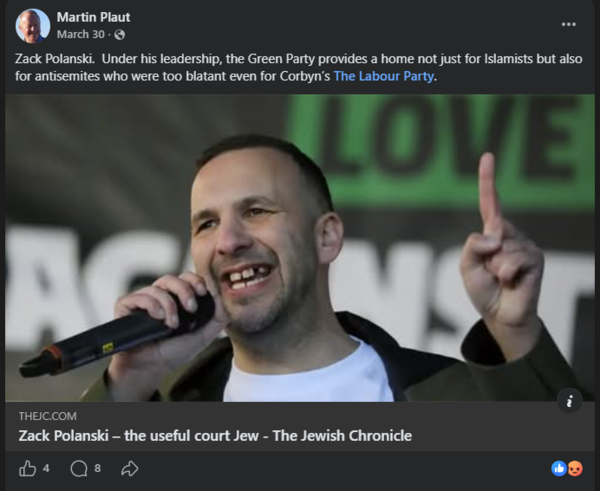
Plaut’s social media suggests he has since transferred his distaste for Corbynites in the Labour Party to Zack Polanski, the Jewish leader of the Greens and Abdi-Wali’s opponent. In March this year, he shared an article in the Jewish Chronicle, ‘Zack Polanski — the Useful Court Jew,’ written by Stephen Pollard, to his Facebook. Plaut wrote the words ‘Zack Polanski’, following by a line from the article: ‘Under his leadership, the Green Party provides a home not just to Islamists but also to antisemites who were too blatant even for Corbyn’s [Labour Party].’
In response to questions for this article, Plaut said he did not believe that Polanski was a ‘court Jew’ and that he ‘categorically rejected’ this view. He said he did not ‘have a view’ on the membership of the Green Party. He also indicated he did not understand the meaning of the word ‘Islamist’ in his post and commented that ‘Sagal is a ‘Muslim and I strongly support her.’ He did not respond when it was pointed out that his personal website includes the category ‘Islamists’ and that he had used the word over 25 times on his X account. Plaut’s Facebook post remained live at the time of going to press.
Hope Again?
We are faced today with another fraud, this time directed towards the voting public of Camden rather than the Labour membership. In this byelection, the most cynical and diehard Starmerite cadres in the country, leading supporters of Israel among them, are presenting themselves as bearers of the hope that their own man — their own political project — bludgeoned away.
That makes laying out the facts all the more important. Sagal Abdi-Wali’s story is the story of Camden Labour, and the story of Camden Labour is that it was Starmerism’s ground-zero. Here, local democracy was brutally dismantled, with the council subordinated to the interests of housing developers and the imperative to defend Israel. The priorities of the local party mirror those of the national one under Starmer: from complicity in genocide to trickle-down housing policy to what Councillor Paul Tomlinson called ‘social cleansing.’
The Starmerite machine that made Sagal Abdi-Wali now asks voters to send her to Westminster, hoping that in the glow of Burnham’s leftward turn its dark arts — lobbying for Israel, rolling over for exploitative property developers, purging community stalwarts who dared to dissent — will go unseen. That cannot be allowed to happen, not least because Camden Labour and its petty authoritarians represent the highest (and lowest) form of the party culture that the new Prime Minister has promised to vanquish.
* One of the authors of this piece, Paul Holden, co-authored a book,Who Rules South Africa,with Plaut published in 2012.
Part II of this article will dig into Camden Labour’s record in power, from blocking divestment from Israel to catastrophic failure on affordable housing.
Read the full story at the source
Source: Tribune