
World Tribune
Lula’s Leap Into the Future
The people’s president won by combining 20th-century politics with 21st-century campaigning.
English (original) ·Read in Deutsch ⇄
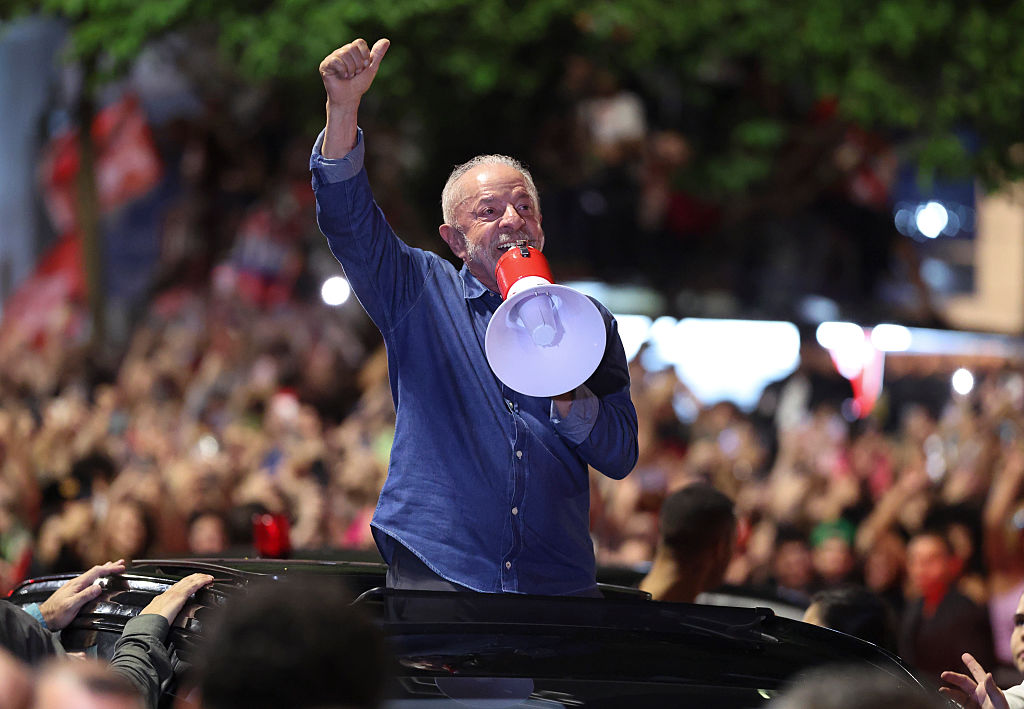
In the first round of the Brazilian presidential elections earlier this month, Luiz Inácio Lula da Silva styled his campaign as the culmination of his decades-long political career — the final chapter in this elder statesman’s legacy. When the results were announced on 4 October, it appeared that this narrative had little sentimental purchase. Much of the electorate wanted a younger candidate, a new direction, an outlet for their frustration. About 56 million of them voted for Senator Flávio Bolsonaro, the son of the former president now serving a lengthy prison sentence for attempting a coup. He received 47 percent of valid votes to Lula’s 45 percent.
While neither of the contenders got the majority needed to avoid a runoff, the verdict seemed clear: Lula, seeking an unprecedented fourth term at the age of eighty, was on his way out, and bolsonarismo had come roaring back.
No candidate who failed to win the first round had ever prevailed in the second. Bolsonaro allies had swept to power in legislative races across the country, suggesting that Brazil had shifted to the right and out of Lula’ reach. Yet there was one key figure in Lula’s orbit who remained confident in the possibility of a turnaround: Congressman André Janones. With Lula’s blessing, he immediately set about bringing the campaign into the digital spaces it had so far struggled to penetrate. The Brazilian far right, seemingly convinced they were unbeatable, downplayed Lula’s steady rise in the polls over the last three weeks — until finally, on Sunday, he defied the odds and stormed to victory, winning an astounding 64 million votes.
The outcome was the result of two immediate factors: Lula’s singular leadership, and Janones’s intuitive understanding of today’s online ecosystem. Together, they managed to beat the Bolsonaro machine.
Janones is not a standout politician, yet his savviness as an operator and digital strategist is well known. A lawyer from Minas Gerais, he first gained national prominence with his social media commentary during Brazil’s 2018 truckers’ strike. He was elected to Congress that year and built a following with his informal, confrontational communication style — distinct from the polished language of most campaigns. He has often been hard to pin down politically. He briefly ran for president in 2022 on the ticket of a tiny party with little popular appeal before heartily endorsing Lula and becoming one of the president’s most dogged defenders.
The first round of the campaign leant heavily on traditional tactics: occasional rallies, slick campaign ads highlighting Lula’s achievements, interviews in the presidential palace. The aggregate effect, in a country where politics often seems remote from everyday life — with lawmakers seemingly powerless to confront rising costs and spiralling levels of debt — was to cast lulismo as a distant part of the establishment.
Lula could, of course, point to significant gains during his third term. He pushed through a comprehensive modernisation of the country’s tax system and increased the share paid by the rich. He reintroduced and expanded social programmes for the poorest Brazilians. Employment rose to the highest level on record while inflation fell to the lowest. Lula vigorously resisted Trump’s intimidation, standing firm against punitive tariffs and forcing the White House to drop them. He charted an autonomous foreign policy, strengthening ties with other nations of the Global South. And he safeguarded Brazil’s democratic institutions after Jair Bolsonaro’s attempt to rewind to the days of military dictatorship.
But the sense of precarity that continued to afflict many Brazilians, especially indebted and lower middle-class ones, was harnessed by the far right to drive a hardline politics of ‘security’: promising the individual protection from the twin menaces of crime and communism. This bolsonarista offer began to cut through thanks to historically low turnout, mobilisation among far-right evangelicals and the support of the country’s most reactionary elites — from the military police to agribusiness — not to mention Washington’s overt attempts to sway the election in Bolsonaro’s favour. Lula found that a straightforward attempt to run on his record would not wash in a polarised and sceptical political climate.
As young people took to the streets to protest against a possible Flávio victory, it fell to Janones to shake things up from inside the campaign. The first move was to bypass the gatekeepers. The day after the first round, Janones began transforming a WhatsApp channel he had created months earlier, named Exército do Lula (‘Lula’s Army’), into a command centre for the runoff. At that time it had roughly 50,000 followers. Within days, it had attracted millions. By October 23 it had passed 10 million — roughly a tenth of the Brazilian electorate. The scale was extraordinary even by the standards of Brazilian digital politics, where WhatsApp has long been a central platform for persuasion and mobilisation (not to mention insidious misinformation).
The political imperative, Janones recognised, was to raise the saliency of the election for the millions who had not bothered to vote in the first round. The campaign did not necessarily need to convert Bolsonaro voters; it needed to turn out eligible voters likely to support the president. Through Exército do Lula, followers received videos, audio messages, hashtags and instructions which allowed them to distribute campaign material across other social platforms, recruiting others and amplifying content. The aim was to turn a passive audience into an organised network of political messengers, carrying Lula’s platform into family chats, neighbourhood networks and private conversations that his official accounts might never reach.
All this might seem obvious for a twenty-first century campaign, but the Workers’ Party (PT) has, by its own admission, been slow to get with the times. Whereas Lula’s official messaging recapped the familiar themes of his biography and social programmes, Janones’s digital operation was more responsive and combative. It tried to make the stakes of the election personal, to answer attacks quickly, and to give supporters a direct role in the contest. The far right, with tacit assistance from US Big Tech platforms, had a robust social media presence throughout the campaign. In the final weeks it felt like Lula had finally entered the ring.
Janones thus offered something the PT’s traditional machinery increasingly struggled to provide: a mechanism for turning political loyalty into meaningful, coordinated action. The issue had arisen well before the campaign. On 1 May 2024, Lula attended a Labour Day rally at São Paulo’s Corinthians stadium. The event drew an estimated 1,635 people. For a party that emerged from the labour movement, and a president whose political identity was forged in the industrial trade unions around São Paulo, this was a humiliating spectacle. Clearly, the institutional ties that had sustained the PT for decades could no longer guarantee mass mobilisation.
The campaign’s treatment of Lula’s life story in the first round was also hagiographic when it should have been parasocial. Lula’s rise to power is not simply an inspirational tale of poverty overcome; it is a reflection of many strands of Brazilian political history — rural to urban migration, industrialisation, redemocratisation — which bound together different social layers that had little else in common. Lula is a leader in whom disparate groups can see their struggles combined. The campaign initially erred in presenting this history as a finished monument, to be admired from a distance. Janones reanimated it as a living legacy.
During the final televised debate, Bolsonaro made a mocking reference to the fact that Lula has only nine fingers, having lost one of them in a factory accident as a teenage metalworker. This snide attack allowed Lula to remind voters where he comes from: the long hours he had to work, the harsh conditions under which Brazilians like him were — and still are — forced to make a living. He did not need to appeal to anyone’s pity. He simply remarked that he knew the world of work because, unlike Flávio, he had lived it. The missing finger evoked his life before the presidency, the party and the mythologies that have sprung up around him. A cool assertion of political authority grounded in personal experience. In that moment, Lula expressed everything his campaign had previously struggled to convey.
The exchange made clear that Lula’s most effective political resource is not mere nostalgia, but a life story that still resonates with tens of millions of people across Brazil’s deep social and demographic divides. By bringing that story into the digital spaces where Brazilians increasingly encounter politics, the campaign reworked by Janones managed to reach undecided voters and activate supporters. Now, as Lula embarks on his fourth term — facing hostile domestic elites, a continent dominated by the right, and White House that tried to ensure his downfall — he will have to apply the same logic to his policy programme: renovating his classic mode of social democracy for the rapids of the 2020s.