
Politics Tribune
Israel’s Election Offers Palestinians Nothing
As my family navigates a West Bank lockdown, it’s difficult to find hope in any of the election outcomes.
English (original) ·Read in Deutsch ⇄
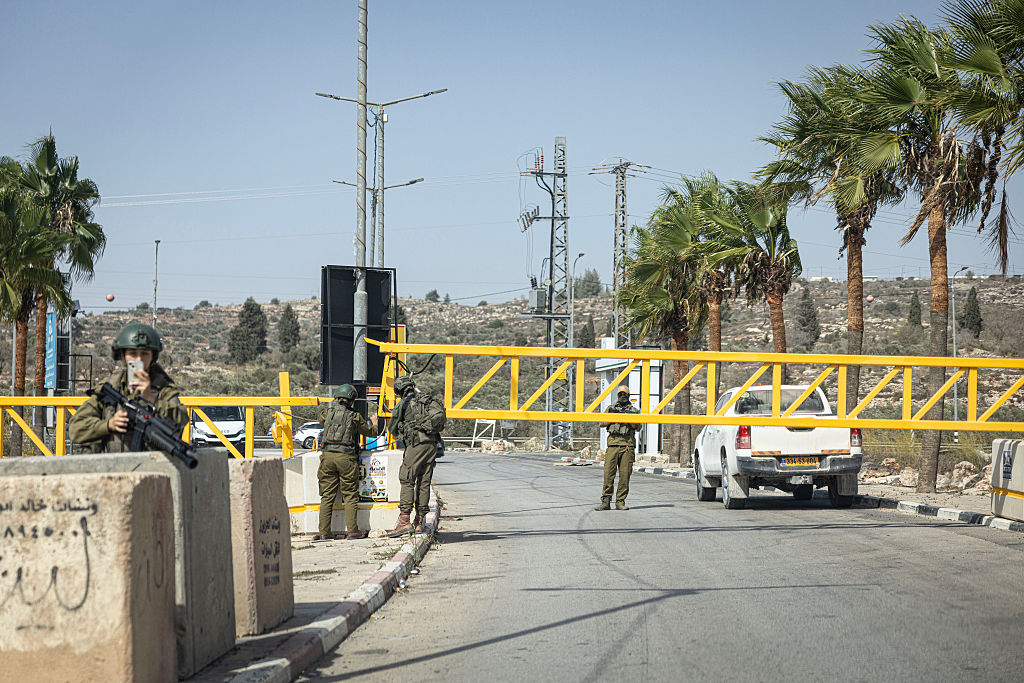
Living in London for the past five years has taught me how to be present in my family’s life from afar. I follow our family WhatsApp group, keep up with the little details of everyone’s life and look forward to the photos and messages that make the distance feel a little less vast. But when your family lives under occupation, you learn not to take even the simplest plans for granted.
On Thursday, my sister spent the day baking a cake and preparing food with her five-year-old daughter and two-year-old son, ready to drive from Ramallah to Jerusalem the following day to celebrate our father’s 76th birthday. I went to bed in London expecting to wake up to messages saying they were on their way. But, as so often happens in Palestine, the occupation had other plans.
Instead, I woke up to messages from my sister about the shooting in Hebron, in which two Israeli soldiers were killed. Israeli forces subsequently killed two Palestinian men they identified as the attackers. Later that morning, Israel’s prime minister, Benjamin Netanyahu, ordered Hebron to be locked down and instructed the military to prepare for a full closure of the West Bank.
‘We won’t be able to make it anymore,’ my sister wrote.
I called her immediately. ‘What are we going to do with all the food and the cake?’ she asked. She had already invited our aunties to join them at my father’s house, and the children were excited. Everything was ready, but the checkpoint she needed to pass to leave Ramallah was now closed, so she could no longer make the journey as planned.
We tried to make light of the situation. But after we hung up, I was left in despair, thinking about how we keep trying to carve out small moments of joy, only to find that even these can be taken away in a second.
Over the course of my father’s birthday, Israeli occupation forces began their siege of Hebron. So far, their raids and demolitions have resulted in the arbitrary detention of dozens of Palestinians, the eviction of hundreds of families from their homes and the displacement of thousands from the city and surrounding towns and villages.
By Sunday, Netanyahu’s threat of a mass lockdown had become reality. Israel closed all crossings out of the West Bank to Palestinians. My sister’s cancelled journey to our father’s birthday was one small example of what that closure meant: the sudden loss of the freedom to make even the simplest plans. Across the West Bank, thousands of Palestinians were facing the same uncertainty, unable to know when they would be able to travel again or resume their daily lives.
Netanyahu was able to shut down the West Bank so quickly because Israel already exercises sweeping control over Palestinian movement. In April 2026, the United Nations Office for the Coordination of Humanitarian Affairs (OCHA) reported 925 movement obstacles affecting an estimated 3.4 million Palestinians across the West Bank, including East Jerusalem. These included checkpoints, road gates, roadblocks and earth mounds. The total number of obstructions was 43 percent higher than the average over the preceding two decades. At least 459 of these obstacles hindered access between Palestinian towns and villages and the main roads connecting them.
OCHA also documented around 2,000 access incidents across the West Bank in 2025, an average of approximately 38 a week. These included mobile checkpoint stops, vehicle and identity checks, extended delays, closures and restrictions on access to agricultural land. The figures describe the scale of the restrictions, but not what it means to organise your life around them. A road closure can mean missing a hospital appointment, arriving late for work or being unable to reach a university. Nor can the figures capture the movement that never happens as life grounds to a halt — the dinners with relatives that are pre-emptively cancelled, the postponed visits to an elderly parent, the decisions to abandon mundane plans rather than put young children at risk going from point A to point B.
The Israeli press has reported that the lockdown will end after the elections on Tuesday. But I find little reason to trust that this will mean a return to normal, as if normal were something we still had in our lives. Netanyahu has announced plans for a ‘very extensive’ military operation in the West Bank, on a scale not seen since 1967, while finance minister Bezalel Smotrich has called for a campaign ‘exactly like in Gaza’. Even if the election-related closure is lifted, there is little reason to believe that the wider assault on Palestinian movement and everyday life will end with it.
There is much speculation about who will form the next government and whether a change of leadership in Tel Aviv might bring a change of direction. But as I sit in London watching my family navigate life in the West Bank, it’s difficult to find much hope in any of the possible outcomes. The opposition may want Netanyahu out, but the bloc’s refusal to form an electoral alliance with the Palestinian parties of the Joint List or Ra’am will likely keep it from forming a government. Leading opposition figures have also advocated for the expansion of settlements and continued control over Palestinians. These parties may disagree with Netanyahu on who should govern Israel, but none of them offer my family much reason to believe that life will become easier.
Since our mother died a few years ago, my sister’s Friday visits to my father have been an important part of his week. She would drive from Ramallah with her children, and they would spend time together. For a while it was a familiar routine, requiring little more than deciding what to eat and when to leave.
But since October 2023, the weekly Friday visits have gradually become every month or two. A simple act that held our family together has become something we can no longer take for granted.
Sometimes, watching what happens between Ramallah and Jerusalem, I feel as though my sister lives just as far from my father as I do. And as we spent his 76th birthday separated from one another, all I could think about was my sister’s question. What do we do with all the food and the cake?