
World Tribune
India: Modi’s Tightrope
Can the BJP chart a course between America and China?
English (original) ·Read in Deutsch ⇄
In September 2019, Donald Trump and India’s Narendra Modi walked hand-in-hand across the stage at the NRG Stadium in Houston, Texas, exchanging sweet-nothings before more than 50,000 people in one of the largest ever receptions of a foreign leader. Almost exactly six years later, Trump imposed a 50 percent tariff on Indian goods, higher than on any other Asian partner.
Much has been made of Trump and Modi’s affinities as far-right populists. Yet a series of economic and geopolitical disputes have, at least temporarily, sent India spiraling out of Trump’s inner circle and looking for new partners beyond the US sphere of influence.
While India has long insisted on a policy of non-alignment between the major world powers, the country had tilted decisively towards America in recent decades. The US emerged as India’s single largest export destination for goods in 2018. The two nations have engaged in joint military exercises and signed a bilateral nuclear agreement. The tech industry has been at the heart of this economic relationship: many American multinational firms outsourced operations to Indian cities in the 2000s, and thousands of Indian immigrants now work for US technology companies.
Yet Trump’s professed ambition to bring manufacturing back to the US and ‘protect’ American jobs placed Indian tech workers at the centre of MAGA’s war on immigration in early 2025. The White House is now advancing plans to heavily restrict visas for such skilled workers by penalising US corporations seeking to hire them.
The 50 percent tariffs were meanwhile ostensibly imposed to punish India for continuing to buy and refine Russian oil during the war on Ukraine. India is the second-largest buyer of Russian oil after China, and this energy relationship has only deepened as a result of Trump’s war on Iran. Disruptions to shipping routes through the Strait of Hormuz mean that Russia now accounts for half of all crude oil imports in India.
Access to Indian agricultural markets has been a further point of difference in several rounds of talks over an India–US trade deal. Mass resistance to the BJP’s 2020 farm laws, which would have opened the door to greater private involvement in the agricultural market, forced the government to U-turn and institute minimum prices for specific crops and high tariffs on many imports. This policy has brought it into conflict with Washington, which has continued to aggressively push for access to the Indian agricultural sector.
All this culminated in several public diplomatic breakdowns over the last two years. With India and Pakistan on the brink of war in 2025, Trump took credit for brokering a ceasefire — a claim the Indian government strongly denied. Modi’s domestic image depends on being seen as a ‘strong’ leader willing to be tough on Pakistan; to admit to caving to American pressure on the issue risks damaging his credibility among his Hindu nationalist supporters. Pakistan, in contrast, publicly thanked Trump for his intervention and announced that it would nominate him for a Nobel Peace Prize. Pakistan has also emerged as a key mediator between the US and Iran, in a development widely seen as a setback for India’s international standing.
Modi has nevertheless refrained from inflaming tensions further. He has refused to comment publicly on the US war on Iran and has failed to meaningfully oppose Israel’s US-funded genocide against the Palestinian people. When a US submarine torpedoed an Iranian ship returning from a joint naval exercise in India, resulting in the deaths of 87 Iranian sailors, the BJP-led government said nothing.
But while keeping its head below the parapet, India has quietly begun to turn elsewhere, agreeing trade deals with Britain, Canada, the European Union and Italy. The government has even made overtures to China, something that had long been resisted because of border disputes in Ladakh and Arunachal Pradesh (what China calls South Tibet). It has eased restrictions on Chinese investment on electronics and solar cell manufacturing in particular, and the state-run think-tank Niti Aayog has proposed further relaxations in Chinese foreign direct investment.
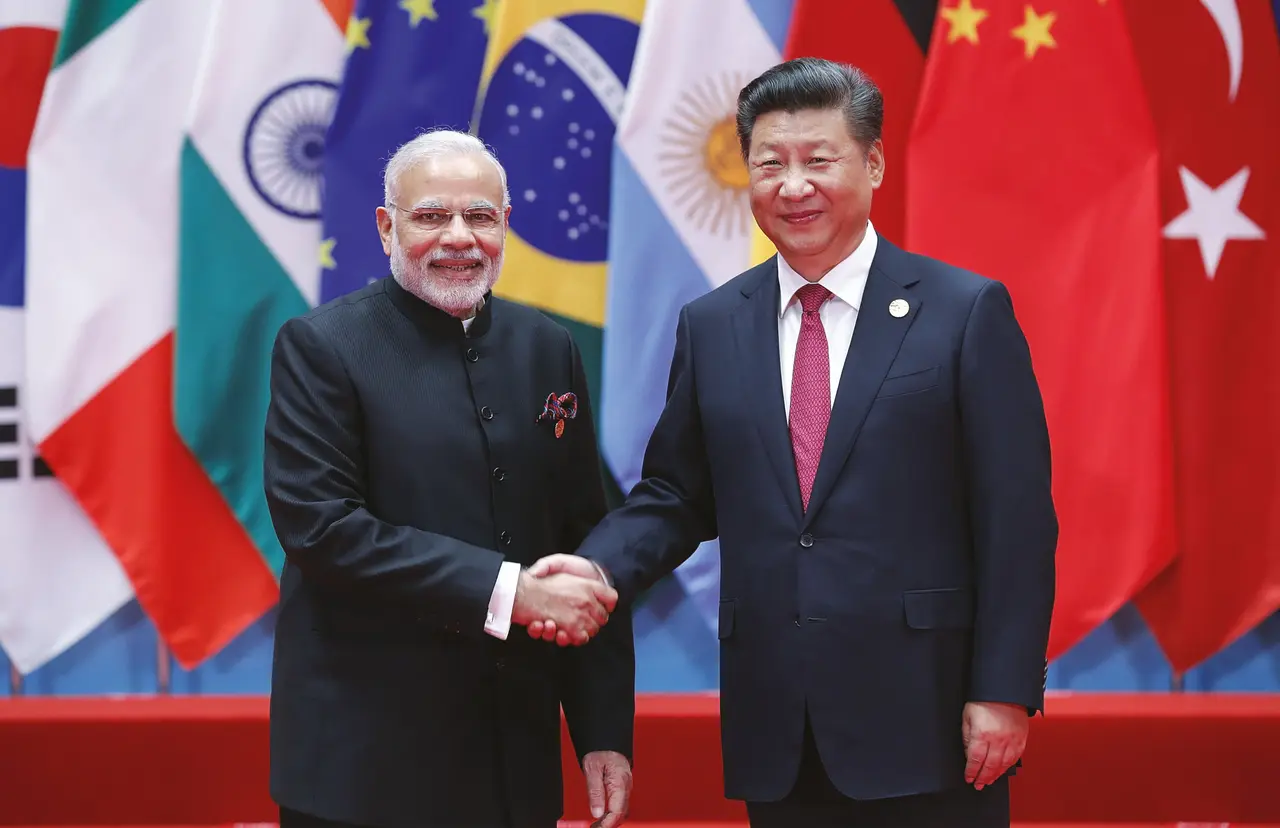
At the BRICS summit in September, Xi Jinping made his first visit to New Delhi in seven years. The declaration they signed there does not explicitly criticise the US-Israeli assault on Iran and Lebanon, but it does rebuke Israel for the displacement and bombardment of Palestinians in Gaza. There was no mention made of Russia’s war on Ukraine. Modi rejected characterisations of the BRICS as an ‘anti-Western’ grouping and reassured onlookers that it was ‘not against anyone’.
After more than a decade in power, Modi’s rule finally looks vulnerable. Youth unemployment is at a record high and student anger erupted across the country this summer with the Cockroach Janata Party protests lampooning Modi and other prominent BJP leaders. As the rupee plummets and India’s muscular militarism falters, Modi is keen to use opportunities like the BRICS summit to revive his authority and silence his domestic critics. Yet he remains wary of provoking Washington. Longstanding territorial disputes and mistrust in the relationship with China cast doubt on whether the pivot towards the latter will last. And Trump’s capriciousness — willing to summarily inflict economic pain on allies — remains a major liability. The result is a challenge for New Delhi: non-alignment may be necessary to navigate this new global conjuncture, but is India willing to pay the price of pursuing it?