
Politics · Tribune · · 2h
Hope Again?
English (original) · Read in Deutsch ⇄
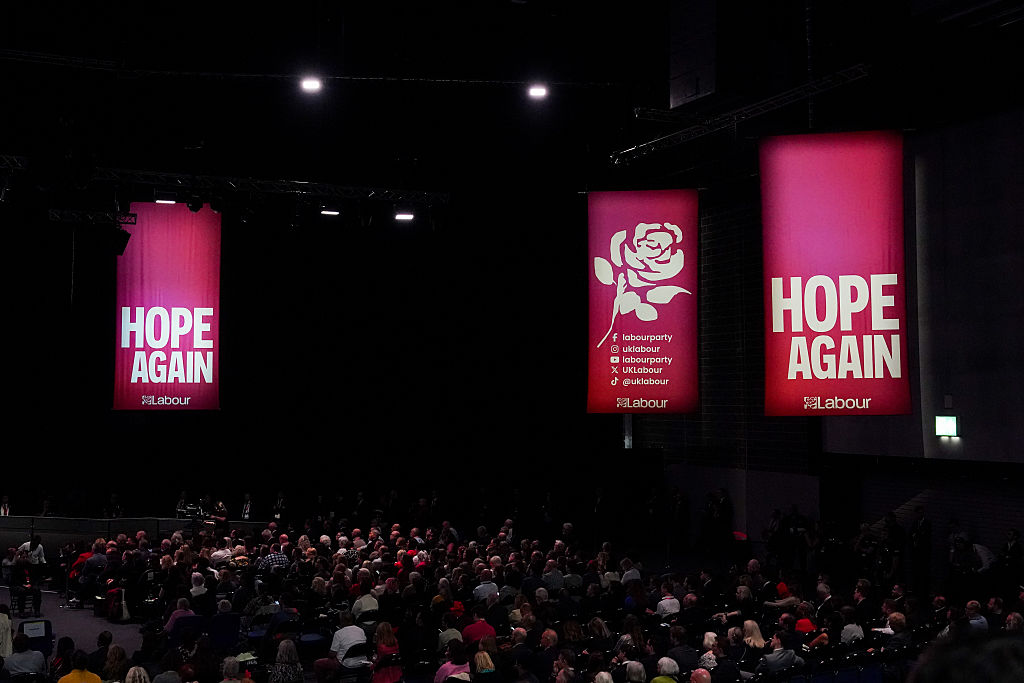
In a pub backroom in my hometown of Cheshunt, a local Labour member summed up Andy Burnham’s impact on the party so far, stating plainly that she was no longer ‘embarrassed to be a member’.
This palpable relief rippled through the many meeting rooms of Liverpool earlier this week. Socialist MPs and delegates, trade unionists and activists generally had a similar line: recognising the chasmic improvement from Keir Starmer, but without illusions about the task that’s now at hand. As Ian Lavery MP put to Tribune, we need to see ‘meat on the bones’ of the new Prime Minister’s call to end forty years of neoliberalism.
Still, the day before Burnham’s leadership speech, in which social care took centre stage, he might have felt he was waking up with someone else’s hangover. Hundreds of migrant care workers, represented by Unison, Britain’s biggest trade union, rallied against proposed reforms to indefinite leave to remain, which would make it even more difficult for migrants to get settled status. The contradiction between old legacies and new promises was clear. As Neil Duncan Jordan MP put it, ‘You can’t fix the NHS without fixing social care and you can’t fix social care whilst attacking its workforce.’
The sickly, lingering stench of Starmerism wafted far outside the conference hall to sting the noses of the Labour Party grassroots as their trains arrived on Merseyside. Long before the conference started, the party machine had resorted to its familiar dirty tricks. Like dozens of others, my home constituency saw our conference motion on council housing ruled out of order. The soft-left group Mainstream made an effort on public ownership of water which met the same fate.
Despite the hard work of the Socialist Health Association to force the issue on Palantir’s entanglement in the NHS, the bureaucracy again won the day after several rounds of blocks and appeals. SHA Chair Doctor Rathi Guhadasan noted that ‘No reason was given for rejecting our motion and doing so will not prevent Labour Party members from campaigning for the permanent exclusion of this vile company from the NHS.’
These are all stark reminders that while Starmer is gone, his draconian structures remain, and Burnham’s warm words about pluralism and a broad church are yet to become a reality. This is a conflict at the heart of the Burnham’s Labour. Yet, crucially, it is one that members can wade into, and help to shape it in a progressive direction, with the worst elements of the Labour Together project now weaker than they were.
Burnham began the conference unassailable among the party membership and somehow managed to finish it even stronger. His impassioned conference address marked him as the most left-wing Prime Minister in decades. Tracing Britain’s decline back to Thatcherism, which he framed as the triumph of profiteers over the public realm, Burnham channelled a familiar-sounding left populism when he declared that the common wealth ‘created for the many was seen as an opportunity for the few’.
It was also refreshing to hear Burnham, who has been criticised for wanting to be liked by all, pick an enemy and go after the interests benefiting from the diaster of water privatisation. The promised legislation to expand public control and repeal Thatcher-era laws preventing public ownership gave tangible political direction to this rhetoric. That same interventionist turn was seen in the commitment to bring vacant properties into public hands and take control of rundown private rents where landlords fail to make improvements. Both felt authentically Labour, and so does the recentring of the party’s so far elusive manifesto commitment to the largest council housebuilding programme in a generation.
The most eye-catching moment was Burnham’s call for a National Care Service free at the point of use. This would be genuinely transformational. The failings of the existing model have darkened the lives of millions, as families strain to navigate a cold system in which patients are treated as customers, so that a diagnosis of dementia often becomes a prescription for spending a lifetime’s savings. A National Care Service would be the most seismic expansion of the health and welfare framework since the founding of the NHS itself.
There are also concerns and uncertainties. Can we expect a rupture with the outgoing Housing Secretary and developer compadre Steve Reed, whose record on council housebuilding was one of promising much and delivering very little? Writing in these pages, Tom Blackburn describes Burnham’s ‘Your First Home’ scheme as nothing more than a ‘slightly tweaked version of George Osborne’s controversial Help to Buy’, providing public subsidies that will flow to private banks, without tackling the real causes of unaffordable housing.
In the same vein, it must be pointed out that decriminalisation of public ownership of water is still a far cry from nationalisation; Burnham must be wary of replicating previous failed attempts to discipline water companies through public control. And the plan to fund the National Care Service by amending the triple lock on pensions has been challenged in Tribune by Jon Trickett MP, who observes that ���A decent pension and free personal care are both possible with a progressive tax system. The left must push the government to build one.’
But the fact remains that Burnham has led a remarkable turnaround in both rhetoric and policy which is reflected in Labour’s six-point poll lead over Reform — something that would have recently been unthinkable. If the left tries to pretend nothing has changed beyond the accent and the hair colour of the leader, it risks consigning itself to isolation and irrelevance. The Labour left is strongest when it gives voice to the majority of members, who are now willing to ‘Hope Again’, and who will not be won over by dismissing a popular leader who speaks their language. Rather than declaring red lines crossed before the new leadership has taken a step, the aim should rather be to engage in the argument, set real expectations, and hold Burnham to them.
Speaking to Tribune, Socialist Campaign Group Secretary Richard Burgon MP welcomed Burnham’s analysis of ‘deindustrialisation, privatisation and the shift of wealth away from workers’ but he says that the left now must be focused on ‘turning those words into reality through our ideas and organising’. The enormous institutional pressure on Burnham that is bound to come from elites means that an organised counterweight is all the more important. This does not mean giving the government a free ride; it means demanding that it delivers.
Burnham owes his new job in large part to Starmer’s miscalculation of the power held by the movement he spent so much time performatively kicking. The Labour left, while numerically weak in Parliament, scored repeated victories on the two-child benefit cap, winter fuel payments, and clawing back £5 billion in planned cuts to disabled people’s incomes because its arguments resonate with the country at large. Its role, as Tony Benn understood it, is to be the ‘buckle that links the street to the statute book’. Starmer’s chronic intransigence isolated his leadership from the broad left, making an enemy of the social movements across Britain’s progressive base, from disability rights campaigns to anti-war and anti-racism movements, who mobilised against him. It is not in Burnham’s interest to go down the same path of collision with these forces.
Ed Miliband’s message to the mass movement against Israel’s war crimes in Gaza — ‘We hear you. You were right’ — suggests this lesson is, at least in some small part, being learnt. This is light-years away from the open contempt displayed by Starmer towards those campaigning against genocide. It provides an opportunity to build on the recent sanctions against illegal settlements and redouble the campaign to stop the flow of arms to the Israeli military. It also follows that a government announcing its ‘reset’ on this issue must address the proscription of Palestine Action, with dozens arrested outside Labour conference for displaying support for the direct action group.
In this political context, there are two further immediate and interlinked demands. The first was perfectly captured by Unison general secretary Andrea Egan at Tribune’s conference fringe. ‘We’re not expecting neoliberalism to be gone by the time the Chancellor finishes reading out the Budget statement next month’, she said. ‘But we do expect a bold Budget, with serious measures to improve lives.’
The second is the restoration of Labour Party democracy, which can strengthen the hand of the left in fighting for the cost-of-living measures in the upcoming Budget, alongside the wider patchwork of campaigns for internationalism, fairness for migrant workers and more. The good vibes of the Burnham bounce may have lifted spirits, but they are no substitute for real mechanisms that enable members to fight for what they believe in. We need to put an end to the routine blacklisting of prospective candidates and restore a sense that Labour is project with a participatory, member-led culture, to which radicals can contribute.
Waking up at 5 a.m. to check the Makerfield by-election result, it felt, for me as it did for many of us, as though we could finally lift our heads above water after years of clinging on to Labour’s sinking ship. It’s now time to channel this renewed sense of hope and organise for what comes next.
Read the full story at the source
Source: Tribune