
World · Tribune · · 3h
Germany Has Entered the Populist Era
English (original) · Read in Deutsch ⇄
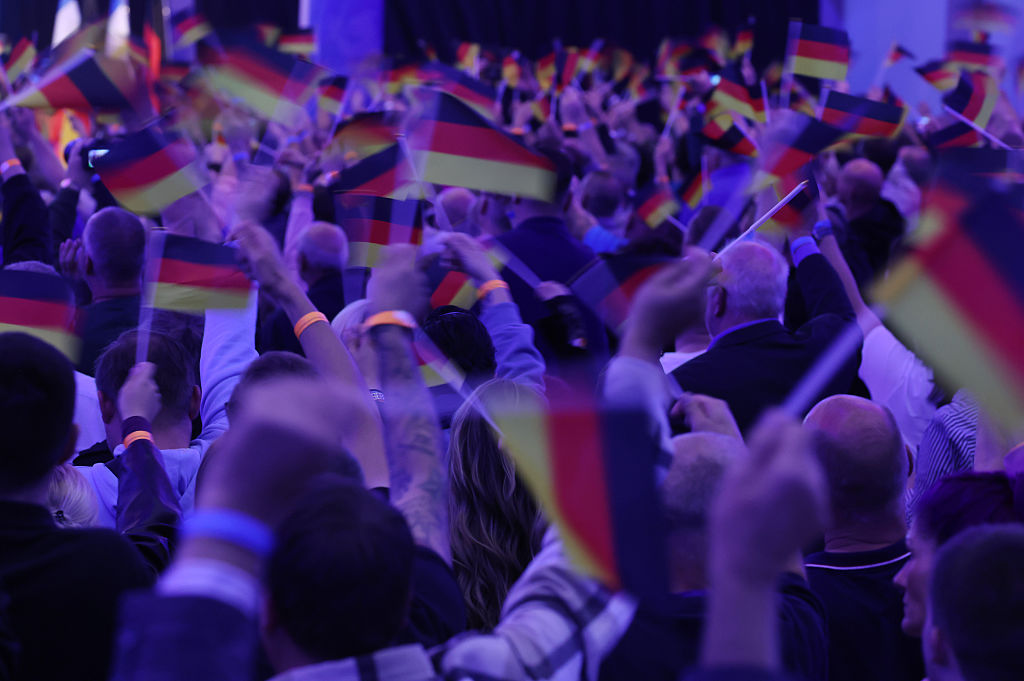
The three regional elections held in Germany last month — two in the sparsely populated, economically embattled East, and one in the booming multicultural capital, Berlin — saw Europe’s populist wave definitively hit its largest economy. That this wave was approaching, a decade after it had swelled in Southern Europe, was already clear from the 2025 federal election, in which the left-wing Die Linke as well as the far-right Alternative für Deutschland (AfD) made notable gains. But the votes in September represent a shift from quantity to quality: a sign that German populism is here to stay.
In the eastern periphery, the AfD is now far and above the strongest force in politics. In Berlin, a bellwether for the political mood in other large urban areas, Die Linke is now in the lead (even if that lead is much smaller than that of its far-right rivals). We may still be a ways off from the ‘candle burning at both ends’ metaphor used to describe the ill-fated Weimar Republic, destabilised by the Nazis on the one end and Communists on the other, but a new era of polarisation — and, as a result, institutional instability — appears to have dawned in the Federal Republic. As the middle erodes, both the right and left are putting forward contrasting ideas of what ‘democracy’ means. Which of them ultimately wins out will help to determine the country’s political future.
Middle Finger
The AfD has led the polls across the country for some time now, a trend that shows little sign of reversing as Friedrich Merz’s government continues its political freefall. In last month’s elections the right-populist party definitely established itself as the leading force in the East, taking nearly 45 percent of the vote in Saxony-Anhalt, followed by some 38 percent in Mecklenburg-Western Pomerania. For the AfD’s opponents in the ‘democratic’ camp — all of whom, with the partial exception of Die Linke, have seen their support crater — it is becoming increasingly difficult to justify the party’s exclusion from power on democratic grounds.
Much has been written in both the mainstream and left-wing press about the extent to which fears of mass migration and generalised xenophobia motivate AfD voters, as opposed to the experience of economic decline and political frustration. The precise contours of that motivation certainly vary according to region and electoral demographic, but in those areas where the AfD is within striking distance of an absolute majority, its support has come to resemble what in US politics is sometimes referred to as a ‘fuck-you vote’. Similar to support for Trump or the slim majority for Brexit in 2016, rather than an expression of firm right-wing political hegemony, the AfD functions as a lightning rod for frustrations of every stripe — a gigantic middle finger aimed at all those perceived to be responsible for the country’s malaise.
Without a doubt, the success of right-populisms across the West testifies to the growing influence of right-wing ideology as it fills the vacuum left by the neoliberal centre. Nevertheless, this new right remains fragile and at times incoherent in Germany as elsewhere. Perhaps even more so than left-populism, right-populism leans heavily on charismatic leaders: a role which, in Germany, has now been filled by Ulrich Siegmund, the AfD’s poster boy in Saxony-Anhalt whose seemingly effortless charm and ability to weaponise a kind of East German identity politics has led more than one observer to sardonically refer to him as the ‘Mamdani of Magdeburg’. In Mecklenburg-Western Pomerania, the AfD lacks such a figure, and relied heavily on appearances by Siegmund in the final weeks of the campaign. (The Social Democrats meanwhile ran a heavily personalised campaign around Minister-President Manuela Schwesig, perhaps the party’s last genuinely popular politician in Germany, and came in close second.)
Precisely because of its ideologically fragmented character, the track record of right-wing populist governments is mixed. Although they tend to hold onto power longer than their left-wing counterparts, they ultimately suffer from the same dilemma: once they form a government, they cease to be the ‘fuck-you vote’ and begin to bleed support. The AfD leadership seems to be aware of this danger. Its figureheads in the East, like Siegmund or Tino Chrupalla, party leader in Brandenburg, avoid addressing substantive policy by redirecting focus to the so-called ‘democracy question’. ‘The AfD is a democracy project’, the refrain goes, arguing that with election results like these, keeping them out of government is untenable and indeed anti-democratic. It is an exercise in self-victimisation, rather than political agenda setting. And — one has to hand it to them — it works.
The ‘fuck-you’ strategy may soon run its course, however, after the AfD took its first step towards government by appointing a president of the state parliament with the votes of Sahra Wagenknecht’s BSW. By governing, the AfD would be forced to choose between the conflicting class interests within its own ranks. While racism and ‘remigration’ could continue to act as the ideological glue that binds the party together for a while, even the most barbaric migration policy will fail to repair a single bridge, prevent a single factory closure, or fund a single school. It’s not hard to imagine the social grievances currently driving the AfD’s rise becoming its Achilles’ heel in government. That said, they would have ample opportunity to inflict immense damage in the meantime.
Democratic Socialism or Bust
Die Linke’s electoral result in Berlin, winning nearly 26 percent of the vote and taking first place in the capital for the first time, was even better than its supporters predicted, opening up new prospects for the party to play an influential role in national politics. But it forms only one part of a significantly more mixed picture. Whereas the AfD is making impressive gains virtually everywhere across Germany, Die Linke’s success is confined to Berlin — it suffered further historic defeats in its former Eastern strongholds. Last spring’s state elections in western Germany, while not ‘defeats’ in the strict sense, as the party’s overall vote total increased slightly, were hardly cause for celebration.
The party now faces a clear fork in the road. In the Eastern states, it continues to hew to moderate positions and portray itself as a competent administrator with vague slogans such as ‘A Home for Everyone’ and — incredibly — ‘Reliable Governance’. In Berlin, by contrast, although the campaign was also oriented towards governing, it tapped into a left-populist, anti-elite rhetoric and advanced clear demands on housing that successfully polarised the electorate. It came across as combative, as a force intent on driving change from within government, whereas in Mecklenburg-Western Pomerania, the party essentially promised that things would stay just as they are.
The implications for the national party are obvious: the strategy pursued by the party’s new leadership over the past two years, combining a sharper rhetorical edge with a strong focus on door-to-door campaigning and grassroots organising, is bearing fruit. The success in Berlin provides its proponents with a compelling argument to push harder for shifts in campaign strategy and political direction. Complacency, particularly in the provinces, is a path to irrelevance.
For better or worse, this organisational reorientation will now have to take place alongside forming a state government. Granted, this time around, Die Linke will be the leading force in the coalition for the first time, but it will nevertheless have to contend with significant financial constraints, not to mention partners seemingly more intent on sabotaging rather than boosting that partnership. Such a task would prove challenging for the most robust socialist party, but it will be even more difficult for what remains in many ways an embryonic left-populism, as it risks forfeiting the very protest vote that brought it to power in the first place — a fate that has already befallen several of Die Linke’s sister parties across Europe.
In the best-case scenario, Die Linke — unlike the far more contradictory AfD — could leverage tangible material gains on the one hand and consolidate its extra-parliamentary influence on the other to forge its 25 percent in Berlin into a lasting coalition that serves as the basis for further growth. This requires, more than anything else, that Berlin’s left-wing government actually delivers those improvements, while the party leadership must honour its commitment to rebuilding the party into a political fighting machine.
One perhaps reassuring development is the abject fear the prospect of such a government has struck into the hearts of the powers that be. Since election night, Die Linke has been the target of a wall-to-wall smear campaign centred largely around accusations of antisemitism due to its support for Palestine, with everyone from newspaper editors to government ministers joining the fray. The objective of this frantic handwaving is clear: to keep the party out of government, lest it act on its promise to bring hundreds of thousands of housing units back into public hands — a move voters supported overwhelmingly five years ago, but has been studiously ignored by every administration since.
So far, Berliners appear unimpressed: support for Die Linke remains stable, as does support for it forming a government. Nevertheless, this window of opportunity likely won’t remain open for long. After all, a populist moment like the one Germany is currently experiencing is defined by instability and unpredictability within the electoral system. For now, however, the Left has, if not the opportunity, then at least the mandate to put its own vision of democracy into practice, at least in one city-state.
Read the full story at the source
Source: Tribune