
World Tribune
France’s African Shadow
With France in revolt, its former colonies are too. In West Africa’s ‘coup belt’, leaders talk of sovereignty but neocolonialism is proving hard to avoid.
English (original) ·Read in Deutsch ⇄
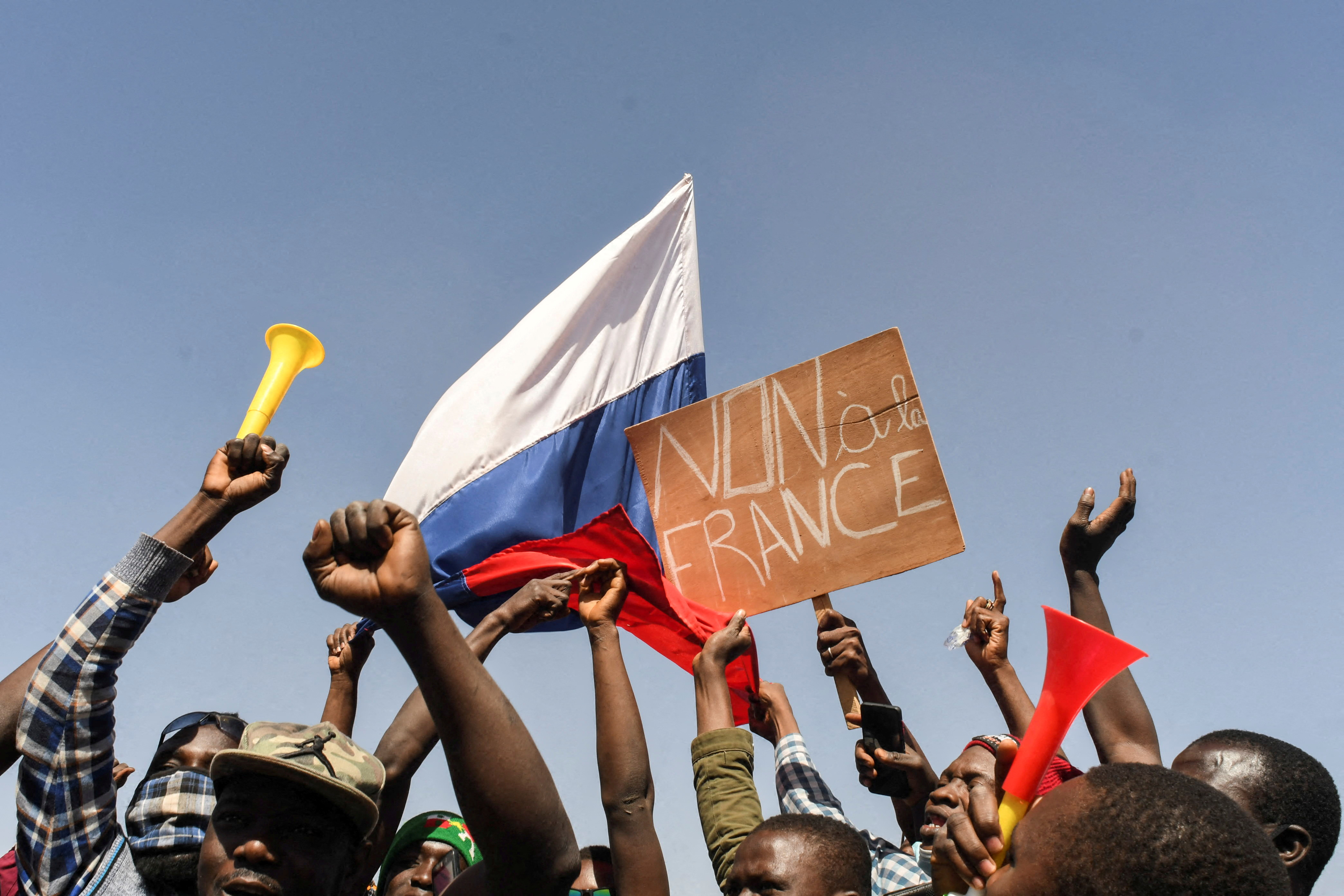
In September, students in two French colonies ignited a movement that soon spread to France. Protesting poor school conditions in France’s South American and southern African outposts, they spoke of a coloniser who never put them first. In multiracial France, many young people felt the same way. But the origins of this movement — carrying radicalism from the global South to North — have been barely noticed in the French press. What kinds of politics are possible for people all over the world seeking to escape centuries of deliberate underdevelopment and dependence enforced by European powers? One region is finding out.
While students blockaded streets in French Guiana and Mayotte, at the United Nations General Assembly in New York an African leader delivered a defiant speech. Niger’s Prime Minister positioned his country alongside neighbouring Mali and Burkina Faso as a regional bloc continuing the anticolonial struggle. The Alliance of Sahel States (AES), Lamine Zeine Ali Mahaman said, had embarked on ‘an irreversible process towards our countries’ sovereignty’. Tearing into former colonial master France, he championed self-reliance, ‘total control over our resources,’ and ‘responsibility for our choices and our alliances’. Ibrahim Traoré, Burkina Faso’s charismatic leader, presented the choice starkly: ‘unite forever against imperialism, or be reduced to being slaves until we disappear.’
AES was forged in 2023 following coups in three former French colonies. All are landlocked states that lie in a contiguous semi-arid sweep across the Sahel and into the Sahara. The coups followed failed attempts by French and allied forces to stem a militant insurrection that took root in Mali following the 2011 overthrow of Libya’s Muammar Gaddafi. By the time French forces began leaving in 2023, al-Qaeda-linked groups had spread from Mali into its two neighbours.
Announcing a definitive break from a French imperialism that remained remarkably intact after flag independence, AES invited Russian troops to battle militants and regain territory under their control. In late August, Russian forces under the so-called Africa Corps, a successor to the Wagner Group, helped Nigerien forces suppress an army mutiny, participating directly in fighting around the military airbase in Niamey.
The United States now waits in the wings, mulling military strikes in concert with Mali against militants. Earlier this year, Washington struck a multimillion-dollar health deal with Burkina Faso and moved to repair relations with Niger, just a few years after it was asked to leave behind its sprawling $100m drone airbase near Agadez.
Has the AES gone from the frying pan of French neocolonialism only to jump into the raging infernos of Russian power, with American imperialism lurking close behind? This cauldron of imperial meddling presents a case study in the challenges of doing politics within a system set up to make you fail.
The Rise and Fall of Sovereignty
At independence, Mali, Burkina Faso and Niger inherited states whose formal sovereignty obscured profound economic dependence on their former colonial power and limited control over vast stretches of their own territory.
How to assert economic and political sovereignty in landlocked, sparsely populated and semi-arid countries still in the grip of French imperialism became a persistent question for anticolonial leaders. Mali’s first leader, Modibo Keïta, pursued economic and monetary sovereignty by withdrawing Mali from the West African monetary union and creating a national currency in 1962. Meanwhile, in Niger, Djibo Bakary’s campaign to leave the French Community — following Sékou Touré’s Guinea — on the eve of independence failed after French meddling in a 1958 referendum. Later, in the 1980s, Burkina Faso underwent a radical socialist experiment under Thomas Sankara, who pursued economic self-reliance but was deposed and killed in a 1987 coup that brought his former comrade Blaise Compaoré to power. Compaoré reversed many of Sankara’s policies and rebuilt relations with France. Suspicions of French involvement in Sankara’s overthrow and assassination persist.
A fractured territorial sovereignty was also built into the very bones of these states. All three inherited highly centralised states governing enormous peripheral spaces. In Mali and Niger, this left many Tuareg communities in the Saharan north distant from political power, culminating in several punishing rounds of open rebellion. In Burkina Faso, pastoral communities, including many Fulani, would similarly find themselves at the margins of the state. It did not help that, particularly in Niger, some peripheral regions also contained prized natural resources.
These internal tensions weakened the emerging states, and helped in unravelling their attempts at meaningful sovereignty while increasing their dependence on foreign power. Mali, which left the colonial-era CFA franc in 1962, returned in 1984. By the dawn of this century, all three countries still used the colonial-era CFA franc and were governed by political classes deeply entwined with Paris. Niger had long supplied uranium to France’s nuclear industry. In Burkina Faso, Blaise Compaoré remained in power. By the time revolutions and wars broke out to their north in 2011 – in Tunisia, Egypt and most importantly Libya – Mali, Niger and Burkina Faso all sat near the foot of the UN’s Human Development Index: Mali ranked 175th of 187 countries, Burkina Faso 181st and Niger 186th. The promise of independence had frayed.
The Libyan Connection
The 2011 Libyan civil war marked a turning point. After Muammar Gaddafi was ousted by a NATO-led intervention in which the USA, France and Britain played leading roles, ethnic Tuareg fighters who had served the Libyan leader trundled back across the Sahara to northern Mali with weaponry looted from Libya’s vast armouries. This proved to be the spark that lit a tinderbox. Their manpower and materiel were a boon to Tuareg separatists fighting for the independent state of Azawad. The separatists initially fought alongside al-Qaeda-linked and other militant groups, but the alliance quickly fractured, with the Jihadis driving their erstwhile allies from major northern cities and then pushing south. The Malian government struggled to contain the rebellion and was soon overthrown by mutinying soldiers furious at its handling of the war. Their advance prompted French military intervention in 2013. As the insurgencies began to spill across Mali’s borders, Operation Serval gave way to the regional Operation Barkhane in 2014.
The instability was a factor in the rise of ethnic militias and competition between pastoralists and farming communities over land and resources, compounded by climate pressures and the retreat of the state; all of this in countries suffering from chronic underdevelopment.
The counter-insurgency approach — bomb now, ask questions later — could kill militants but did little to extinguish the insurgencies. At times, it made matters worse. As Tony Chafer and his co-authors at the Royal United Services Institute have argued, France’s intervention in the region amounted to a ‘disutility of force’ which ‘made the military situation worse and the attainment of an acceptable political outcome harder.’
Unable to contain the militant insurgencies amid rising mistrust of French intentions, the Sahel was beset by a succession of military coups and counter-coups. Assimi Goïta emerged as Mali’s anti-French ruler in 2021, after taking part in a coup the previous year that overthrew the elected president, and then removing the civilian-led transitional government that replaced him. In Burkina Faso, Ibrahim Traoré came to power in September 2022 in the country’s second coup in eight months. Then, in Niger in July 2023, Abdourahamane Tiani, commander of the presidential guard, overthrew his employer.
The Russians Are Coming
Then came the Russians. Russian personnel operating under the Wagner Group began to arrive in Mali in 2021, just as the French were on their way out. Deployments to Burkina Faso and then Niger would arrive from 2024 onwards. Western governments were suspicious of Russian intentions: Russia’s war in Ukraine was already underway while the drawing down of French forces represented a diminishing Western footprint in the region. In 2022, the UK government said that Wagner was a ‘driver of conflict’ in the region and accused it of ‘capitalising on instability for its own interests.’ The American government claimed that a Russian disinformation campaign was ‘treating government takeovers as new waves of decolonisation in Africa’ and that such a discourse ‘allows for support of Wagner’s unrestrained exploitation of African resources, notably gold, diamonds, and timber.’
Russian troops came to Mali without the French colonial baggage. Their arrival also recalled the Soviet era, when Mali enjoyed strong military, educational, and trade ties with Moscow, as did Burkina Faso under Thomas Sankara.
Needless to say, the Russians have since expanded their economic partnerships with the resource-rich AES countries, striking deals for Mali’s storied gold and lithium, and Niger’s abundant uranium resources. But this has not simply meant transferring French control of these resources to Moscow. AES governments appear, in some cases, to be bargaining with their new partners from a firmer position. In 2025, Mali began construction on its first-ever gold refinery, with a Russian company holding a minority stake. Niger nationalised its uranium mines, wresting them from French-majority control, before striking a deal with the Russians.
The notion that the Russians are — as Hannah Rae Armstrong, writing for Brookings, puts it — there to Nonetheless, critics see a clear logic of Russian power: ‘protect the juntas, protect the mines,’ as Hannah Rae Armstrong puts it. Russian efforts to shore up the governments in Niger and Mali this year against a putsch in Niamey and a siege of Bamako, respectively, suggest as much. That highlights a difficult postcolonial condition. AES rulers, who have not yet sought a popular mandate, want to control their resources but must struggle too to control their territory.
Peace is the Hardest Thing
The AES was formed, says Article 5 of its Charter, to assert ‘territorial integrity and sovereignty’ over swathes of its member states that had fallen into militant hands. The Charter claims a commitment to diplomatic means, but AES governments have also made no bones about hitting hard — at considerable human cost. In 2025 alone, reports suggest Malian forces and their Russian allies killed 918 civilians, compared with 232 killed by al-Qaeda-linked and Islamic State-linked groups. In Burkina Faso, government forces and allied militias killed 523 civilians, compared with 339 killed by the two militant groups. Niger is an exception to this pattern, since there Islamic State Sahel Province is the principal source of civilian harm in the most heavily affected western regions. But state violence risks feeding the grievances through which militant groups recruit.
Indeed, this year alone, armed groups have demonstrated an extraordinary ability to strike across Mali simultaneously, capturing towns and military positions and increasingly threatening the capital itself. On April 25, JNIM (an al-Qaeda-linked group) and Tuareg rebels launched one of the largest coordinated offensives Mali has seen in years, with attacks stretching from the north to Bamako, Mopti and Sévaré. In Kati, a suicide attack killed Mali’s defence minister, Sadio Camara. JNIM has also sought to lay siege to Bamako, building on a fuel blockade begun in 2025 by attacking the roads and supply lines on which Mali’s capital depends.
Before the AES, Mali had recognised that restoring state sovereignty could mean more than recovering territory by force. It could also mean addressing some of the conditions driving conflict: accountable local government, rebuilding schools and clinics, and restoring livelihoods. It signed the Algiers Accord with northern armed groups in 2015 and, a few years later, began negotiations with al-Qaeda-linked leaders, achieving agreements over freedom of movement, disarmament and access to farmland — even when such negotiations were opposed by France.
The window for reconciliation narrowed as Goïta consolidated power following the second coup in 2021 and tilted toward military conquest. Fighting with northern rebels resumed in 2023, and Bamako formally abandoned the Algiers Accord in January 2024. Traoré, meanwhile, has made mass mobilisation central to his own war effort, recruiting tens of thousands of civilian Volunteers for the Defence of the Homeland to fight alongside the army.
Russian involvement has only intensified this approach. Moscow had spent almost a decade demonstrating the limits of military reconquest in Syria, helping Bashar al-Assad recover much of the country and remain in power, only for the government it had fought to preserve to collapse with astonishing speed in December 2024. By kicking the French out, the AES may appear to have decolonised their war; alongside their Russian allies, they have so far failed to decolonise the way it is fought.
The Empire Strikes Back
While AES leaders have attempted to reorient away from the old French imperial sphere, they are now increasingly looking towards the United States as a potential partner in countering militants and attracting investment. The turnaround is extraordinary.
As recently as April 2025 in Burkina Faso, supporters of Ibrahim Traoré took to the streets after General Michael Langley, commander of US Africa Command (AFRICOM), told a US Senate hearing that Traoré’s government was using the country’s gold resources to protect its military regime rather than benefit ordinary citizens. And in 2024, Tiani’s government in Niger terminated its military cooperation with the United States, forcing Washington to abandon its sprawling airbase near Agadez, where drones had surveilled the Sahara from high above.
But behind the scenes, Trump meant change. While the Biden administration had made a return to constitutional government a condition for restoring economic and security cooperation with AES members, the Trump administration has renewed engagement with their military governments.
In August, the Mali Security Partnership and Counterterrorism Act was introduced in Congress, following a rapprochement with Bamako that has seen senior US officials visit the country and Washington increase intelligence sharing. The transactional character of the emerging relationship was already apparent in reports last year that US officials were exploring increased counterterrorism assistance alongside access to mineral resources, as the US scrambled for rare earths amid competition with China.
Then there is the five-year bilateral health cooperation deal struck with Burkina Faso in February. Subject to congressional funding, Washington intends to provide up to $147 million to combat HIV/AIDS, malaria and other infectious diseases, including $12 million for health surveillance, digitised data reporting and laboratory capacity. The small print remains unclear, but similar deals struck elsewhere in Africa under Trump’s America First strategy, including with Nigeria, contain provisions for sharing health data and pathogen samples with Washington, raising questions about data sovereignty.
AES leaders have insisted that any renewed relationships would not be conducted on neocolonial terms. But the Americans have made no secret of their intentions, with a 2025 US Army War College assessment concluding: ‘Instability in the Sahel directly affects US economic, security, and political interests, particularly in maintaining trade routes and ensuring African economies can integrate into global markets.’ The assessment also warned that Russian influence could shut Washington and its allies out of the region.
As if to come full circle, the Sahel states may now find themselves seeking another foreign partner in a counter-insurgency war. If military force has repeatedly failed to resolve political problems in the region, it is a bitter irony that AES states now lean on the country that launched the War on Terror. Afghanistan and Iraq offer sobering warnings about the limits of attempting to resolve political crises through counter-terrorism.
Mali, Burkina Faso and Niger now face their disempowered position within the world system while confronting the existential threat of militant insurgencies. AES leaders have sought to navigate these constraints by bargaining with both Russia and the United States. Their leaders have presented an image of strength. But their hand weakens as insurgencies grow, increasing their dependence on foreign guns. In the end, sovereignty may depend less on which foreign power the AES can expel than on whether it can build states its own people have reason to defend.