
World Tribune
Football and the Crisis of Self-Regulation
The Premier League is designed to minimise corporate accountability and maximise profit. Let it be a warning in the age of Big Tech.
English (original) ·Read in Deutsch ⇄
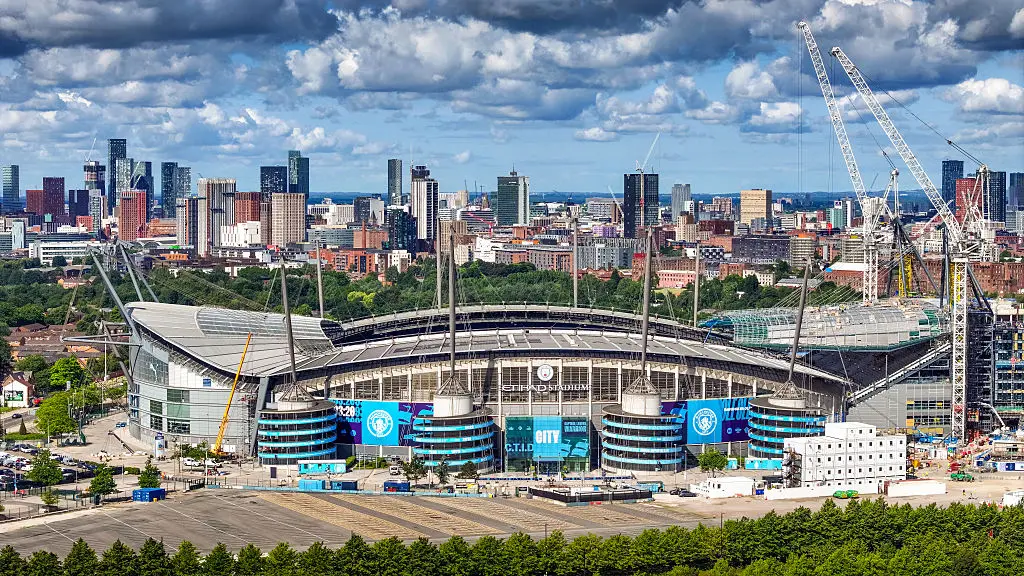
In late September, the Premier League found Manchester City guilty of 114 breaches of league financial rules over a nine-year period stretching from 2009/10 to 2018/19. During that time, City evaded league financial regulations through ‘sham’ contracts, sponsorship deals and inaccurate accounting to conceal nearly £900 million in illicit revenue. City have appealed the judgment.
While this amounts to one of the biggest scandals in the history of sport in this country, football’s chattering classes have affected an ashen-faced incredulity with almost no exploration of how we’ve arrived here. Sky’s nonplussed coverage of City’s recent victory over Liverpool in their first men’s fixture since the news broke was typical. After Rayan Cherki converted one of the most dazzling goals in recent memory, all that commentators Peter Drury and Gary Neville could do was say how brilliant City were in sad, mournful voices.
Prime Minister Andy Burnham’s initial reaction to the news was similarly gormless. His knack for blokey populist rhetoric temporarily deserted him as he said that he would be ‘really concerned’ if City’s ownership — led by Deputy Prime Minister and Vice President of the United Arab Emirates, Mansour bin Zayed Al Nahyan, and bankrolled by the Gulf state’s fossil fuel wealth — took their money elsewhere, and credited them with being ‘a huge partner in the building of modern Manchester’. Culture Secretary Lisa Nandy went out of her way to say that the UAE’s money is still welcome in English football.
There’s still little information about what City’s punishment might be, with speculation ranging from massive fines, to point deductions, to the stripping of titles, and even outright expulsion from the Premier League. A decision is pending the outcome of the club’s appeal, which could mean a multi-year delay.
But the fact that City may finally be held to account shouldn’t be taken as evidence of a robust governance regime overseeing English football. Rather, the absurdity of City’s violations and the prime minister’s own murky relationship to its ownership exposes the sheer hypocrisy of its ‘self-regulation’ scheme, especially under the corrupting pressure of international and hydrocarbon capital.
At a time when AI companies are running wild on the ‘frontier’ and the government has yet to exert any control over privatised utilities, the Man City scandal should serve as a symbol of the retreat of the state from British life, and the Premier League a model of how to mismanage a social good.
Anatomy of a Cartel
The Premier League was created in 1992 for one primary reason: to limit the amount of money trickling down from the wealthiest clubs to those lower on English football’s pyramid. At its best, this has facilitated the gradual transformation of England’s top division from an insular hinterland, lagging behind mainland Europe in tactical and technical terms, to perhaps the strongest league in world football. Much of this development is the product of concentrated investment, as the 1992 arrangement created a cartel with massively increased bargaining power when it came to the sale of television broadcast rights.
The league itself was incorporated as a private limited company and tasked with administering the sport’s financial rules and managing its commercial relations. Its only shareholders are the owners of the clubs in the league in that particular year. Its chair is a former banker and CEO named Alison Brittain, and its board of directors is made up of people you’ve probably never heard of and almost never hear from. The Football Association (FA), nominally ‘the governing body of football in England’, has very little oversight of all this. A notoriously fusty institution, the FA is essentially a bureaucracy that administers English football as a sport — that is, what happens on the pitch at any level of organised football — as opposed to as a business or cultural form.
UEFA, European’s football governing body, meanwhile, has a say over Premier League clubs only in the context of its own competitions, like the Champions League, Europa League, and Conference League. Earlier this year, UEFA expressed concerns about how the Premier League’s blasé approach to spending and self-regulation might impact the competitiveness of the rest of Europe. The Premier League rejected their concerns and any suggestion of a uniform financial fair play regime.
The formation of the Premier League in this free-trade, pro-business, anti-independent regulation mode was consistent with the broader emphasis on deregulation and commodification under prime ministers John Major and Tony Blair. It is perhaps fitting that Major’s Chelsea and Blair’s supposedly beloved Newcastle both went on to be extreme cases of clubs falling into very obviously dirty hands — both were as sanguine about the running of football clubs as Peter Mandelson was ‘intensely relaxed about people getting filthy rich’.
It wasn’t until almost twenty years after the league’s founding that rules were put in place around spending and ‘sustainability’, supposedly in order to protect clubs from insolvency. Consistent with the austerity discourse of David Cameron and George Osborne and the ‘troika’ of the IMF, European Central Bank, and European Commission that was becoming political common sense at the time, the basic premise was ‘live within your means’. But they had another use, too: ‘The owners are asking for rules because they can’t implement them themselves – many of them have had it with shovelling money into clubs, and the more money you put into clubs, the harder it is to sell at a profit,’ explained then-UEFA President Michel Platini.
In effect, the function of the spending rules was to ensure that the existing owners could profit from the sale of the club as a commodity years down the line, and to try to prevent clubs with fresh investment from overtaking them as part of football’s ruling bourgeoisie. In the view of football’s establishment, it had been all too easy for upstart clubs to use bottomless pits of petrodollars to elbow their way into the Champions League by paying huge fees and wages for brilliant players. The rules were introduced too late to stop Abramovich’s Chelsea or Mansour’s City, but they are currently frustrating Newcastle and Aston Villa’s ownership, a muddle of Egyptian billionaires and US private equity.
The spending rules created to protect football’s old guard capitalist class club owners from its nouveau riche did, however, successfully sink the likes of Bury, Stockport and Rochdale. A recent report by the new Independent Football Regulator — a 2025 creation that in theory has wide-ranging powers but is so far untested as an actual agent of change — states that the non-elite clubs are ‘dangerously exposed, with the majority of clubs living on the edge of financial disaster’. It also accepts that football has to some extent always been this way, with IFR chair David Kolgan saying that ‘nobody in football for 100 years has believed that football was trading in a solvent and effective state’.
In essence, thirty years of British governments and English football’s governing body have allowed capital — and in recent years, nation states bound to a fraction of capital, that of fossil fuels — to exert huge influence over British society’s most popular cultural form. It is probably only thanks to a Portuguese computer hacker leaking documents to Der Spiegel that the Premier League even bothered to investigate City’s spending and bookkeeping in the first place, shaming the League into action.
A Symbol and a Warning
It is apt that the City verdict has led to some awkward questions for Burnham (and equally awkward answers), because the entire situation is absolutely of a piece with the ‘four decades of neoliberalism’ he says he wants to undo.
Four months into his government, Burnham’s actions continue to lag far behind his rhetoric. He has conveniently deferred his most compelling proposals until after the next general election, while his chancellor’s budget failed to grasp the scale of the present crisis.
Meanwhile, privatised utilities remain free to do whatever they’d like. The water industry, for example, still operates on a self-monitoring system — introduced by Burnham’s New Labour colleagues in 2009 — that was designed to ‘reduce administrative burdens on regulators’ by politely requesting that private equity-owned bodies like Thames Water ensure their own compliance with the law. Now we have rivers of shit. Burnham’s recent proposal of ‘regional water councils’ to oversee the industry has already been met with scepticism from local campaigners, who see it as a ruse to shift blame for poor performance while maintaining the current system, safe from public ownership.
We’re seeing this kind of failure emerge again in real-time. The UK’s AI safety regime gives an unreasonably long leash to the tech giants destroying our world. Practically, the system works by asking OpenAI, Anthropic, and Meta for permission to review their models before they’re released to the public, so that the government can make mere recommendations based on what they find. In September, the White House decided that the UK would no longer receive this early access to certain models, throwing the whole safety regime into chaos before Trump changed his mind. In September, the ‘architect’ of this AI safety strategy left the government for a job at Anthropic. The revolving door continues to spin, and the only thing it keeps out is sovereignty.
Nobody wants any of this. Nobody ever voted for it. But it will endure until there is enough popular organisation to create the political will required to change it. In recent weeks, Champions League fixtures took place against a backdrop of political unrest across mainland Europe. As the conflict between democracy and capital comes into ever-sharper focus, elite football limps along, a symbol and a warning hiding in plain sight.