
World · Tribune · · 3h
Farage is Faltering. The Far Right is Not
English (original) · Read in Deutsch ⇄
There was an initial sense of relief when Channel 4 exposed Reform’s backroom sleaze last week. It seemed that the curtain had been lifted. Secretly filmed over champagne and oysters, Farage discussed the prospect of funnelling foreign donations into party coffers. Amid the scrutiny over his undeclared £5 million ‘personal gift’ from a cryptocurrency billionaire, you could be forgiven for hoping that this gathering cloud of sleaze might smother the resurgence of Britain’s far right.
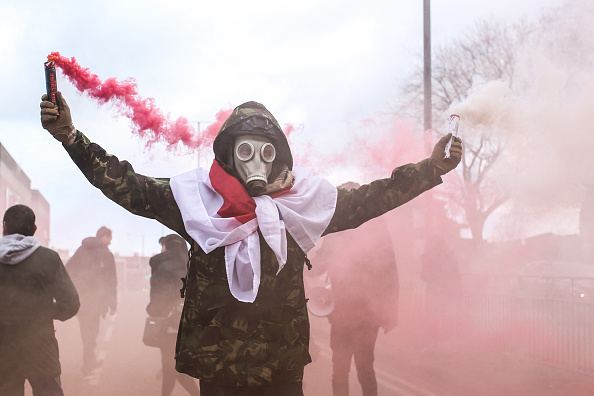
But just as Reform’s conference was engulfed by scandal, hundreds of masked men demonstrated a different form of far-right capacity on the South Coast. In Dover, protesters dressed in black and moving in formation linked arms across carriageways, obstructing traffic at one of Britain’s most important pieces of border infrastructure.
The next evening, around 140 people rescued from a small boat were brought ashore in Portsmouth, and within hours hundreds of anti-migrant agitators had converged on the city. They tried to block coaches carrying the rescued people to processing facilities. Roads were closed, vehicles were damaged and clashes with the police continued into Monday morning.
The two mobilisations showed that Reform’s electoral fortunes are not a reliable measure of the wider far right’s strength. It is tempting to view a setback for Farage’s party as evidence that the broader movement is also waning. In reality, the political ecology in which Reform operates continues to thicken. Its networks are becoming more extensive, its organisations more capable and its actions more dangerous.
Influencer Militia
Both actions were led by Daniel Thomas, known to his followers as ‘Danny Tommo’, a notorious self-publicist whose backstory includes a prison sentence for attempted kidnapping. His organisation, Patriot Platform, is not a militia in any developed sense, despite its paramilitary pretensions. But it would be wrong to dismiss the matching black clothes, balaclavas and choreographed blockade as mere cosplay. It is more than just macho theatre designed to generate clips, donations and followers. Clickbait spectacle and organisational heft are not mutually exclusive. In fact, the spectacle is an essential part of the organisational process. It advertises the group, invites identification with it and tests whether an audience assembled online can assert power offline.
Dover was organised through mailing lists and peer-to-peer messaging services, allowing hundreds to assemble before the police or anti-racists had fully grasped what was happening. Portsmouth was more opportunistic. There, the unexpected decision to bring people rescued in the Channel ashore created an event around which Thomas and his allies could mobilise. Supporters were summoned through livestreams and social media. The physical crowd and the online audience reinforced one another.
Both events showcased the ‘influencer militia’ aesthetic that Thomas has long rehearsed, in which he has cast himself as a citizen-soldier defending Britain from invasion. The grandiosely named Operation Overlord, which he helped launch in late 2025, combined pseudo-military expeditions to France to harass refugees and charity workers with appeals for recruits and equipment. Its theatre was absurd, but its organisational purpose was real.
The streaming economy gives Thomas’s project a material basis. Confrontation produces content; content generates donations, subscriptions and merchandise sales; and those revenues help finance further confrontation. This is the spectacular politics of digital fascism. Patriot Platform can thus respond to an organisational problem exposed by the racist riots of 2024. Those disturbances demonstrated how rapidly rumours and inflammatory online material could bring thousands onto the streets, but they also revealed the fragility of such protests. Crowds assembled and dispersed quickly under pressure from arrests, public revulsion and mass anti-racist opposition.
Patriot Platform asks whether something more durable can be built: a layer of people who can be contacted and redeployed once the larger crowd has gone home.
Beyond Robinson
Robinson does not lead a disciplined membership organisation. His power lies in connecting anti-migrant campaigners, streamers, wealthy donors, hardened fascists and a vast digital audience. This structure provides flexibility and distance from responsibility. Robinson can promote an action without formally organising it, creating an atmosphere in which violent confrontation and then disavowing it when it occurs.
Yet online followers are not necessarily dependable activists. Huge demonstrations can project an image of strength without leaving durable organisation behind. This was clear on 16 May, when Robinson’s attempt to reproduce the enormous Unite the Kingdom mobilisation of the previous September drew a significantly smaller crowd.
Patriot Platform attempts to compensate through a form of franchised mobilisation. Thomas operates at one remove from Robinson, recruiting and deploying activists while Robinson supplies mass amplification at decisive moments. At Dover, Robinson promoted Patriot Platform after the blockade had begun without assuming responsibility for it.
If the experiment works, Robinson gains access to a potentially more dependable street force without commanding it directly, while Thomas gains recruits, money and authority through his proximity to Robinson. Dover and Portsmouth suggest that Thomas is trying to make racial violence more reproducible — less dependent upon a singular riot and more capable of being summoned, branded, repeated.
There are consequences here for the electoral far right. A scandal may weaken Reform while opening space for fascist networks to develop greater capacity on the streets, and for Rupert Lowe’s Restore Britain to court activists alienated by Farage’s faltering pursuit of respectability. Years of anti-migrant agitation have now created networks and forms of political power capable of outlasting any individual electoral vehicle. The climate of Farageism strengthens organisations beyond his control, which can develop capacities of their own.
Defeating Farage at the ballot box will not by itself dismantle the networks built around the politics he has helped normalise. A hardened and organised far-right core can continue to reproduce itself and expand its forces long after an election is over, with violent consequences for minority communities.
Building Power
Still, the far right does not have the terrain to itself. In Glasgow in July, years of organising by Stand Up to Racism, trade unions, refugee groups and community organisations produced a mobilisation capable of substantially outnumbering ‘Unite the Clans’. Actions like this, alongside the enormous Together rally in London in March, play a critical role in breaking the far right’s claim to own the streets and limiting the confidence of the hardened core around Robinson, Thomas and others.
The bedrock of this response is the crucial but unglamorous work of building local relationships and networks of practical solidarity. Counter-demonstrations remain indispensable, but their strength is built before the far right announces its mobilisation. Anti-racist organisation must be consistent, rooted in everyday life and capable of bringing people together between moments of confrontation.
The wider labour movement must draw the correct organisational conclusion. The far right is using every tool at its disposal: it is digitally connected, internationally networked and able to draw upon wealthy donors. Anti-racists therefore need a more visible and durable presence in working-class communities. Trade unions have a particularly important role, both inside workplaces and beyond them — supporting food-bank collections, campaigning around housing and public services, and helping to rebuild forms of collective organisation and trust.
Where such networks do not exist, a sudden riot or far-right demonstration outside asylum accommodation can leave small numbers of anti-racists isolated and threatened communities exposed. They may find only a handful of local labour activists, faith organisations or campaigners to whom they can turn. However committed those people may be, the balance of forces is not on their side.
Robust anti-racist networks can break that isolation. They make sustained campaigning possible, develop new activists, build relationships across communities and allow conversations with neighbours who have been drawn towards the outer edges of reactionary politics. They also establish the local foundations from which a much larger response can be mobilised when the far right appears.
In the town where one of us grew up, local anti-racists recently combined a free family day with a collection of coats for asylum seekers. The aims were modest: to give families a day out, support people with very little and bring neighbours together. Such activity does not substitute for confronting the far right, but it does help create the relationships and practical solidarity through which larger confrontations can be won.
From the Streets to the Ballot Box
Reform’s Zia Yusuf blamed last weekend’s disorder on Andy Burnham, expressing support for protesters’ ‘outrage, their anger, their terror’. He accused the Prime Minister of generating disorder by providing a police escort to people whom he claimed had ‘broken into this country’.
Yusuf’s response illustrates how far-right disorder can be politically useful to Reform even while it attempts to preserve some distance from men like Thomas. Rather than challenge the racist premises of the mobilisation, party figures can recast the violence as evidence that Britain is trapped in a migration emergency. Those creating the disorder are kept at arm’s length, while the crisis they manufacture is used to validate Reform’s diagnosis.
The far right is not a single organisation operating under a common command. Reform, Restore Britain, Robinson and Patriot Platform pursue different forms of power and frequently compete with one another. Nonetheless, they operate on the same political terrain, legitimising shared grievances while playing different roles. Recognising this interplay does not mean describing them as the electoral and street wings of a unified project. It means understanding that gains in one arena can strengthen actors in another.
Anti-racism must therefore intervene wherever those forces operate — in elections, workplaces, communities and on the streets. Stand Up to Racism’s campaigning against Reform candidates across the country is one example of how electoral advances can be contested without abandoning the mobilisation needed to confront fascists physically.
The masked formation at Dover bore an eerie visual resemblance to federal immigration agents operating under Trump. Of course, Patriot Platform remains a private far-right initiative while ICE exercises the coercive power of the state. Yet the Trump administration has incorporated far-right spectacle and vigilante violence into its immigration enforcement campaign, which has pushed deaths in ICE custody up to their highest level for two decades.
Farage is down, but he is not out. Reform retains a substantial base that has proved resilient amid repeated allegations of corruption. Renewed shocks to food and fuel prices arising from the US–Iran war and the developing El Niño could deepen the cost-of-living crisis and give Farage another opportunity to redirect economic insecurity against minority communities. Voters beyond Reform’s core might now be repelled by the impression that something about Farage is seedy or corrupt, but worsening material conditions could change their calculations.
Andy Burnham has interrupted Reform’s momentum partly by offering a rival explanation for social decline. Towns have been hollowed out by deindustrialisation, privatisation, underinvestment and the concentration of political power. The clock is ticking for his government to translate that account into improvements people can feel in their everyday lives.
The new Prime Minister also faces immediate questions over Indefinite Leave to Remain. Trade unions and Labour backbenchers are pressing him to abandon Starmer’s plans to make life even more difficult for the social-care workers and other skilled migrants on whom we rely: dramatically extending the waiting period for them to apply for settled status, as a means of deterring migration and appealing to Farage voters. This will be an early test of whether Burnham is prepared to break with the programme of scapegoating migrants that characterised the previous leadership.
The different components must work together to prevent the most right-wing party in modern British history from taking power. That imperative is clear, but it is not enough. Though Farage may be faltering, the forces nourished by his politics are not waiting for Reform to recover; they are organising autonomously. The anti-racist movement must stop them in their tracks. It must assert its presence by confronting fascists on the streets, building the social power upon which effective confrontation depends, and becoming a force that the establishment cannot ignore.
Read the full story at the source →
Source: Tribune