
World Tribune
Chokepoint Resistance
Empire wants to defy space and time. The resistance has learned to weaponise them.
English (original) ·Read in Deutsch ⇄
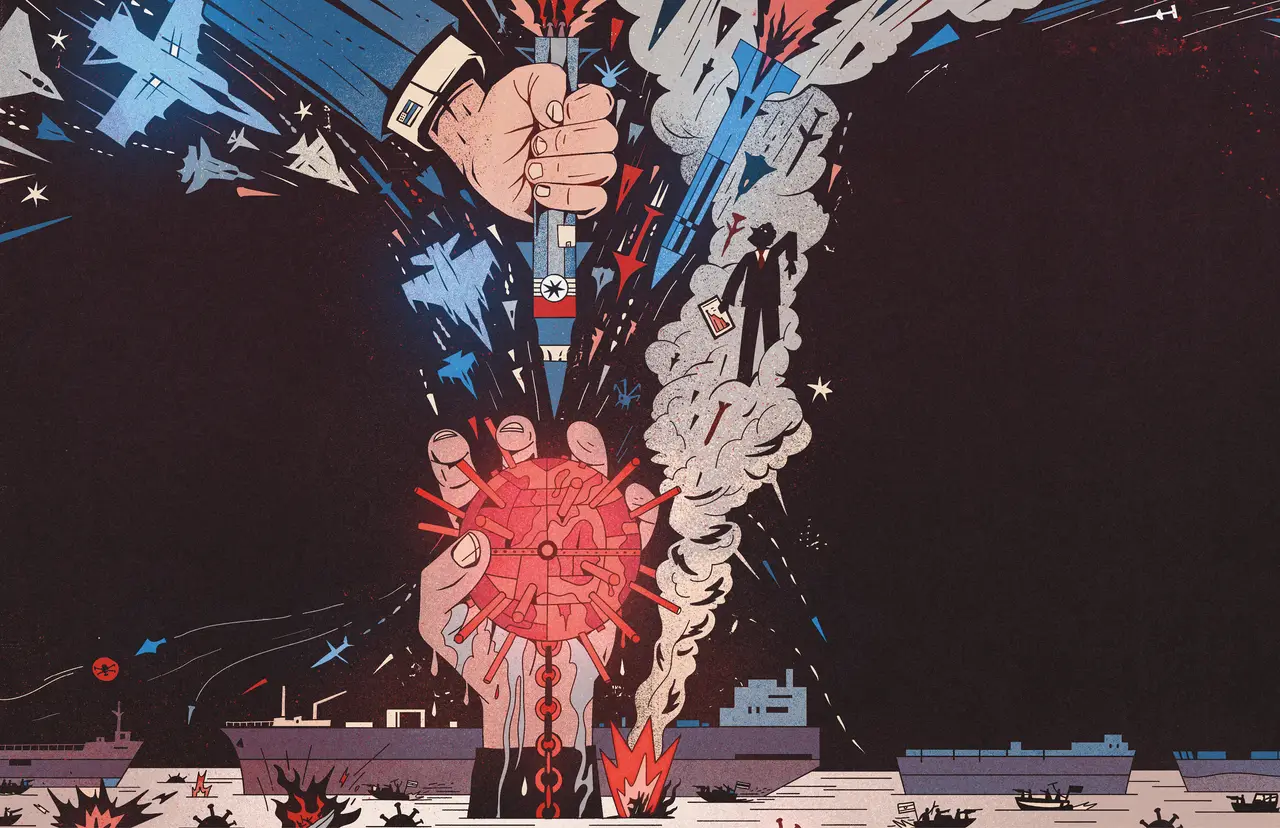
As the Galaxy Leader — a high-sided car carrier linked on paper to an Israeli businessman through a labyrinth of shell companies — transited through the Bab al-Mandab on 19 November 2023, a helicopter slowly descended onto the vessel. The ship had been chosen for its weaknesses: a broad, clean deck and no armed guards. The landing was clumsy. There was no air support or overwatch. Within minutes, eight masked men wielding AK-103s had stormed the ship and taken control of its bridge and engines, detaining the twenty-five sailors on board.
The spectacle mattered as much as the seizure itself. Slickly edited GoPro footage was released almost immediately which showed the gunmen dropping from a clear sky, fanning out across the deck and forcing the crew to their knees under Yemeni and Palestinian flags. It was a massive propaganda coup for the hijackers: Yemen’s Ansarullah, also known as the Houthis. A militia with perhaps as few as five airworthy helicopters had pulled off a maneuver reserved for elite navies.
The raid kicked off a broader campaign in the Red Sea and Bab al-Mandab, in which Ansarullah systematically targeted commercial shipping thought to be tied to Israel and its allies as a means of imposing costs for the genocide in Gaza. By late 2024, Ansarullah had launched roughly 200 attacks, forcing major container lines and energy conglomerates to abandon the waterway and instead route around the Cape of Good Hope, adding weeks to their voyages and billions in extra freight and insurance costs. The disruption sent tremors through supply chains from Rotterdam to Mumbai.
The Biden administration responded with Operation Prosperity Guardian, aiming to protect traffic and hit Ansarullah launch sites. For fifteen months, the US Navy notched up near flawless tactical victories against Yemen in what became its longest sea battle since WWII. Yet it failed to lift the blockade. The Galaxy Leader incident had already proved the essential point: a lightly equipped, Iran-aligned actor could weaponise an eighteen-mile-wide corridor and make global trade blink. Today’s maritime capitalism is at once highly efficient, deeply integrated and acutely vulnerable — and that vulnerability offers those targeted by empire a means of fighting back.
The struggle over the chokepoint is part of a dynamic of imperial aggression and resistance that has become increasingly important over the past three years. It captures the distinct logics on each side of this conflict. Washington remains reliant on ‘shock and awe’: rapid decapitation strikes and covert operations designed to collapse a state before it can mobilise. Its targets, by contrast, have learned to harness geography: disrupting global trade instead of seeking direct military confrontation. The clash between the two shows that technological superiority cannot compensate for strategic brittleness. The very instruments designed to guarantee US-Israeli supremacy have left it exposed.
Regime Change Returns
In early 2026, the efficacy of the shock-and-awe model appeared to have been vindicated. Caracas woke abruptly on 3 January to the low drone of aircraft flying in from the Caribbean. The power was out. Minutes later, fuel depots, radar sites and barracks took the first hits. The Pentagon had planned the attack over months under the cover of anti-drug operations, moving a carrier group, F-35s and bombers into the Caribbean while a full-scale replica of Nicholas Maduro’s safe house went up in the desert for endless rehearsals. When the order came, 152 aircraft stripped away Venezuela’s air defenses in half an hour. By 02:02, commandos had Maduro and Cilia Flores in custody; by 4:29 they were out of Venezuelan airspace. Trump later made an address from Mar-a-Lago describing the raid as an ‘amazing military feat’ to a public watching shaky phone clips of the attack.
The outcome — Maduro handcuffed, blindfolded and locked up in a Brooklyn jail — seemed to prove that regime change was back. The goal had been to compress it into a single operation, presenting the world with a fait accompli before diplomats could react. For a national security elite haunted by past failures, it seemed like confirmation that the US could still remove a foreign leader cleanly.
The attack on Venezuela emboldened an already vocal group of hawks in Washington and Tel Aviv. Senior Trump administration figures soon signalled that any confrontation with Iran would redeploy this repertoire of covert action and decapitation. Many of the same conditions seemed to be in place: the US and Israel had clear aerial dominance, a panoply of bases and intelligence networks that burrowed deep into Iranian institutions. Special forces raids, cyber operations and surgical strikes would aim to neutralise Tehran’s leadership and nuclear infrastructure in a matter of hours. Iran, the hawks insisted, could be shocked into capitulation before it could mobilise asymmetric responses. West Asia’s strongest noncompliant state would crumble and a Zionist-friendly regime would rise in its place.
The analogy, however, rested on a fatal misreading of geography. The assault on Venezuela was self-contained; the country’s fate could be decided without many reverberations further afield. Iran sits astride one of the world’s most critical energy chokepoints, the strait of Hormuz, and is linked to a transnational network of armed movements from Lebanon to Yemen that can project force across multiple maritime corridors. The Ansarullah campaign had already demonstrated what such advantages were worth: Tehran never had to fire a single missile at a merchant ship itself. Its allies could instead tie down Western naval assets, drive up the costs of Israel’s war and remind capital markets that global shipping lanes can act as highly effective leverage. US planners saw decapitation as a master key. Iran’s strategists bet on chokepoints.
Two Visions
These are not just two distinct military strategies but different visions of what war is meant to achieve. The US-Israeli version wagers that technology, air supremacy and highly-skilled death squads can stand in for political legitimacy — delivering fast, telegenic victories. For Iran and its allies, the key vectors are geographical leverage, the dispersal of forces and the creation of prolonged crisis. They have no fantasies of tanks in Washington or Tel Aviv; their aim is simply to make domination so economically and politically costly, and so systemically disruptive, that even a formal victory curdles into a strategic loss.
Venezuela and Yemen bookend the contrast. In Caracas, the US could remove a head of state overnight because it owned the skies, had bases studding the hemisphere and had spent decades infiltrating Venezuelan institutions. In the Red Sea, the same powers, with far larger arsenals, struggled to subdue a relatively small force in one of the poorest countries on earth — because that force sat on a chokepoint the world economy could not easily bypass.
The war began in Venezuelan style: hundreds of strikes on military and civilian targets, an opening tableau meant to suggest that Tehran would fall as swiftly as Caracas. But Iran had spent years preparing for this first act, scattering its assets far and wide, insulating its military sites, building redundancy into its leadership structures and extending its deterrent network across the region. Hezbollah, the Iraqi militias and Ansarullah each wielded their own leverage over maritime corridors, energy infrastructure and US bases. These forces tightened their grip on the chokepoints, harassing vessels and threatening closure at Bab al-Mandab while putting pressure on American installations and the client states that support them.
The crucial fulcrum was the Strait of Hormuz. The sea between Iran’s mountains and Arabia’s deserts narrows to only a few dozen miles wide, and a fifth of the world’s traded petroleum passes through this slim corridor. Iran immediately began to calibrate attacks on shipping and infrastructure in and around it, using its impressive arsenal of drones, mines, coastal batteries and boats. This was not a complete closure — Iranian exports continued and in some instances even exceeded pre-war levels — but rather a selective disruption of tanker traffic, targeted at states complicit in the US-Israeli war.
When passage became intermittently impossible or uninsurable, millions of barrels a day were shut in and prices spiked to triple digits. What was supposed to be a short, decisive campaign turned into a grinding energy and inflation crisis. Cracks opened within the US-Israeli axis as allies counted the economic damage, and Trump began to clash with Netenyahu over how long the war could continue. Months of strikes failed to reopen the strait on Washington’s terms. As Iranian Foreign Minister Abbas Araghchi tweeted on 22 March, ‘The Strait of Hormuz is not closed. Ships hesitate because insurers fear the war of choice you initiated — not Iran. No insurer — and no Iranian — will be swayed by more threats.’
By the time diplomats assembled at Versailles in June 2026, the strategic reality was clear. The US had proved it could execute a Venezuela-style decapitation. But Iran had proved it could answer with a Yemeni-style economic strangulation, turning the architecture of globalisation against the very powers that built it. The chokepoint triumphed over shock and awe.
Chokepoint Capitalism
This leverage is a direct byproduct of the logic of capitalism itself. From the rise of ‘containerisation’ in the 1960s to the accelerating trade flows of the 1980s, the commercial shipping industry has consolidated into three massive corporate alliances: the Ocean Alliance, the Gemini Cooperation and the Premier Alliance, whose coordinated routes span the oceans and make just-in-time production possible. The ships themselves have also swollen to extraordinary size: vessels now regularly exceed 20,000 twenty-foot equivalents (the measure of cargo capacity), with tankers and gas carriers worth well over $100 million each.
These massive vessels and coordinated routes maximise profitability by cutting unit costs, but they also concentrate risk. When a single hull holds two million barrels of crude, its war-risk insurance premium becomes a matter of systemic importance. Before the Ansarullah attacks, war insurance for a Red Sea transit was merely a rounding error: about 0.05 percent of a ship’s value (and often waived altogether). A few weeks into the campaign, that premium rose by a factor of ten or more. By 2025, rates of 1 percent and even 2 percent of hull value were common, pushing the extra cost of a single passage to $2 million for a $100 million vessel, sometimes even higher.
The structure of the insurance market amplified the crisis. War-risk coverage on ocean-going ships is underwritten by a small oligopoly of London-based syndicates and P&I (protection and indemnity) clubs. Guided by a Joint War Committee that operates across the different firms, the underwriters can instantly reclassify entire maritime regions as high-risk zones, or ‘listed areas’. Once this designation was applied to the Red Sea and Bab al-Mandab, the underwriters dropped automatic coverage and demanded separate, skyrocketing premiums for every day spent inside the waterways. As the asymmetric warfare expanded from Israeli-flagged ships to any vessel tied to the US or the UK, some insurers simply refused to cover the corridor at all. A handful of insurance committees in London were able to force the world’s container fleets and energy majors to divert thousands of miles around Africa.
Because shipping lines are consolidated into these three global alliances, these operational changes instantly cascaded across markets. When the largest carriers pulled out, the Suez Canal’s share of global trade plunged from 12 percent to well under 10 percent. Every detour added ten to twenty days and up to 4,000 nautical miles to a standard voyage, driving up fuel consumption, crew wages and charter fees. Freight rates on key routes surged, and insurers collected record premiums even as they narrowed coverage. What Yemen demonstrated was that you did not need to sink a fleet to rattle the entire world; you just needed to raise the perceived risk until the machinery of shipping and insurance was forced to remake itself.
The Hormuz crisis amplified this disruption by orders of magnitude. As Iranian forces targeted tankers, oil storage facilities from Basra to Ras Tanura were filled to capacity, forcing producers to halt drilling. US government modelling showed that combined production shut-ins across Iraq, Saudi Arabia, Kuwait, the UAE, Qatar and Bahrain topped 9 million barrels a day. Brent crude prices shot to $110–115 a barrel and stayed there, rising costs of diesel and jet fuel fed straight into headline inflation across importing economies, and liquefied natural gas markets convulsed as Qatari volumes were constrained and spot prices in Asia and Europe tore away from US benchmarks.
The New Front Line
military doctrine in ruins. While supercarriers and precision-guided missiles remain instruments of extraordinary destruction, they cannot guarantee the passage of 400-metre container ships through a twenty-mile strait when a determined actor is prepared to take shots at it, and when a handful of underwriters have decided the transit is too risky to cover. The same features that make modern capitalism hyper-profitable — rapid trade, oligopoly, concentrated finance — are precisely what leave it susceptible to economic strangulation. A handful of cheap missiles and drones fired at a narrow shipping lane can dictate whether a tradesman in Essex pays more for his diesel, his mortgage and his credit card debt, or whether his local council can afford to keep the library open — and perhaps even whether he votes to re-elect the politicians who brought these miseries upon him.
If central banks and governments could once treat Persian Gulf conflicts as regional affairs, today the separation is dead. Because prices across the world — particularly asset values and housing costs — are tied to the movements of commodities and energy resources, disruption can trigger wage disputes, debt defaults, political unrest and electoral upsets. By compressing space and time, US-led globalisation created the impression that it could dominate both forever. But that same act of compression is what has bound the fortunes of local politics to that of distant straits, with disastrous effects for the hegemon.
The same logic will shape Great Power conflict in the years ahead. The balance between the US and China increasingly turns on who can assert control over the chokepoints of East Asia — the Taiwan Strait, the South China Sea and the Malacca Strait, through which the bulk of China’s imported energy passes. Beijing has spent two decades building its forces around exactly that premise, investing in submarines, mines and the DF-21 and DF-26 anti-ship ballistic missiles — the so-called ‘carrier killers’ — designed to deny a superior navy access to those narrows. Chokepoint resistance, in other words, is not simply a matter of answering aircraft carriers with coastal batteries, but of turning the everyday insecurities of global capitalism, from inflation to interest rates or housing, into another theatre of war.