
World Tribune
China: The Challenger
Deep changes in the structure of world capitalism are driving Great Power rivalry.
English (original) ·Read in Deutsch ⇄
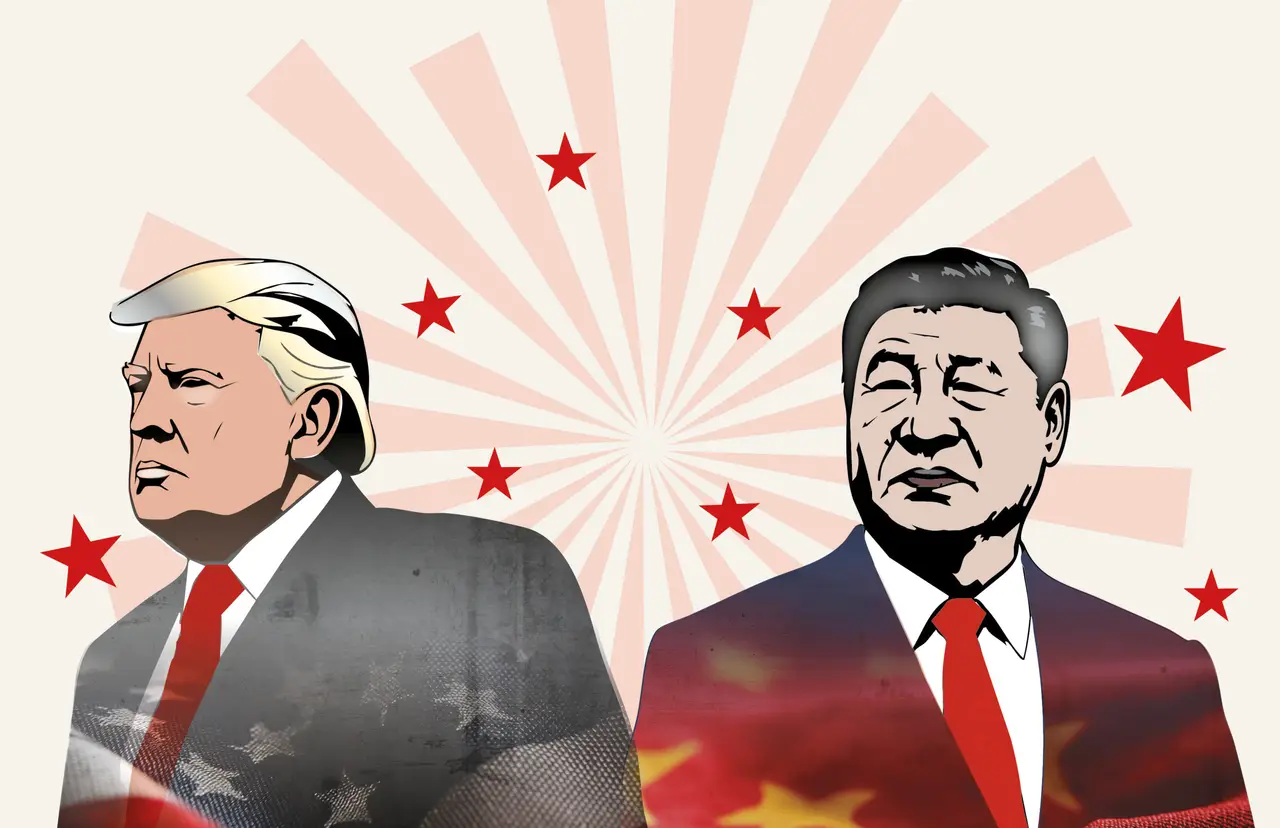
In 2023, an American four-star military general wrote in a leaked memo that his country would soon be at war with China. It was an urgent necessity, he told the US Air Mobility Command, to begin ‘preparation for the next fight’ — adding, in a tender aside, that ‘I will be tough, fair and loving in my approach to secure victory’. The prediction captured the mood in Washington, where elites had already spent years ramping up their coercion towards the PRC: encircling the country with hostile military bases, attempting to cripple key parts of its economy, engaging in ever more reckless shows of force.
With the two parties of the US political duopoly now determined to out-hawk one another, it seems plausible that what has been called the New Cold War might lurch into a hot one — unleashing a wave of destruction without recent historical precedent. The bastions of the foreign policy consensus are busy ‘game-planning’ this scenario. The Atlantic Council declares that ‘the challenge is how to fight and win a regional, limited war against a nuclear-armed great power’. The Center for Strategic and International Studies demands a ‘rapid shift to a wartime industrial footing’. The Heritage Foundation insists ‘it is time to restart large-scale military exercises’.
How did we get to this point? This is not simply the result of a military-industrial complex lobbying for war or a radicalised political class pushing the country to the right, although both are part of the story. It is a symptom of the increasingly ‘bipolar’ structure of contemporary capitalism, with an established centre in the West and an emerging one in the East. The economic logic of US–China rivalry, as it has developed from the dawn of globalisation to the darkness of Trump II, is among the primary forces remaking our world.
The role assigned to China in the international division of labour has now come into conflict with the American monopoly over crucial resources. So far, Washington’s attempts to forcibly resolve this contradiction have not succeeded. Yet they have plunged the planet into a new age of imperial escalation, generating military tensions, trade wars and proxy battles whose full consequences remain to be seen.
In the mid-1970s, the US entered a crisis of overaccumulation, as the country’s available capital exceeded its opportunities for lucrative investment. The result was declining profitability, and the solution was for Washington to become the spearhead of globalisation, prising open new markets for American companies. China, then in the midst of its post-Mao transition to capitalism, fit neatly into US economic designs as a supplier of cheap labour: the new workshop of the world. The US could outsource its manufacturing to China and expand its financial sector, in what seemed like a win-win for the ruling classes of both countries.
The Dengist CCP believed that globalisation was the best route to national development, just as the US leadership thought that free trade with China was the key to maximum profitability. Both had to accept a degree of working-class discontent: China faced massive protests against privatisations, layoffs, wage suppression and the dismantling of public services; the US saw waves of social unrest as a result of rising deindustrialisation and unemployment. But this seemed to be a price worth paying. Beneath the surface, though, the contradictions were building up. China soon began to realise that its role in the US economic empire meant it could only develop within strict limits. As long as it was confined to supplying cheap labour, it was at the mercy of foreign capital; most of the value it generated could be appropriated by the US companies it supplied.
The situation became untenable as China faced its own looming crisis of overaccumulation in the early 2000s. Like the US in the 1970s, it needed to find profitable outlets for investment: all the more so given that the legitimacy of one-party rule was directly tied to the continuation of the developmental dream. This made it essential for the PRC to break free of the constraints imposed by the US-dominated global market. Carving out more space for Chinese capitalism meant loosening America’s grip on strategic sectors.
One of these was intellectual property, as the key mechanism through which US firms were able to subordinate their Chinese suppliers. During the decades of the transpacific honeymoon — the 1980s and 90s — the Chinese had hoped that foreign capital would share its cutting-edge technologies with local firms, allowing them to embark on their own paths of innovation. But this was always an illusion. US companies which maintained profitability by laying claim to the most advanced technologies were never going to hand them over.
For a time, China tried to use its pivotal position in global manufacturing — turning components containing complex technology into final goods — to make up for this shortfall, exploiting opportunities for technical learning and reverse engineering. But this was at best an attempt to imitate Western technologies that failed to overcome the condition of dependency. So, in 2006, China dramatically changed direction. Rather than relying on foreign investors, it began to drive innovation in a series of carefully chosen industries. Two of them were green energy and digital technology.
Renewables were a means of reducing China’s energy costs as well as its dependence on imports that passed through US-controlled maritime chokepoints. Digital technologies could meanwhile boost entire manufacturing sectors and spread rapid productivity gains throughout the whole economy. Leadership in these sectors was not only a way of generating profits, but a political tool for influencing the developmental prospects of other countries. By building out both the energetic and digital infrastructures that would become increasingly essential to twenty-first century capitalism, China hoped to combine economic prosperity with extraterritorial power — outrunning US attempts to keep it shackled.
The results were spectacular. Twenty years ago, China was nowhere on the league tables of countries that hold patents for breakthrough innovations; now it is almost on par with the US, and its influence in setting international technical standards trails close behind. Its colossal green capacity has reshaped global energy politics beyond recognition. By 2022, China had come to account for 90 percent of investment in the factories making the equipment and components necessary for the green transition. In the first six months of 2025, the country installed more solar infrastructure than the US had built throughout its entire history. It is exporting increasing shares of its clean tech to developing nations, with China’s Electric Vehicles now roaming the streets of Thailand and Brazil and its solar products remaking energy systems from Pakistan to South Africa.
The US worked hard to prevent this technological catch-up through a combination of military sabre-rattling and widening sanctions. Obama initiated the ‘pivot to Asia’ which planned to concentrate 60 percent of American naval and air force assets in the region. One of his final acts as president was to commission a report titled ‘Ensuring Long-Term US Leadership in Semiconductors’, which paved the way for the restrictions that were imposed under Trump — marking the switch to a policy of aggressive economic containment that has continued ever since.
The semiconductor industry can be divided into three main segments: design, manufacturing, and assembly. Chip design is incomparably more demanding than chip manufacturing, which is itself far more sophisticated than chip assembly. The disparities of globalisation meant that design took place in the capitalist core, especially the US, while manufacturing and especially assembly were outsourced to peripheries like China. The outcome was not only uneven flows of revenue but a hierarchy of political leverage. A modern car may contain more than a thousand chips; if even one of them is missing then the vehicle cannot leave the factory. By depriving a manufacturer or an assembler of such crucial components, the US can create major problems, hobbling production and preventing the development of cutting-edge machines.
This was the approach it took to China. The aim was not to ‘deglobalise’ or even to ‘decouple’, but rather to lock Chinese firms into a subordinate position so that they could not outcompete their American counterparts. This also implied maintaining harsh conditions for Chinese workers, consigning them to low-wage manual activities rather than allowing them to reap the benefits of development. Yet the strategy failed to pay off. Chinese firms managed to bypass some of the technology restrictions by securing access through subsidiaries or renting from non-sanctioned firms. The state’s industrial policies provided effective coordination and financial support for Chinese companies, as well as training up highly-skilled workers and attracting foreign investors. Containment proved elusive.
At the same time as it began to weaken American tech-supremacy, China also sought to gain access to critical metals by investing in mining and physical infrastructures abroad, launching its Belt and Road Initiative in 2013. It committed billions each year to overseas investment and construction contracts in transport, energy, mining and manufacturing — extending its projects across West Asia, Africa and Latin America. Ever since the global financial crisis, US administrations had been stressing the importance of strategic metals, but they did little to follow through. Today, China accounts for around 90 percent of global production of refined rare-earths and battery-grade graphite, and dominates the refining of other critical metals like cobalt and lithium. It has developed numerous trade routes throughout Asia that circumvent the massive presence of the US navy in the Indian and Pacific Oceans.
The first Trump administration responded with bipartisan legislation to drive infrastructure investment overseas, trying to secure access to critical minerals by supporting mining firms and projects. But this new approach is not only belated; it is also hamstrung by decades of financialisation. Most US initiatives are still driven primarily by private finance. Because infrastructure projects offer rates of return of only 2 to 3 percent, US financial firms who are accustomed to 15 percent have little incentive to back them. China meanwhile uses public banks to fund the BRI, allowing it to expand into countries rich in mineral resources. Last year it injected a record $213 billion into its BRI partners — a 75 percent increase on its previous record in 2024.
By the time Trump returned to the White House, China had consolidated these gains. It had centralised access to a wide array of strategic metals and weathered American sanctions. This did not mean it had knocked the US off its pedestal nor replaced it as the organising force of world capitalism. In fact, it turned out that companies like Microsoft, which had integrated Chinese firms and universities into their innovation systems — capturing their local knowledge production — stood to benefit from China’s tech catch-up. The US still has a clear lead over China in AI, with 59 models classed as ‘notable’ to China’s 35. US military spending remains more than triple that of China, and its semiconductor industry is far ahead. Yet China’s advances nonetheless present both downstream and upstream challenges to the US’s digital supply chain. Downstream, global companies are increasingly turning to Chinese AI models to cut costs. These models are not pioneering tech, but they are cheap and efficient enough to serve businesses’ purpose. Upstream, China has extended export restrictions on various strategic metals and even considered outright bans, giving it crucial leverage in Trump’s ongoing trade war. Because the US needs these metals, it has rowed back on its most extreme tariff threats. US tariffs on Chinese imports are lower today than they were before Trump’s ‘Liberation Day’ announcement in March 2025, whereas for allies like the EU and UK they are considerably higher.
The costs are now coming due. Since 2021, the ratio of US foreign profits to domestic profits has dropped by roughly 25 percent. While globalisation had four decades of success in restoring prosperity to American businesses, its increasing dysfunction is plain to see. The rules of the game have undermined the very actors who designed them by unleashing Chinese ‘industrial maximalism’. Mounting US–China antagonism is not simply about trade flows or even short-run profits, but about the very conditions of sustained profitability: the interrelated networks of production, finance, technology and energy, in which we have begun to see the embryonic form of a China-centred global market.
This is how we must read Trump’s recent attacks on both labour at home and other states abroad: as an attempt to restore the good old days of globalisation when US profits soared at the cost of the rest of the world. The price of his tariffs and wars must be paid by working-class people who bear the brunt of inflation, while regressive tax policies offset it for the wealthy. Restrictions on imports from China and elsewhere are what Rudolf Hilferding would call ‘a means for the conquest of foreign markets by domestic industry’, which have come alongside attempts to strongarm countries into investing in the US and using military might to wrest control of strategic regions. Despite promising to end ‘forever wars’, Trump could not withstand the structural pressures of profitability for long. His imperialism is a violent attempt to rewind to the unipolar moment.
Will it work? As Washington’s backlash sows ever more chaos and destruction, it makes it easier for China to position itself as a rational actor, promising a benevolent global order far from the double-standards and uneven development of US empire. It has built relationships with other countries that have begun to use its digital and physical infrastructures, forging alliances that partially escape the American chokehold. Yet despite this progress, the power the US has accumulated over decades in these sectors will not yield easily. Washington’s control over monetary and military infrastructures remains almost absolute. Imperial power will not accept autonomous development, and it will respond with overwhelming force. This is something Chinese authorities must bear in mind when trying to solve their problems of domestic capitalism through external policies that run counter to US interests. It is also a crucial insight for all those who desire an entirely different world order.