
World taz
Midterm elections in the USA: Magicians without magic
In the midterms, the Democrats have a good chance of breaking the Republican majority. Even Trump doesn't seem to be able to change that. Why is that? more...
Deutsch (original) ·Auto-translated to English
Yes, of course, opinion research has often been wrong. It was unable to capture the mood in the USA and did not sense the desire to disrupt the past elections. And yet something big could happen on November 3rd, when Americans elect their representatives: Donald Trump and his Republicans could suffer a defeat, perhaps even a massive one.
On the one hand, demoscopy has adapted its methods and has been doing much better research since then. And secondly, it is the Republicans themselves who are increasingly doubting that they can defend both chambers of the US Parliament, the House of Representatives and the Senate. If most pollsters are to be believed, the House will go to the Democrats. The question now is “how big the Democrats’ majority will be in 2027,” says Erin Covey from the independent election analysis service “Cook Report”.
And in the Senate, even election victories for the Democrats in once deeply red states such as Texas (where Democrat James Talarico is surprisingly strong), North Carolina (which is already in favor of the Democrats), Alaska (with Democrat Mary Peltola) or Iowa (where the candidates are neck and neck) are no longer unthinkable and thus a tipping of the majority. In Michigan, Abdul El-Sayed, a Muslim socialist, could even be elected to the Senate. To take note again: a MUSLIM SOCIALIST! IN THE USA!
The taz is an independent, left-wing and opinionated daily newspaper. We have been arguing in our comments, essays and debate texts since the taz was founded in 1979. We often cannot and do not want to agree on an opinion. That's why you'll find some completely opposing positions here - all part of the very broad left-wing spectrum of opinions.
The United States seemed to be in the iron grip of Donald Trump and his MAGA army. Where does this ray of light come from in the political darkness? And what does that mean for the state of democracy in the USA?
There is a wealth of explanations for the rise of right-wing extremist populists over the past 20 years. You don't have to be a Marxist to understand that the modern system of Western democracies no longer works for enough people, at least it feels like it. In the globalized, digitalized world, too few people benefit from cognitive-cultural capitalism, as the sociologist Andreas Reckwitz calls it. And those condemned to watch are turning away from their elites with a destructive fury, in Saxony-Anhalt as well as in South Dakota.
In the state of social and cultural division in Western societies, disruptive answers thrive quite impressively. And the power of global crises since the financial market meltdown of 2008, Corona and the recent wars, most recently in Iran, have only increased uncertainty and fear of loss. The analyzes on this are as numerous as they are impressive.
In the USA, the Democrats have learned very different lessons from this. Jon Ossoff, for example, the Democratic candidate for the Senate in Georgia, has focused on denouncing the obvious corruption of the Trump clan, the new elite. Others, like Zohran Mamdani in New York and El-Sayed in Michigan, pose as socialist warming room operators and promise affordability through city-run supermarkets, health insurance for all or free child care.
But no matter how successful some of the diverse democratic ideas may be and how popular one or the other candidate may be, it is not yet clear whether they are really a response from the left to the distortions of globalized and digitalized capitalism. Rather, there is some evidence to suggest that it is not the Democrats who are particularly strong at the moment, but rather Donald Trump and his Republicans who are weak.
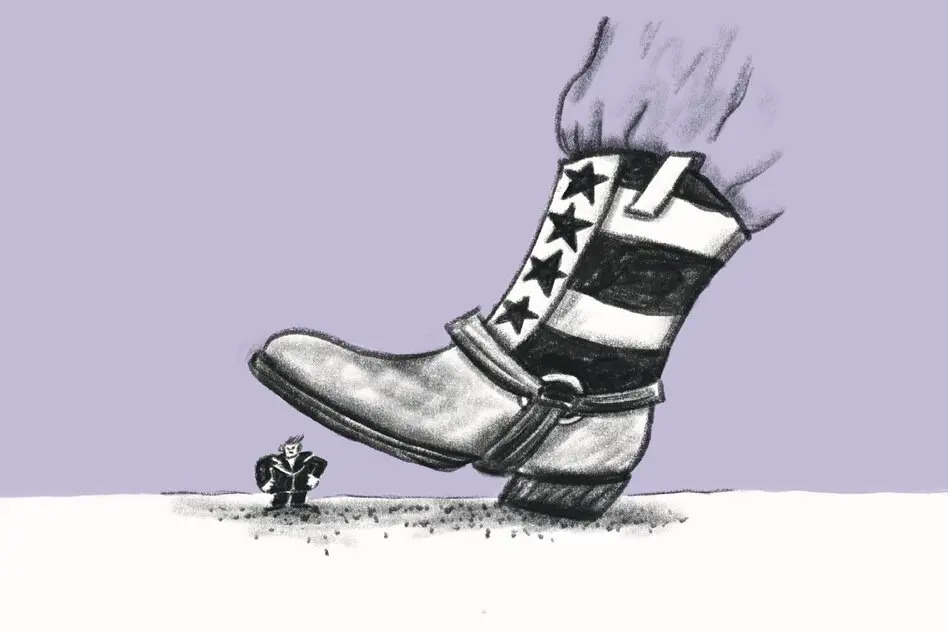
Trump, the magician, the puppet master, the man who thinks he can shoot a person on 5th Avenue in New York with impunity, the bully who seemed to impose his rules on the world almost unchecked, has been shrunk to human size since his return to the White House.
Trump's ability to incite people and stir up emotions, his killer instinct for momentum, seems strangely worn out. His attempt to make the midterms a vote about himself, as if the name Trump were on the ballot paper, mobilizes the hard core of his MAGA base - but at best provokes mixed feelings within his own party: Some candidates prefer to keep their maximum distance from the president in order not to be dragged into the abyss.
The Donald Trump of 2026 has become more of a liability than a strength of his party. Only a good 30 percent currently appreciate Trump's leadership, while 60 to 70 percent reject it. The values are at a historically low level. There are a number of reasons why this is the case:
Trump entered the White House with a series of promises that buoyed him during the election campaign. There is the attempted revival of manufacturing through a tariff war that has spooked the rest of the world. The effect, launched by Trump with spectacular vigor, was soon lost somewhere between China's rare earths and the Persian Gulf. What happened instead: The high inflation denounced in Trump's election campaign as Biden-flation has fallen much less than promised - most recently it was still an impressive 3.7 percent. If a gallon of diesel costs $6, then the same farmers in Iowa and workers in Appalachia who carried Trump into office twice will feel the impact. Life in the US, already expensive, is becoming increasingly difficult to afford.
And his promise to bring American soldiers back from the crisis regions of the world turned into a new war against Iran, which after just a few months felt like another never-ending one. This war cost him a lot of credit from some of his supporters, and the high prices from others. Trump only fulfilled the promised brutal persecution of undocumented immigrants by the paramilitary squadrons of the immigration agency ICE.
In November 2024, Donald J. Trump won a presidential election in the USA for the second time and has been in office as the 47th president since January 2025. He is driving forward the restructuring of public institutions and a change of course in foreign policy.
Trump drew part of his aura from the myth of being the world's best dealmaker, one that may be a bit vulgar but is restoring the United States to its former greatness internationally. The Ukraine War? He ends on the first day of his term! The Iranian nuclear program? He stops it in the shortest possible time, either with a historic deal or through the overwhelming power of the US Air Force. Help for the Iranian people? Is on the way! The only problem is: by his second term in office at the latest, the autocrats of the world have adjusted to Trump, analyzed and deciphered him. Russian President Vladimir Putin is cleverly playing with Trump. Chinese head of state Xi Jinping is countering tariff threats by banning the export of rare earths and forcing Trump to compromise. And the Iranian regime, although stripped of its leadership, is resisting regime change with surprising tenacity. Even the historically tame Europeans have defied Trump's neo-imperialist ambitions to annex Greenland and wrested a deal from him that gave the USA hardly any more rights in Greenland than they already had. The world has learned to deal with the US President's erratic foreign policy.
Americans love strong leaders. But they also smell weakness.
We analyze the US midterm elections on November 3rd: What does the result mean for US politics, the Democrats, Donald Trump and the 2028 presidential election?
Register here or watch live in the stream.
America is witnessing a president tearing down the East Wing of the White House for his dream of a massive ballroom. And right after the election, construction is scheduled to begin in Washington on an Arch of Triumph, a structure nearly twice as tall as the Arc de Triomphe in Paris, which would tower over the Lincoln Memorial across the river. Donald Trump's cult of personality is growing beyond his political fanaticism. Part of its appeal lies in political fanaticism. Now, it seems, Donald Trump is particularly planning his monumental legacy. He cares about himself and his political legacy, not his voters.
However, a president who allows monuments to be built instead of fulfilling promises to the people, who leads the country into a war without being able to win it, who fails because of Putin, Xi and Iranian clerics and who ultimately seems to lack the necessary assertiveness, falls short of a central motive of right-wing populism: creative power.
In a hyper-globalized world, this is the one narrative that right-wing and far-right populists share. They suggest simple solutions in a complex world, independence from complicated facts and absolute freedom of action.
Unfortunately, there is little evidence that the vast majority in the USA has recognized that Trump's policies are a disaster, that they reject his racism, his neo-imperialism and his nationalist politics. But Americans are no longer so carefree about voting for a failure in the White House who can't deliver.