
Climate taz
The future of winter sports: a shot at climate change
The Alpine Ski World Cup season begins in Sölden. The early date in autumn has become established, but there is criticism of it - even among athletes. more...
Deutsch (original) ·Auto-translated to English
One hundred percent snow guarantee. The promise is emblazoned in bold white letters on the website of Sölden, one of Austria's largest glacier ski areas. In the background you can see tourists racing down the slopes. There is snow everywhere: on the ski huts, the mountain slopes and especially on the downhill slopes.
The reality is different: Anyone who has looked at the slopes in Tyrol that are over 3,000 meters high in the past few weeks will have noticed that snow was in short supply there this autumn too. The alpine ski area with its green meadows was more inviting for hiking than skiing. Even at the top of the glaciers it is constantly above zero degrees Celsius. Actually not good conditions for winter sports.
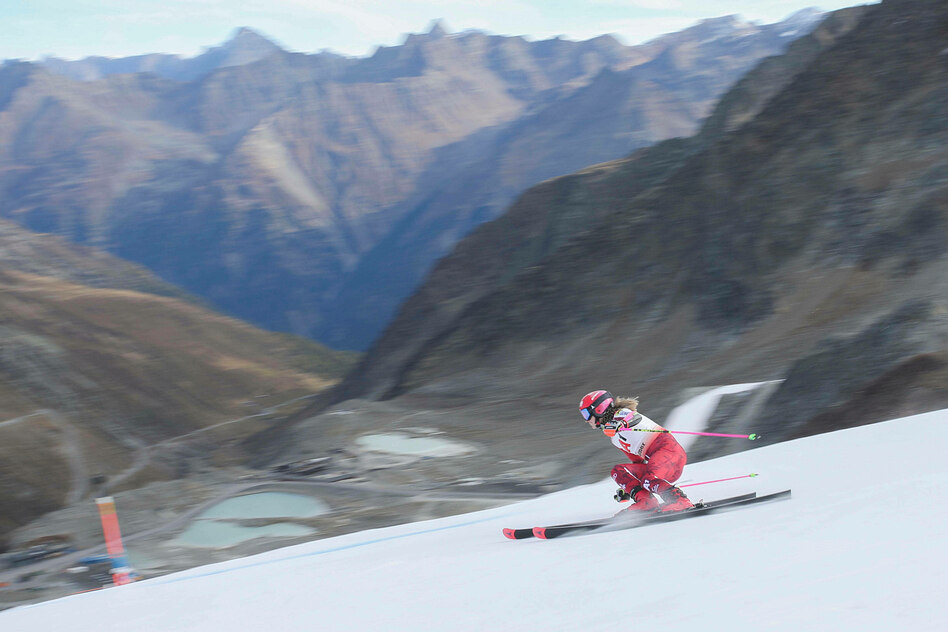
The fact that a snow-white band still runs down the Rettenbach glacier in the middle of the rocks is due to the start of the season in the Ski World Cup. This weekend, the best skiers in the world will race down the slope again in the giant slalom: on Saturday the women with the record winner Mikaela Shiffrin (USA) and her German challenger Emma Aicher. The men follow on Sunday, with the Brazilian Lucas Pinheiro Braathen starting the race as favorite. Alexander Schmid is considered the most promising German on the almost 1,200 meter long route with a gradient of up to 68 percent.
The major spectacle in Sölden will be followed by a further 39 races for women and 42 for men in downhill, slalom, giant slalom and super-G until the end of the season in Sun Valley (USA) in March 2027, including in Kitzbühel, Garmisch-Partenkirchen and Bormio.
After the Sölden weekend there will be a three-week break until the slalom races on November 14th in Levi, Finland. But the early start to the season in Sölden has become established. Since 2000, the World Cup has started every year in the lower Ötztal. Always in October.
However, there is also loud criticism of the major event, which is expected to attract 30,000 spectators again this year. The early start, the mild autumn temperatures and the lack of natural snow are discussed. “It is simply an artificially created beginning of winter that does not correspond to nature,” says Ursula Bittner from Greenpeace in Austria. “Nobody benefits from it, except the economy in Sölden.”
But she seems to be benefiting from it quite a bit. "Pictures with snow and blue skies create emotions. When these pictures go out, as many colleagues in the industry confirm to me, they get the first bookings," explains Jakob "Jack" Falkner, the long-time managing director of Bergbahnen Sölden. Although his lifts operate almost all year round, they only make big profits in winter. That's why the following applies in Sölden: the earlier the ski area opens, the more profitable the company becomes.
In fact, the World Cup in Sölden is an excellent advertising space for tourism and sport. It provides publicity to draw the attention of an audience of millions to the winter sports resort in Tyrol in the fall. Bittner says they are even going so far as to intervene in the fragile ecosystem of the ski area. "Because of the climate crisis, the glacier is receding. In order to be able to continue driving on it, you have to intervene massively. They used huge excavators and blasting and partially filled up the crevasses with concrete." In fact, as the FAZ reports, the glacier has lost more than half of its area since the 1980s.
Philipp Falkner, who is also president of the organizing committee behind the World Cup race, does not want to know anything about the Greenpeace criticism. "The retreat of glaciers is a natural process that occurs almost everywhere in the world. As a result, a lot of rock has become ice-free. It has been straightened and renovated," he rejects the criticism. Everything was approved.
Many ski areas have been accused of interfering too much with nature for years. Above all, the clearing of forests to expand new lifts or slopes, as well as the energy and water consumption for artificial snowmaking, are viewed critically. "We don't need more ski areas in Austria. We have to design them so that they are as sustainable as possible, that would be a goal," says Greepaece spokeswoman Bittner.
The lack of natural snow is becoming more and more of a problem, and not just in Sölden. By the year 2100, the snowfall limit in the Alps could rise to around 1,700 meters. It is currently 1,000 meters. The consequences would be unforeseeable, as in Austria less than half of the kilometers of slopes are at the forecast altitude, and in Germany only around 10 percent. The problem cannot be solved with artificial snowmaking. It is actually only possible at sub-zero temperatures, i.e. above the snowfall line, and also requires a lot of energy.
In order to make the autumn race possible, Sölden is primarily relying on snow depots. Towards the end of winter, large amounts of artificial snow are produced, which are stored under protective foil throughout the summer. The reserves can then be accessed in the fall. What is also urgently needed: the majority of the route had to be covered entirely with snow from the depot.
In the future, the energy required for artificial snow in Sölden will also be drawn from the new glacier photovoltaic system, which will go into operation this winter. It cost around 14 million euros. The “solar forest” stands at an altitude of almost 3,000 meters, the design of which is reminiscent of Star Wars technology. “We will be able to cover a quarter of our total electricity consumption with this in the future,” says Falkner.
The biggest environmental problem in ski tourism is not on the slopes. It is the arrival and departure that is particularly important ecologically. “Three quarters of the emissions are released through this alone,” emphasizes Bittner. Using public transport is therefore particularly important. Free shuttle buses, like those offered this weekend, are therefore a good idea.
But is that enough? There is no direct train connection in the town of 3,000 people; the nearest train station in the Inn Valley is 40 kilometers away. This is one of the reasons why most guests, around 89 percent in Tyrol in recent years, still travel by car. A guest survey in 2024 showed that the luggage transport, convenience and journey time are the main deterrents from traveling by train.
The massive volume of travel in winter sports is also being questioned in the professional circus. The Swiss slalom specialist Daniel Yule, who is not competing in Sölden, says of the International Ski Association FIS race calendar: "The speed riders are flying to the USA twice this year. Once at the beginning of the season and then again for the finale. Isn't that a bit much travel? Does that really make sense?"
Because global warming is increasingly posing problems for top-class sport. "It's becoming more and more difficult to find places where you can train well. You have to see that snow sports will still exist in a few years. Because if we continue like this, there will be no more snow because of climate change," says Yule.
The 33-year-old is therefore calling for a rethink from the Fis: "It is important to me that this issue is accepted, because skiing is my passion. We have to try to protect it so that future generations can still ski."
But such a rethink seems to take time. Time that the Alpine glaciers may no longer have. This doesn't affect the event in Sölden at all. “We would like to have a double weekend in the future,” says Falkner. It should be two weekends in a row. Because of sustainability.