
World · taz · · 3h
A turning point in the industry: more and more new business models with armaments
Deutsch (original) · Auto-translated to English
The profit prospects in the defense sector as a result of the war in Ukraine are attracting more and more companies who also want a piece of the pie. The DHL Group is apparently no longer just transporting civilian parcels and parcels. The German postal and logistics company apparently asked at an arms trade fair in Poland how Ukraine could be supported in exporting armaments, or so the Handelsblatt reports.
Accordingly, after more than four years of war, Ukraine has now reached the point where it no longer needs all the military technology and equipment manufactured in the country to combat Russian aggression - it can also produce for export and thus profitably. So far, such exports have gone through Poland, but DHL is probably interested in opening up new routes, for example via Romania and the Black Sea. The company itself did not want to comment on this.
But it would probably not be the first time that DHL has been involved in logistics for defense companies. At least that's what a trial before the Leipzig Labor Court in July shows, which the company lost. It was about an employee. He had publicly criticized the fact that arms deliveries for Rheinmetall had gone through the DHL air freight hub in Leipzig. DHL terminated him immediately, but the labor court overturned the termination, citing the Verdi representative's freedom of expression.
DHL is not the only example of how companies with previously civilian production can open up new military business areas. Some factories are even being converted entirely to armaments: the VW factory in Osnabrück, for example, was recently sold to Israeli investors and will in future produce components for the “Iron Dome” air defense system, whose manufacturer Rafael Advanced Defense Systems is one of the new factory owners in Osnabrück.
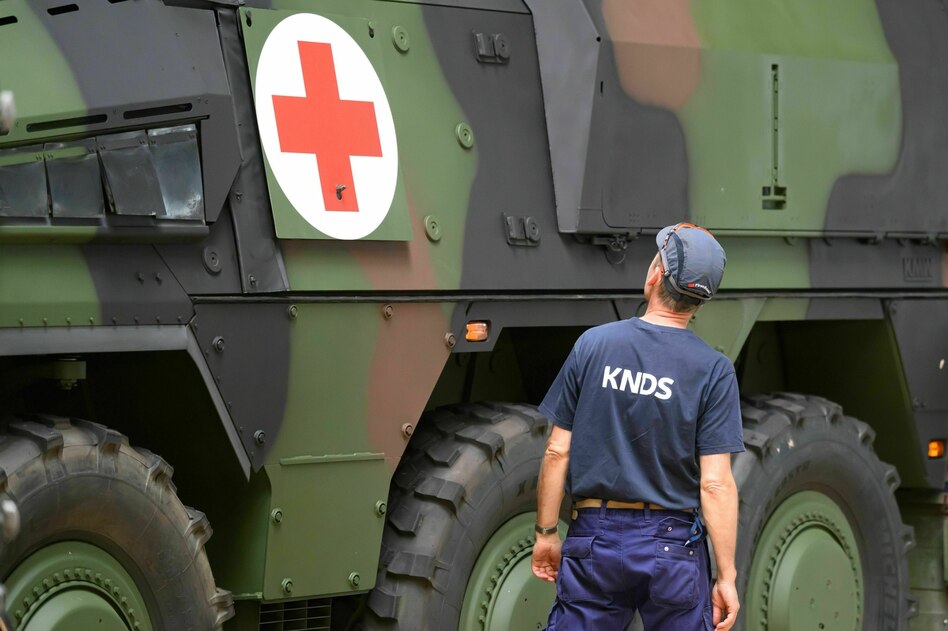
And in Görlitz, Saxony, tanks are now produced instead of trains. The changeover is progressing successfully, reported the new owner KNDS Deutschland in June, which had taken over the location from the Alstom company a year earlier.
The housing group Vonovia also has its eye on the turnaround billions. Its 130,000 apartments in the capital could actually be socialized after the left-wing election victory, as the majority of Berlin called for in a referendum in 2021. So other business models are needed: The company can quickly build soldiers' apartments, said CEO Luka Mucic in an interview with the German Press Agency.
The Bundeswehr's personnel strength is currently 187,000 soldiers, but in the future it is expected to increase to at least 260,000. Vonovia calculates that it could be difficult for the Bundeswehr to find suitable living space, especially in cities like Berlin. The company therefore offers the German military “serial new construction in designated residential areas”. The Bundeswehr leadership and the Ministry of Defense have already been informed about the offer and must now decide, said Mucic.
However, seizing arms contracts is not yet a solution to the crisis in the German economy: The Institute for Labor Market and Occupational Research (IAB) has just calculated that military contracts have so far been unable to replace job losses in civilian sectors.
According to the researchers, around 15,000 jobs are currently being lost in German industry every month. Only around 1,100 employees switched to the defense industry last year. On the other hand, 23,000 industrial employees went into public administration or social security. (with dpa)
Read the full story at the source
Source: taz