
Climate taz
Heat pump beats gas heating: Climate-friendly heating is cheaper than fossil fuels
Installing a heat pump is also worthwhile for older, unrenovated houses. It is cheaper than gas heating, shows a study commissioned by the WWF. more...
Deutsch (original) ·Auto-translated to English
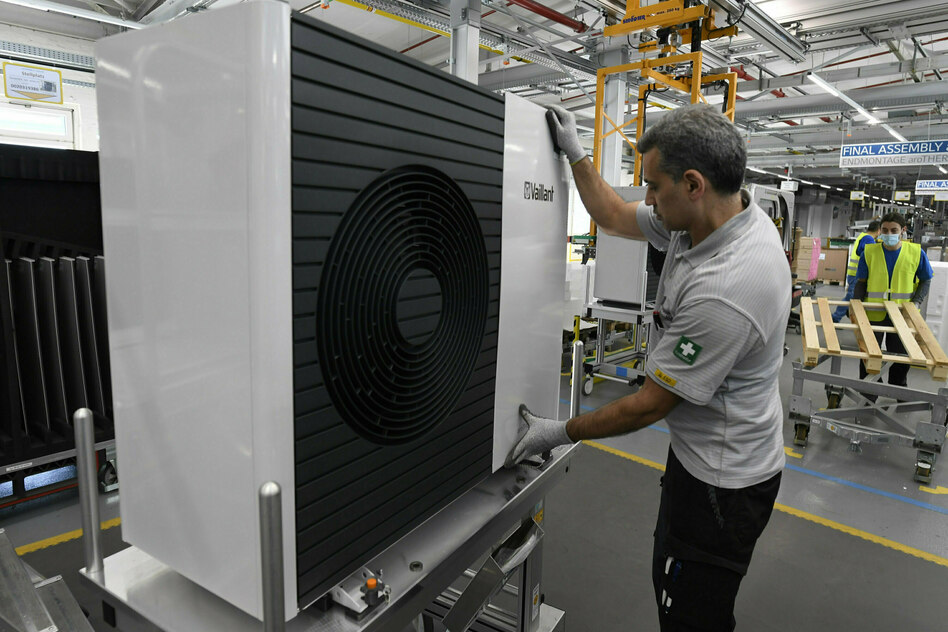
Even in unrenovated houses, installing a heat pump is significantly cheaper in the long term than gas heating. This is the result of a study by the consulting company Prognos on behalf of the Nature Conservation Association WWF. Because government funding for heat pumps will gradually decrease in the coming years, the calculations show that quick installation pays off. Consumer advocates are demanding that the state provide better financial support, especially to low-income households, so that they can quickly switch to climate-friendly heating.
The background: It is legally stipulated that Germany must be climate neutral by 2045. By then at the latest, houses must be heated in a climate-friendly way. The traffic light government therefore banned the installation of gas and oil heating systems from a certain point onwards and introduced funding for climate-friendly heat pumps. The black-red government overturned the ban and instead introduced a quota for green fuels for gas heating, which must gradually be mixed with oil and gas. It is still unclear where the required quantities of biofuels will come from.
The state continues to support the purchase of a heat pump. But heat pumps are not a sure-fire success, said Sebastian Breer, WWF building expert, when presenting the study to journalists on Tuesday. “Although many heat pumps are sold, there are still many other heating systems.” Last year, around 290,000 heat pumps were sold in Germany, as well as more than 220,000 new gas heaters.
Buying a gas heater is significantly cheaper than buying a heat pump. In the long term, a heat pump is still cheaper because the operating costs are much lower, the calculations show. “A heat pump always has an economic advantage,” said Dominik Rau from Prognos. The cost of gas will rise sharply in the coming years. The new guidelines from the black-red federal government are responsible for this, among other things, because the mandatory addition of green fuels to gas makes operations significantly more expensive. Rising network charges and the CO2 price also result in higher costs.
It is often claimed that heat pumps do not make sense in older buildings because too much heat is lost without renovation. A heat pump is also worthwhile for unrenovated houses, as the figures from the Prognos calculations show. If a heat pump is installed in October 2026 in a single-family home with energy efficiency class F that was built between 1958 and 1968, the total costs for heating over a period of 15 years are expected to be 56,815 euros. With a gas heater it would be 61,118 euros.
The purchase costs of 34,000 euros for the heat pump including possible government subsidies and 14,500 euros for the purchase of a gas boiler are included here. For households with an annual income of less than 30,000 euros, there is an additional subsidy, the so-called income bonus. According to the calculations, the heating costs for them are even lower at 47,295 euros. If there is a solar system, this reduces heating costs significantly.
However, if it is installed in August 2029, the heat pump's advantage will be smaller because the funding will drop significantly by then. The state subsidies are then between 4,600 euros and 5,380 euros lower, depending on the funding eligibility. “Speed pays off now,” said Rau.
But there is a political conflict of objectives here, says Lorena Jonas from the Federal Association of Consumer Organizations (vzbv). On the one hand, the state is currently supporting low-income households, she said. On the other hand, the reduction in funding would disadvantage those who cannot invest immediately - i.e. households with little money. The installation of a heat pump must be 100 percent pre-financed; government subsidies only flow after installation. “This is a huge problem for households with little income,” she emphasized. At least for those who are entitled to the income bonus, the pre-financing should be eliminated, she demanded.
In any case, financing is difficult for many despite the subsidies, said Jonas. The state needs to make improvements at this point. It does indeed grant cheap loans. “But the house banks are not passing this on,” she reported. For example, the state should provide better access to cheap loans through its development bank KfW or offer default guarantees in order to reduce financing costs.